
What is Bedrock (BR) Crypto? BR Token Price, Airdrop & Technology Explained
Bedrock Crypto is revolutionizing decentralized finance (DeFi) with its multi-asset liquidity restaking protocol, designed to maximize yield while preserving liquidity. By leveraging Bedrock technology, users can stake Ethereum ( ETH), Bitcoin (BTC), and IoTeX (IOTX) to earn rewards and receive liquid tokens like brBTC. This article dives into what is Bedrock Crypto, analyzes the Bedrock token price, explains the Bedrock airdrop, and explores how BR token and BR coin drive this ecosystem.
What is Bedrock (BR) Crypto?
What is Bedrock Crypto? At its core, Bedrock Crypto is a decentralized protocol that addresses the liquidity-yield dilemma through its Proof of Staked Liquidity (PoSL) mechanism. By enabling multi-asset restaking, Bedrock allows users to stake ETH, BTC, and other assets to earn yields while receiving liquid tokens like brBTC. The BR token, Bedrock’s native governance coin, powers ecosystem incentives, governance participation, and liquidity provisioning.
Innovations like BTCFi 2.0 and the veBR model (achieved by locking BR coins) position Bedrock as a leader in transforming Bitcoin into a productive DeFi asset. With over $50 billion in Total Value Locked (TVL) and 278,627 holders, Bedrock crypto is rapidly gaining traction. The BR token facilitates governance participation, liquidity provisioning, and ecosystem incentives. Holders of BR tokens influence the protocol’s future development while benefiting from its growth.
Bedrock Airdrop Eligible Now: Claim Your BR Tokens
The Bedrock airdrop rewards early adopters with free BR tokens, driving engagement and decentralization. Here’s how to participate:
- Eligibility Check: Visit Bedrock’s official portal to verify eligibility.
- Claim Process: Eligible users can claim BR tokens at claim.bedrockdao.com until June 2025.
- Token Allocation: 5.5% of the 10 billion BR token supply (20% community allocation) is distributed in Season 1.
The Bedrock airdrop caps individual claims at 0.4% per wallet, ensuring fair distribution. Post-claim, users can stake BR coins to earn veBR, increasing governance power and rewards.
Bedrock (BR) Tokenomics: Supply, Utility & Value Drivers
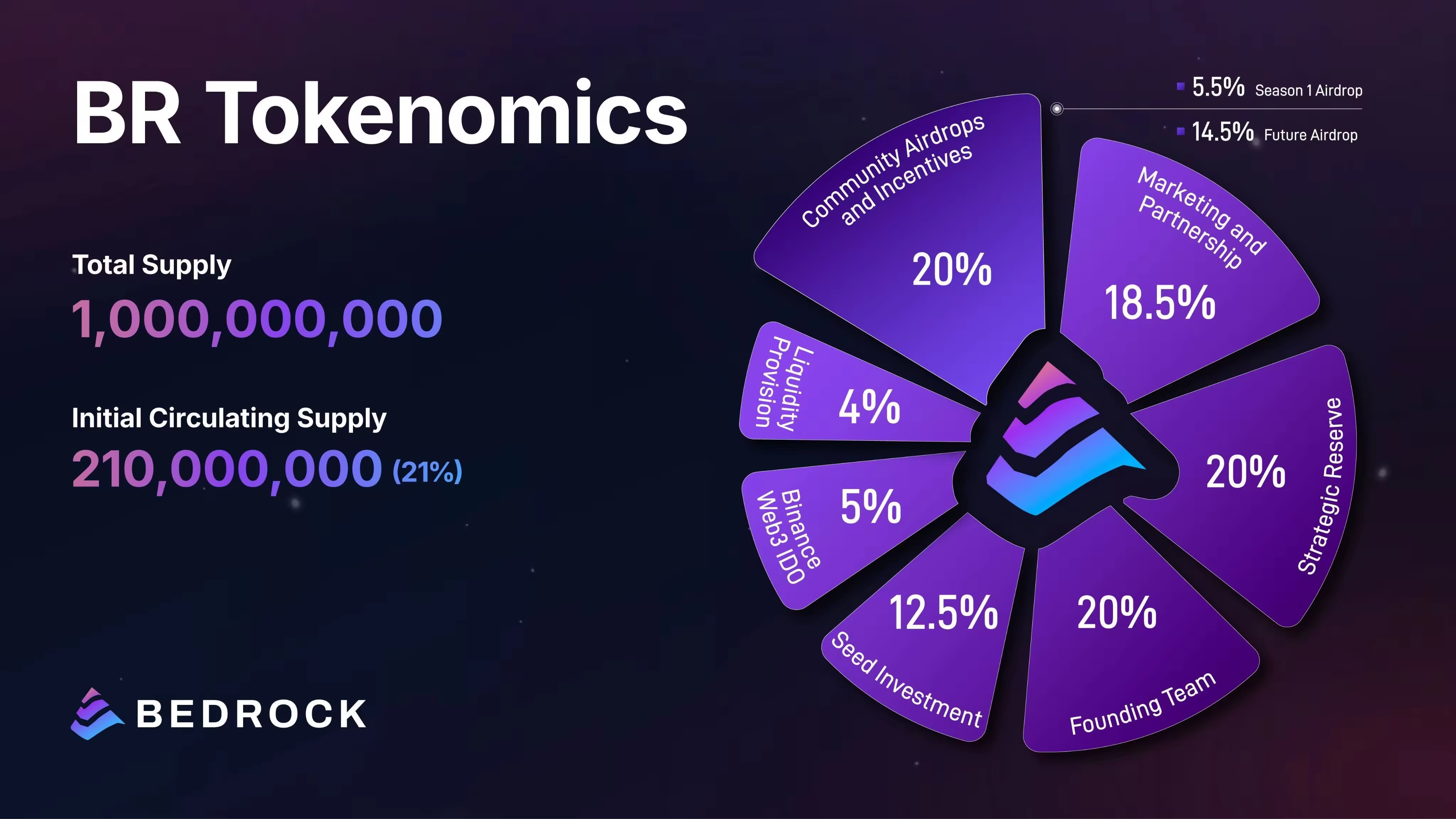
Bedrock tokenomics ensures a balanced ecosystem with a total supply of 10 billion BR tokens:
- Community & Airdrop: 20% (5.5% already distributed).
- Ecosystem Growth: 18.5% for partnerships and marketing.
- Investors & Team: 52.5% (locked for one year post-launch).
BR Token Price Drivers:
- veBR Locking: Converts BR into non-tradable veBR, reducing circulating supply.
- Revenue Buybacks: Protocol fees fund BR buybacks, increasing scarcity.
- Governance Demand: Seasonal resets incentivize participation.
Bedrock Technology: Innovations and Ecosystem Benefits
Bedrock technology is redefining liquidity restaking through:
- Multi-Asset Restaking: Stake ETH, BTC, or IOTX across chains.
- brBTC & BTCFi 2.0: Convert BTC into brBTC for seamless DeFi integration.
- veBR Governance: Lock BR coins for voting rights and higher rewards.
- Cross-Chain Integration: Partnerships with Ethereum, BNB Chain, and Merlin enhance interoperability.
This Bedrock technology framework ensures liquidity, scalability, and sustainable rewards, making BR a leading Bedrock crypto asset.
BR Token Price Today & Market Performance
The BR token price has shown significant growth:
- Current Price: $0.1697 (March 21, 2025).
- Market Cap: $35.15Billion (FDV: $168.63Million).
- Trading Pairs: BR/USDT dominates on some core exchanges.
Analysts attribute this surge to Bedrock’s BTCFi 2.0 adoption and rising TVL. For real-time BR token price updates, track markets on CoinGecko or CoinMarketCap.
How to Buy BR Tokens? A Step-by-Step Guide
Interested in investing in Bedrock crypto? Follow these steps:
- Choose an Exchange: BR token is listed on several centralized exchanges, with WEEX listing coming soon.
- Create an Account: Sign up and complete KYC verification.
- Deposit Funds: Add USDT or supported cryptocurrencies to your exchange wallet.
- Trade BR/USDT: Use the exchange’s platform to buy BR tokens.
- Store BR Securely: Transfer BR coins to a personal wallet for security.
Bedrock Crypto: Future Roadmap & Investment Potential
Bedrock aims to expand its ecosystem through:
- Multi-Chain Expansion: Support for BNB Chain, Ethereum, and additional networks.
- DeFi Service Enhancements: Upgrades to borrowing, lending, and trading functionalities.
- Governance Expansion: Enhanced veBR governance mechanisms.
Final Thoughts
Bedrock (BR) Crypto is transforming liquidity restaking and BTCFi 2.0, offering innovative solutions for passive income while maintaining asset liquidity. With a rapidly expanding ecosystem, strong tokenomics, and increasing market adoption, the BR token presents a compelling opportunity for traders and long-term investors. However, thorough research and risk assessment remain crucial before investing.
For the latest updates on what is Bedrock Crypto, Bedrock airdrop, Bedrock token price, and Bedrock technology, stay connected with official sources and market trackers.
Latest Updates on WEEX
WEEX Exchange’s WXT Token Surges 101%
If you want to buy WXT now, you can sign up for a WEEX account
WEEX Owen: Michael Owen Joins as Global Brand Ambassador
Championing a revolutionary crypto trading experience

You may also like

World Collective Oil Reserve (WCOR) Price Prediction 2026-2045: Expert Insights
WCOR (World Collective Oil Reserve) is a Solana-based cryptocurrency token that promotes an “oil reserve + real-world asset (RWA) narrative.” However, there is no public evidence that it is actually backed by physical oil assets. It is essentially a highly speculative, narrative-driven token. Its current market cap is around $14 million, with relatively low liquidity and high volatility, and its price is mainly driven by market sentiment and hype. Most analyses suggest limited short-term upside, with a possible gradual increase to around $0.02 by 2030. Overall, it is considered a high-risk crypto asset driven more by narrative speculation than fundamentals.

WEEX Gold & Silver 0% Fees Event: Trade Metals, Crude Oil and Stock Futures With Zero Fees
Join the WEEX 0-fee futures event from April 16 to May 31, 2026. Trade eligible gold, silver, crude oil, and stock futures with 0% fees.

Can PAC Coin Reach $1 Soon? Analyzing Public Asset Control
PAC is a Solana-based meme token with a government-themed narrative, but it is highly speculative.
At its current price (~$0.0009) and 1B supply, reaching $1 would require a $1B market cap, which is very unlikely.
Short-term moves to $0.001 or $0.01 are more realistic, but the token is highly volatile due to low liquidity and hype-driven trading.
Overall, $1 is not a realistic target, and PAC is better suited for short-term speculation than long-term investment.

What Is SAOS? Strategic American Oil Supply Token Explained
SAOS is a meme token on Solana with a 75,000 USD market cap and 22,000 USD locked liquidity, positioned around oil supply themes but lacking real asset backing
It thrives on pure narrative speculation, with no utility, website, or doxxed team, making it highly volatile and attention-dependent
Traders should distinguish SAOS from legitimate real-world asset projects, as its branding is speculative rather than substantive
Positive aspects include locked liquidity reducing rug pull risks, but low trading activity signals high uncertainty
NBIS Stock: What Nebius’ AI Cloud Surge Means Now
NBIS stock jumped as Nebius reported rapid AI cloud growth. See the key Q1 2026 numbers, catalysts, valuation risks, and what to watch next.

What Is Public Asset Control (PAC) Coin? Explained for Beginners
Public Asset Control (PAC) is a Solana-based token that uses a “government asset control” narrative involving oil and gold themes, but it has no verified ties to any real institutions or governments. It is mainly an entertainment-focused, speculative meme coin.
The project’s claims about links to entities like BlackRock or Palantir are unverified, and its own disclaimer states it is not a real financial or institutional asset. Like many new Solana tokens, PAC is highly volatile, with low liquidity and limited transparency, including no fully verified audit.
Overall, PAC is a high-risk speculative token driven by hype and storytelling rather than real utility. Beginners are advised to be cautious, verify contract details, and prioritize risk control before considering any trading.

Public Asset Control: What PAC Token Really Is
Public Asset Control PAC is a Solana token with bold asset-control branding. Learn what it is, what is verified, and the key trading risks.

Why Is Chinese Oil Asset Reserve (COAR Crypto) Trending Now?
Why is Chinese Oil Asset Reserve trending now? Learn the latest COAR crypto price action, trading volume, oil narrative, Solana pair data, and what is driving attention today.

How to Buy Chinese Oil Asset Reserve (COAR) Token in 2026: Latest Step-by-Step Guide, Contract Address, and Safe Buying Tips
How to buy Chinese Oil Asset Reserve (COAR) token step by step, including the official COAR contract address, Solana wallet setup, SOL funding, and latest market data.

COAR Coin: What Chinese Oil Asset Reserve Really Is
COAR coin is a new Solana oil-narrative token. Learn what Chinese Oil Asset Reserve claims, how to verify the contract, and key trading risks.

Did the CLARITY Act Pass Today? Latest Status and the History of the Crypto Bill
SEO meta description: Did the CLARITY Act pass today? Read the latest crypto bill update, the history of the CLARITY Act, House and Senate votes, and what happens next for U.S. crypto regulation.

What Is Chinese Oil Asset Reserve (COAR) Token? $COAR and Coar Stock Relationship Explained
Chinese Oil Asset Reserve (COAR) token explained, $COAR price, Solana details, and the relationship between COAR and Coar stock. Learn the latest facts.

Trade to Earn on WEEX: Join the Futures Trading Event and Earn Real-Time WXT Rewards Throughout May 2026
Join the WEEX Trade to Earn Series Five event from May 1–31, 2026 and earn real-time WXT rewards through futures trading. Boost your rebate level, complete missions, invite friends, and maximize your trade to earn rewards with USDT-M futures trading.

Trade to Earn With Futures Trading on WEEX: How Smart Traders Are Turning Every Position Into WXT Rewards
Join the WEEX Trade to Earn Series Five campaign and earn real-time WXT rewards through futures trading from May 1–31, 2026. Upgrade mining levels, unlock higher rebate ratios, complete missions, and maximize your trade to earn rewards with USDT-M futures trading.

CBRS Stock: What to Know About Cerebras After Its IPO
CBRS stock surged after Cerebras priced its IPO at $185. Learn what the AI chipmaker does, why valuation matters, and what risks to watch.
SpaceX IPO Stock Market Impact: What Investors Should Watch
SpaceX’s IPO could reshape indexes, liquidity, space stocks, and crypto risk appetite. Here is what matters before the listing.

HMSTR Token Price: What Moves Hamster Kombat Now
Track HMSTR token price, supply, catalysts, and risks. Learn what drives Hamster Kombat price action and what traders should watch.

How to Buy Public Asset Control (PAC) Token in 2026: Latest Solana Buying Guide
How to buy Public Asset Control (PAC) token in 2026, PAC contract address, Solana wallet setup, Jupiter swap guide, latest price, liquidity, and risks.
World Collective Oil Reserve (WCOR) Price Prediction 2026-2045: Expert Insights
WCOR (World Collective Oil Reserve) is a Solana-based cryptocurrency token that promotes an “oil reserve + real-world asset (RWA) narrative.” However, there is no public evidence that it is actually backed by physical oil assets. It is essentially a highly speculative, narrative-driven token. Its current market cap is around $14 million, with relatively low liquidity and high volatility, and its price is mainly driven by market sentiment and hype. Most analyses suggest limited short-term upside, with a possible gradual increase to around $0.02 by 2030. Overall, it is considered a high-risk crypto asset driven more by narrative speculation than fundamentals.
WEEX Gold & Silver 0% Fees Event: Trade Metals, Crude Oil and Stock Futures With Zero Fees
Join the WEEX 0-fee futures event from April 16 to May 31, 2026. Trade eligible gold, silver, crude oil, and stock futures with 0% fees.
Can PAC Coin Reach $1 Soon? Analyzing Public Asset Control
PAC is a Solana-based meme token with a government-themed narrative, but it is highly speculative.
At its current price (~$0.0009) and 1B supply, reaching $1 would require a $1B market cap, which is very unlikely.
Short-term moves to $0.001 or $0.01 are more realistic, but the token is highly volatile due to low liquidity and hype-driven trading.
Overall, $1 is not a realistic target, and PAC is better suited for short-term speculation than long-term investment.
What Is SAOS? Strategic American Oil Supply Token Explained
SAOS is a meme token on Solana with a 75,000 USD market cap and 22,000 USD locked liquidity, positioned around oil supply themes but lacking real asset backing
It thrives on pure narrative speculation, with no utility, website, or doxxed team, making it highly volatile and attention-dependent
Traders should distinguish SAOS from legitimate real-world asset projects, as its branding is speculative rather than substantive
Positive aspects include locked liquidity reducing rug pull risks, but low trading activity signals high uncertainty
NBIS Stock: What Nebius’ AI Cloud Surge Means Now
NBIS stock jumped as Nebius reported rapid AI cloud growth. See the key Q1 2026 numbers, catalysts, valuation risks, and what to watch next.
What Is Public Asset Control (PAC) Coin? Explained for Beginners
Public Asset Control (PAC) is a Solana-based token that uses a “government asset control” narrative involving oil and gold themes, but it has no verified ties to any real institutions or governments. It is mainly an entertainment-focused, speculative meme coin.
The project’s claims about links to entities like BlackRock or Palantir are unverified, and its own disclaimer states it is not a real financial or institutional asset. Like many new Solana tokens, PAC is highly volatile, with low liquidity and limited transparency, including no fully verified audit.
Overall, PAC is a high-risk speculative token driven by hype and storytelling rather than real utility. Beginners are advised to be cautious, verify contract details, and prioritize risk control before considering any trading.
