What Is KAIO (KAIO)?
RWA tokenization gets thrown around a lot. Trillion-dollar market predictions. Global banks experimenting. But here's the problem no one wants to admit: most DeFi infrastructure breaks the moment a regulator looks at it.
No KYC. No investor caps. No jurisdictional locks. KAIO is trying to fix that. Not by patching existing systems. By building from scratch with compliance embedded at the smart contract level.
What Is KAIO?
KAIO crypto is a cross-chain protocol for issuing and managing tokenized real-world assets. Think private credit, money market funds, bonds—anything a traditional finance firm might tokenize.
The difference? Compliance isn't an afterthought. It's hardcoded.
Every KAIO-based token knows who can hold it, where they can hold it, and what they can do with it. Transfer restrictions, investor caps, jurisdictional blacklists—all enforced automatically.
One sentence summary: KAIO builds the plumbing so institutions can put regulated assets on-chain without losing their legal safe harbor.
Who Created KAIO?
Founded in 2023 by Avtar Sehra (CEO). His resume: investment banking, financial engineering, risk management. Not a crypto degen. That matters because KAIO pitches to TradFi, not retail traders.
The project launched as Libre Capital before rebranding to KAIO. COO Olivier Dang rounds out the leadership.
Funding worth noting: $11 million seed round. Backers include Laser Digital (Nomura's crypto arm) and WebN Group. Institutional money, not venture capital flipping tokens.
This isn't a meme coin team. But institutional backing also means slower moves. Don't expect 200% pumps.
How KAIO Works
Let's simplify what the whitepaper overcomplicates. Core mechanism: regulatory logic lives inside the smart contract. Not off-chain. The token itself enforces rules.
Six components matter. Investor onboarding: pass KYC/AML first, then your wallet gets permissioned. Asset issuance: funds become permissioned tokens. Embedded compliance: smart contracts check investor status and geography before transfers. Try sending to an unverified wallet? Transaction fails.
Lifecycle management automates subscriptions, redemptions, and NAV reporting. Cross-chain interoperability keeps liquidity moving across networks. An institutional gateway lets asset managers skip learning Solidity. The catch? This only works if institutions actually use it. No assets? Empty infrastructure.
KAIO Tokenomics
Token Details
- Total supply: 10,000,000,000 (fixed)
- Initial circulating supply: 633,000,000 KAIO
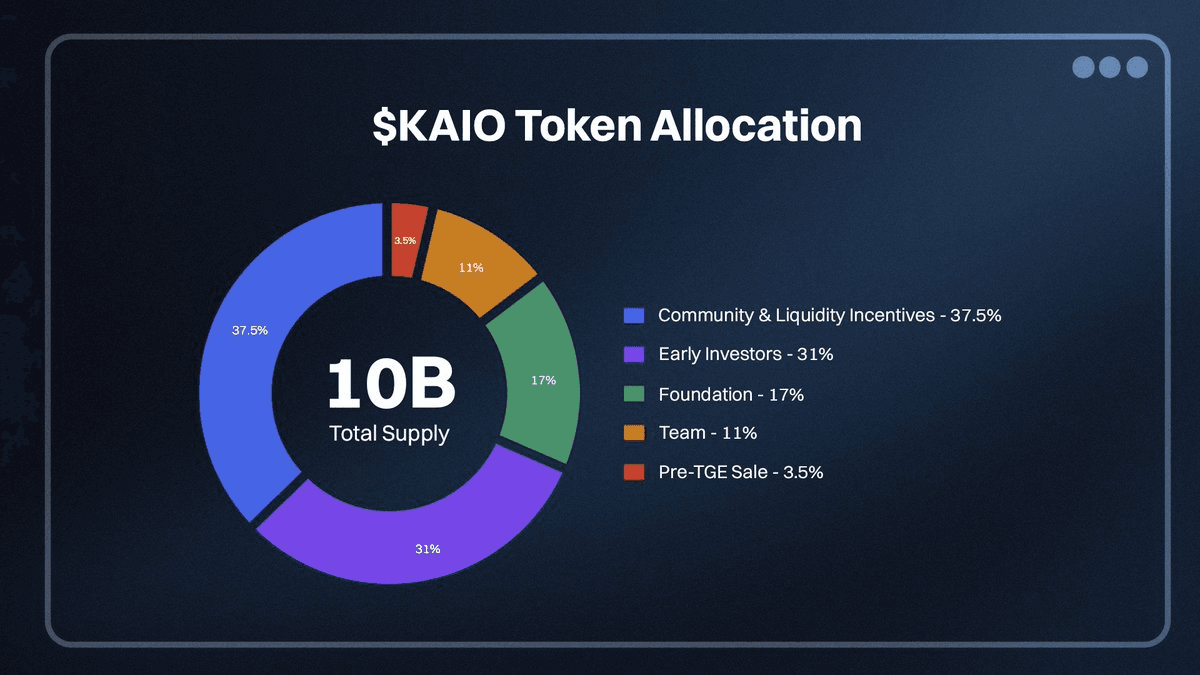
Distribution breakdown:
- Community + Liquidity (37.5%): Largest chunk. Drives adoption and exchange liquidity.
- Team + Investors + Pre-TGE (45.5%): Major allocation. But here's the key—12-month cliff. No tokens at TGE. Then unlocks over 24 months.
- Foundation (17%): Ecosystem development, partnerships, treasury.
Token Utilities: What Can You Do With KAIO?
Three real uses today. Two more as the ecosystem grows.
Access to products. KAIO acts as a coordination layer. Want exposure to tokenized funds? You'll likely need KAIO.
Governance. Voting on protocol upgrades, treasury allocations, key decisions. How much weight? That depends on TVL.
Staking and rewards. Lock KAIO to earn incentives. Details still vague—watch for updates.
Future utilities (planned): Ecosystem growth incentives for developers. Fee redirection from tokenized assets to stakers.
The utility is real but backward-looking. Value accrues only if TVL grows. No assets = no fees = no reason to hold KAIO.
Conclusion
KAIO sits where two trends overlap: RWA tokenization and institutional crypto adoption. No short-term narrative chasing here. The team picked a structural problem—compliance—and built for it.
Institutional backing? Check. Live tokenized funds? Check. Cross-chain architecture? Also check. Execution has started. But adoption decides everything. Not tech. Not hype. If regulators clarify rules and demand grows, KAIO could matter. If not? Just another protocol with good intentions.
Ready to trade? WEEX offers zero fees, instant execution, and the security you need. Sign up on WEEX Now and Start Trading!
FAQ
What is KAIO crypto?
KAIO is a compliance-first protocol for tokenizing real-world assets (RWAs) on blockchain. It embeds KYC, investor caps, and jurisdictional rules directly into smart contracts.
What blockchain does KAIO run on?
KAIO is cross-chain. Tokenized assets can move across multiple blockchain networks. Specific chains supported depend on deployment—check their official docs.
Who founded KAIO?
Avtar Sehra, a former investment banker with experience in financial engineering and risk management. The project was originally called Libre Capital before rebranding.
What is the total supply of KAIO token?
10 billion KAIO, fixed supply. Initial circulating supply at TGE is 633 million.
Is KAIO a good investment?
High risk. Adoption is unproven. Competition from BlackRock and others is real. If KAIO signs major asset managers, upside exists. If not, the token has no floor.
Latest Updates on WEEX
If you want to buy WXT now, you can sign up for a WEEX account.
Welcome Bonus from WEEX — Claim Up to 30,000 USDT! Join Now!

You may also like

Public Asset Control: What PAC Token Really Is
Public Asset Control PAC is a Solana token with bold asset-control branding. Learn what it is, what is verified, and the key trading risks.

Will PAC Coin Reach $1? PAC Crypto Price Analysis
Will PAC coin reach 1? Current price is 0.000467, 1B supply, 467K marketcap. Here is what 467K marketcap would actually require.

Claude AI helps uncover forgotten Bitcoin fortune worth $400K hidden for 11 years
Claude AI helped recover a Bitcoin wallet lost for 9 years. 5 BTC, $400K. Did AI crack encryption? No. Here is what actually happened.

What Is COAR Crypto? Chinese Oil Asset Reserve (COAR) Coin Explained
What is COAR crypto? Chinese Oil Asset Reserve on Solana. market cap, oil-themed meme token. No real reserves. Learn risks & data inside.

Introducing Superform ($UP): User-Owned Onchain Neobank and Price Prediction
Superform is a user-owned onchain neobank gaining attention from v2 growth, SuperVaults, $UP utility, and WEEX trading.

What Is SAOS Crypto? Can SAOS Hit $0.1?
Is SAOS crypto a hidden gem? Strategic American Oil Supply on Solana explained. No hype, just data: $75K cap, locked LP, RWA narrative.

World Collective Oil Reserve (WCOR) Crypto Price Prediction 2026: Is WCOR a Good Investment
World Collective Oil Reserve (WCOR) crypto price prediction for 2026. We analyze the Solana registry token, on-chain risks, and whether WCOR can break 0.015.

$SUPERFORM Airdrop on WEEX: Complete Guide to SUPERFORM and Claim Free $SUPERFORM
Learn Superform tokenomics, its user-owned neobank ecosystem, and how to claim rewards in the WEEX 50,000 USDT SUPERFORM airdrop before May 21, 2026.

What Is WEEX Token (WXT)? A Complete Guide
WEEX Token (WXT) is the native utility token within the WEEX ecosystem. Its main purpose is to improve the trading experience rather than serve purely as a speculative asset.
In simple terms, WXT is mainly used for fee discounts (the more you hold, the lower your trading fees), staking rewards, and participation in platform events and governance voting. It also allows users to engage more deeply in the WEEX ecosystem, including promotional campaigns and future Web3 integrations.
In terms of acquisition, users can typically buy WXT directly on the WEEX exchange using assets like USDT, or earn it through platform events. For storage, it can be kept in an exchange wallet for convenience or transferred to external wallets (such as cold wallets) for enhanced security.
From a tokenomics and market perspective, WXT’s value is closely tied to WEEX’s user growth, trading volume, and overall crypto market conditions, making it relatively volatile and high-risk. Analysts generally view it as more suitable for users interested in the long-term development of the platform rather than short-term speculation.
Overall, WXT is a “trading utility token” that enhances user experience through fee discounts, staking benefits, and eco

What is World Cup Doge (WCDOGE) Coin? Is WCDOGE a Good Investment?
What is WCDOGE crypto? Meme token or football fan play? Real data, honest risks, and how to buy World Cup Doge.

SIM Owner Details: Legal PTA Check and Safety Guide
Learn what SIM owner details means, how to check SIMs on your CNIC through official PTA channels, and how to avoid lookup scams.
NBIS Stock: What Nebius’ AI Cloud Surge Means Now
NBIS stock jumped as Nebius reported rapid AI cloud growth. See the key Q1 2026 numbers, catalysts, valuation risks, and what to watch next.

WXT Bounty Hunter Program Explained: Earn Crypto Rewards While Learning to Trade on WEEX
The WXT Bounty Hunter Program is a WEEX campaign running from May 8 to May 18, 2026, designed to help beginners learn crypto trading while earning rewards.
Users complete simple tasks like depositing USDT, trading WXT, and holding tokens to receive WXT rewards. New users can earn bonuses such as 200 WXT, while advanced users can compete for larger rewards based on trading activity, including a 100,000 WXT prize pool.
The program uses net metrics (deposits and buys minus withdrawals) to ensure fairness and excludes institutional trading. Holding 300 WXT also unlocks extra benefits like enhanced airdrops.
Overall, it combines learning and earning, making it an entry point into crypto trading on WEEX.

Grass Token Price: GRASS Live Data, Drivers, and Risks
Track Grass token price, market cap, supply, unlocks, and key GRASS price drivers before trading the Solana AI and DePIN token.
WCOR Coin Explained: World Collective Oil Reserve on Solana
WCOR coin is a Solana token tied to an oil-reserve registry narrative. Here’s what it claims, current data, and the risks traders should watch.

What Is SAOS Crypto? Can SAOS Hit $0.1?
Is SAOS crypto a hidden gem? Strategic American Oil Supply on Solana explained. No hype, just data: $75K cap, locked LP, RWA narrative.

KAIO Airdrop: Share 50,000 USDT on WEEX with 0-Fee Trading
Trade KAIO/USDT with 0 fees on WEEX from May 7–14, 2026. New users can complete deposit and spot trading tasks to share 50,000 USDT in rewards.

What Is SAOS? Strategic American Oil Supply Token Explained
SAOS is a meme token on Solana with a 75,000 USD market cap and 22,000 USD locked liquidity, positioned around oil supply themes but lacking real asset backing
It thrives on pure narrative speculation, with no utility, website, or doxxed team, making it highly volatile and attention-dependent
Traders should distinguish SAOS from legitimate real-world asset projects, as its branding is speculative rather than substantive
Positive aspects include locked liquidity reducing rug pull risks, but low trading activity signals high uncertainty
Public Asset Control: What PAC Token Really Is
Public Asset Control PAC is a Solana token with bold asset-control branding. Learn what it is, what is verified, and the key trading risks.
Will PAC Coin Reach $1? PAC Crypto Price Analysis
Will PAC coin reach 1? Current price is 0.000467, 1B supply, 467K marketcap. Here is what 467K marketcap would actually require.
Claude AI helps uncover forgotten Bitcoin fortune worth $400K hidden for 11 years
Claude AI helped recover a Bitcoin wallet lost for 9 years. 5 BTC, $400K. Did AI crack encryption? No. Here is what actually happened.
What Is COAR Crypto? Chinese Oil Asset Reserve (COAR) Coin Explained
What is COAR crypto? Chinese Oil Asset Reserve on Solana. market cap, oil-themed meme token. No real reserves. Learn risks & data inside.
Introducing Superform ($UP): User-Owned Onchain Neobank and Price Prediction
Superform is a user-owned onchain neobank gaining attention from v2 growth, SuperVaults, $UP utility, and WEEX trading.
What Is SAOS Crypto? Can SAOS Hit $0.1?
Is SAOS crypto a hidden gem? Strategic American Oil Supply on Solana explained. No hype, just data: $75K cap, locked LP, RWA narrative.