
Bitcoin developers propose fix for transaction verification gap affecting Lightning wallets

 Prefer us on Google


Bitcoin developers have proposed a new verification system that would allow lightweight wallets to independently authenticate transaction signatures recorded on the blockchain.
The draft Bitcoin Improvement Proposal, submitted by developer Jean Pablo on Nov. 22, addresses a limitation in how wallets verify transaction information received from external servers.
The proposal could particularly benefit wallets such as Electrum, which supports Bitcoin's Lightning Network and relies on external servers for some blockchain information.
Currently, lightweight wallets can verify that a transaction was included in a Bitcoin block using a cryptographic proof tied to its transaction ID, or txid.
However, that identifier excludes witness data, which contains signatures and other information used to authorize spending under Bitcoin's Segregated Witness (SegWit) system.
Consequently, a wallet could successfully verify a transaction's inclusion while holding witness data that differs from what miners actually included in the block.
Pablo's proposal addresses this discrepancy by introducing standardized witness transaction inclusion proofs built around a second identifier, known as the witness transaction ID, or wtxid.
Unlike the conventional transaction ID, the wtxid incorporates witness data, allowing wallets to verify that the full transaction they received matches the version included in a mined block.
The proposed system connects that identifier to Bitcoin's existing witness commitment, which is recorded in the block's coinbase transaction. A second cryptographic proof then connects the coinbase transaction to the block header.
What each Bitcoin proof checks
An ordinary proof checks the transaction ID. The draft adds a path from the witness data to the same block header.
Two ways to prove a Bitcoin transaction was included The ordinary proof covers the transaction ID without the witness. The draft would connect a witness transaction ID to the block header through the coinbase commitment. Transaction copy held by the walletTransaction detailsWitness dataConventional proofProposed witness proofTransaction IDCalculated without witness dataWitness transaction IDCalculated with witness dataCoinbase transaction inclusionWitness stays uncheckedCoinbase witness commitmentBlock header
Two ways to prove a Bitcoin transaction was included The ordinary proof covers the transaction ID without the witness. The draft would connect a witness transaction ID to the block header through the coinbase commitment. Transaction copy held by the walletTransaction detailsWitness dataConventional proofTransaction IDCalculated without witness dataBlock headerWitness stays uncheckedProposed witness proofWitness transaction IDCalculated with witness dataCoinbase witness commitmentCoinbase transaction inclusionSame block header
A wallet can compare the witness data it received with what a valid block committed to.
The proposed path assumes a valid block with a SegWit witness commitment. Chain selection and confirmation depth are separate from inclusion verification.
Sources and evidence
Sources
- Jean Pablo's draft specification
- Bitcoin Core witness proof discussion
Supporting facts
- A conventional transaction ID, or txid, excludes SegWit witness data, so a txid inclusion proof can establish that the transaction is in a block while leaving the exact signatures or other witness data the wallet received unchecked. [1]
- For a block with a SegWit witness commitment, the draft would let a wallet check the witness transaction ID it calculates from the full transaction against a proof tied to the block header through the miner's coinbase transaction. [1] [2]
- For a valid block, the proposed proof establishes inclusion in that particular block. The verifier separately checks whether the header belongs to the chain it accepts, and confirmation depth depends on later blocks in that chain. [1]
Method
The diagram follows the two proof paths described in the draft and the wallet verification flow in the Bitcoin Core discussion.
Scope
The proposed path assumes a valid block with a SegWit witness commitment. Chain selection and confirmation depth are separate from inclusion verification.
Infographic by CryptoSlate
Together, these checks allow wallets to authenticate witness data without downloading and examining the entire block.
Electrum's Lightning needs drive Bitcoin verification proposal
The development follows an earlier request from Electrum contributor SomberNight, who sought witness inclusion proofs to strengthen transaction verification for the wallet's Lightning Network functionality.
Lightning wallets interact with Bitcoin's underlying blockchain when opening, closing and monitoring payment channels, making reliable transaction information particularly important.
The proposed verification system would allow such wallets to independently confirm the witness data supplied by servers while continuing to operate without storing complete blockchain data.
The request previously prompted work on Bitcoin Core, where developers explored extending existing transaction proof commands to cover witness information.
That pull request closed in May without being merged, and developer Sjors Provoost later continued the effort through a separate implementation that introduced commands to generate and verify witness proofs.
Meanwhile, Bitcoin Knots introduced experimental witness-proof support in version 29.1, and Electrum developers have been working on related protocol changes.
However, these efforts use different proof formats, creating compatibility challenges between wallets and the servers providing blockchain information.
Pablo's proposal attempts to resolve those differences by specifying two binary formats and a JSON representation for exchanging and verifying proofs.
The first format provides a separate cryptographic proof for each transaction, while the second reduces duplicated information when verifying multiple transactions together.
In one example involving 10 transactions, the second format reduced proof data from 4,523 bytes to 3,325 bytes, approximately a 26% reduction.
The proposal also includes a Python reference implementation and 93 test cases designed to establish consistent verification behavior across software implementations.
Of those tests, 31 cover proofs that should be accepted, while 62 cover invalid proofs that verification software must reject.
The specification would give Bitcoin Core, Electrum and other wallet developers a common framework for implementing witness verification.
Pablo has requested feedback on the proposed formats and verification requirements, leaving developers to determine whether a shared standard can replace the experimental approaches already in use.
-- Price
This content is provided for general informational purposes only and doesn't constitute financial, investment, legal, or tax advice. Any events, rewards, online promotions, or related information mentioned herein should not be considered a recommendation, solicitation, or invitation to purchase, sell, trade, or otherwise deal in any crypto assets. Crypto assets are highly volatile and may result in loss. The availability of WEEX services, products, and related events may vary by region. You are responsible for ensuring that your participation is in accordance with applicable local laws and regulations.
You may also like
Bank of America Releases 2027 Investment Outlook: Global Stock Markets Could Rise 4%-8%! Improved Financial Environment Allows for Cryptocurrency Investments

UBS Downgrades Aixtron to Sell, Expects AI Optical Communication Equipment Demand to Slow by 2028, Shares Plunge Over 10%
Unitree Stock Hits 20% Limit-Up: What Drove the November 23 Surge
Unitree Robotics (688836) hit its 20% limit-up at ¥708 on Nov 23, 2026. See the price data, the reported catalysts, the valuation context and what is unconfirmed.
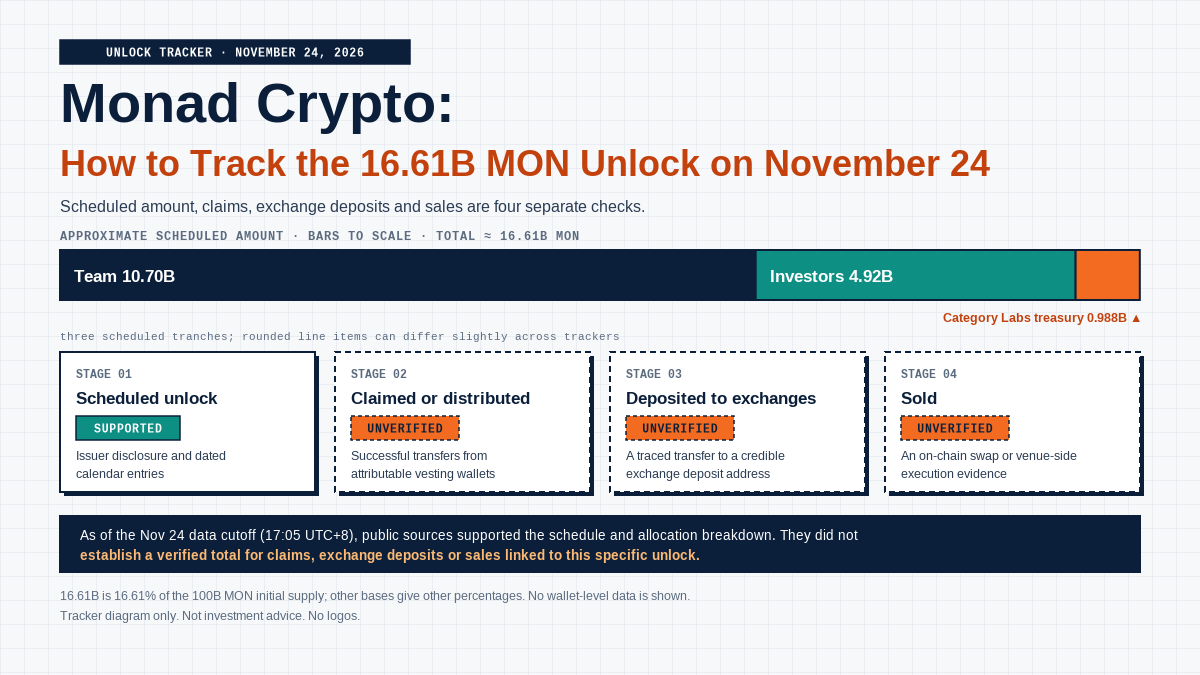
Monad Crypto: How to Track the 16.61B MON Unlock on November 24
Track Monad’s 16.61B MON unlock on November 24. See the team, investor, and treasury allocations, and learn how to verify claims and exchange deposits.

China Launches AI Standardization Pilot in Five Free Trade Zones
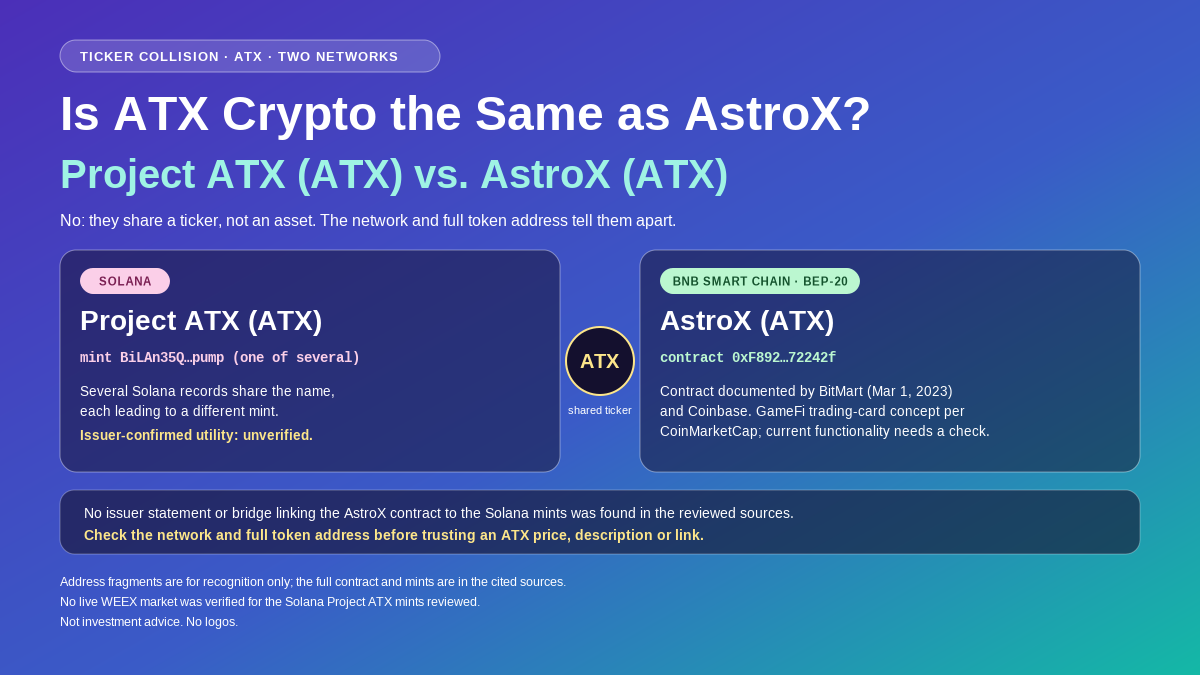
Is ATX Crypto the Same as AstroX? Project ATX (ATX) vs. AstroX (ATX)
Compare Project ATX on Solana with AstroX on BNB Smart Chain. Learn how to verify each token address before trusting an ATX price or buying guide.
Bayer Signals Future Pharmaceutical Deals May Target Mid-Stage Clinical Assets

Ethereum ETF: $96 million in net inflows stop the November bleeding
AI Agents in Payments: Cards Dominate, Yet Stablecoins Fill the 'Gap'|a16z Frontier
Grayscale Claims Bitcoin and Major Assets Are Oversold, Market Outlook Affected by AI Risks
Jensen Huang's "Miraculous Return" Forces Investment Banks to Rewrite Reports Overnight

Applied Digital Stock Surged 20% on a Hyperscaler Deal. What to Know About Its $41 Billion in Leases
Hewlett Packard Enterprise Q4 Earnings Exceed Market Expectations, Board Approves $5 Billion Stock Buyback Plan

Nvidia vs. SpaceX: The AI Revolution Is Big Enough for Both. Here's the Better Buy.

Bitcoin’s supply squeeze narrative faces scrutiny after 11,000 BTC moves to Kraken

Reactions Prove 167-Year-Old Riemann Hypothesis with Help from Claude; Are We Close to Superintelligence?
3 Unstoppable AI Stocks to Buy Hand Over Fist Before the End of 2026

Texas Pacific Land Company Acquires EagleRock Land in $3 Billion All-Stock Deal

Central Bank Anti-Money Laundering Bureau Emphasizes Need for Enhanced Cooperation Against Cross-Border Money Laundering Networks
Sandisk Just Split Its Stock 8-for-1. Is It Time to Buy?
XRP Ledger lending upgrade just 5 votes away from approval

Media: Jensen Huang and His Wife Have Accumulated Vast Wealth

The Scarce Dividend in the Autonomous Taxi Race: Supporting Service Stations
Hong Hao Believes US Stocks Have Peaked, Rebound Unlikely to Reach New Highs

dtcpay Supports Visa Stablecoin Fund Flow to Expand Cross-Border Payments

BHP Plans to Double Copper Production in South Australia to 650,000 Tons by 2040, Shares Rise Over 2%
BlackRock’s staked Ethereum ETF can delay redemptions if unstaked ETH runs short
Bank of America Merrill Lynch: Chip Stocks Need 'Peak Rates' to Hit Bottom, Waiting for 'Prices to Ignore Bad News' to Buy
3 AI Hardware Stocks Down More Than 30% From Their Records to Buy Now and Hold Through 2030

Bill Miller Explains Bitcoin Valuation is Easier than Artificial Intelligence
Bank of America Releases 2027 Investment Outlook: Global Stock Markets Could Rise 4%-8%! Improved Financial Environment Allows for Cryptocurrency Investments
UBS Downgrades Aixtron to Sell, Expects AI Optical Communication Equipment Demand to Slow by 2028, Shares Plunge Over 10%
Unitree Stock Hits 20% Limit-Up: What Drove the November 23 Surge
Unitree Robotics (688836) hit its 20% limit-up at ¥708 on Nov 23, 2026. See the price data, the reported catalysts, the valuation context and what is unconfirmed.
Monad Crypto: How to Track the 16.61B MON Unlock on November 24
Track Monad’s 16.61B MON unlock on November 24. See the team, investor, and treasury allocations, and learn how to verify claims and exchange deposits.
China Launches AI Standardization Pilot in Five Free Trade Zones
Is ATX Crypto the Same as AstroX? Project ATX (ATX) vs. AstroX (ATX)
Compare Project ATX on Solana with AstroX on BNB Smart Chain. Learn how to verify each token address before trusting an ATX price or buying guide.
Latest articles


Latest coin listings on WEEX


