
HOOD Q3 Earnings: Record $1.42B Revenue, So Why Did Crypto Revenue Fall 55%?

 Prefer us on Google


Robinhood just delivered its highest quarterly revenue on record. The problem is that not every part of the business is growing with it.
On October 27, 2026, Robinhood Markets (NASDAQ: HOOD) reported third-quarter net revenue of $1.424 billion, up 12% from a year earlier. Yet cryptocurrency transaction revenue fell 55% to $120 million, while net income declined 14% to $476 million.
Meanwhile, event contracts generated $173 million in revenue, overtaking crypto as a larger transaction-based revenue category for the quarter.
That creates a more interesting question than whether Robinhood had a good or bad earnings report: is the company building a more diversified trading business, or replacing one volatile revenue engine with another?
The answer sits in three places: the changing revenue mix, the gap between record sales and lower profits, and the risks attached to prediction markets.
HOOD Q3 2026 Earnings by the Numbers
Robinhood released its third-quarter results after the U.S. market close on October 27. The quarter ended September 30, 2026.
According to Robinhood's official Q3 earnings release, the key figures were:
| Metric | Q3 2026 | Year-over-year change |
|---|---|---|
| Total net revenue | $1.424 billion | +12% |
| Transaction-based revenue | $867 million | +19% |
| Crypto transaction revenue | $120 million | -55% |
| Event contracts revenue | $173 million | More than 6x |
| Options revenue | $399 million | +31% |
| Equities revenue | $121 million | +41% |
| Net income | $476 million | -14% |
| GAAP diluted EPS | $0.51 | -16% |
| Adjusted EPS (non-GAAP) | $0.60 | -3% |
The first distinction is between revenue and profit.
Robinhood's transaction business became larger, supported by options, equities and prediction markets. But the company retained less net income than it did a year earlier.
The second distinction is between the two earnings-per-share figures.
GAAP diluted EPS was $0.51. Adjusted EPS was $0.60. The adjusted figure excludes specified items under Robinhood's non-GAAP methodology. They are different measures, and neither should be compared with an analyst forecast without checking that the same accounting basis is being used.
The third distinction is the changing business mix. Crypto is no longer the obvious growth leader in Robinhood's trading revenue.
Why Did Robinhood Crypto Revenue Fall 55%?
Robinhood reported $120 million in cryptocurrency transaction revenue, down 55% year over year.
A weaker revenue figure does not necessarily mean every customer stopped trading crypto. Revenue depends on trading activity, transaction economics and where that activity takes place.
The company's operating metrics give a clearer picture.
Robinhood reported that total crypto notional trading volume declined 38% year over year to approximately $50 billion.
Within that total:
- Robinhood App crypto notional volume fell 48% to $21 billion.
- Bitstamp crypto notional volume fell 28% to $29 billion.
These are measures of trading volume, not the company's earnings from those trades. The figures show that crypto activity declined across both parts of the reported business, although at different rates. (Source: Robinhood Q3 2026 results)
The difference between the 38% decline in total crypto notional volume and the 55% decline in transaction revenue also deserves attention.
Volume and revenue are not interchangeable. The amount earned per dollar traded can change with product mix, pricing, customer activity and other factors.
The financial report does not establish that one specific factor alone explains the entire gap, so it would be misleading to attribute the decline entirely to competition or to a single crypto market event.
The practical takeaway is that Robinhood's crypto business faced pressure in both activity and monetization.
That leaves a new question: whether other trading products can make the overall platform less dependent on crypto cycles.
Prediction Markets Overtook Crypto Revenue: Can the Growth Last?
Prediction markets allow participants to trade contracts tied to the outcomes of defined events.
Unlike buying a company share, an event contract is settled according to an event's specified outcome and rules.
Robinhood's prediction markets business has grown rapidly.
In Q3 2026, event contracts generated $173 million in revenue, compared with $120 million from cryptocurrency transactions.
That is a $53 million difference.
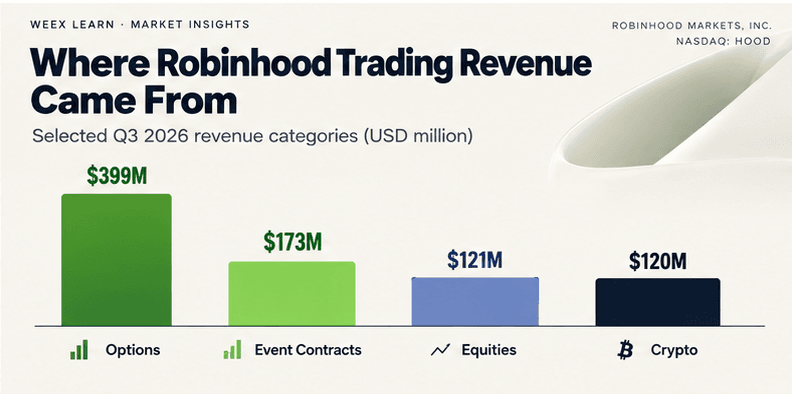
Event contract revenue increased more than sixfold year over year, while the number of event contracts traded increased more than sevenfold to 16.4 billion, according to Robinhood.
But there is an important distinction: 16.4 billion contracts traded is not $16.4 billion of revenue.
Trading volume measures activity. Revenue reflects what the business earns from that activity.
Why the Revenue Mix Matters
Prediction markets contributed approximately 20% of Robinhood's $867 million in transaction-based revenue during the quarter. Crypto accounted for approximately 14%.
This marks a meaningful shift in the platform's transaction revenue mix.
However, a larger quarterly revenue contribution does not prove that prediction markets will produce stable, recurring income.
Event-driven trading can be affected by the calendar of major events, market participation, contract availability and fee economics.
A strong quarter may reflect an unusually active period rather than a permanent revenue run rate.
Three Questions About Prediction Market Growth
The first is repeat participation.
Will customers continue trading event contracts when the most widely followed events have passed?
The second is incremental growth.
Are prediction markets bringing in new customers and new activity, or are existing active traders shifting some of their attention from crypto and options?
The third is regulation.
Event contracts face legal and regulatory uncertainty. Changes to permitted products, jurisdictional rules or enforcement could affect the market's growth and the economics of providing access to these contracts.
Robinhood itself identifies potential restrictions on event contracts among the risks in its earnings disclosures.
Prediction markets are now financially important to Robinhood. Their long-term durability is still an open question.
-- Price
Why Did Robinhood Profit Fall Despite Record Revenue?
This is the most revealing part of the quarter.
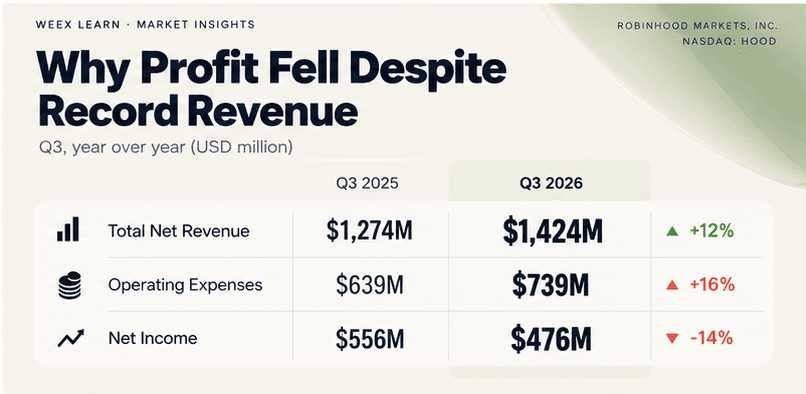
Robinhood's total net revenue increased from $1.274 billion in Q3 2025 to $1.424 billion in Q3 2026.
That is an additional $150 million in quarterly revenue.
Yet net income fell from $556 million to $476 million.
How can both happen?
The financial statements show several moving parts.
Operating Expenses Absorbed More of the Revenue Growth
Total operating expenses increased from $639 million to $739 million, a rise of $100 million.
Robinhood attributed the increase primarily to higher provisions for credit losses associated with its expanding credit card business, expenses related to newer businesses, and investments in growth.
The provision for credit losses alone increased from $26 million to $71 million.
That is a $45 million increase, illustrating how expansion beyond brokerage trading can create costs and financial risks of its own.
Operations expenses also rose significantly, while technology and development spending increased.
The result was that a substantial share of the new revenue was absorbed by higher operating costs.
Non-Operating Items and Taxes Added Pressure
Operating costs do not tell the whole story.
Robinhood reported a $60 million net other expense in Q3 2026, compared with approximately $1 million a year earlier.
Its income tax provision also increased from $78 million to $149 million.
Taken together, these changes help explain why higher revenue did not translate into higher net income.
The numbers can be simplified:
- Revenue increased by $150 million.
- Operating expenses increased by $100 million.
- Net other expense increased by approximately $59 million.
- The income tax provision increased by $71 million.
The result was an $80 million decline in reported net income, from $556 million to $476 million. (Source: Robinhood Q3 financial statements)
This is not simply a story of a trading business becoming less profitable.
It is also the story of a platform investing in new businesses, taking on additional costs and facing a different mix of financial expenses.
For HOOD, that distinction matters. Investors evaluating the quarter need to consider whether these costs are temporary, cyclical or necessary to support future revenue.
Does Robinhood's Growth Still Justify Its Valuation?
Revenue growth alone cannot answer whether a stock is attractively valued.
The more useful question is what assumptions about future earnings are already reflected in its price.
Robinhood's Q3 results present both supportive and challenging evidence.
On the positive side:
- Transaction-based revenue increased 19%.
- Options and equities revenue grew.
- Event contracts became a meaningful revenue contributor.
- Robinhood Gold subscribers increased 34% to 5.2 million.
- Total platform assets reached approximately $396 billion, up 19%.
On the risk side:
- Cryptocurrency transaction revenue declined sharply.
- Net interest revenue fell 9%.
- Operating expenses increased faster than total revenue.
- Prediction markets remain exposed to event cycles and regulatory uncertainty.
These figures suggest that Robinhood is becoming a broader financial platform, rather than relying on a single trading category.
However, diversification does not automatically mean higher profitability.
A new business line may create revenue while requiring additional infrastructure, compliance spending, credit exposure or customer-acquisition costs.
For valuation, investors need to judge not only whether these products grow, but whether they can generate sustainable earnings after their associated costs.
A high growth expectation can make a stock sensitive to even relatively small disappointments in margins or future guidance.
What Could Happen Next for HOOD Stock?
The Q3 results do not support one guaranteed direction for HOOD.
Instead, they point toward three possible scenarios.
Scenario 1: Broader Trading Growth Offsets Crypto Weakness
If options, equities and prediction markets continue expanding while expenses stabilize, Robinhood could improve its earnings mix.
In this case, crypto would become one part of a larger business rather than the main driver of investor expectations.
Scenario 2: Revenue Grows but Profit Margins Remain Under Pressure
If newer business lines require sustained spending, revenue could keep growing without a comparable increase in net income.
Investors would then focus more heavily on cost efficiency, credit losses and adjusted-versus-GAAP profitability.
Scenario 3: Event Trading Slows or Faces Regulatory Constraints
If prediction-market participation weakens or regulatory developments limit available contracts, one of the quarter's fastest-growing revenue sources could lose momentum.
That would put greater weight back on the performance of options, equities, crypto and other businesses.
None of these scenarios is a price target. They are ways to assess what future quarterly results would need to demonstrate.
How to Trade HOOD on WEEX: A Step-by-Step Guide
WEEX offers two different ways to gain exposure to HOOD-linked price movements: stock tokens and perpetual futures. These products have different trading mechanisms and risks.
How to Trade HOOD Stock Tokens on WEEX
Step 1: Create or Log In to Your WEEX Account
Visit WEEX and log in to your account. Complete any required identity verification before using available trading services.
Step 2: Prepare Your USDT Balance
Check that your account has sufficient USDT. If you need to transfer funds, confirm the supported deposit network and address before proceeding.
Step 3: Open the HOOD Stock Token Trading Page
Navigate to the HOOD/USDT stock token trading pair.
WEEX stock tokens are synthetic, price-tracking assets. They do not represent ownership of actual Robinhood shares or provide shareholder rights.
Step 4: Select Your Order Type
Review the available price and trading information. Choose a market or limit order if supported, enter the desired amount, and check the order details.
Step 5: Review and Submit Your Order
Verify the order price, quantity and applicable fees before submitting. Execution prices may differ from expectations, particularly during volatile market conditions.
How to Trade HOOD Futures on WEEX
For readers interested in derivatives, WEEX also provides a separate HOOD/USDT futures trading page.
After opening the contract page, review its current availability, leverage options, margin requirements and funding information. If trading is enabled, users can select Long or Short, choose their position size and consider Stop Loss and Take Profit settings before confirming an order.
Futures trading carries additional risks, including liquidation and amplified losses from leverage. Neither product guarantees profits, and availability may vary by jurisdiction.
FAQ
1. How Much Revenue Did Robinhood Report in Q3 2026?
Robinhood reported record total net revenue of $1.424 billion for the third quarter of 2026, up 12% year over year. Transaction-based revenue reached $867 million.
2. Why Did Robinhood's Crypto Revenue Fall 55%?
Crypto transaction revenue fell to $120 million as trading activity weakened. Total crypto notional volume declined 38% year over year. The decline in revenue was larger than the decline in volume, indicating that transaction activity and revenue economics both matter.
3. Did Robinhood's Prediction Market Revenue Exceed Crypto Revenue?
Yes. Event contracts generated $173 million in Q3 2026, compared with $120 million from crypto transactions. However, event-contract revenue should not be confused with the number or notional value of contracts traded.
4. Why Did HOOD Profit Decline Despite Record Revenue?
Robinhood's operating expenses increased 16% to $739 million, while net other expense and the income tax provision also increased. Net income therefore fell 14% to $476 million despite record revenue.
5. Can You Buy Real Robinhood Shares on WEEX?
The WEEX HOOD stock token is a synthetic, price-tracking digital asset, not an actual Robinhood share. It does not provide stock ownership or shareholder rights. WEEX also has a separate HOOD futures product with derivative and leverage risks.
This content is provided for general informational purposes only and doesn't constitute financial, investment, legal, or tax advice. Any events, rewards, online promotions, or related information mentioned herein should not be considered a recommendation, solicitation, or invitation to purchase, sell, trade, or otherwise deal in any crypto assets. Crypto assets are highly volatile and may result in loss. The availability of WEEX services, products, and related events may vary by region. You are responsible for ensuring that your participation is in accordance with applicable local laws and regulations.
You may also like

HYPE Price Jumps After ICE Backs trade[XYZ] on Hyperliquid: What Is Confirmed and What Is Not

Taiwan Crypto Regulations 2027: What Investors Need to Know

CLS Stock After Q3 Earnings: Revenue Up 83%, 2027 Outlook and What Investors Should Check

Exchange Convert vs DEX Swap: What’s the Difference? Try Convert Crypto On WEEX!
Is XTruth Oil (XTO) a Stock or Crypto? How Its Oil Rewards Actually Work

What Is Pearl (PRL) Crypto and How Does Its Mining Work?

Stake ETH or Hold USDT on WEEX? The Price Move That Decides It

How Transparent Is a Crypto Exchange? Checking Proof of Reserves and Protection Funds

What Is Leverage Trading in Crypto? A Beginner’s Guide With Simple Examples

Is RSI a Good Indicator? How the Relative Strength Index Works, Its Limits and How Traders Use It
CRWV Stock Swings From -9.5% to +5.9%: Why CoreWeave Reversed

Walrus (WAL) Jumps 30%: Sui Storage Token Rallies on AI Data
CoreWeave Stock Plunges 15%: Why a Bond Yield Spooked CRWV

Best Crypto Miner for Beginners: What to Check on Cost, Power, Hashprice and Profit Before You Buy
MU Stock Falls Below $1,000: Is the CXMT Threat Real or Just an Excuse to Take Profits?
Stop Limit Order: How It Works and Why It Can Fail to Fill

Best Crypto Podcasts for Beginners: A 4-Week Listening Plan

Conflux (CFX) Price Jumps on China's National Blockchain Network Plan: Does the Policy Actually Name CFX?
What Is Plume (PLUME)? Why the RWA Token Stays 93% Below Its High Even After the Layer 2 Rally

Who Is David Ellison? Skydance’s Strategy, Media Consolidation, and the Investment Case
Crypto Funding Rate: Who Pays, What It Costs, What It Signals
PEP Earnings: PepsiCo Beats Q3, Cuts Guidance on North America
BTC Futures Analysis: $80K Held, but Longs Are Still Paying Up
Third-Party Trading Platforms vs Direct WEEX Trading: Fees, Liquidity, Security, and Control

What Is Blockchain and How Does It Work? One Real Payment Traced

How to Day Trade Crypto for Beginners: Do the Fee Math First

What Is a Blockchain Node? Types, 2026 Counts, and Real Costs

TSMC Stock Outlook Ahead of Q3 Earnings: Can AI Demand Push Shares Higher?
Taiwan Stock Market Nears 50,000: Can the TAIEX Break the Milestone After the Holiday?
How to Buy USDT in Thailand: Payment Methods, Fees and Transfer Checks
HYPE Price Jumps After ICE Backs trade[XYZ] on Hyperliquid: What Is Confirmed and What Is Not
Taiwan Crypto Regulations 2027: What Investors Need to Know
CLS Stock After Q3 Earnings: Revenue Up 83%, 2027 Outlook and What Investors Should Check
Exchange Convert vs DEX Swap: What’s the Difference? Try Convert Crypto On WEEX!
Is XTruth Oil (XTO) a Stock or Crypto? How Its Oil Rewards Actually Work
What Is Pearl (PRL) Crypto and How Does Its Mining Work?


