
What Is a Funding Rate? How Perpetual Futures Charge Longs and Shorts

 Prefer us on Google


A funding rate is a periodic transfer between long and short positions in a perpetual future, designed to keep the contract price near its reference market. It is not a fixed entry fee: when the displayed rate is positive, longs generally pay shorts; when it is negative, shorts generally pay longs, with the actual amount depending on the live rate, position notional, and settlement condition.
How funding moves between longs and shorts
A perpetual future has no expiry, so the market uses funding to discourage the contract from staying far from its reference price. Strong demand for longs can coincide with a positive rate, while stronger demand for shorts can coincide with a negative rate. That describes a funding transfer at a particular time; it is not proof that price must rise, fall, or reverse.
WEEX’s Taiwan BTC/USDT perpetual page displayed a funding-rate field and a settlement countdown on September 17, 2026. The field changes with the contract and market. Read the value currently shown on the page rather than turning one percentage into a long-term condition. WEEX’s contract-formulas guide should be read with the current product rules.
How the charge affects a position
Funding is generally based on a position’s notional value and the live rate, not simply on the margin deposited. Therefore, the direction, size, and whether the position is held at the settlement point can affect the account result. In a positive-rate environment, a long trader should include funding in the cost of holding; in a negative-rate environment, a short trader should not assume a fixed income because the rate can change.
Funding is separate from trading fees, realized profit and loss, and slippage. A favorable price move can still be reduced by fees and funding, while a nearly flat price can still produce a changed net result. When reviewing a position, keep direction, notional value, funding, entry and exit execution, and available margin as separate fields.
A beginner’s funding checklist
- Select the correct perpetual pair and confirm the displayed funding rate, settlement countdown, and position direction.
- Put the rate into the context of your intended holding period and position size instead of looking only at whether it is positive or negative.
- Include funding with fees, slippage, price movement, and margin changes. A funding transfer is not a guaranteed return.
- Set an exit condition and check the position record around settlement. Do not ignore liquidation distance simply to wait for a possible payment.
- Re-read the live product rules when the interface shows maintenance, trading restrictions, or a change to the contract’s parameters.
-- Price
Funding is not a stand-alone signal
A high positive rate can reflect crowded long demand or a temporary imbalance; a negative rate cannot independently prove a reversal. Funding, open interest, order-book depth, and price behavior should be considered in one risk framework. Claims that a trader can earn a stable return merely by collecting funding ignore direction, liquidation, execution, and liquidity risks.
Leverage magnifies a price loss and can trigger liquidation before the next funding event. Check the current terms on the WEEX futures page before deciding whether to act. If your goal is to buy and hold an asset without a perpetual position, compare the BTC/USDT spot page; spot still carries price, custody, and transfer risk.
Reading a funding field responsibly
The sign tells you the usual direction of the transfer, but it does not tell you the size of the eventual account change by itself. A small rate applied to a large notional position can matter, while a large-looking rate on a very small position may have a different effect. Check the position notional and the product’s displayed calculation rather than comparing percentages across unrelated pairs.
The countdown is also a condition to observe, not a promise that the rate will remain unchanged until settlement. The rate may update, the position may be resized, and a close may occur before the event. Keep a record of the rate and position details shown when you make a decision, then review the final position record afterward.
Keep the account calculation visible
When you open a position, record the displayed rate, notional value, direction, and settlement countdown. After the event, compare the funding line with the position history rather than estimating from memory. This is especially useful when a position was resized, partially closed, or held across more than one displayed update.
Do not compare a funding percentage from one contract directly with another without checking each product’s notional convention and settlement rule. The same sign can have a different practical effect when position size, price, and account currency differ.
Common questions
Is funding a fee kept by the exchange?
It is generally a transfer between long and short positions rather than the same item as a trading fee. Read the position record and fee page separately because the calculations and recipients differ.
Does a positive funding rate mean price must fall?
No. It reflects a funding condition at a particular time and cannot, by itself, forecast price direction or a turning point.
Do I need to watch funding without leverage?
If you do not hold a perpetual position, you do not pay or receive funding as a contract position. Spot and futures are different products, so confirm what the account actually holds.
More reading: Perpetual futures for beginners · Spot trading for beginners · A Bitcoin funding-rate example
This article is general information, not investment, financial, legal, or tax advice. Perpetual futures, funding, and leverage can result in asset loss.
This content is provided for general informational purposes only and doesn't constitute financial, investment, legal, or tax advice. Any events, rewards, online promotions, or related information mentioned herein should not be considered a recommendation, solicitation, or invitation to purchase, sell, trade, or otherwise deal in any crypto assets. Crypto assets are highly volatile and may result in loss. The availability of WEEX services, products, and related events may vary by region. You are responsible for ensuring that your participation is in accordance with applicable local laws and regulations.
You may also like

Perpetual Futures for Beginners: Margin, Funding and Liquidation Explained
What the LUSD Attack Shows About DeFi Risk
What Is BONK? WEEX Spot and 1000BONK Futures Status and Risk Checks
What Is BRETT? WEEX Spot and Futures Status and Risk Checks
What Is FLOKI? WEEX Spot and 1000FLOKI Futures Status and Risk Checks

What Is WIF (dogwifhat)? WEEX Spot and Futures Status and Risk Checks

Who Is Attending TOKEN2049 Singapore 2026? Top Speakers, Exchanges and Exhibitors to Watch
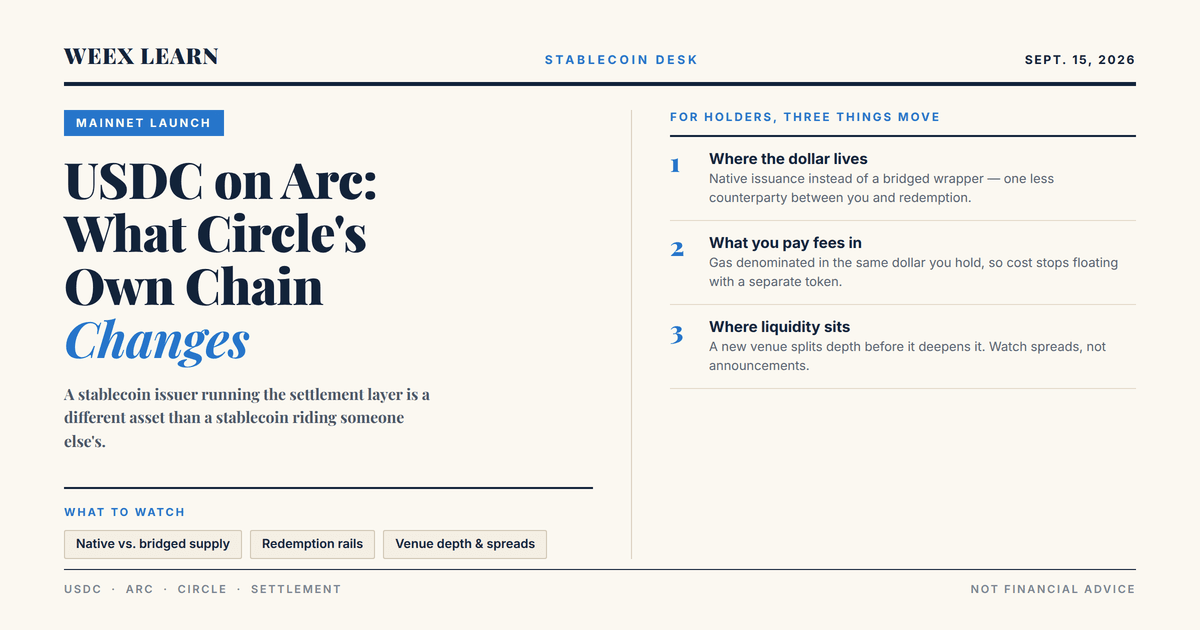
USDC on Arc: What Circle's Mainnet Launch Changes for Holders
SpaceX Stock Futures: Where to Put Stops on a 115% Range
How to Trade Microsoft (MSFT) Stock Token with USDT on WEEX
How to Trade Apple (AAPL) Stock Token with USDT on WEEX
Crypto Futures Trading Explained: Leverage, Funding, Liquidation
Crypto Futures Trading: Leverage, Funding and Apple Perps
How to Trade Tesla (TSLA) Stock Token with USDT on WEEX: A Trading Guide for Beginers in 2026
How to Trade NVIDIA (NVDA) Stock Token with USDT on WEEX
How to Trade U.S. Stocks Without a Brokerage Account Using USDT

Nike Stock Price Prediction 2026: What the $50 Target Actually Requires to Happen
CLARITY Act Enters a Critical Window: What the September 15 Senate Vote Actually Means
What Are Spot Stock Tokens? How Synthetic Stock Trading Works

XST Coin Price Bounced 19% Off a New Low in Hours: Is This the Bottom or Just Noise?
What to Do After Buying USDT in Pakistan: Spot, Futures or Hold?

What Is the WEEX Mini App? A Lightweight Way to Trade Inside Telegram
XST Coin Price Crosses Into Deep Capitulation Territory: What a 90%+ Decline Actually Signals
CyberLeek Is Trending—but Why Are People Searching for CYBERLINK?
Nvidia After-Hours Stock Price: What Moved NVDA After the Earnings Report?
Crypto Futures Liquidation in Pakistan: How It Works and How to Manage Risk
Bank Account Freeze Risk for Crypto Traders in Pakistan 2026
Crypto Tax in Pakistan: What FBR Rules Mean for PKR Traders
Humanity Protocol Unlocked 266 Million H Tokens Today—Where Did They Go?
DGAI Has Trading Volume but No Reported Circulating Supply—So What Is Its Real Market Cap?
Perpetual Futures for Beginners: Margin, Funding and Liquidation Explained
What the LUSD Attack Shows About DeFi Risk
What Is BONK? WEEX Spot and 1000BONK Futures Status and Risk Checks
What Is BRETT? WEEX Spot and Futures Status and Risk Checks
What Is FLOKI? WEEX Spot and 1000FLOKI Futures Status and Risk Checks
What Is WIF (dogwifhat)? WEEX Spot and Futures Status and Risk Checks





