
4 Chip Stocks Down as Much as 36% From Their Highs to Buy and Hold for the Next Decade

 Prefer us on Google


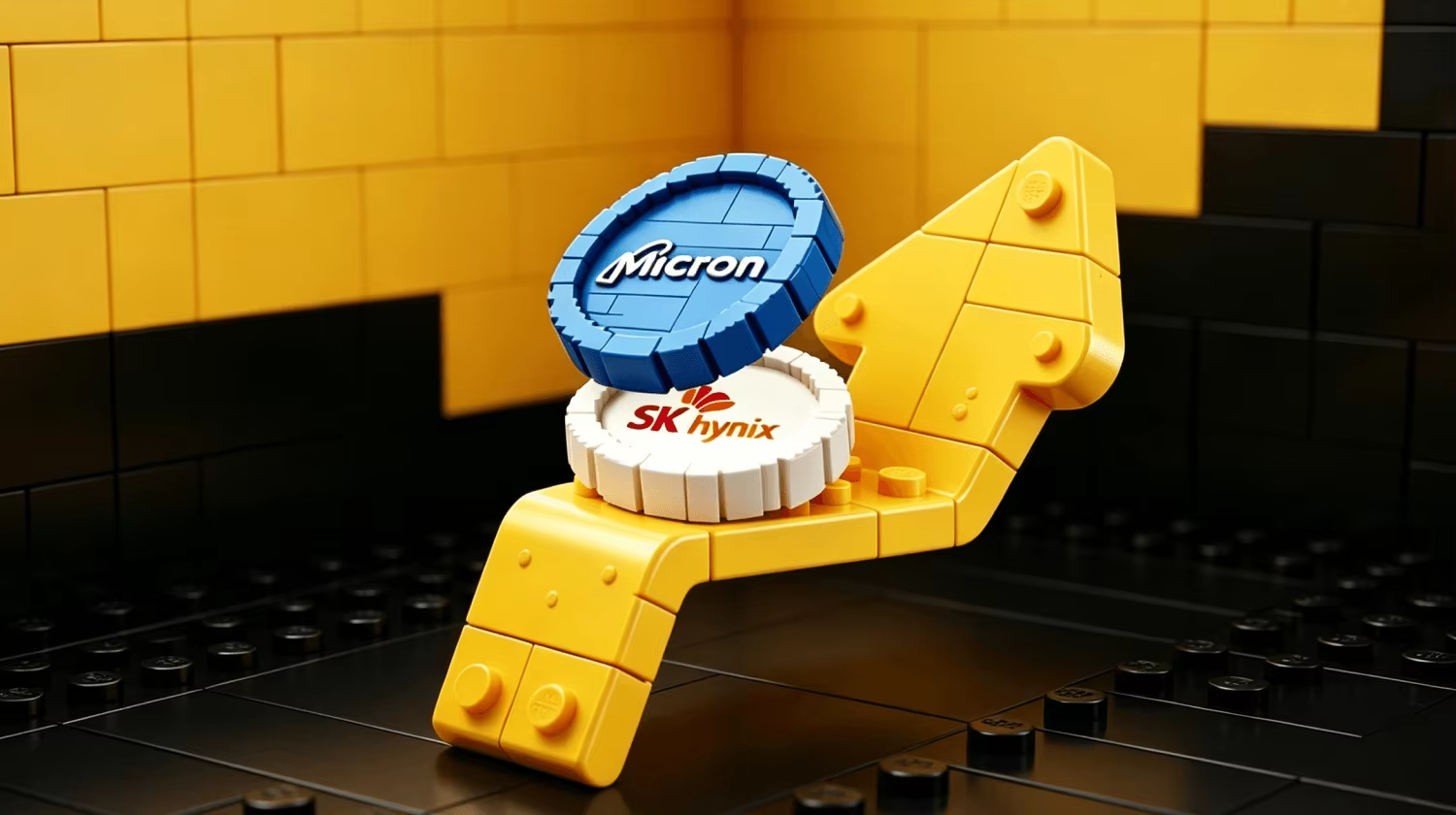
Most chip stocks are far off their highs. As I write, Advanced Micro Devices (AMD -5.58%) trades around 18% below its record close, and Taiwan Semiconductor Manufacturing (TSM -6.34%) sits about 18% below its own. ASML (ASML -5.91%) is about 25% under its June record, and Micron Technology (MU -7.62%) is about 36% under its own.
Each handles a different link in the chain that turns artificial intelligence (AI) spending into hardware. AMD designs chips. TSMC makes them, partly using ASML's lithography machines (which print a chip's patterns on silicon wafers). And Micron provides the memory that sits next to them.
For a 10-year hold, I think this matters. Some of these companies get paid almost no matter whose chip wins. Others have to keep winning.
Image source: Taiwan Semiconductor Manufacturing Company.
- AMD's data center sales are accelerating
AMD's data center segment sells server processors and AI chips. Showing how fast this business is scaling, its revenue climbed 97% year over year in the third quarter to a record $8.5 billion, up from $6.7 billion in the second quarter and $5.8 billion in the first. Growth from the previous quarter accelerated from 16% to 27%. And the segment now makes up 64% of AMD's sales, up from 47% a year earlier.
That's well above the more than 60% a year AMD targets for the segment over the next three to five years.
The biggest risk, I think, is the price. At around $535, AMD trades at about 30 times the earnings analysts expect for 2027. Even its own target of adjusted earnings over $20 a share in three to five years puts today's price at about 27 times those earnings.
- TSMC just had its best month ever
AMD depends on TSMC for all its processor and graphics chip wafers at 7 nanometers or less (a lower number means a more advanced chip), according to AMD's last quarterly filing.
Notably, chips built at 7 nanometers or below brought in 79% of TSMC's wafer revenue in the third quarter, as total revenue grew 41% year over year in U.S. dollars and net income climbed 69% in Taiwan dollars. Then October's sales set a monthly record of around 587 billion Taiwan dollars, up about 60% from a year earlier.
Of course, most of TSMC's main plants are in Taiwan. A conflict or trade fight involving the island is the biggest risk, because it might disrupt the factories AMD relies on.
- ASML's customers are already looking to 2030
The most advanced chips rely on extreme ultraviolet (EUV) lithography machines, and ASML is now the world's only maker of them.
Its third-quarter sales hit 11.7 billion euros, up 55% year over year. And management expects 2026 sales of 44 billion to 45 billion euros, around 36% above 2025's total at the midpoint.
"In light of their demand visibility, some customers are expressing an interest in placing orders with us for 2029 and even 2030," CEO Christophe Fouquet said in ASML's third-quarter results release.
But the chip industry has historically been cyclical, and ASML's sales rise and fall with it. At around 24 times the earnings analysts expect for 2027, the stock arguably prices in a long upturn.
- More memory per chip
Micron's link is high-bandwidth memory (HBM), stacked memory chips that sit next to an AI processor and deliver data to it. In June 2025, Micron said its HBM had been built into AMD's Instinct MI350 Series.
And every new generation needs more of it. AMD's latest AI chip, the MI455X, has 12 HBM stacks totaling 432 gigabytes, versus 8 stacks and 288 gigabytes in the MI355X, one of the MI350 Series chips.
Micron's cloud memory unit sells HBM to data center customers. Its revenue climbed to $16.3 billion in the fiscal fourth quarter of 2026 (the period ended Sept. 3, 2026) -- up from $13.8 billion in fiscal Q3 and $4.5 billion a year before.
But memory has a long history of sharp price swings. Micron's gross margin surged to 81% in fiscal 2026 from 40% a year before, and a margin that can double in a year can fall just as fast when the industry adds supply.
Which would I buy first?
All four look like companies that can continue to grow through 2036. But TSMC and ASML mostly get paid as long as the industry keeps making advanced chips, whoever designs them. AMD has to keep winning business from rivals, and Micron has to deal with memory prices.
So, I think all four are worth considering over the next decade, but I'd put the most money into TSMC and ASML. I'd start with TSMC, at around 18 times expected 2027 earnings versus about 30 times for AMD.
I'd add AMD and Micron in smaller amounts over the months ahead. Ten years is plenty of time to buy in stages.
-- Price
This content is provided for general informational purposes only and doesn't constitute financial, investment, legal, or tax advice. Any events, rewards, online promotions, or related information mentioned herein should not be considered a recommendation, solicitation, or invitation to purchase, sell, trade, or otherwise deal in any crypto assets. Crypto assets are highly volatile and may result in loss. The availability of WEEX services, products, and related events may vary by region. You are responsible for ensuring that your participation is in accordance with applicable local laws and regulations.
You may also like

$LIBRA: One of the defendants seeks to remove Judge Ledesma and halt the review that could reactivate the case
Solmate plans AI GPU service with Solana payments: What do we know?

Is Apple Losing Its Memory?

Tech Giants Should Diversify Data Center Investments

Blue Wave Sweeps the U.S., Halting Digital Asset Legislation

Bitcoin: Michael Saylor Hints at New Strategy Purchase

Wall Street Tests the AI Boom: What the Industry's Balances Reveal After the Democratic Victory

Perpetuals on Stocks: SEC Comes to CFTC's Aid Against Cboe and Citadel

The Privacy Paradox of Bitcoin: Satoshi Acknowledged It Long Ago, Have the Successors Solved It?
Prediction: Archer Aviation Will Fly Paying Passengers Before the 2028 Olympics. Here’s What $5,000 Invested Today Could Be Worth by Then.

Liftoff Mobile Stock Rises 30% After Strong Earnings Report

BCRA's Demand for Pesos Fell in October, but There Were Positive Signs: Is Remonetization Starting?

In Anthropic's Doomsday Narrative, There Is No Room for Jensen Huang

China Uncovers AI Projects Worth $3.2 Billion Involving NVIDIA Chips

What Investment Signals Are Released as the 'Big Three' of AI New Cloud Submit Their Reports?
Strive CEO States No Common Stock Issued, mNAV Metric Removed

In-Depth Interview | Fu Peng: I Have No Faith in BTC

Why AMD Shares Are Surging and What a $10,000 Investment in the Stock Could Be Worth in 3 Years

Apple Becomes a Safe Haven Amid AI Sell-off, Bernstein: 37x P/E Still Not Expensive

9-Minute Attack Window, 7.1 Million BTC Exposed: How Bitcoin Can Save Itself from Quantum Threats

Wall Street's Next Blockbuster Stock Split Could Come From This Chip Equipment Giant

Kraft Heinz's Revival Plan: Cheese Ramen and High-Protein Jell-O

Bernstein: Why You Absolutely Shouldn't Buy the Dip on Nvidia Right Now?
Progress in Arbitration of Financial Loan Contract Dispute Involving ST Sanmu
Pony Ma's Latest Internal Speech Exposed! Using AI to Improve Efficiency in Core Business, Exploring AI Native and New Battlefields

Kevin O'Leary Explains How Uncertainties in the U.S. Are Slowing Crypto Adoption

From London to Ras Al Khaimah: A Crypto Founder's Reason for Leaving

Two U.S. Senators Demand Answers on Insider Trading Prevention Measures in Trump White House's Prediction Market
Poland to Fund Long-Term U.S. Military Presence

As Whales Embrace ETFs, Security Anxiety in the Crypto World is Spreading
$LIBRA: One of the defendants seeks to remove Judge Ledesma and halt the review that could reactivate the case
Solmate plans AI GPU service with Solana payments: What do we know?
Is Apple Losing Its Memory?
Tech Giants Should Diversify Data Center Investments
Blue Wave Sweeps the U.S., Halting Digital Asset Legislation
Bitcoin: Michael Saylor Hints at New Strategy Purchase
Latest articles




Latest coin listings on WEEX


