
Monad Crypto: How to Track the 16.61B MON Unlock on November 24

 Prefer us on Google



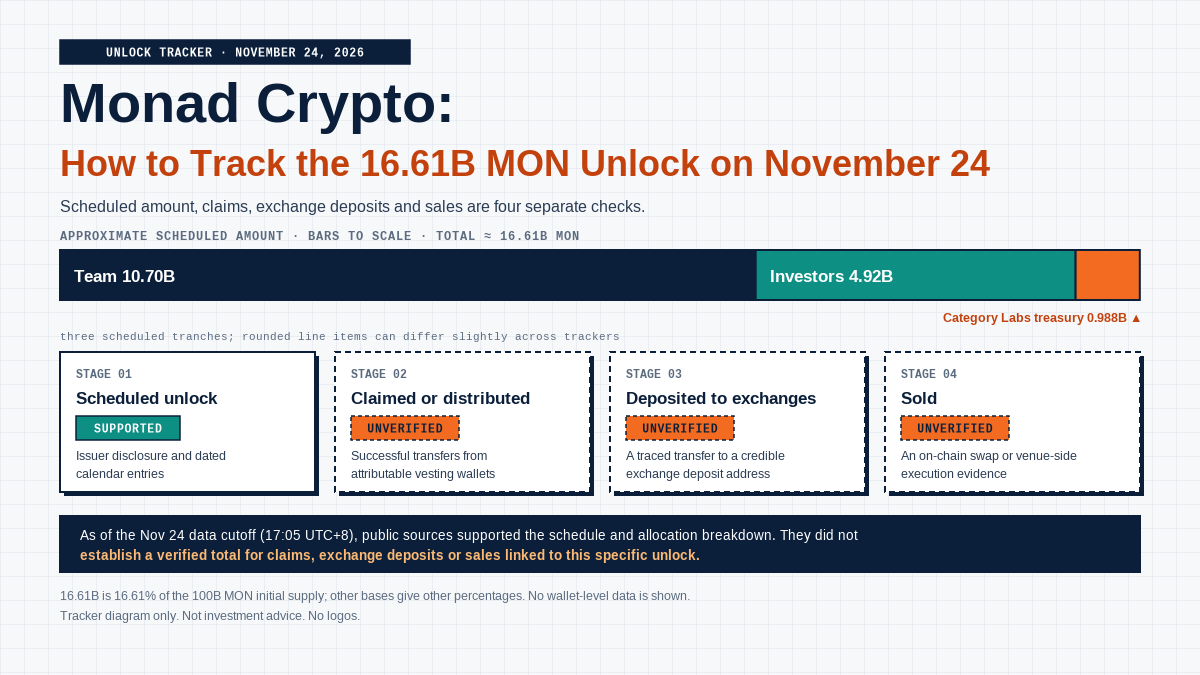
The November 24, 2026 Monad (MON) unlock schedule accounts for approximately 16.61 billion MON across the team, investors, and Category Labs treasury. Track it in three stages. Confirm the scheduled amount in the vesting disclosures, check whether eligible tokens moved out of verified vesting wallets, and follow those tokens to any identified exchange destinations. As of our data cutoff, the public sources reviewed supported the schedule and allocation breakdown. They did not establish a verified total for claims, exchange deposits, or sales linked to this specific unlock.
The headline number is useful because it tells you the scale of the first anniversary cliff. The next number worth watching is how much MON you can trace to attributable wallets. A tracker can advance to the December event as soon as its November schedule rolls over. That update tells you what the calendar is counting next. It leaves the question of November’s actual wallet activity open.
WEEX provides separate MON/USDT perpetual futures and MON/USDT spot markets. The perpetual page lets readers follow derivatives pricing and contract information, while the spot page is the reference for the order-book market. Check the current order status and product terms before submitting an order during the unlock window. The WEEX Shopping Fest Lucky Egg campaign is scheduled to close November 25 at 23:59 UTC+8. Eligible futures activity can count toward campaign tasks, subject to the event’s product and account rules.
Author: WEEX SEO Team
Published: November 24, 2026
Updated: November 24, 2026
Data Cutoff: November 24, 2026, 17:05 UTC+8 (09:05 UTC)
Key Takeaways
- Approximately 16.61 billion MON was scheduled for the first anniversary cliff, including about 10.7 billion for the team, 4.92 billion for investors, and 988 million for the Category Labs treasury.
- The headline amount equals about 16.61% of the 100 billion MON initial supply. Other percentages use different supply denominators.
- A schedule entry establishes expected eligibility. A verified wallet transfer can establish a claim or distribution. An attributed exchange deposit takes additional destination evidence.
- The public records reviewed at the cutoff did not provide a transaction-backed total for claims, exchange deposits, or completed sales from the November 24 tranche.
What Was Scheduled to Unlock for Monad (MON) on November 24?
November 24, 2026 marks the first anniversary of Monad’s public mainnet launch. Monad’s token disclosure describes a one-year lock on team tokens and separate one-year cliffs for investors and the Category Labs treasury. Tokenomist’s event breakdown puts the combined November amount at 16.61 billion MON. CoinGecko’s calendar showed 16.61 billion, while DefiLlama’s pre-event snapshot showed approximately 16.613 billion. The headline uses the rounded figure.
| Allocation | Approximate November 24 amount | Basis for the scheduled release |
|---|---|---|
| Team | 10.70B MON | The disclosure estimates that team tokens both vested and unlocked by the first anniversary represent about 10.7% of initial supply. Individual grants have their own vesting terms. |
| Investors | 4.92B MON | The first anniversary tranche represents roughly a quarter of the approximately 19.7B MON investor allocation. |
| Category Labs treasury | 0.988B MON | The first anniversary tranche represents roughly a quarter of the approximately 3.95B MON reserved for future employee compensation. |
| Total | 16.61B MON | Approximate sum of the three scheduled tranches. Rounded line items can produce small differences across trackers. |
The team accounts for roughly 64% of the planned event. This matters when you start following transactions. Transfers attributable to investors and the treasury can be significant, but they cover only part of the schedule. Keep the three groups separate before calculating any claim rate or share sent to exchanges. The Category Labs treasury is also a distinct allocation from the Monad Foundation’s Ecosystem Development reserve. A transfer from an ecosystem wallet needs its own attribution before it is counted against this cliff.
Why One Tracker Says 16.6% and Another Says About 140%
The numerator is roughly 16.61 billion MON in both cases. The difference is what each publisher divides it by. The initial supply measures the event against the original token base. A schedule-based released-supply figure measures it against allocations the tracker already classified as released. A circulating-supply estimate measures it against a narrower set of tokens that the provider classifies as circulating.
| Comparison base | Approximate denominator | Scheduled unlock as a share of that base |
|---|---|---|
| Initial MON supply | 100B MON | 16.61% |
| Previously released supply in Tokenomist’s event analysis | 51.31B MON | 32.37% |
| Circulating supply in the reviewed tracker snapshot | 11.83B MON | About 140.5% |
The last figure shows how large the scheduled tranche is relative to the tracker’s circulating-supply estimate. To estimate how much newly eligible MON actually entered circulation, you would need recipient activity and a consistent circulation methodology. The same applies to the dollar headline. A valuation calculated by multiplying the scheduled token count by one MON price is a snapshot of notional value. It cannot tell you how much a large order would realize across available markets.
November 24 Unlock Tracker: Schedule, Claims, Exchange Deposits, and Sales
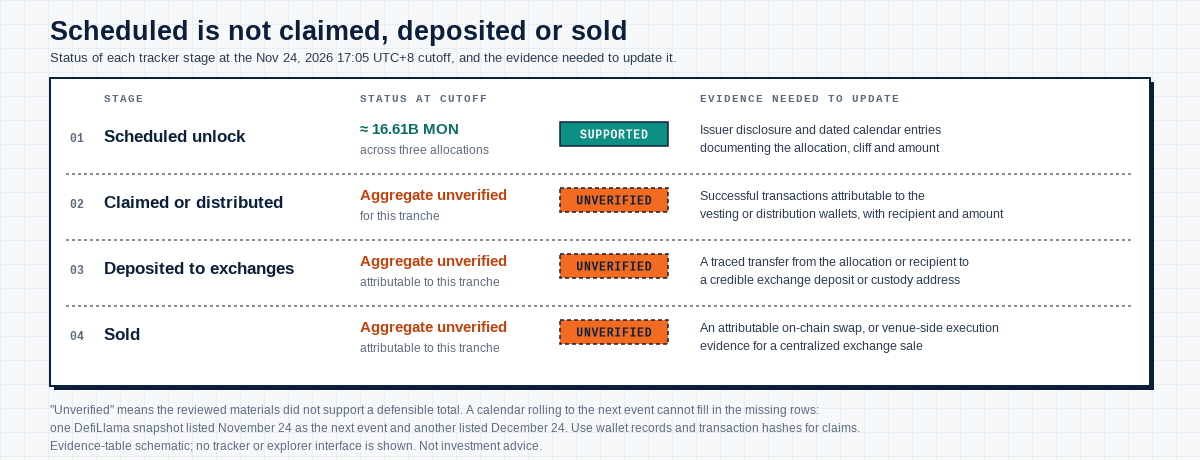
Each stage requires a different record. Start with the three allocation buckets, then update the next column only when the evidence links a movement to this event. Here is what we could substantiate from the public sources reviewed at the cutoff.
| Stage | November 24 status at cutoff | Evidence needed to update the tracker |
|---|---|---|
| Scheduled unlock | Approximately 16.61B MON across three allocations | Issuer disclosure and dated calendar entries documenting the allocation, cliff, and scheduled amount |
| Claimed or distributed | Aggregate amount for this tranche unverified | Successful transactions attributable to the relevant vesting or distribution wallets, with recipient and amount recorded |
| Deposited to exchanges | Aggregate amount attributable to this tranche unverified | A traced transfer from the identified allocation or recipient to a credible exchange deposit or custody address |
| Sold | Aggregate amount attributable to this tranche unverified | An attributable on-chain swap, or venue-side execution evidence for a centralized exchange sale |
“Unverified” means the reviewed materials did not support a defensible total. A calendar changing to the next event cannot fill in those missing rows. In fact, the reviewed DefiLlama material included one snapshot listing November 24 as the next event and another listing December 24. Both are useful for understanding the schedule. For a claims report, you still need the corresponding wallet records and transaction hashes.
-- Price
How to Use Tokenomist and MonadVision to Track Claims
Tokenomist’s Monad claims page is the starting point for checking whether the provider displays event-level claim activity. Tokenomist describes its On-Chain Claims feature as tracking movements from known vesting or internal wallets to beneficiaries. The public Monad page reviewed for this article exposed schedule and supply information, but we could not verify a breakdown of claims tied to the November 24 tranche. If your view displays a cumulative claimed figure, check the date range and allocation before using it. Cumulative activity can include periods outside the event you’re covering.
When you have a credible wallet address or transaction hash, open MonadVision, an explorer listed in Monad’s mainnet documentation. Check the block time, execution status, sender, recipient, and amount. MON is Monad’s native gas token, so inspect native value movement as well as any internal movements surfaced in the transaction details. A tracker may categorize movements using labels. Preserve the transaction hash alongside the label so a reader can review the underlying record.
- Record the schedule first. Save the event date, source, allocation, and scheduled amount. Use UTC for the transaction log so observations from different platforms line up.
- Establish wallet provenance. Use a disclosed or credibly labeled vesting or distribution address. Leave the allocation unassigned if the source cannot substantiate ownership.
- Identify the first attributable movement. Record the hash, block time, amount, and beneficiary. A transfer between wallets controlled by the same entity may be an internal move. Check the transaction context before calling it a claim.
- Follow the beneficiary separately. Record whether the funds remain in the receiving wallet, move to another address, enter a recognizable staking flow, reach an exchange, or are swapped on-chain.
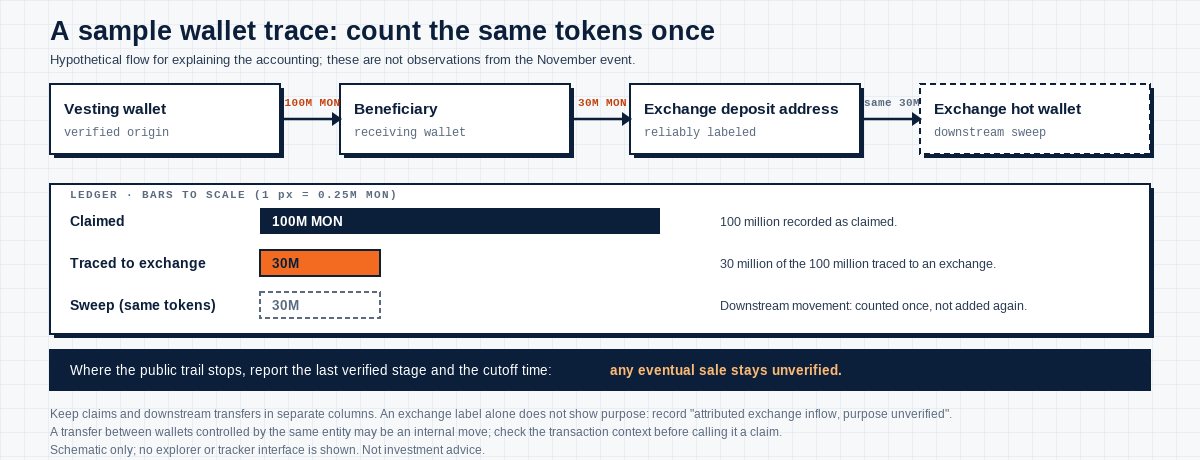
- Deduplicate the amount. Keep claims and downstream transfers in separate columns. If the same MON moves through several addresses, avoid counting each hop as additional released supply.
For example, suppose a verified vesting wallet sends 100 million MON to a beneficiary, and that beneficiary later sends 30 million MON to a reliably labeled exchange deposit address. In this hypothetical case, record 100 million claimed, of which 30 million was traced to an exchange. If the exchange later sweeps the 30 million into its hot wallet, that is downstream movement of the same tokens. The public trail still leaves any eventual sale unverified. The numbers here illustrate the accounting and are not observations from the November event.
How to Tell Whether Unlocked MON Reached an Exchange
The strongest deposit evidence combines a verified origin with a credible destination. A transfer from a known vesting wallet, or from a beneficiary who can be traced back to it, is more informative than a general surge in exchange inflows. MON already circulating before November 24 can be deposited during the same window. A platform-wide inflow figure therefore needs wallet-level attribution before it can be used to quantify this specific cliff’s impact.
Read exchange labels in context. A transfer into a labeled wallet can reflect a customer deposit, custody, an internal sweep, or inventory movement. Use the destination label, wallet history, source attribution, and direction together. For example, you could record a transfer as “attributed exchange inflow, purpose unverified” when the exchange relationship is credible but the reason for the transfer remains unknown. Trading on a centralized exchange generally requires additional venue-side evidence to link a deposit to a completed order. A decoded on-chain swap can provide direct execution evidence for the attributed address.
Market data can add context once the transfer timeline is in place. Compare the block times of identified claims and deposits with spot volume, spread, depth, and price. Then check whether the derivatives market showed a concurrent shift in open interest or funding. For example, a spot sell-off with rising perpetual volume can be meaningful, but perpetual volume alone tells you little about whether an identified unlock recipient sold. Keep market activity and attributable wallet behavior in separate columns until the evidence connects them. WEEX’s earlier Monad unlock analysis provides pre-event spot and perpetual context for that comparison.
What Comes After the November Cliff?
The post-cliff schedule differs by allocation. The disclosure gives investors and the Category Labs treasury equal monthly installments of one forty-eighth of their respective allocations after the anniversary cliff. DefiLlama’s later snapshot lists approximately 492.71 million MON for those two buckets on December 24. The same snapshot models team vesting separately as a continuous release. Individual team grants follow their own conditions, so a tracker’s modeled weekly or monthly rate should retain its source and methodology.
Keep a separate record for recurring vesting and protocol-level supply changes. The Monad disclosure describes validator rewards as a source of issuance and base transaction fees as a source of burning. Those mechanics affect supply through network activity. An upcoming investor installment changes the vesting schedule, while issuing rewards or burning fees changes another part of the supply picture. Tracking these separately makes it easier to explain why the measured circulating supply did or did not change after a given event.
Trade Monad (MON) on WEEX
Use the spot market to inspect the MON/USDT order book, recent trades, and spread. If the market is accepting orders and you choose to trade, confirm the pair, review the order type and amount, and check the final price and fees before submitting. A limit order gives you control over the price you specify. Whether it fills depends on liquidity and how the market trades.
For the perpetual market, confirm that order entry is available and check the margin mode, leverage, funding, and liquidation parameters shown for the contract. A futures trade gives you exposure to the contract price. The spot and futures views are also useful for monitoring the event without opening a position. If you are participating in a WEEX promotion, check the live campaign rules for qualifying activity and product eligibility in your account.
WEEX Editorial View
The most informative follow-up to this cliff is a reconciliation by allocation. Start with the 16.61 billion MON schedule and update it with attributable claims, then exchange deposits or on-chain swaps. Prioritize the team bucket because it accounts for about two-thirds of the planned tranche and has grant-level vesting conditions. Where the public trail stops, report the last verified stage and the cutoff time. That gives readers a figure they can check and a clear basis for assessing later claims about sell pressure.
FAQ
1. How Much MON Was Scheduled to Unlock on November 24?
Approximately 16.61 billion MON was scheduled across the team, investors, and Category Labs treasury. The approximate allocations were 10.70 billion, 4.92 billion, and 988 million MON, respectively.
2. How Can I Check How Much MON Was Actually Claimed?
Check whether Tokenomist shows event-level claims for Monad, then verify available transaction hashes against a Monad mainnet explorer. Look for successful transfers from attributable vesting or distribution wallets into beneficiary wallets. Use the event date and allocation filters so you don’t combine earlier releases with the November tranche.
3. Does an Exchange Deposit Mean the Recipient Sold MON?
A verified deposit shows that the tokens reached an address attributed to a venue. Confirming a sale requires execution evidence. You can often inspect a DEX swap on-chain. A centralized exchange trade generally needs venue-side records to connect a specific deposit to a sale.
4. Why Did DefiLlama Move to December While Other Pages Still Showed November?
Calendar views can roll forward at different times or show cached snapshots. DefiLlama’s reviewed views showed November 24 in one snapshot and December 24 in another. Use each view’s timestamp for schedule comparisons and check on-chain records separately for actual transfers.
5. What Is the Next Scheduled MON Unlock After November 24?
DefiLlama’s later snapshot lists about 492.71 million MON for investors and the Category Labs treasury on December 24, 2026. It models team releases separately. Check the latest calendar version before using that amount in a new report.
Sources
- Monad token disclosure hosted by Coinbase, initial supply, allocation terms, team vesting, and protocol supply changes.
- Tokenomist, Weekly Unlock Digest: Nov 23–29, 2026, Monad claims page, and On-Chain Claims methodology.
- DefiLlama and CoinGecko, Monad unlock calendar snapshots accessed November 24, 2026.
- Monad documentation, mainnet network and explorer information, accessed November 24, 2026.
- WEEX, MON/USDT spot and perpetual market pages, previous Monad unlock analysis, and official Lucky Egg event page.
This content is provided for general informational purposes only and doesn't constitute financial, investment, legal, or tax advice. Any events, rewards, online promotions, or related information mentioned herein should not be considered a recommendation, solicitation, or invitation to purchase, sell, trade, or otherwise deal in any crypto assets. Crypto assets are highly volatile and may result in loss. The availability of WEEX services, products, and related events may vary by region. You are responsible for ensuring that your participation is in accordance with applicable local laws and regulations.
You may also like

Prediction: Alphabet Will Be the World's Most Valuable Company by 2031
What Is ATX Crypto? A Beginner’s Guide to Project ATX (ATX)
Learn what ATX crypto means, why Project ATX appears under multiple Solana mint addresses, and how to tell those tokens apart from AstroX (ATX).

Ethereum ETF: $96 million in net inflows stop the November bleeding

Lee Chang-yong Discusses Potential Erosion of Capital Movement Regulations with Introduction of Won Stablecoin

Bitcoin’s supply squeeze narrative faces scrutiny after 11,000 BTC moves to Kraken

Korean Token Securities Need Connection to Overseas Blockchain Financial Infrastructure

ECB Seeks Partners for Tokenized Deposits and Securities Pilot

[Analysis] Reasons Why This Bitcoin Decline Is Different from the Past

SBF Expresses Regret Over Anthropic Sale: AI Has a 25% Chance of Destroying Humanity, Young People Should Master AI

VIX Soars to Highest Level Since Last Year’s Tariff Turmoil, Goldman Sachs Fear Index Nears Maximum, US Stocks May Face Over $80 Billion Sell-off Next Week

Is Arthur Hayes buying the dip after moving $5M in USDC?

Bitcoin: Major Investors Return After Nine Months of Selling

Musk Regrets Spending Over $400 Million on Republican Candidates

ZRO Unlock on November 20: Why Are Supply Estimates Different?

Options Overview | AMD Sees $37.88 Million in Forward Double Call Sell, Limited Upside Ahead; Intel Shows Large Put Buys Indicating Bearish Dominance

APEC Releases Connectivity Blueprint

Institutional Withdrawal and Retail Frenzy: Why is the Eastern European Crypto Market Exhibiting 'Abnormal' Trends?

Bitcoin income ETFs promise regular payments. What do investors give up?

USD.AI Evaluates GPU Transactions at $25 Billion

Solana tokenized equities reach $1.22 billion as stock offerings expand
IoTeX adds quantum-resistant technology to developer portal
How to Choose Precious Metal ETFs? A Comprehensive Analysis of Mainstream Gold, Silver, and Mining Stock ETFs
Shiba Inu Experiences Outflow of 300 Billion SHIB from Exchanges

Hacker moves over 34279.66 ETH from Binance after inactivity
Why Are Tokenized Stocks Seeing Strong Buying Pressure While Prices Keep Falling?

XRP holders demand Ripple burn 31.1 billion tokens by March 2027
Pump.fun Launches Prediction Market Feature in Collaboration with Polymarket

ARTEX AI tool breaches networks in under 3 hours, FBI warns

Gnosis Safe wallet reportedly drained of $6.45M in suspected exploit
Thailand Stablecoin Transfer Limit: What the SEC Draft Proposes
Prediction: Alphabet Will Be the World's Most Valuable Company by 2031
What Is ATX Crypto? A Beginner’s Guide to Project ATX (ATX)
Learn what ATX crypto means, why Project ATX appears under multiple Solana mint addresses, and how to tell those tokens apart from AstroX (ATX).
Ethereum ETF: $96 million in net inflows stop the November bleeding
Lee Chang-yong Discusses Potential Erosion of Capital Movement Regulations with Introduction of Won Stablecoin
Bitcoin’s supply squeeze narrative faces scrutiny after 11,000 BTC moves to Kraken
Korean Token Securities Need Connection to Overseas Blockchain Financial Infrastructure
Latest articles


Latest coin listings on WEEX


