
Bitcoin Just Hit $80,000: Last Week WEEX's Prediction Came True — What's Next?

 Prefer us on Google


Updated: August 25, 2026
Bitcoin just did what last week's forecast said it might: it touched $80,000. After a week of accelerating ETF inflows, a major short squeeze, and a Treasury-driven shift in risk appetite, BTC broke through the exact resistance zone flagged in our previous analysis, posting its biggest weekly gain in roughly three years along the way. This piece picks up where that forecast left off — confirming what happened, explaining why this move looks different from a typical squeeze-driven spike, answering the questions readers raised after the last article, and laying out what it would take for Bitcoin to push toward its next resistance band.
Bitcoin Reaches $80,000, Confirming Last Week's Forecast
Last week, WEEX asked Can Bitcoin Reach $80,000 in August? and concluded that the probability of BTC touching that level was increasing, while whether it could hold above $80,000 would depend on ETF inflows, the dollar, and how the market absorbed selling pressure near that psychological round number.
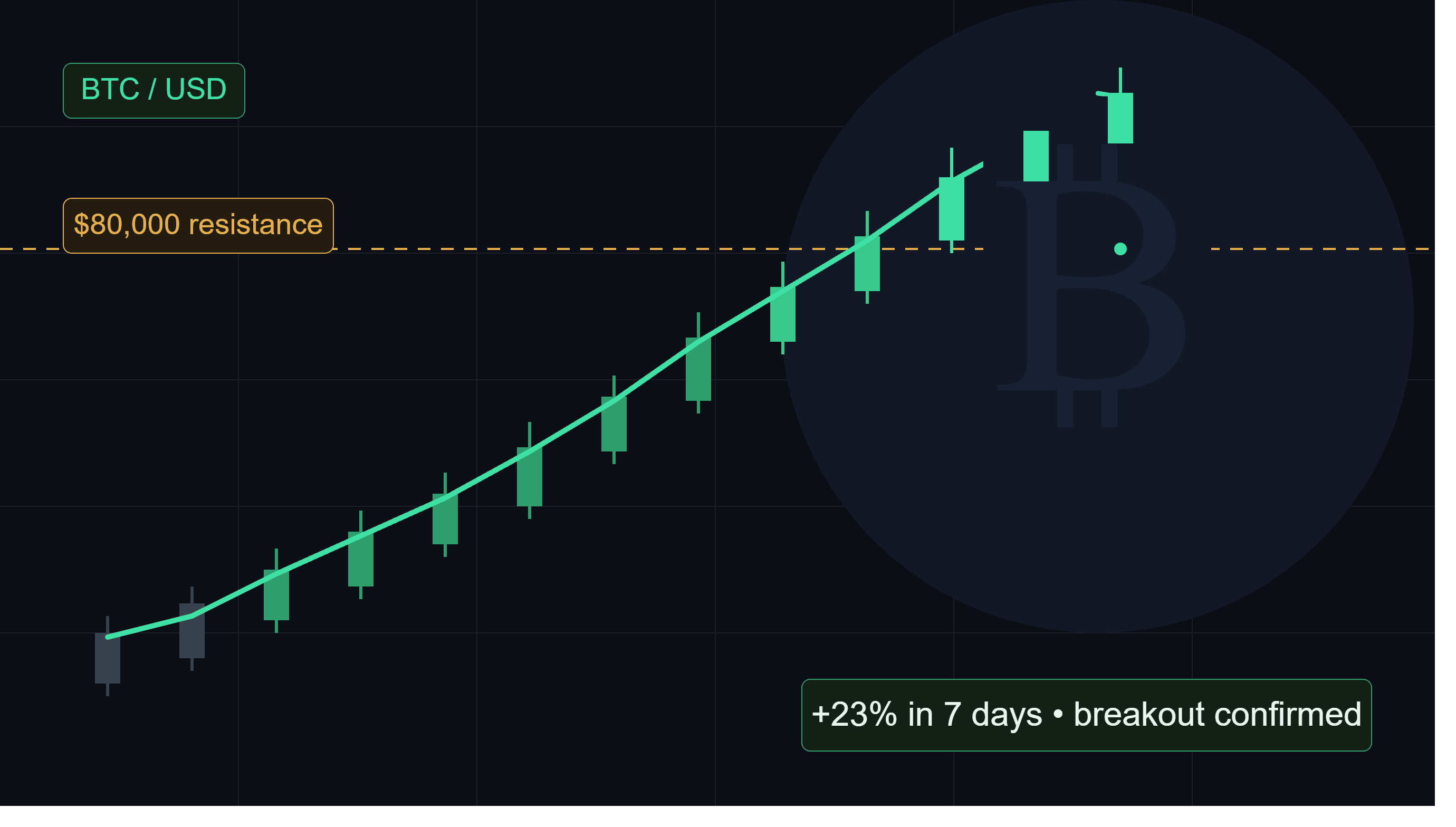
As of August 25, that first part of the forecast has played out. Bitcoin touched as high as $80,908 to $81,257 during Asia trading hours, its first time above $80,000 since mid-May, before settling back to trade around $79,933. The move capped a rally of roughly 23% over the seven days through Sunday, August 23, the cryptocurrency's biggest weekly gain in about three years.
With the first target now confirmed, the question has shifted: is this rally durable enough to hold above $80,000, or even push toward the next resistance zone, or is it the kind of sharp squeeze that tends to fade?
What Actually Drove Bitcoin Above $80,000?
The breakout wasn't a single-day event. It was the continuation of a rally that began the prior week when Bitcoin surged more than 20% in three days, its biggest three-day gain since 2023. Several factors combined to push BTC through the level our earlier analysis flagged as the key resistance zone:
- A U.S. Treasury catalyst: The Treasury's announcement that it would double its purchases of longer-dated government bonds pushed yields lower and improved risk appetite across markets, extending directly into crypto.
- A large short squeeze: More than $4 billion in bearish crypto positions were liquidated as prices climbed, forcing short sellers to buy back BTC and accelerating the move higher. On August 25 alone, over $400 million in total crypto liquidations hit the market, including $160 million in Bitcoin shorts.
- Renewed ETF demand: U.S. spot Bitcoin ETFs pulled in $1.92 billion in net inflows last week, the largest weekly haul since October, when Bitcoin reached its previous cycle peak near $126,000.
Current Bitcoin Price and Key Levels to Watch
| Metric | Current Reading |
|---|---|
| Price (Aug 25) | ~$79,933, intraday high $80,908–$81,257 |
| 7-day change | +23% (biggest weekly gain in ~3 years) |
| Next resistance | $88,000–$90,000 |
| Nearest support | $75,000–$76,000 |
| 24h liquidations | $400M+ total, $160M in shorts |
| Distance from October peak | Still well below ~$126,000 |
Bitcoin remains meaningfully below its October 2026 all-time high of roughly $126,000, and spent much of this year trading 40–50% under that record while capital rotated into the AI-driven stock rally instead. This latest move has pulled Bitcoin's year-to-date losses below 10% for the first time since mid-May, but it has not erased the deeper pullback that defined most of 2026.
-- Price
Why This Rally Looks Different From a One-Off Squeeze
One detail separates this move from a purely leverage-driven spike: traders were actually taking leverage off as the price climbed. Coin-denominated open interest fell from about 353,500 BTC to 312,600 BTC between August 12 and August 23, an 11% drop and the lowest level in at least a month, even as Bitcoin's dollar price rose sharply.
That combination — rising price, falling leveraged positioning — typically signals spot-driven buying rather than a fragile, leverage-fueled bounce. The options market backs this up: 25-delta call volatility has been outpacing puts at every maturity since the breakout, and skew has turned negative on the front end for the first time this year, meaning traders are paying more for upside exposure than downside protection. Fundstrat noted in a Monday client note that the buying following last week's short squeeze suggests the rally "may be more durable than a tactical bounce."
Answering What Readers Asked After Last Week's Forecast
A number of readers pushed back on last week's piece, and it's worth addressing the most common questions directly now that $80,000 has actually been touched.
"Wasn't $80,000 just a round-number magnet that would reject again?" It nearly did — the article noted that Bitcoin had failed to break $80,000 the week prior, with that stall tied to profit-taking. What changed this time was the scale of ETF inflows and the Treasury-driven yield move, which gave the breakout attempt more fuel than the previous failed test.
"Isn't this just another short squeeze that fades in a few days?" Partially, yes — a meaningful share of the move was mechanically driven by liquidations. But the falling open interest and shifting options skew described above suggest fresh spot demand is reinforcing the move rather than leverage alone carrying it.
"Does this mean Bitcoin is back to its October highs?" No. Even after this rally, BTC remains well below its ~$126,000 October peak, and prediction markets and analysts remain split on whether this move extends toward new highs or stalls out at the next resistance band.
What's Next: Can Bitcoin Reach $85,000 or $90,000?
With $80,000 now confirmed as touched rather than merely targeted, the market's attention has shifted to the next resistance band at $88,000–$90,000. Getting there would likely require continued ETF inflows at last week's pace, a market environment where the incoming Fed chair's first Jackson Hole keynote this week doesn't reintroduce hawkish surprise, and $75,000–$76,000 holding as support on any pullback.
| Scenario | Potential Range | Key Condition |
|---|---|---|
| Bullish continuation | $85,000–$90,000 | ETF inflows persist, Jackson Hole tone stays neutral-to-dovish |
| Consolidation | $75,000–$82,000 | Bitcoin digests the 23% weekly gain before its next move |
| Pullback | Below $75,000 | Renewed short-covering fades and profit-taking dominates |
Futures markets are currently pricing roughly a 36% probability of a September rate hike, a detail worth watching closely given how directly this rally has tracked Treasury yield moves. Markets will be watching new Fed Chair Kevin Warsh's first Jackson Hole address this Friday for signals on that path.
Frequently Asked Questions
1.Did Bitcoin actually reach $80,000?
Yes. On August 25, Bitcoin touched an intraday high between $80,908 and $81,257 before settling back near $79,933, confirming the breakout that last week's forecast flagged as increasingly likely.
2.What caused Bitcoin's rally above $80,000?
A combination of a U.S. Treasury announcement to increase long-bond purchases, a short squeeze that liquidated more than $4 billion in bearish positions, and $1.92 billion in weekly spot Bitcoin ETF inflows, the largest since October.
3.Is Bitcoin's rally likely to continue toward $90,000?
It's possible but not confirmed. Falling leverage and a bullish shift in options positioning support the case for continuation, but the next resistance band at $88,000–$90,000 has not yet been tested, and this week's Jackson Hole commentary from the Fed could swing sentiment either way.
4.How far is Bitcoin from its all-time high?
Bitcoin remains well below its October 2026 peak of roughly $126,000, even after this rally, meaning the current move is a recovery within a longer drawdown rather than a new record
This content is provided for general informational purposes only and doesn't constitute financial, investment, legal, or tax advice. Any events, rewards, online promotions, or related information mentioned herein should not be considered a recommendation, solicitation, or invitation to purchase, sell, trade, or otherwise deal in any crypto assets. Crypto assets are highly volatile and may result in loss. The availability of WEEX services, products, and related events may vary by region. You are responsible for ensuring that your participation is in accordance with applicable local laws and regulations.
You may also like

Banks Improved Their Profitability, But Concerns Over Delinquency Persist: Key Insights from Recent Financial Statements

CME Targets ETFs: The First FCA-Regulated Multi-Asset Crypto Indices Are Born

Crypto Funds: $3.2 Billion in One Week, Bank of America Hasn't Seen This Since October 2025

What Is Worth Preserving: Rupture On Remains, Decay, And The Collector's Dilemma

Fundamental Analysis of Cryptocurrencies: How to Evaluate Digital Assets Before Buying

AI Forces Diversification of Bitcoin Custody

Natura Changes CEO: Carlucci Returns After a Decade

Warren Buffett Turns 96: The Investments That Made Him a Wall Street Legend

After MiniMax's Stock Price Rebounds 92%: What Remains When a Model Company Removes the Model
Meta Faces Dilemma After AI Layoffs: Cybersecurity Incidents Up 40%, Cleanup Time Up 70%

Bull Secures €387.8 Million Contract for LUMI-AI Supercomputer

Chinese AI Through the Eyes of Silicon Valley VCs: Sanctions Didn't Lock It Down, but Instead Brought Out a 'Monster'

Consolidation in Ranges and Rate Reevaluation: Trader Assesses Bitcoin and Ethereum Movement Scenarios
Digital Ruble Fails to Generate Significant Interest Among Russians, Says Sberbank

AI Scam Hits $3.2 Million Per Incident, Crypto Security Battlefield Shifts from 'Code' to 'Scams'

Matt Damon to Keynote at Ripple Swell 2026 in New York

How Paintings Could Have Become Part of the Digital Economy, but Didn't
Shein's IPO and China's PMI: What Changes for Markets

From Pay to One-Stop Asset Management, BiyaPay Expands Global Diverse Financial Services Boundaries

Trump's Cryptocurrency Scheme Rakes in $1.4 Billion While Investors Lose $4.7 Billion
AI Creates Abundance, BTC Creates Scarcity: What Web3 Truly Changes Is Not Production Relations, But Value Relations

Cryptocurrency Arbitrage and Price Scanning: How Quants Identify Inefficiencies in Funding Rates and Spreads Using Trading APIs

DRAM Shortage Until 2030: How to Position Yourself on Memory Giants?
Why Stablecoins Can't Serve as Credit Despite Being Transferable and Store of Value?

Bernstein Comments on Seven Memory Types: After HBM, DRAM and NAND Compete for the Next Trillion-Dollar Market
After Impacting Two Generations, Meta Ordered to Pay $18 Billion

What is Thinking Cat (HMM)? Reasons Why Ownerless Tokens Can Still Fail

Derivatives Begin to Drive Spot Markets: South Korea's Asset Pricing Power is Flowing Out
ECB Official Calls on Central Banks to Embrace Blockchain

The 25th Word: A Secret Vault in Your Ledger Signer
Banks Improved Their Profitability, But Concerns Over Delinquency Persist: Key Insights from Recent Financial Statements
CME Targets ETFs: The First FCA-Regulated Multi-Asset Crypto Indices Are Born
Crypto Funds: $3.2 Billion in One Week, Bank of America Hasn't Seen This Since October 2025
What Is Worth Preserving: Rupture On Remains, Decay, And The Collector's Dilemma
Fundamental Analysis of Cryptocurrencies: How to Evaluate Digital Assets Before Buying
AI Forces Diversification of Bitcoin Custody

Contents
Latest articles




Latest coin listings on WEEX


