
CFTC Says US-Regulated Exchanges Can Begin Trading Individual-Stock Perpetual Futures

 Prefer us on Google


TL;DR: CFTC chairman Michael Selig said on November 3 that individual-equity perpetual futures can begin trading on appropriately registered US exchanges. The contracts fall within a joint CFTC-SEC regulatory framework, highlighting the effort to bring perpetual-style trading into supervised domestic markets.
Perpetual futures have long been central to crypto derivatives trading, particularly on venues outside the United States. US regulators are now extending the structure into individual equities through a tightly defined securities-futures framework.
In a November 3 statement, Commodity Futures Trading Commission chairman Michael Selig said individual-equity perpetual futures can begin trading on CFTC-registered exchanges that also meet the relevant SEC registration requirements. The announcement follows earlier approval of a Bitcoin perpetual futures product on a regulated US venue.
What makes an equity perpetual different
A traditional futures contract expires or settles on a specified date. A perpetual contract is designed to maintain exposure without a conventional expiration, using contract-specific mechanisms to keep its price related to the underlying asset. That feature has made perpetual products popular in crypto, where traders often want continuous leveraged exposure.
Moving the structure to individual shares introduces other questions. Stocks have corporate actions, shareholder rights, trading halts and different market hours. The product traded is a derivative, not the underlying share itself, so customers need to understand what they own and how price adjustments are handled.
The CFTC says the products have been deemed approved under an existing Commission regulation as security-futures products and are subject to both commodities and federal securities-law requirements. That dual oversight is a material difference from the unregulated or lightly regulated offshore venues often associated with perpetual contracts.
Why the agencies are coordinating
US securities and derivatives regulators have historically had overlapping interests where instruments sit between their traditional categories. Selig framed the step as part of a coordinated approach with the SEC, pointing to an interagency memorandum of understanding signed earlier in 2026.
The policy argument is that traders may obtain a clearer set of safeguards when activity takes place on regulated domestic exchanges. That does not mean regulation makes leveraged positions safe. Margin calls, volatile prices, thin liquidity and market disruptions can still produce large losses, particularly when a derivative offers continuous exposure.
There is also a competition question. Crypto-native traders have become accustomed to perpetual markets with continuous access and different settlement mechanics. US venues will have to demonstrate that their products are useful without losing clarity on customer protections. This echoes the challenges discussed in NewsBTC's coverage of proposed tokenized securities infrastructure.
What traders need to inspect
The decisive details will be contract specifications, margin arrangements, eligible customers, clearing, reference prices and how corporate events affect payouts. The phrase 'can begin trading' establishes a regulatory opening; it should not be read as confirmation that every broker already offers every contemplated contract.
The development is significant for the convergence of crypto market structures and traditional finance. Rather than securities markets adopting blockchain itself, they are adopting a derivative format popularised by digital-asset trading. The test now is whether that format works responsibly under domestic exchange rules.
This article was written by the News Desk and edited by Samuel Rae.
-- Price
This content is provided for general informational purposes only and doesn't constitute financial, investment, legal, or tax advice. Any events, rewards, online promotions, or related information mentioned herein should not be considered a recommendation, solicitation, or invitation to purchase, sell, trade, or otherwise deal in any crypto assets. Crypto assets are highly volatile and may result in loss. The availability of WEEX services, products, and related events may vary by region. You are responsible for ensuring that your participation is in accordance with applicable local laws and regulations.
You may also like

Bitcoin’s projected difficulty cut would still leave older S19 rigs short at 5-cent power

Miami-Dade To Accept Bitcoin For Property Taxes

Square Completes Bitcoin Payment Expansion for U.S. Merchants, Supports Lightning Network Payments

Federal Reserve Warns Bitcoin Faces Interest Rate Hike

唐华斑竹: $292 Million Liquidated Across the Market, $222 Million in Long Positions

Aave Labs Believes cirBTC Meets Conditions for Launch on Ethereum Market

Strategy spent more than twice as much on preferred buybacks as Bitcoin last week

Onramp Launches Business Bitcoin Accounts With Two-Person Withdrawal Approvals As Wrench Attacks Climb
Algorithmic Trading and Cryptocurrencies: How Do Robots React to Volatility?
Mark Moss: Bitcoin is at the Best Buying Opportunity, Expected to Reach Historic Highs in 2027

Any Bitcoin recovery faces a cash problem as Binance’s stablecoins fall to $32 billion
MARA Bitcoin Mining Costs Reach $62,862 Per Coin, With Electricity Costs at $39,674

IPS has 500 million USD trapped in Ueno Bank

Large Bitcoin Mining Farm Dismantled in Culiacán with 130 Equipment
Bitdeer Reports 89% Revenue Growth in Q3 to $320.7 Million

Core inflation excludes oil. Bitcoin investors still cannot ignore it

What Happened Today in the Crypto Market? A Review of the Most Important Cryptocurrency News (November 9, 2023)

HIVE Reports $78.7 Million Net Loss in Q2, GPU Cloud Business Signs $185 Million ARR

Bloomberg: With Democrats Regaining Control of Congress, Are Good Days Over for the Crypto Industry in Washington?

Hyperscale Data Sells Off Bitcoin Reserves, Accumulating Approximately $74.4 Million for Debt Repayment and AI Data Center Construction

Canaan Technology Reports $14.5 Million Revenue in Q3, Initiates $20 Million Stock Buyback Plan

大冰要抄底(专注交易) Predicts Bitcoin and Ethereum Market Trends
Trump Media adds 1,510 Bitcoin in Q3 as treasury reaches $1.17B

47% Top Tax Rate Approaches: Seven Tax Reduction Strategies for Australian Crypto Investors
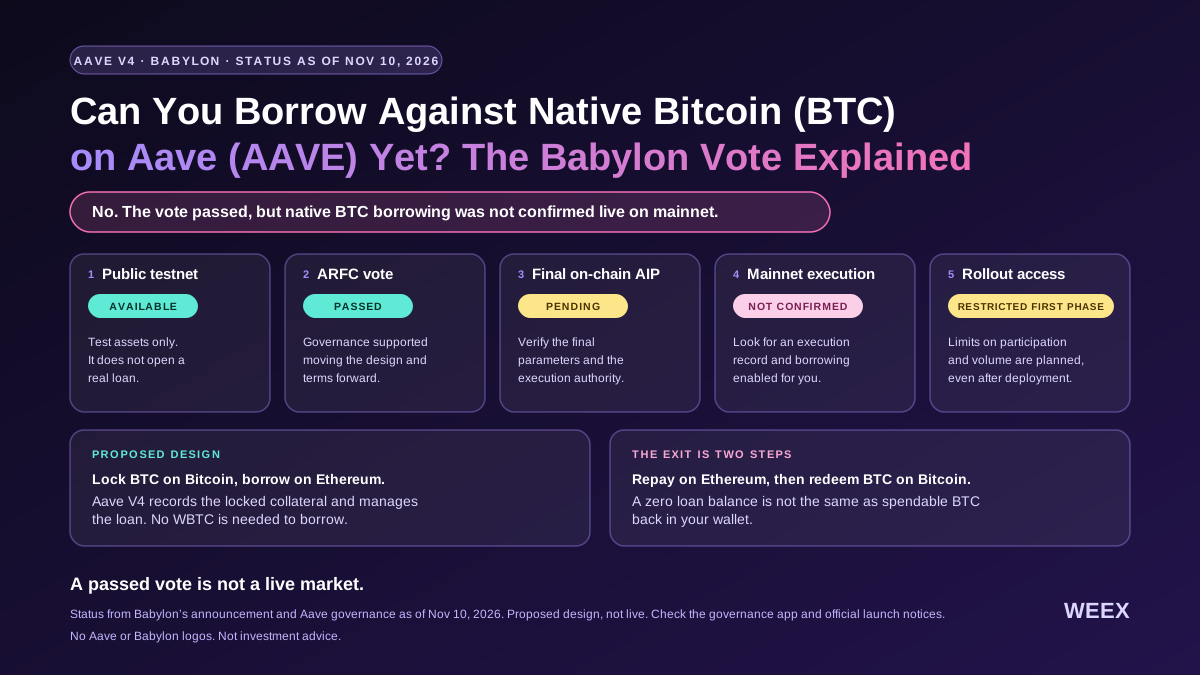
Can You Borrow Against Native Bitcoin (BTC) on Aave (AAVE) Yet? The Babylon Vote Explained
Can you borrow against native Bitcoin on Aave yet? See what the Babylon vote approved, what still needs to launch, and how BTC liquidation would work.

Kim & Chang Lawyer: "Excessive Responsibility Should Not Be Imposed on Stablecoin Issuers"
Mr&强 Analyzes Bitcoin and Ethereum Fluctuation Patterns

WEEX Exclusive:Middle East Easing Expectations Boost Stocks | WEEX Daily Brief (November 10, 2026)
On November 9 close, the S&P 500 and Dow both rose more than 2%. Middle East easing expectations pushed oil prices lower. Bitcoin and Ethereum spot ETFs saw net outflows last week. AVAX rose on reports of tokenized-stock clearing. PIEVERSE surged short-term. November 10 focus is October CPI, TSMC monthly sales data, CoreWeave earnings and others.

When is the launch date of Bitcoin Hyper? Testnet, tokens, and mainnet are separate milestones
Middle East Easing Expectations Boost Stocks | WEEX Daily Brief (November 10, 2026)
On November 9 close, the S&P 500 and Dow both rose more than 2%. Middle East easing expectations pushed oil prices lower. Bitcoin and Ethereum spot ETFs saw net outflows last week. AVAX rose on reports of tokenized-stock clearing. PIEVERSE surged short-term. November 10 focus is October CPI, TSMC monthly sales data, CoreWeave earnings and others.
Bitcoin’s projected difficulty cut would still leave older S19 rigs short at 5-cent power
Miami-Dade To Accept Bitcoin For Property Taxes
Square Completes Bitcoin Payment Expansion for U.S. Merchants, Supports Lightning Network Payments
Federal Reserve Warns Bitcoin Faces Interest Rate Hike
唐华斑竹: $292 Million Liquidated Across the Market, $222 Million in Long Positions
Aave Labs Believes cirBTC Meets Conditions for Launch on Ethereum Market
Latest articles





Latest coin listings on WEEX


