
CLARITY Act Fails Its September 15 Senate Vote: What Happens Now

 Prefer us on Google


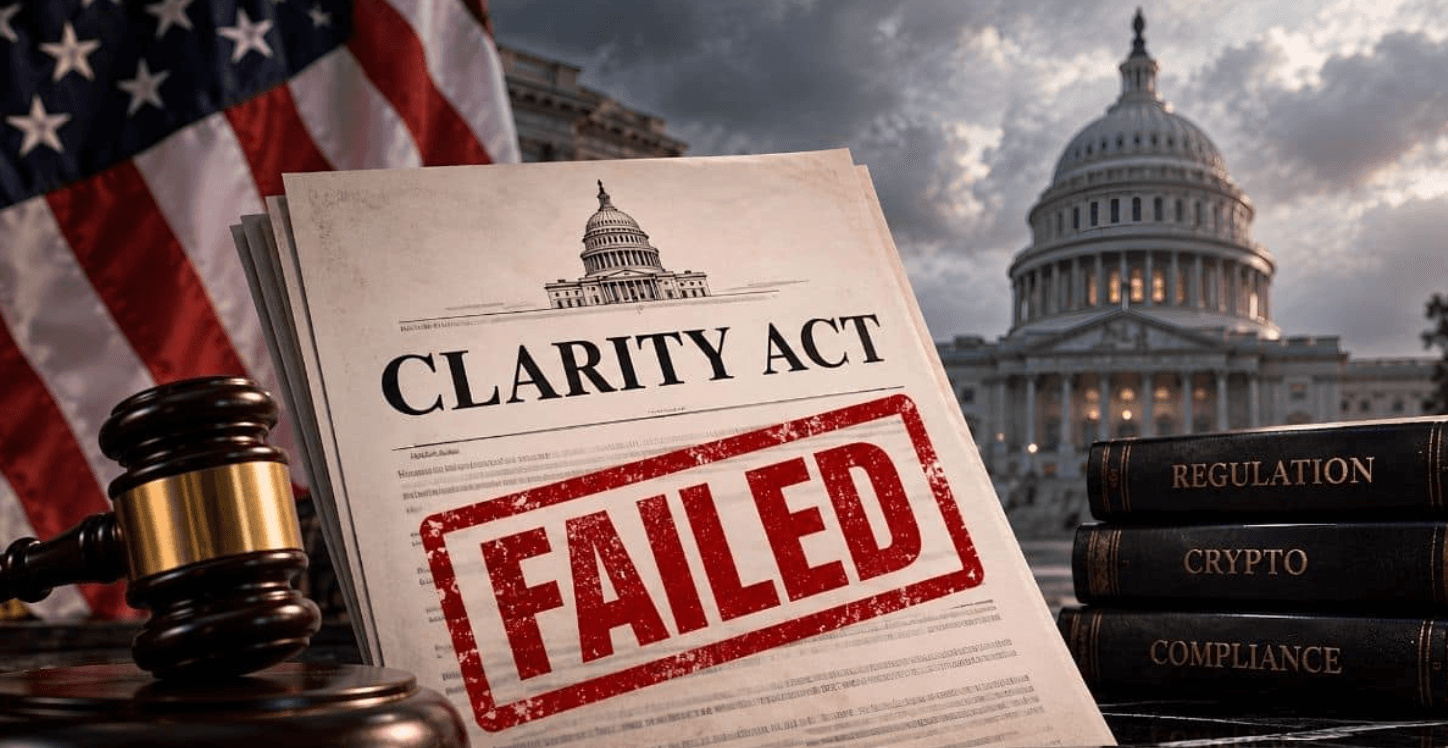
CLARITY Act fails to secure the 60 votes it needed on September 15, falling short with an unofficial tally of 46 yes to 43 no. CLARITY Act fails not because Republicans lacked unity, but because the seven-plus Democratic votes the bill needed simply never materialized, even after months of negotiation and a text rewritten specifically to address Democratic concerns. CLARITY Act fails at exactly the moment prediction markets had been signaling for weeks, with Polymarket pricing the bill's odds of becoming law in 2026 at just 16% as of September 6, and Galaxy Research pegging it even lower at 10%.
What actually happened on the floor, why the vote came up short despite genuine last-minute concessions, and what this means for crypto regulation heading into 2027, is worth walking through in detail rather than treating today's result as the end of the story.
What the Actual Vote Looked Like
The cloture motion on H.R. 3633 needed 60 votes from the Senate's 100 members to succeed. The unofficial tally came in at 46 yes to 43 no, according to CoinGape's live coverage of the floor proceedings, a result that falls into what crypto.news had characterized in advance as a "wide miss" scenario, below 55 votes, signaling deep structural opposition rather than a narrow, fixable shortfall. That distinction matters for reading today's outcome correctly: a vote landing in the 57-to-59 range would have suggested a bill close enough to succeed with minor amendments in 2027. A result in the mid-40s suggests something closer to a genuine breakdown in the coalition that had been holding together through committee votes earlier this year.
Key Democrats who had been actively negotiating on the bill's language in the weeks leading up to the vote ultimately voted no on the cloture motion itself, according to reporting from journalist Eleanor Terrett cited in CoinGape's coverage. That detail is significant because it means the vote's failure wasn't simply a matter of Republicans failing to find seven willing Democrats somewhere in the caucus. It reflects senators who had been at the table, working through specific language changes, ultimately concluding the final product still wasn't something they could support.
Why the Last Minute Concessions Weren't Enough
The bill's Republican sponsors didn't walk into today's vote without trying to close the gap. Senators Cynthia Lummis, John Boozman, and Tim Scott released a substitute text late in the weekend before the vote, incorporating 126 separate changes requested by Democrats, explicitly framed as their "last, best and final" offer, according to CryptoTimes' reporting. That's not a token gesture. Incorporating that many specific requested changes represents a substantial rewrite aimed directly at the concerns that had been blocking Democratic support.
It wasn't enough. Three specific disputes remained unresolved heading into the vote and appear to have ultimately sunk it: ethics rules targeting President Trump's roughly $1.4 billion in crypto-related income during 2025, DeFi developer liability provisions under Section 604, and a stablecoin yield provision that reportedly threatened as much as $1.35 billion in annual Coinbase USDC rewards revenue, according to crypto.news's reporting. Senator Elizabeth Warren used her floor remarks ahead of the vote to sharpen the ethics dispute specifically, telling colleagues that Trump "opened his own crypto business" shortly before his second inauguration and that his family "raked in $1.4 billion" from crypto ventures in 2025, a pointed framing of exactly the conflict-of-interest concern Democrats had been pushing to address more directly than the bill's current text did.
Why Lummis Says This Is Effectively Over for 2026
Senator Cynthia Lummis didn't hedge about what a failed vote would mean. Speaking to reporters ahead of the outcome, she said plainly: "I think we're done. It's over. Because we've been working on this bill for over a year, and we've given them over 120 of their requests. That's enough," according to reporting from Brendan Pedersen cited in CoinGape's live coverage. That's a specific, on the record acknowledgment from one of the bill's lead Republican sponsors that today's failure effectively closes the door on passage within the current legislative calendar, not a temporary setback that gets revisited next month.
The math behind that assessment is straightforward. With roughly 14 working days remaining before the Senate's October recess ahead of the midterm elections, and the House having already canceled its own voting days for the weeks of September 21 and September 28, there simply isn't enough remaining legislative runway in 2026 to restart negotiations, secure a different outcome, and still complete floor debate, a final passage vote, and reconciliation with the House's 2025 version before the year ends.
-- Price
Why This Doesn't Mean Regulation Stops
A failed cloture vote doesn't return crypto to a regulatory vacuum, and it's worth being precise about what actually continues regardless of today's outcome. SEC Chair Paul Atkins had told reporters on September 2 that he expected and hoped the legislation would pass, while separately confirming that the SEC and CFTC intend to keep advancing crypto market structure rules using their existing administrative authority regardless of what Congress does. That fallback path remains fully available today: agency-level rulemaking continues, just without the durable, federally preempted framework that a signed law would have provided, and without the kind of permanence that shields rules from being unwound by a future administration.
Existing enforcement tools also remain fully active. Nothing about today's failed vote changes the SEC and CFTC's current authority to pursue unregistered offerings, non-compliant custody arrangements, or stablecoin products operating outside existing guidance. The absence of comprehensive legislation means the regulatory picture continues to develop through agency rules and enforcement actions rather than through statute, a meaningfully different path than the one CLARITY Act's supporters had been pursuing, but not the complete absence of a path.
What This Likely Means for the Timeline Going Forward
Crypto.news's earlier reporting had specifically noted that failing cloture "kills the Clarity Act for 2026 and, given midterm politics, likely until 2027," a timeline that aligns closely with Lummis's own public assessment today. The current, 119th Congress runs through January 2027, meaning any attempt to revive comprehensive market structure legislation would most likely require a new Congress to reintroduce similar legislation from scratch, a process that historically takes six to twelve months of preparatory work before a vote becomes possible again, before even factoring in how the 2028 presidential election cycle could further complicate the calendar.
That said, today's specific vote count, 46 to 43, leaves the coalition in a genuinely different position than a true collapse would have. The bill still cleared the House 294 to 134 in July 2025 with 78 Democrats voting yes, and it advanced through the Senate Banking Committee 15 to 9 with bipartisan support in May 2026, meaning the underlying bipartisan interest in market structure legislation hasn't disappeared even though today's specific vote fell well short of the threshold needed to advance it further this year.
Conclusion
CLARITY Act fails its September 15 cloture vote by a wide margin, 46 to 43 against a 60 vote threshold, despite a last minute substitute text incorporating 126 Democratic-requested changes and months of active negotiation with senators who ultimately voted no anyway. The three disputes that sank the bill, ethics provisions tied to Trump's crypto income, DeFi developer liability, and stablecoin yield rules threatening Coinbase's USDC revenue, remain exactly where they were before today's vote, now without a clear legislative vehicle to resolve them in 2026. Regulatory rulemaking through the SEC and CFTC continues regardless, but the durable, statute level clarity the industry had been pushing for now appears unlikely to arrive before the next Congress convenes in 2027.
FAQ
1. Did the CLARITY Act pass the Senate on September 15?
No. The cloture motion failed with an unofficial tally of 46 yes to 43 no, well short of the 60 votes needed to advance the bill to formal floor debate.
2. Why did the vote fail despite last minute changes to the bill?
Republican sponsors incorporated 126 Democratic-requested changes into a substitute text released just before the vote, but three unresolved disputes, ethics rules tied to Trump's crypto income, DeFi developer liability, and stablecoin yield provisions, remained sticking points that ultimately kept enough Democrats from voting yes.
3. Does this mean the CLARITY Act is completely dead?
For 2026, effectively yes, according to lead sponsor Senator Cynthia Lummis, who said "it's over" following the vote. Reviving comparable legislation would likely require a new Congress, since the current one runs through January 2027.
4. What happens to crypto regulation now that the bill failed?
The SEC and CFTC have confirmed they will continue advancing crypto market structure rules using existing administrative authority, meaning regulatory development continues through agency rulemaking rather than through a comprehensive federal statute.
5. What were the three main disputes that blocked the bill's passage?
Ethics provisions related to President Trump's roughly $1.4 billion in 2025 crypto income, DeFi developer liability under Section 604, and a stablecoin yield rule that reportedly threatened as much as $1.35 billion in annual Coinbase USDC rewards revenue.
This content is provided for general informational purposes only and doesn't constitute financial, investment, legal, or tax advice. Any events, rewards, online promotions, or related information mentioned herein should not be considered a recommendation, solicitation, or invitation to purchase, sell, trade, or otherwise deal in any crypto assets. Crypto assets are highly volatile and may result in loss. The availability of WEEX services, products, and related events may vary by region. You are responsible for ensuring that your participation is in accordance with applicable local laws and regulations.
You may also like

Ampleforth Proposal 54 Canceled, 98% of USDC Balance Requested
S&P 500 Faces an 8%-10% Pullback Risk: Should SPY Investors Be Worried?

Direct Access to US Stock Market Liquidity: Bitget Wallet Integrates Reality to Create "On-Chain Wall Street"

Vote on CLARITY Act and Strategic Bitcoin Reserve Discussion in the US

Grayscale: In the Age of AI, Financial Privacy is Becoming a Core Issue for Crypto

Goldman Sachs Predicts RMB Will Appreciate to 5.5 in Five Years: What Should You Do?

Trump Agreed to Crypto Income Limits — Will It Be Enough to Save the CLARITY Act Today?
Trump agreed to crypto ethics limits in the CLARITY Act, but his existing $1.4B in crypto income is grandfathered in. Here's the full breakdown.

CLARITY Act Odds Crash to 16%, Then Rebound to 31%: Inside the Ethics Fight That Won't Stay Settled
CLARITY Act odds crashed to 16%, then rebounded on Trump's ethics compromise — only for new opposition to emerge. Here's the full odds timeline explained.

5% Rate, Brent at $110: The Fed Stuck Before Wednesday
TRX ETF Launches, TRON's Ambitions Go Beyond "US Stock Compliance"

South Korea Faces Fourth Wave of Calls to Delay Crypto Tax

Countdown to Arc Mainnet: Key Launchpads and Platform Tokens to Watch

A new XRPL upgrade could concentrate XRP ownership inside banks instead of retail wallets
$680 Million Warning: Most DeFi Attacks Fall Outside Audit Scope

TRON’s quantum plan could leave some wallets able to pay but unable to replace their keys

$55 million Aave stablecoin pool sees just $4.4 million available for withdrawals
Challenging 5 Days for Crypto and Markets: Three Major Decisions Ahead!

Why Did Kraken Buy Reap Instead of a U Card?

Bitcoin is set for a MASSIVE fundamental week! Analysis by Vincent Ganne

Ampleforth Faces Proposal Attack, Demanding Transfer of 2.5 Million USDC
CPI Surpasses Expectations, Raising Rate Hike Bets; U.S. Bonds Face Dual Challenges at 5% Threshold and Fiscal Concerns
Debunking the Ethereum 'Abandoning' ETH Argument: What Does It Mean to Pay Gas Without ETH?

Why AI faces an immediately difficult choice: Nationalize or decentralize – AI’s 2026 slowdown dilemma
Cryptocurrency Transparency Bill Hangs Between Deal and Failure in the U.S. Senate

Ampleforth Suspected Malicious Governance Proposal Involves 2.5 Million USDC
Can Bitcoin Really Reach $400,000 by 2030?
XRP Ledger activates fixCleanup3_3_0 amendment for lending protocol
BRICS: Russia Settles 90% of Its Transactions in Local Currencies

BitMine’s staked ETH equals nearly 12% of Ethereum’s active stake, but who controls it?
Linera Community Fundraising Falls Short, Why Is the 'a16z Concept' Struggling to Sell?
Ampleforth Proposal 54 Canceled, 98% of USDC Balance Requested
S&P 500 Faces an 8%-10% Pullback Risk: Should SPY Investors Be Worried?
Direct Access to US Stock Market Liquidity: Bitget Wallet Integrates Reality to Create "On-Chain Wall Street"
Vote on CLARITY Act and Strategic Bitcoin Reserve Discussion in the US
Grayscale: In the Age of AI, Financial Privacy is Becoming a Core Issue for Crypto
Goldman Sachs Predicts RMB Will Appreciate to 5.5 in Five Years: What Should You Do?
Contents
Latest articles


Latest coin listings on WEEX


