
Crypto-Backed Loan Liquidation: Should You Repay or Add Collateral?

 Prefer us on Google


Crypto-Backed Loan Liquidation: Repay or Add Collateral?
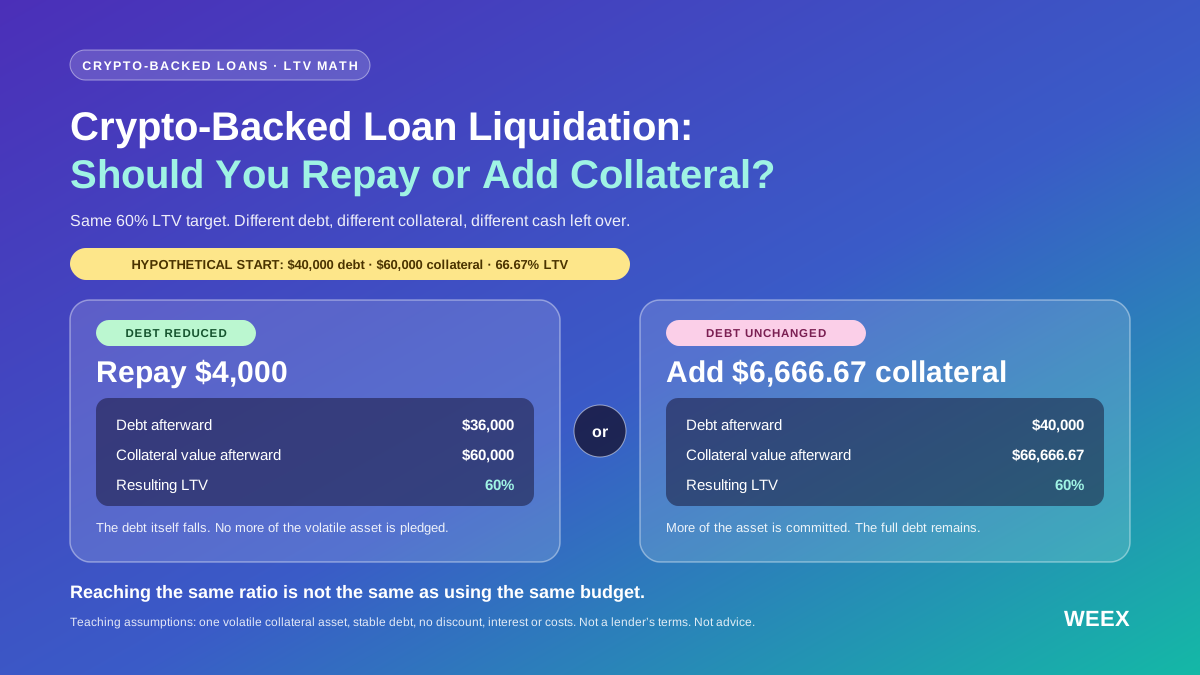
Repaying part of a crypto-backed loan usually lowers loan-to-value, or LTV, more efficiently per dollar than adding the same value of collateral. Adding collateral can still make sense when eligible assets are already available and preserving borrowed funds matters. However, the decision depends on where the repayment money comes from, the lender’s valuation rules, interest terms and whether the transaction can complete before liquidation becomes possible.
Our view is that borrowers should compare the debt, collateral and accessible reserves remaining after each action, rather than simply choosing whichever button improves the displayed health score. A collateral top-up can create breathing room while leaving the full debt intact. Repeatedly committing more assets to preserve an oversized loan can turn a manageable borrowing decision into a much larger exposure.
What Triggers Crypto-Backed Loan Liquidation?
Crypto-backed loan liquidation becomes possible when a borrowing position breaches the applicable risk threshold. The lender or protocol can then use collateral to recover debt under its rules.
The basic calculation is:
LTV = Outstanding Debt / Recognized Collateral Value
For example:
$40,000 / $60,000 = 66.67% LTV
Outstanding debt can include accrued interest. Recognized collateral value means the value accepted by the loan’s risk calculation—not necessarily the number displayed on an unrelated exchange.
Coinbase’s loan-health guidance includes unpaid interest in outstanding debt and states that liquidation thresholds vary by collateral market. Borrowers should use the threshold shown for their actual loan.
A warning threshold is also different from a liquidation threshold. Receiving a notification does not establish a guaranteed period in which to respond.
For protocol-based borrowing, crossing a threshold can make a position eligible for action by third-party liquidators. Morpho documents both partial and full liquidation, depending on the position and transaction.
The practical objective is to restore a meaningful buffer before reaching that boundary.
Start With One Loan and One Clear Target
Consider a hypothetical loan with the following current balances.
| Measurement | Assumed Value |
|---|---|
| Outstanding debt | $40,000 |
| Recognized collateral value | $60,000 |
| Current LTV | 66.67% |
| Illustrative liquidation threshold | 80% |
| Borrower’s chosen target LTV | 60% |
These are teaching assumptions, not a lender’s quoted terms or a recommended LTV.
For the calculations below, assume one volatile collateral asset, stable dollar-denominated debt, no collateral discount and no transaction costs. Interest is initially held constant so the two actions can be compared cleanly.
Without intervention, collateral worth $60,000 would reach the illustrative 80% boundary after falling to $50,000:
Collateral Value at Liquidation = Outstanding Debt / Liquidation LTV
$40,000 / 80% = $50,000
That represents a 16.67% decline from its current value:
Price Decline to Boundary = 1 - (Collateral Value at Liquidation / Current Collateral Value)
1 - ($50,000 / $60,000) = 16.67%
The borrower now has two ways to reach 60% LTV: reduce the debt by making a repayment, or increase the collateral supporting it.
Throughout the examples, percentages can be entered into a calculator as decimals: 60% equals 0.60, and 80% equals 0.80.
How Much Must You Repay to Reach the Target LTV?
When repayment comes from funds outside the pledged collateral, the required amount is:
Required Repayment = Current Debt - (Target LTV × Current Collateral Value)
For the example:
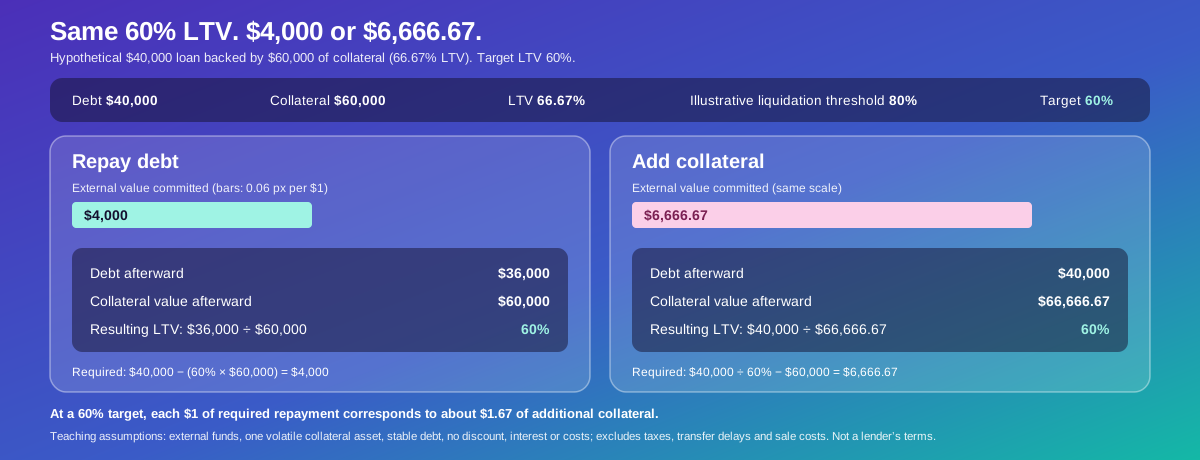
$40,000 - (60% × $60,000) = $4,000
After a $4,000 repayment, debt falls to $36,000 and collateral remains worth $60,000.
LTV After Repayment = $36,000 / $60,000 = 60%
This action reduces the liability itself. It does not require pledging additional units of the volatile asset.
However, the repayment must actually settle and be credited. Buying the repayment asset, sending a transfer or submitting a transaction does not necessarily mean the loan balance has already changed.
-- Price
How Much Collateral Must You Add Instead?
For a top-up using the same collateral asset and valuation treatment:
Required Additional Collateral Value = (Current Debt / Target LTV) - Current Collateral Value
The example requires:
($40,000 / 60%) - $60,000 = $6,666.67
Debt remains $40,000, while recognized collateral rises to approximately $66,666.67.
| Result | Repay Debt | Add Collateral |
|---|---|---|
| External value committed | $4,000 | $6,666.67 |
| Debt afterward | $36,000 | $40,000 |
| Collateral value afterward | $60,000 | $66,666.67 |
| Resulting LTV | 60% | 60% |
Reaching the same target requires more value through the collateral route.
In this simplified model:
Required Collateral Top-Up = Required External Repayment / Target LTV
$4,000 / 60% = $6,666.67
At a 60% target, each dollar of required repayment corresponds to approximately $1.67 of additional collateral.
This is a comparison of balance-sheet effects. It does not yet account for asset-sale costs, taxes, transfer delays or whether the borrower already owns eligible collateral.
Does the Same Target LTV Provide the Same Price Buffer?
Under the stated assumptions, yes. If debt stays constant and all collateral moves by the same percentage, both positions starting at 60% LTV reach an 80% boundary after a 25% collateral decline.
The relationship is:
Price Decline to Boundary = 1 - (Current LTV / Liquidation LTV)
Therefore:
1 - (60% / 80%) = 25%
The following stress test applies to both target-LTV paths.
| Further Collateral Decline | Resulting LTV |
|---|---|
| 0% | 60.00% |
| 10% | 66.67% |
| 20% | 75.00% |
| 25% | 80.00% |
The 25% figure describes the mathematical boundary, not an amount the borrower can safely wait to lose. Interest, execution delays and valuation differences can reduce usable breathing room.
This also prevents a common misinterpretation: the repayment path is cheaper to establish here, but it does not create a larger immediate percentage buffer when both paths finish at the same LTV.
Their remaining debt and asset commitments are different, which matters for subsequent decisions.
What If You Have the Same $10,000 Available for Either Action?
An equal-budget comparison answers a different question.
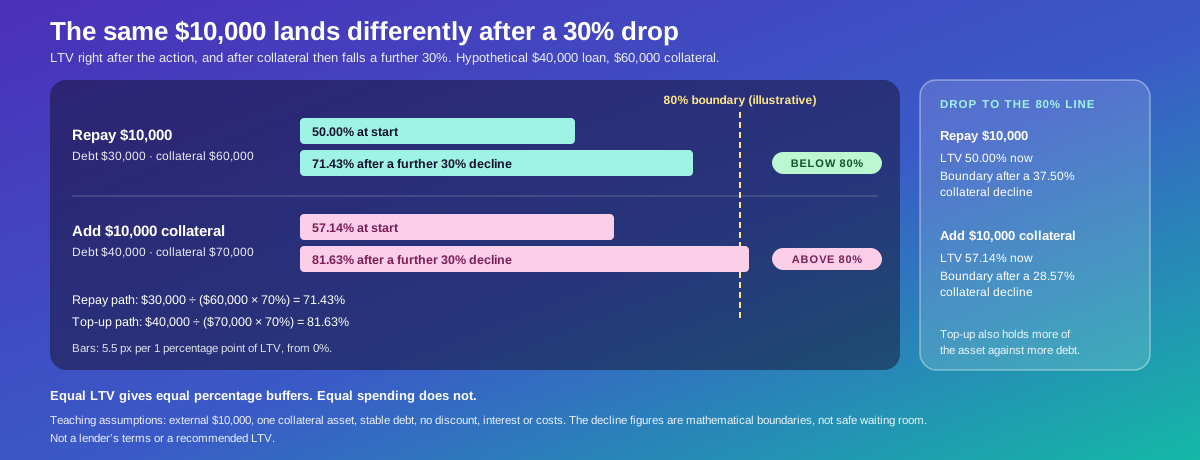
Suppose the borrower has $10,000 of external funds and either uses all of it to repay debt or buys and pledges $10,000 of additional collateral.
| Measurement | Repay $10,000 | Add $10,000 of Collateral |
|---|---|---|
| Remaining debt | $30,000 | $40,000 |
| Collateral value | $60,000 | $70,000 |
| LTV | 50.00% | 57.14% |
| Decline to the assumed 80% boundary | 37.50% | 28.57% |
For the same external commitment, repayment produces a lower LTV and a larger initial price buffer.
A further 30% collateral decline makes the difference visible.
For the repayment path:
LTV After Decline = Remaining Debt / Collateral Value After Decline
$30,000 / ($60,000 × 70%) = 71.43%
For the collateral top-up path:
$40,000 / ($70,000 × 70%) = 81.63%
The top-up path crosses the illustrative boundary while the repayment path remains below it.
There is an economic trade-off: purchasing additional collateral also creates more exposure to a recovery. The top-up path is therefore a decision to retain more debt and hold more of the asset, not merely an alternative administrative method.
If the collateral already existed elsewhere in the borrower’s portfolio, pledging it does not itself increase total market exposure. It does increase the amount committed to the loan and reduce freely accessible reserves.
What Changes If You Sell Pledged Collateral to Repay?
Repaying with external funds and repaying by selling existing collateral are different calculations.
A collateral sale reduces both debt and the assets supporting it. The $4,000 repayment figure above cannot simply be reused.
The required sale amount is:
Required Collateral Sale = [Current Debt - (Target LTV × Current Collateral Value)] / (1 - Target LTV)
For the example:
[$40,000 - (60% × $60,000)] / (1 - 60%) = $10,000
Afterward, debt is $30,000 and collateral is $50,000, producing 60% LTV.
By contrast, selling only $4,000 would leave:
LTV After Sale = ($40,000 - $4,000) / ($60,000 - $4,000)
$36,000 / $56,000 = 64.29%
That improves the position but misses the target.
This formula assumes the action is permitted, proceeds equal the recognized value sold and costs are zero. A live platform may offer a repay-with-collateral operation, impose restrictions or require a different sequence.
Do not assume collateral can first be withdrawn safely. Removing it before debt is reduced can worsen loan health.
Will Repayment Always Reduce Interest Costs?
No. Interest savings depend on the loan agreement.
For a loan where future interest accrues on the remaining balance, reducing debt generally lowers subsequent interest, assuming the rate and other conditions remain unchanged.
For illustration, suppose debt grows by 1% over the next month:
| Equal-Budget Path | Starting Debt | Assumed Interest Addition |
|---|---|---|
| Repay $10,000 | $30,000 | $300 |
| Add $10,000 collateral | $40,000 | $400 |
This is a hypothetical growth assumption, not a quoted rate.
Fixed-interest commitments can behave differently. Coinbase’s current payment guidance distinguishes variable-rate borrowing from fixed-rate loans and states that early repayment of its fixed-rate loans does not reduce interest owed.
Separate two questions: how much does repayment improve loan health, and how much interest does it actually save?
The answers need not be proportional.
How Should You Choose a Buffer for Another Price Decline?
A target LTV should reflect a stress scenario, rather than simply matching a dashboard’s preferred color.
Under the simplified model:
Stressed LTV = Starting LTV × (1 + Debt Growth Rate) / (1 - Collateral Decline Rate)
For the stressed LTV to remain below the liquidation threshold:
Starting LTV < Liquidation LTV × (1 - Collateral Decline Rate) / (1 + Debt Growth Rate)
With an 80% liquidation threshold, a 30% collateral decline and 1% debt growth:
Starting LTV < 80% × (1 - 30%) / (1 + 1%)
Starting LTV < 55.45%
A 60% starting LTV would not meet that scenario.
This is a planning calculation, not a forecast or a universal safe level. It omits valuation discounts, changing parameters, fees and transaction failures. A borrower would need additional headroom rather than targeting the exact calculated boundary.
Why Can Automatic Loan Protection Still Fail?
Automation can reduce the need for manual intervention, but it still depends on eligibility, available funds and successful execution.
Coinbase states that its protection feature requires available collateral, applies once before needing reactivation and expires after one year. Insufficient funds can result in partial or no application. Its guidance explicitly says market volatility and technical issues can prevent execution.
Those conditions are product-specific, but they illustrate the operational questions worth asking.
Does protection use assets already in an eligible balance? Is it still enabled after an earlier intervention? Can it execute quickly enough during a sharp move? What happens if the full top-up amount is unavailable?
An alert is also not a repayment. An enabled feature is not a completed collateral addition.
The meaningful confirmation is the updated loan balance and health metric after the action has settled.
When Can Adding Collateral Be the Better Practical Choice?
A top-up can be reasonable when eligible collateral is already available, repayment assets would take longer to obtain, and the resulting exposure remains acceptable.
Execution time matters near a liquidation boundary. A modest improvement that can complete promptly may be more useful than a theoretically efficient operation requiring multiple transfers.
Preserving liquidity can matter too. The borrowed funds may already be allocated to an obligation, and repayment may leave too little accessible cash for essential expenses.
However, collateral addition still has an opportunity cost. The pledged asset becomes less freely available and may be sold under liquidation rules.
A useful test is to ask whether, starting fresh today, the borrower would choose to hold the enlarged collateral position alongside the remaining debt. If the answer is no, topping up may be postponing a necessary reduction.
When Does Repayment Deserve Priority?
Repayment is particularly relevant when the borrower’s objective is to reduce debt, preserve existing collateral units and avoid adding more exposure.
The equal-budget example shows its mathematical advantage when external repayment funds are available and assets receive identical dollar valuation.
But using every available dollar can leave a household or business fragile in a different way. A healthy-looking loan dashboard does not capture rent, payroll, taxes or other near-term obligations.
Compare the position after repayment with the cash reserve left outside it. If both are inadequate, full closure or a larger restructuring may warrant consideration rather than repeated small interventions.
Repayment also depends on access to the accepted asset. A balance held in an account subject to restrictions may not be usable immediately; Coinbase specifically warns that deposited funds can face temporary holds affecting payments.
How Do Multi-Asset Loans Change the Comparison?
A simple dollar-LTV model may be insufficient when several collateral and debt assets share one position.
Different collateral assets can receive different liquidation thresholds or valuation treatment. Their prices may also fall together, and the debt asset itself can change value.
Aave uses a health factor based on total collateral value, the weighted liquidation threshold and total borrow value. Its documentation notes that both collateral and borrowed-asset changes affect health, and that no universally safe health factor exists.
Consequently, adding $1,000 of one asset may improve health differently from adding $1,000 of another.
Similarly, Morpho documents collateral as specific to each market. Assets elsewhere in an account should not automatically be counted as supporting that position.
Use the actual allocation and risk metric before applying the simplified formulas.
How Can WEEX Convert Help Prepare Repayment Funds?
For readers holding assets on WEEX, WEEX Convert can help compare a supported conversion into an asset required for repayment elsewhere. Availability must be checked for the selected assets and account.
The relevant workflow is to select the From and To assets, enter the amount, and review the estimated receipt before confirming. WEEX’s official Convert guide describes this quote-review process and notes that conversion rates can differ from spot prices.
The page advertises no conversion fee, but the final comparison should still use net usable proceeds. Withdrawal charges, network costs, minimums and transfer timing can affect how much reaches the lender.
Confirm the exact accepted token and network before transferring. Similar dollar values do not make different assets interchangeable for repayment.
A completed conversion also does not reduce an external loan automatically. The repayment must reach the correct destination and be applied to the debt. When liquidation is close, a cross-platform route may take too long.
What Should You Verify After Taking Action?
The operation is complete only when its effect appears in the borrowing position.
For repayment, verify that outstanding debt decreased by the credited amount. For a top-up, check that collateral was allocated to the correct loan and recognized at the expected value.
Then recalculate the buffer using the new debt and collateral figures, including interest posted during the process.
Aave’s repayment instructions distinguish approving a token transfer from confirming repayment and checking the resulting health factor. That distinction matters: authorization alone is not debt reduction.
Keep the transaction record and confirm whether any automatic protection must be re-enabled. Reassess the reserve remaining outside the loan before treating the position as resolved.
WEEX Editorial View: Improving LTV Is Only Part of the Decision
Repayment is generally more efficient per dollar in the simplified equal-budget comparison. That makes it a strong starting point when the purpose is to reduce debt and external repayment funds are readily available.
Collateral addition can still be useful, especially when eligible assets are accessible and execution speed matters. But it should be evaluated as a commitment of assets against continuing debt.
The crucial distinction is between reaching the same ratio and using the same budget. Equal LTV produces equal immediate percentage buffers under matching assumptions; equal external spending produces different results.
Our view is that borrowers should optimize for a position they can sustain through another decline, including the cash they retain outside it. A healthier ratio is valuable only when it supports a more resilient overall balance sheet.
FAQ
1. Is It Better to Repay a Crypto-Backed Loan or Add Collateral?
With external funds and identical valuation treatment, repayment lowers LTV more per dollar. The practical choice also depends on transaction timing, remaining reserves, loan terms and whether eligible collateral is already available.
2. How Much Must I Repay to Reach a Target LTV?
In the simplified model, subtract target LTV multiplied by current collateral value from outstanding debt. A $40,000 debt backed by $60,000 of collateral requires a $4,000 external repayment to reach 60% LTV.
3. Does Adding Collateral Reduce My Debt?
No. It increases the assets supporting the debt. Interest and repayment obligations continue according to the agreement.
4. Can Automatic Protection Guarantee That I Avoid Liquidation?
No. Its effectiveness depends on the product’s conditions, available assets and successful execution. Verify that the feature remains enabled and check the position after any intervention.
5. Can I Sell Collateral to Repay the Loan?
Some products permit this, but selling collateral reduces both debt and backing assets. The required sale can therefore be larger than an external repayment achieving the same target LTV. Check the permitted operation before attempting it.
Sources
| Source | Material Reviewed |
|---|---|
| Coinbase Loan Health | LTV, market-specific thresholds and protection limitations |
| Coinbase Loan Payments | Repayment terms, interest distinctions and temporary holds |
| Morpho Liquidation Documentation | Liquidation eligibility and collateral recovery |
| Morpho Collateral and Health | Market-specific collateral allocation |
| Aave Health Factor and Liquidations | Multi-asset health calculations and liquidation risk |
| Aave Repayment Guide | Approval, repayment and confirmation steps |
| WEEX Convert | Conversion preview and product access |
| WEEX Convert Guide | Quote review, supported limits and conversion records |
Sources reviewed October 27, 2026. All loan amounts, thresholds and stress scenarios used in calculations are hypothetical.
This content is provided for general informational purposes only and doesn't constitute financial, investment, legal, or tax advice. Any events, rewards, online promotions, or related information mentioned herein should not be considered a recommendation, solicitation, or invitation to purchase, sell, trade, or otherwise deal in any crypto assets. Crypto assets are highly volatile and may result in loss. The availability of WEEX services, products, and related events may vary by region. You are responsible for ensuring that your participation is in accordance with applicable local laws and regulations.
You may also like

Why JPMorgan Raised the Target Price for Yushu Technology to 995 Yuan

Turbulent Middle Eastern Crypto Market Welcomes Leadership Change

Ritual Raises $30 Million to Launch Token: AI Game Changer or Retail Investor Trap?

Global Markets in the Last 24 Hours: Brent Oil Reaches $115.81, Bitcoin Drops to $79,818

The Mismatch Between Capital Frenzy and Deployment Economics in the Embodied Industry Clock Cycle

One Week Countdown to Midterm Elections! Will Crypto Change?

Bitcoin at $90,000: The $68 Million Bet on the U.S. Midterm Elections

BisonFi: How an Aggregator Captured Orders with Over $2 Billion in Weekly Trading Volume?

Anthropic IPO Filing Lifts AI Sentiment; BTC Holds Near $80,000 | WEEX TradFi Daily (October 27, 2026)
All three major indexes closed higher on October 26. Anthropic formally filed for a listing, rekindling AI speculation; the Philadelphia Semiconductor Index rose about 3% on the day, and Tesla reached a more-than-three-month high. Bitcoin was near $80,200, down for three consecutive weeks and testing $80,000 for a third time. Local assets plunged after the election result. The October 27 focus is the opening of the Federal Reserve meeting and earnings from Visa, PayPal and others.

WEEX Exclusive:Anthropic IPO Filing Lifts AI Sentiment; BTC Holds Near $80,000 | WEEX TradFi Daily (October 27, 2026)

How Optimism’s draft manual silently strips tokenholder elections

Tom Lee Did It Again. Bitmine Spent $24 Million on Ethereum, but Purchases Are Decreasing

Miden Partner Mainnet Launches, Plans Transition to Public Mainnet in Coming Months
Elon Musk's Grand Scheme to Undermine New Cloud Providers
What Is a Cryptocurrency Market Deleveraging Event? Liquidations vs. ADL
Understand a cryptocurrency market deleveraging event: liquidation vs. ADL, misleading open-interest declines, hedge risks, and checks before trading.
Who Holds Tokenized Stocks? A Large Number of Retail Investors with Highly Concentrated Assets

Flash Loans Secure Two Governance Seats: What Does the X100 Theft Teach the Industry?

AI Reduces Vulnerability Discovery Costs, Crypto Industry Divided in Response

Real and Fake Cryptocurrency Market Makers: What Makes a Market Maker Legitimate?

Evernorth takes a page from Michael Saylor’s Bitcoin playbook with new $80 million XRP funding plan

UK Prepares to Address Major Incidents Involving AI Agents: What Incident Plans Do Businesses Need?

Dragonfly Partner Responds to DFINITY's Technology Infringement Allegations, Related Patent Approved at the End of July

Who actually decides if a major crypto update goes ahead?

XRP: The number of wallets reaches a record 8.24 million

Chain Theory Proposes Deriving the Fine Structure Constant Using Quantum Information

Aave lowers USDT borrowing rate kink to 92% on Ethereum market

Circle Shareholders and Sun Yuchen File Lawsuits Amid Ongoing Controversy Over Trump's Family Crypto Business WLFI

Analysis of the NEAR and ICP Dfinity Public Chain Dispute

New OCC stablecoin rule resets redemptions, and banks face big shifts

Tether’s own AI study shows when buying a laptop costs more than cloud tokens
Why JPMorgan Raised the Target Price for Yushu Technology to 995 Yuan
Turbulent Middle Eastern Crypto Market Welcomes Leadership Change
Ritual Raises $30 Million to Launch Token: AI Game Changer or Retail Investor Trap?
Global Markets in the Last 24 Hours: Brent Oil Reaches $115.81, Bitcoin Drops to $79,818
The Mismatch Between Capital Frenzy and Deployment Economics in the Embodied Industry Clock Cycle
One Week Countdown to Midterm Elections! Will Crypto Change?




