
Decibel launches Aptos Encrypted Mempool to protect traders from MEV

 Prefer us on Google


Decibel Trade has introduced Aptos' Encrypted Mempool on its decentralized trading platform, allowing users to conceal pending order details in an effort to reduce frontrunning and other transaction manipulation risks.
Summary
- Decibel Trade has activated Aptos' Encrypted Mempool, allowing traders to conceal transaction details before execution.
- The optional feature encrypts order payloads while keeping sender addresses and gas fees visible.
- Validators collectively decrypt orders after block finalization, using the network's existing security mechanism.
- Aptos testing recorded approximately 20 milliseconds of additional latency per block in a 50-node benchmark.
- The launch follows the October 12 mainnet activation of Encrypted Mempool under AIP-144.
According to an October 21 announcement from Aptos, the feature is available on an opt-in basis, letting traders encrypt individual transaction payloads before submission while keeping their trades settled onchain.
Decibel Trade enables encrypted orders to reduce MEV exposure
The new feature allows Decibel users to keep the contents of their trading orders private while transactions await inclusion in a block. It is intended to address maximal extractable value (MEV), which can arise when participants use advance knowledge of pending transactions to influence execution.
Encrypted Mempool is now supported on @DecibelTrade, built on @Aptos and incubated by Aptos Labs.
When a trader opts in, the order's payload is encrypted client-side, ordered while encrypted, and decrypted by validators together only after the block is finalized. Sender and gas... pic.twitter.com/iSaX27JlSw
--- Aptos Labs (@AptosLabs) October 21, 2026
Under conventional public mempool arrangements, block producers can inspect transaction details before deciding their order. Automated traders may exploit that information by placing transactions ahead of another user's order or surrounding it with their own trades.
Aptos' implementation changes which information validators can access during this stage. Traders who select encryption have their transaction payloads concealed before those transactions reach the network.
The encrypted information includes the function being called and its inputs, such as the trading instructions included in the transaction. Sender addresses and gas-fee information remain visible.
Orders are decrypted after the block's contents have been finalized through consensus, immediately before execution. Transactions remain recorded on the blockchain, preserving the ability to examine their contents after processing.
Encryption is optional for each transaction. Decibel users can continue submitting ordinary transactions without activating the feature.
The Aptos network introduced its encrypted mempool on October 12, making the technology available to supported wallets and applications before Decibel's October 21 activation.
Aptos uses validator encryption to protect pending transactions
The technical framework behind the feature is described in Aptos Improvement Proposal 144, authored by Aptos Labs cryptographer Rex Fernando.
AIP-144 introduces batch threshold encryption, allowing validators to collectively decrypt transactions after consensus has determined their ordering.
The network generates an encryption key for each epoch, with validators holding separate decryption shares. A single validator cannot independently reveal a pending transaction's encrypted contents.
Aptos states that decryption requires the same stake-weighted threshold used by its consensus mechanism. The arrangement avoids relying on a separate private transaction relay or external group of key holders.
Aptos described the design in its October 12 technical announcement, explaining that the transaction payload remains hidden during ordering and becomes readable only after finalization.
The system uses a batch process designed to reduce the computation and communication required for decryption. According to the network, a single threshold reconstruction can process an entire block regardless of how many encrypted transactions it contains.
Performance testing against the AptosBFT consensus implementation recorded approximately 20 milliseconds of additional latency per block in a 50-node benchmark.
The original proposal describes support for more than 1,000 transactions per second, although those figures represent technical performance targets and testing rather than Decibel's observed trading throughput.
Aptos' TypeScript software development kit supports encrypted submissions from version 7.0.0 onward. Existing Move smart contracts do not require modification to use the network-level capability.
The Petra wallet was the first wallet to make encryption available directly through its transaction signing process.
Decibel expands Aptos trading infrastructure after February launch
Decibel is an onchain trading exchange incubated by Aptos Labs. It launched on mainnet in February 2026, supporting an order-book trading model in which matching and settlement occur through blockchain infrastructure.
Aptos Foundation and Aptos Labs previously committed over $50 million toward trading infrastructure, research and other ecosystem initiatives, including Decibel.
In May, crypto.news reported on Aptos' encryption plans, when the network was preparing native transaction privacy protections against frontrunning and censorship.
The proposal has since moved from the development stage to mainnet availability, with Decibel now supporting encrypted submissions for its traders.
Independent data from DefiLlama placed Decibel's total value locked near $29.4 million on October 21, compared with approximately $51 million at the end of February. The measure represents assets deposited in the protocol, not cumulative trading volume.
The encryption framework has defined limitations. Transaction senders and fees remain publicly visible, and the initial design focuses on concealing payloads during block ordering.
AIP-144 identifies transaction simulation as another privacy consideration because simulations performed with unencrypted transaction contents may expose information before the final encrypted submission. The proposal discusses separating simulation and submission endpoints or disabling simulation by default when encryption is enabled.
Meanwhile, Aptos gained 8.83% to trade at $0.834274 at press time, according to crypto.news market data. The cryptocurrency recorded $73.9 million in 24-hour trading volume, with prices ranging between $0.761868 and $0.843564.
The rally brought APT's weekly gain to 1.84%, while its monthly performance stood at 8.29%. The token remained 73.26% below its price from a year ago.
APT's market capitalization reached approximately $737.1 million, placing it 92nd among cryptocurrencies. Its circulating supply stood near 883.3 million tokens.
-- Price
This content is provided for general informational purposes only and doesn't constitute financial, investment, legal, or tax advice. Any events, rewards, online promotions, or related information mentioned herein should not be considered a recommendation, solicitation, or invitation to purchase, sell, trade, or otherwise deal in any crypto assets. Crypto assets are highly volatile and may result in loss. The availability of WEEX services, products, and related events may vary by region. You are responsible for ensuring that your participation is in accordance with applicable local laws and regulations.
You may also like

SpaceX’s $194 billion share unlock exposes a major risk in Aave’s tokenized stock ambitions

The Global Illusion of 'Zero Tax' on Crypto: No Capital Gains Tax Does Not Mean Tax-Free Profits

DekaBank launches Bitcoin trading for Sparkassen customers

Solana Surpasses Robinhood Chain with 1.5 Million Tokenized Shareholders

Elon Musk Discusses National Debt, Reflections on DOGE, and the Robot Economy, Revealing the Truth About Superintelligence Going Out of Control

Kraken’s $80 stablecoin fee gap exposes hidden costs

Money Here: What the New Cryptocurrency Regulations Change

Cardano Leios targets 3–5x capacity through staged Dijkstra rollout
Pump.fun’s 79% first-day dropout rate fuels memecoin trader fatigue

Dragonfly Executive Haseeb Qureshi: AI Agents Don't Need Cryptocurrency, What They Need is Us Humans

After Disassembling a Genuine Ledger, TBC Discusses the True Boundaries of Self-Custody
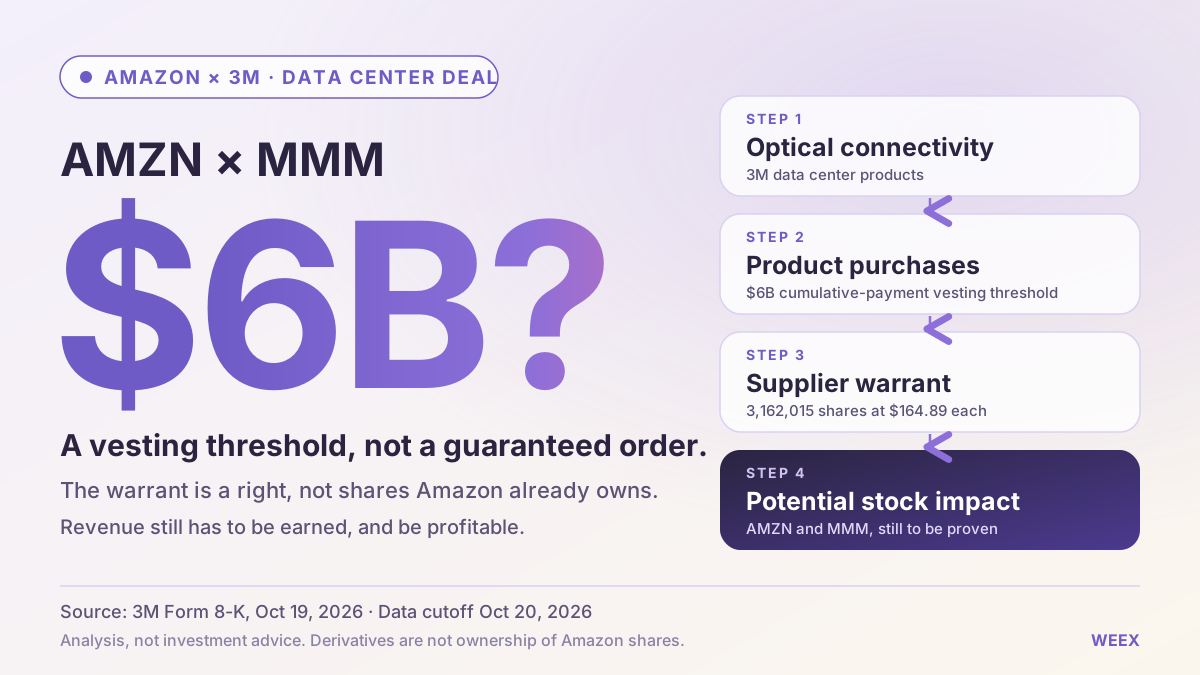
Amazon’s 3M Data Center Deal: What It Means for Amazon (AMZN) and 3M (MMM) Stock
Assess Amazon’s 3M data center deal, the $6 billion warrant threshold, potential dilution, and what the agreement could mean for AMZN and MMM stock.

CFTC Chair: Breaking State-Level Fragmentation to Make the U.S. a Global Crypto Hub
NDV: Where Did the Money Go? A Review of the 16 Years of Stagflation and Wealth Erosion in the United States

XRP Ledger Bug Fixes to Be Implemented on Friday!

Ethereum: Tom Lee Links Crypto Decline to AI Concerns
Why Is Ethena (ENA) Rising? Price Recovery, USDe Growth and Token Risks

Aero Says Goodbye to ve(3,3) Economic Model After Two Delays and Merges Online

Brooklyn's 'Crypto Hunters': A Cross-National Scam Chase Across Three Time Zones

Bitcoin at $100,000 in 2026: Bitwise Remains Optimistic Despite Inflation

White House Crypto Committee: Four People Departed in 14 Months

Slow Fog Releases DarkSword Trojan Analysis Report: Public Code Weaponized, iOS Crypto Wallets Face Threats
French National Assembly Passes Tax Amendment on Stablecoin Transactions, Effective 2027

Perp DEX Generates $125 Million in Fees Monthly, Who Really Gets Rewarded?

TRON Industry Weekly Report: Stagflation May Lead BTC to Test $80,000 Support Again, Detailed Explanation of Building Chain Abstract Web3 Experience Infrastructure Newton

XRP Ledger bug-fix patch set for Oct. 23 with 29 validators support

Why You Might Be Losing Money on Papertrade?
JUST Completes 5th JST Buyback & Burn: Over 170M Tokens (~$23.53M) Burned Ahead of Major Deflationary Upgrade

SEC approves Cboe to list binary options on Coinbase and MARA metrics
唐华斑竹: GasFree Users Exceed 500,000, Making TRC 20 Token Transfers More Convenient
SpaceX’s $194 billion share unlock exposes a major risk in Aave’s tokenized stock ambitions
The Global Illusion of 'Zero Tax' on Crypto: No Capital Gains Tax Does Not Mean Tax-Free Profits
DekaBank launches Bitcoin trading for Sparkassen customers
Solana Surpasses Robinhood Chain with 1.5 Million Tokenized Shareholders
Elon Musk Discusses National Debt, Reflections on DOGE, and the Robot Economy, Revealing the Truth About Superintelligence Going Out of Control
Kraken’s $80 stablecoin fee gap exposes hidden costs





