
How did Revolut, valued at $115 billion, become a challenger to banks?

 Prefer us on Google


challenger"; it has become a true industry giant, with a user base exceeding the combined total of SoFi, Robinhood, Dave, and Chime.
However, when comparing financials, the gap becomes apparent. Barclays Group's pre-tax profit in 2025 is projected to be around £9.14 billion, while Revolut's is about one-fifth of that.
A card can be quickly distributed to many people, but salary, deposits, and lending relationships take time to build.
Revolut has taken over a decade to transition from payments to accounts, surpassing traditional banks in customer scale.
However, the subsequent profit model still needs to return to transactions, balances, and credit, a challenge that Barclays has tackled for over a century.
2. Products: From Travel Currency Exchange to Personal and Business Accounts
2.1 Travel Currency Exchange and Cards
In July 2015, Revolut launched its mobile app and multi-currency prepaid card. Storonsky mentioned in an interview that he often travels and had spent hundreds of pounds on foreign exchange fees and commissions.
The first version of the product combined currency exchange and overseas card payments. For travelers departing from the UK, even if the destination was a Euro-using country like France or Spain, exchanging pounds for euros still incurred costs. Users could check the exchange rate and exchange money on their phones before heading out, using the same card locally.
In 2016, Revolut completed a $15 million Series A round. By 2017, when Index Ventures led a $66 million Series B round, Revolut had over 700,000 customers in Europe and had launched its Premium personal account.
Index partner Martin Mignot was impressed by Revolut's ability to simplify and make cross-border money flows more transparent.
2.2 From Personal Accounts to Business Accounts
The company subsequently brought the same currency exchange and payment capabilities to the business sector, with Business accounts offering multi-currency accounts, employee cards, and cross-border transfers. Travelers might exchange money a few times a year, but businesses need to pay suppliers and handle employee expenses monthly, providing Revolut with an opportunity to enter daily operations. By the end of 2025, Business accounts had 767,000 customers, contributing about 16% of the group's revenue.
2.3 Gradually Introduced Financial Services
In 2018, DST Global led a $250 million Series C round, bringing the valuation to $1.7 billion. At that time, Revolut had nearly 2 million customers and processed about $1.8 billion in transactions monthly.
That same year, the company obtained a banking license in Lithuania and launched Metal, while the cryptocurrency trading introduced the previous year added another use for accounts. In 2019, the app also added stock trading. Users began to have reasons to open Revolut accounts beyond traveling.
In February 2020, TCV led a $500 million Series D round, valuing the company at $5.5 billion, with over 10 million customers. TCV partner John Doran emphasized the banking experience Revolut created through technology.
Storonsky's goals became more specific: to expand banking services across Europe and encourage more people to use it daily. That same year, the company launched banking services in Lithuania and Poland and introduced merchant acquiring for business customers. By the time it reached 1 million customers in 2017, Revolut had already discovered that some users were using the card for daily spending, even as their primary account. At this stage, the company began to have the capacity to develop these uses into more complete services.
In 2021, SoftBank Vision Fund 2 and Tiger Global invested $800 million, bringing the valuation to $33 billion, with over 16 million customers.
Tiger Global's Scott Shleifer valued the speed of product development and user experience, believing it could support further expansion. The company announced that the funds would be used for savings, insurance, investments, and overseas markets.
In 2023, Revolut launched its highest tier membership, Ultra, which includes travel insurance, airport lounge access, and third-party subscriptions. Storonsky mentioned that more people purchased it than he initially expected.
3. Profit Model
Storonsky mentioned in the interview that card interchange fees are low in Europe, and credit regulations are strict, so Revolut must first rely on transactions for profit. In 2025, of the group's £4.52 billion revenue, about £3.43 billion comes from fees and service charges, accounting for 76%. User transactions, currency exchanges, trades, or subscriptions can all generate this type of income for Revolut. Interest income accounts for another 21.6%.
The annual report categorizes revenue into six types:
- Card payments
- Interest
- Subscriptions
- Wealth
- Foreign exchange
- Other income
Revenue is charged per transaction. Card payments are the largest category, with expected revenue of about £1 billion in 2025, accounting for 22.2% of group revenue. When users swipe their cards, Revolut, as the card issuer, can earn interchange fees. This category also includes some cash withdrawal and top-up fees. Foreign exchange income is expected to be around £606 million, derived from fees related to currency exchanges, including fees for exceeding package limits. Wealth management services are expected to generate about £663 million, including stocks, cryptocurrencies, commodities, and savings, with revenue models including trading commissions, markups, and custody fees.
Monthly or annual fees apply. Subscriptions contributed £708 million in 2025, a 67% year-on-year increase. Individual users pay for higher exchange limits, travel insurance, and membership benefits, while businesses purchase packages for accounts and operational tools. A business using Revolut for company cards may also incur additional fees for currency exchange, acquiring, or expense management services.
In 2024, with active cryptocurrency trading, Revolut X was launched that year, leading to a 298% increase in wealth management revenue. By 2025, this growth rate fell to 31%, while card payments still grew by 45%, and subscriptions grew by 67%. If customers make fewer transactions, commissions will be affected. As long as they are willing to renew their subscriptions, Revolut will still receive a membership fee next month.
From funds earning interest. In 2025, Revolut had a total interest income of £974 million, with net interest income of £891 million after deducting interest expenses. Of the total interest income, about £448 million came from cash and bank balances, £371 million from financial investments, and customer loans contributed only about £151 million. Cash and financial investments accounted for about 84% of total interest income.
By the end of 2025, the loan balance more than doubled from the previous year to about £2.2 billion, still only equivalent to 6.2% of customer deposits as reported in the annual report.
Storonsky compares bank lending to selling options: interest is continuously collected, but credit losses may concentrate during economic downturns. Consumer loans, credit cards, and mortgages can all increase revenue per customer. To determine whether it is worthwhile to scale up, one must also consider whether interest can cover funding, bad debts, and capital costs.
According to a16z's estimate based on the average number of customers during the period, from 2022 to 2025, Revolut's revenue per customer increased by approximately 65%. By 2025, the group will have 11 product lines, each generating over £100 million in revenue. Revenue per customer is an average for the group and is also influenced by regional differences, the proportion of corporate clients, and changes in the business mix.
Beyond revenue, a16z also estimates that Revolut's return on equity in 2025 will be around 35%, attributing part of the efficiency to natural customer acquisition, self-built core infrastructure, and fewer physical branches. This metric reflects the returns of the existing business mix. In the future, if credit significantly weighs on the balance sheet, capital usage and credit cycles will affect this calculation.
In addition to natural customer acquisition, growth also involves substantial expenditures. In 2025, Revolut's advertising and marketing expenses increased from £359 million to £529 million, a year-on-year growth of 47%, closely matching revenue growth. During the same period, the proportion of administrative expenses, excluding sales, advertising, and marketing, relative to gross profit decreased from 38% to 33%. The next question is whether, as Revolut continues to invest in customer acquisition, both the number of customers and revenue per customer can continue to rise together.
4. Revolut's Growth and International Expansion
4.1 Growth
Continuing with a16z's two variables.
The first is the number of customers. a16z's European survey provides a clue: younger customers are more willing to use Revolut. For those who already have a primary bank, switching accounts means changing salary deposits and bill payments. For those just starting their careers, these habits are still forming. The growth opportunities in Europe partly come from users who have not yet been covered and from a younger generation gradually moving more financial activities online.
The second is revenue per customer. a16z investor Alex Immerman told Reuters that he looks at primary account adoption rates and total customer balances. By 2025, the number of Revolut primary account customers is expected to grow by 45%, faster than the 30% growth in retail customers, although the company has not disclosed absolute numbers.
From the transactions that have already occurred, changes in usage depth can also be observed. By 2025, Revolut disclosed that the number of transactions per customer increased by 24% year-on-year, and the adoption of paid plans grew by 42%. The former reflects that accounts are being used more frequently, while the latter indicates that more customers are willing to pay. Considering these alongside primary accounts and balances provides a clearer picture of whether customer relationships have deepened than merely looking at new account openings.
Changes in balances are even more intuitive. The total balance of Revolut customers increased from approximately £18 billion in 2023 to £30.2 billion in 2024, and then to £50.2 billion in 2025, with the last year showing a growth of 66%.
Storonsky noted that depending on the market, about 10% to 20% of monthly active users deposit their salaries into Revolut. Once salaries are deposited, card usage, bill payments, and investments are more likely to occur within the same account. These two figures measure the growth of primary account customers and the proportion of salary deposits among monthly active users.
Moreover, account balances can lead to payment, foreign exchange, and investment activities. For Revolut, the first step is to encourage customers to keep a bit more money in their accounts. Once balances grow, the next judgment is whether more funds should continue to be allocated to cash and financial assets or gradually used for consumer loans, credit cards, and mortgages. The capital costs and risks of these two paths differ.
4.2 International Expansion
Europe remains the main source of incremental growth. In 2025, the UK and Europe combined contributed approximately 96% of Revolut's fee income. In European markets outside the UK, fee income grew by 54% year-on-year, accounting for about 70% of the group's new fee income. Fee income growth outside Europe is even faster, but in terms of new amounts, Europe still drives growth the most.
Revolut is essentially an international company. When it expanded from the UK to Europe, it sold cards that saved on currency exchange fees. Upon reaching Mexico, it used local banks to accept deposits. Officially opening in January 2026, by the end of September, it had over 1 million account holders, with deposits nearing 7.9 billion Mexican pesos, although it still reported losses in the third quarter. While account openings can happen quickly, whether it can turn deposits and daily transactions into a profitable business remains to be seen based on local accounts.
The US presents another challenge. Revolut has received preliminary conditional approval, but it still has to go through further approvals before officially opening its own bank. It aims to compete with Amex and Chase for customers using high-end credit cards. Cards can generate transaction volumes, but it remains to be seen whether users will also entrust their salaries and deposits to it, and whether the costs of card benefits and credit can be recouped.
Asia also provides an observable sample. Revolut entered Singapore in 2019. The company claims that local operations achieved net profitability for the second consecutive year in 2025, with the number of corporate clients increasing nearly fivefold that year. In October 2026, Revolut announced plans to invest nearly 350 million Singapore dollars in Singapore over the next five years. The company did not disclose the absolute number of local corporate clients in its announcement, but this case offers another observation path: first using cross-border payments and corporate accounts to establish local business, and then seeing if increased investment can continue to grow customers and revenue.
Revolut can bring the same account technology to many places. However, in each new market, the reasons users open accounts and why they are willing to deposit money must be answered by local products.
After reading the data from Revolut for 2025, one can clearly see the complete picture of the emerging Neobank that Revolut has painted:
From entering through currency exchange payment cards, to gradually establishing/deepening account relationships, and finally providing diversified financial services.
-- Price
5. Insights for Emerging Neobanks
The first batch of Revolut customers had a very specific reason to open the app: saving on currency exchange fees while abroad. Only when the same set of products can be used for salary deposits and bill payments do users have a reason to continue using it after their travels.
Revolut has already integrated stablecoin transfers into its existing app. According to Polygon Labs, as of November 2025, Revolut users had processed a cumulative transaction volume exceeding $690 million on Polygon.
For teams looking to build a stablecoin Neobank from scratch, a more pertinent question is: Revolut already has a group of customers who exchange currency and transfer money; which group are you preparing to help collect which funds first?
Most teams target Africa, Asia, and Latin America, discussing using blockchain and stablecoins to address the financial inclusion narrative for 1.3 billion unbanked/underbanked individuals.
This question will yield different answers in different markets. In places where bank cards and mobile banking are already convenient, a stablecoin card may not necessarily replace commonly used cards. In areas where cross-border payments are inconvenient, a freelancer may only want overseas clients to deposit their payments, leaving a portion for local bills. The product must first capture that money, and if the same income recurs next month, users will have a reason to return.
In a specific market, truly identifying a pain point (such as helping them earn money) is the hallmark of a serious player.
Blockchain can help platforms globalize easily, facilitating cross-border settlements and providing users familiar with crypto assets with more trading and investment options. At first glance, it seems to have reached that high ARPU stage. However, its challenge is that the user base is relatively small and incompatible with traditional demographics.
Is it realistic to ask someone without a bank account to use a crypto wallet to trade Nvidia stocks? Recently, I had a conversation with an older gentleman who had a sudden realization:
The 1.3 billion unbanked/underbanked individuals, do they really need a bank account?
This content is provided for general informational purposes only and doesn't constitute financial, investment, legal, or tax advice. Any events, rewards, online promotions, or related information mentioned herein should not be considered a recommendation, solicitation, or invitation to purchase, sell, trade, or otherwise deal in any crypto assets. Crypto assets are highly volatile and may result in loss. The availability of WEEX services, products, and related events may vary by region. You are responsible for ensuring that your participation is in accordance with applicable local laws and regulations.
You may also like

Congo (DRC) Reinstates Cobalt Export Ban

PAXG puts gold in a wallet. Getting the bullion out is another matter

100% Probability of Fed Rate Hike: Why This Will Be 100% Bad News

Crypto: 176 Gendarmes Mobilized Against a Network of Fraud Involving Stolen Data

Gold and silver lose $15 trillion, Bitcoin holds up better

China Securities Index Company Revises the Compilation Plan for SSE Dividend Index and SSE Commodity Stock Index
YC's Investment Logic Transformation: From Software to Hardware, From Models to the Physical World

Palmer Luckey Says He’s Building an Offshore Haven for Industry—And 'Illegal' Medicine

How to Choose Precious Metal ETFs? A Comprehensive Analysis of Mainstream Gold, Silver, and Mining Stock ETFs

Druckenmiller Turns Bearish on Copper Prices, Zeroes Out Stock Positions, Says Current Market Visibility is Lowest in Memory

Aluminum Supply Tightens Further, LME Spread Rises Above $15 Per Ton
Crypto: Tether Gold (XAU₮) Receives Unqualified Audit from KPMG

Cardano holders reject 22M ADA treasury bid to buy physical copper
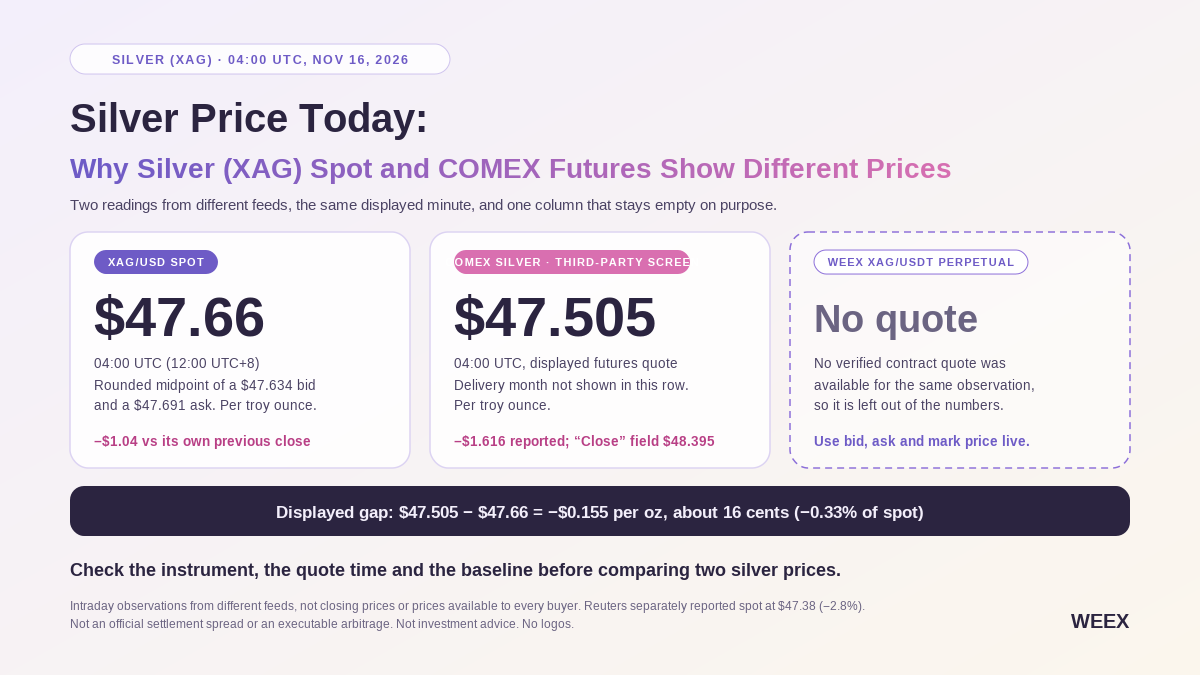
Silver Price Today: Why Silver (XAG) Spot and COMEX Futures Show Different Prices
Silver traded near $47–$48 on November 16. Compare XAG/USD spot, COMEX silver futures, and XAG/USDT perpetuals, and learn why their prices differ.

Funding Weekly | German Robot Company Agile Robots Raises $500 Million Led by SoftBank; Layer 1 Blockchain Alta Completes $47.5 Million Series A Financing

McGlone warns BTC mirrors 2018, 2022 bear markets

Crypto VC funding: Project Faro commits $270m, Index raises $50m

CFTC Plans to Reform U.S. Aluminum Pricing Mechanism

Global Stock Funds Attract $51 Billion in a Week, Hitting a Two-Month High! Bank of America Analyzes the Discrepancy: Many Bearish Voices, Few Actual Short Sellers

Review of 646 Crypto Cards: High Cashback Mostly Hype, Issuer and Real Costs are Key Indicators
Trafigura Becomes Key Player in London Aluminium Short Squeeze

Silver ETF vs. Silver Miners ETF: Which Has Held Up Better This Year?
Startup Voya Energy Proposes Solution to Replace Noisy Diesel Generators in Data Centers

London Aluminum Market Faces Supply Squeeze, Spot Prices Hit 30-Year High

Alta raises $47.5M for blockchain backed by crypto skeptic Jack Zhang
From Shorting Stablecoins to Building Chains: The Shift of Airwallex Founder Jack Zhang and the Battle for Payment Settlement Layers

Despite the decline, Bitcoin has not lost the game against gold

iPhone Attack Kit 'DarkSword' Suspected of Being Misused for Cryptocurrency Theft, Bitquery Identifies Approximately $4.06 Million in Stolen Funds

Why Did Institutions Bet $40 Million on PhotonPay When Stablecoin Transfers Are Cheap Enough?

Hong Kong Launches Tokenized Gold Trading Project, Gold Tokens Correspond to 400 Ounce Gold Bars
Congo (DRC) Reinstates Cobalt Export Ban
PAXG puts gold in a wallet. Getting the bullion out is another matter
100% Probability of Fed Rate Hike: Why This Will Be 100% Bad News
Crypto: 176 Gendarmes Mobilized Against a Network of Fraud Involving Stolen Data
Gold and silver lose $15 trillion, Bitcoin holds up better
China Securities Index Company Revises the Compilation Plan for SSE Dividend Index and SSE Commodity Stock Index
Latest articles


Latest coin listings on WEEX


