
How to Choose Precious Metal ETFs? A Comprehensive Analysis of Mainstream Gold, Silver, and Mining Stock ETFs

 Prefer us on Google


Gold and silver have always been important investment commodities in the global market. As precious metal prices are influenced by macroeconomic factors, the dollar's movement, interest rate expectations, and geopolitical issues, more and more investors are starting to participate in the precious metal market through ETFs.
For U.S. stock investors, precious metal ETFs include not only GLD, which tracks gold prices, but also SLV, which tracks silver prices, AGQ, which provides leveraged exposure, and products like GDX, GDXJ, and SIL that invest in gold and silver mining companies.
These ETFs may seem related to precious metals, but there are significant differences in investment logic and risk characteristics. Some funds hold physical gold or silver directly, while others gain price exposure through financial derivatives, and some invest in the stocks of mining companies.
For investors, when choosing a precious metal ETF, it is essential to clarify whether they want to invest in metal prices, the profit growth of mining companies, or short-term price fluctuations.
1. What Are the Main Categories of Precious Metal ETFs?
Precious metal ETFs in the U.S. market can be roughly divided into four categories:
1. Gold ETFs
These primarily track gold prices, usually gaining exposure by holding physical gold.
Representative products: GLD, IAU, GLDM.
2. Silver ETFs
These primarily track silver prices. Silver has both precious metal and industrial metal properties, and its price fluctuations are usually more significant.
Representative products: SLV, SIVR.
3. Precious Metal Mining ETFs
These invest in gold and silver mining companies, participating in the precious metal industry through the operational performance of mining enterprises.
Representative products: GDX, GDXJ, RING, SIL.
4. Leveraged Precious Metal ETFs
These amplify the daily price fluctuations of precious metals through financial instruments like futures and swaps, suitable for investors with clear short-term trading strategies.
Representative products: AGQ, UGL.
The biggest difference among these four categories lies in the investment targets. For example, SLV tracks silver prices, while AGQ aims for double the daily returns of the silver benchmark; GDX invests in mining company stocks and does not hold gold directly.
2. Mainstream Gold ETFs: GLD, IAU, and GLDM
Gold ETFs are one of the most mature and closely watched product categories in the precious metal ETF market. For investors looking to gain exposure to gold prices without directly purchasing and storing physical gold, physical gold ETFs are a more straightforward choice.
1. SPDR Gold ETF (GLD)
Management Institution: State Street
Annual Fee Rate: 0.40%
Established: 2004
GLD is one of the most representative gold ETFs in the U.S. market, tracking gold price performance by holding physical gold, with high market recognition and trading activity.
Who is it suitable for?
GLD is suitable for investors who value trading activity and wish to flexibly allocate gold, as well as market participants who need to conduct short-term trading through gold ETFs.
2. iShares Gold Trust ETF (IAU)
Management Institution: BlackRock
Annual Fee Rate: 0.25%
Established: 2005
IAU also gains price exposure through physical gold, with a lower fee rate than GLD. For investors looking for long-term gold allocation and concerned about holding costs, it is a choice worth comparing.
Who is it suitable for?
IAU is suitable for investors who wish to gain exposure to gold prices while paying attention to fund fees and long-term holding costs.
3. SPDR Gold MiniShares Trust (GLDM)
Management Institution: State Street
Annual Fee Rate: 0.10%
Established: 2018
GLDM also tracks the price of physical gold, with the most significant feature being its low management fee, making it suitable for investors more concerned about long-term holding costs.
Who is it suitable for?
GLDM is suitable for investors looking for long-term gold allocation, who do not require high trading frequency and are more focused on low fees.
How to Choose Among the Three Gold ETFs?
| ETF | Annual Fee Rate | Main Features |
|---|---|---|
| GLD | 0.40% | High market recognition, active trading |
| IAU | 0.25% | Balanced fees and liquidity |
| GLDM | 0.10% | Low fees, suitable for long-term allocation |
Overall, GLD is more suitable for investors who value trading activity; IAU and GLDM are better for those who focus on holding costs. None of the three aims to amplify gold price fluctuations.
3. Mainstream Silver ETFs: SLV and SIVR
Compared to gold, the investment logic for silver is more complex.
Silver not only has precious metal properties but is also widely used in solar cells, electronic products, electrical equipment, and other industrial fields. Therefore, silver prices are influenced not only by the dollar, interest rates, and precious metal investment demand but also by industrial demand and global economic cycles.
1. iShares Silver ETF (SLV)
Management Institution: BlackRock
Annual Fee Rate: 0.50%
Established: 2006
SLV tracks silver prices by holding physical silver and is one of the larger and more actively traded silver investment products in the U.S. market.
For investors looking to directly participate in silver price fluctuations, SLV is one of the most noteworthy products.
Who is it suitable for?
SLV is suitable for investors who wish to invest directly in silver prices, value trading liquidity, and may need to conduct short-term trading.
2. Abrdn Silver ETF Trust (SIVR)
Management Institution: abrdn
Annual Fee Rate: 0.30%
Established: 2009
SIVR also gains price exposure through holding physical silver, with a lower fee than SLV.
For investors looking for long-term silver allocation while also focusing on fund management fees, SIVR is worth considering.
Who is it suitable for?
SIVR is suitable for investors who wish to hold silver exposure long-term and are more concerned about management fees.
What are the differences between SLV and SIVR?
The core investment logic of both is basically the same, with the main differences being fund size, trading activity, and fees.
SLV: Has advantages in scale and market liquidity, suitable for investors with higher trading needs.
SIVR: Relatively lower fees, more suitable for investors focused on holding costs.
It is important to note that silver price fluctuations are usually higher than those of gold. Silver is influenced by both safe-haven demand and changes in industrial demand, so silver ETFs may not necessarily rise and fall in sync with gold ETFs.
-- Price
4. Why is the Leveraged Silver ETF: AGQ Gaining Attention from Traders?
If SLV is a tool for directly participating in silver price trends, then AGQ is aimed at investors who wish to amplify short-term price fluctuations in silver.
2x Long Silver ETF - ProShares (AGQ)
Management Institution: ProShares
Annual Fee Rate: 0.95%
Established: 2008
Investment Objective: Twice the daily return of the silver benchmark
AGQ aims to achieve twice the daily price fluctuations of the Bloomberg Silver Subindex, primarily gaining exposure through financial instruments like futures and swaps, and does not hold silver directly.
For example, if the silver benchmark rises by 5% on a trading day, AGQ's target return would be approximately 10%; if the silver benchmark falls by 5%, AGQ's target decline would be about 10%. The above does not consider fees and other tracking errors.
However, investors need to be particularly cautious that AGQ aims for double daily returns, not double cumulative returns over the long term.
Due to daily rebalancing of leverage, when silver prices experience sustained fluctuations, the compounding effect may cause AGQ's long-term performance to deviate significantly from double the cumulative increase in silver prices.
Who is it suitable for?
AGQ is more suitable for:
Active traders with a clear judgment on short-term silver trends;
Investors who can withstand significant price fluctuations;
Investors who can continuously monitor positions and adjust trading strategies in a timely manner.
For ordinary investors looking to hold silver long-term and allocate assets, SLV and SIVR are usually easier to understand choices.
5. Precious Metal Mining ETFs: GDX, GDXJ, and SIL
In addition to directly investing in gold and silver, investors can also position themselves in precious metal mining companies through mining ETFs.
The profitability of mining companies is closely related to metal prices but is also affected by production costs, mineral reserves, mining efficiency, energy prices, and company operations.
Therefore, mining ETFs are not equivalent to gold or silver ETFs, and their price fluctuations may be larger.
1. Gold Mining ETF - VanEck (GDX)
Management Institution: VanEck
Annual Fee Rate: 0.51%
Established: 2006
Main Investment: Large gold mining companies
GDX is one of the most representative gold mining ETFs, primarily investing in large global gold producers.
Its main holdings include:
Newmont Corporation (NEM)
Agnico Eagle Mines (AEM)
Barrick Gold Corporation (G)
Wheaton Precious Metals (WPM)
Franco-Nevada Corporation (FNV)
GDX's investment logic is to participate in the potential profit growth that may come from rising gold prices by holding established gold producers.
Who is it suitable for?
Investors who wish to participate in the upside opportunities of the gold mining industry and prefer investments in large, established mining companies.
2. Junior Gold Mining ETF (Market Vectors) (GDXJ)
Management Institution: VanEck
Annual Fee Rate: 0.52%
Established: 2009
Main Investment: Small and mid-sized gold and silver mining companies
Unlike GDX, which primarily allocates to large gold producers, GDXJ focuses more on smaller mining companies at different stages of development.
Its holdings include Alamos Gold, Equinox Gold, Coeur Mining, and IAMGOLD.
Small mining companies may have greater profit elasticity when gold prices rise but are also more susceptible to financing, project development, and production cost changes.
Who is it suitable for?
Investors who are optimistic about long-term gold trends and can accept higher volatility and operational risks of companies.
3. Silver Miners ETF (SIL)
Management Institution: Global X
Annual Fee Rate: 0.65%
Established: 2010
Main Investment: Global silver mining companies
SIL is a representative ETF in the silver mining sector, investing in companies involved in silver mining, exploration, and related businesses.
Its main holdings include:
Wheaton Precious Metals (WPM)
Pan American Silver (PAAS)
Coeur Mining (CDE)
First Majestic Silver (AG)
Hecla Mining (HL)
Since silver has industrial metal properties, SIL is influenced not only by silver prices but also by changes in industrial demand, such as solar energy and electronic products.
Who is it suitable for?
Investors who are optimistic about the long-term price performance of silver and wish to participate in the silver industry chain through mining companies.
Comparison of Mining ETFs
| ETF | Investment Direction | Annual Fee Rate | Risk Characteristics |
|---|---|---|---|
| GDX | Large gold mining companies | 0.51% | Relatively mature but still has significant volatility |
| GDXJ | Small and mid-sized gold and silver mining companies | 0.52% | Higher operational and financing risks |
| SIL | Silver mining companies | 0.65% | Influenced by silver prices and industrial demand |
6. Horizontal Comparison of Mainstream Precious Metal ETFs
To facilitate investors' choices, the previously introduced products can be compared together.
| ETF | Investment Target | Product Type | Annual Fee Rate |
|---|---|---|---|
| GLD | Gold | Physical Gold | 0.40% |
| IAU | Gold | Physical Gold | 0.25% |
| GLDM | Gold | Physical Gold | 0.10% |
| SLV | Silver | Physical Silver | 0.50% |
| SIVR | Silver | Physical Silver | 0.30% |
| AGQ | Silver | 2x Daily Leveraged | 0.95% |
| GDX | Gold mining companies | Stock type | 0.51% |
| GDXJ | Small and mid-sized gold and silver mining companies | Stock type | 0.52% |
| SIL | Silver mining companies | Stock type | 0.65% |
The fee rates are the annual expense indicators disclosed by the funds, subject to the latest fund documents. AGQ is a leveraged product and cannot be directly compared with physical precious metal ETFs for long-term investment performance.
7. How Should Investors Choose Precious Metal ETFs?
Different precious metal ETFs correspond to different investment objectives, and there is no best product suitable for everyone.
1. For Long-term Gold Allocation: GLD, IAU, GLDM
These primarily track gold prices. Investors who value trading liquidity can focus on GLD, while those concerned about long-term costs can compare IAU and GLDM.
2. For Investing in Silver Prices: SLV, SIVR
These are suitable for investors who wish to gain exposure to silver prices without taking on the additional risks of leveraged products.
3. For Short-term Trading in Silver: AGQ
This is suitable for investors with strong trading experience who can withstand significant losses and continuously manage positions.
4. For Optimistic Views on Gold Mining Companies: GDX, GDXJ
Investors preferring large mining companies can focus on GDX, while those willing to accept higher volatility for exposure to small and mid-sized mining companies can research GDXJ.
5. For Optimistic Views on the Silver Industry Chain: SIL
This is suitable for investors who wish to participate in the silver market through mining companies rather than simply tracking the spot price of silver.
8. What Risks Should Investors Be Aware of When Investing in Precious Metal ETFs?
Although gold and silver are often seen as traditional safe-haven assets, investing in precious metal ETFs does not mean there are no risks.
First, interest rates and dollar movements.
Gold and silver do not generate interest. When U.S. real interest rates rise, the opportunity cost of holding non-interest-bearing precious metals may increase. At the same time, a stronger dollar may also exert pressure on the prices of precious metals denominated in dollars.
Second, different price fluctuations between gold and silver.
The investment logic of gold is more related to safe-haven demand, central bank reserves, and real interest rates. Silver, in addition to its financial attributes, is also influenced by industrial demand, so changes in economic cycles may bring additional volatility.
Third, mining ETFs face operational risks.
The profits of mining companies depend not only on gold and silver prices but also on factors such as energy, labor, equipment, taxes, and policies in mining locations. Even if metal prices rise, mining companies may not necessarily rise in sync.
Fourth, leveraged ETFs carry the risk of compounding losses.
AGQ tracks twice the daily returns. When the market experiences sustained fluctuations, long-term holding may lead to significant path dependence and return deviations, which should not be simply understood as double the long-term increase in silver prices.
Conclusion
Precious metal ETFs provide investors with various ways to participate in the gold and silver markets. From physical gold ETFs like GLD and IAU to silver ETFs like SLV and SIVR, and mining ETFs like GDX, GDXJ, and SIL, different products correspond to different market judgments and risk preferences.
For investors looking for relatively direct exposure to precious metal prices, physical gold and silver ETFs are easier to understand choices; those wishing to share in the profit growth of mining companies can research mining ETFs; while leveraged products like AGQ are more suitable for short-term trading rather than simply as long-term allocation tools.
When investing in precious metal ETFs, the key is not just to judge whether gold or silver prices will rise or fall, but to understand what exactly you are buying and what risks you need to bear.
This content is provided for general informational purposes only and doesn't constitute financial, investment, legal, or tax advice. Any events, rewards, online promotions, or related information mentioned herein should not be considered a recommendation, solicitation, or invitation to purchase, sell, trade, or otherwise deal in any crypto assets. Crypto assets are highly volatile and may result in loss. The availability of WEEX services, products, and related events may vary by region. You are responsible for ensuring that your participation is in accordance with applicable local laws and regulations.
You may also like

IoTeX adds quantum-resistant technology to developer portal
Shiba Inu Experiences Outflow of 300 Billion SHIB from Exchanges

Hacker moves over 34279.66 ETH from Binance after inactivity

Why Are Tokenized Stocks Seeing Strong Buying Pressure While Prices Keep Falling?
XRP holders demand Ripple burn 31.1 billion tokens by March 2027
Pump.fun Launches Prediction Market Feature in Collaboration with Polymarket

ARTEX AI tool breaches networks in under 3 hours, FBI warns

Gnosis Safe wallet reportedly drained of $6.45M in suspected exploit
Thailand Stablecoin Transfer Limit: What the SEC Draft Proposes

Tesla Autopilot Team Veterans Found Simulation Startup Valued at $1 Billion
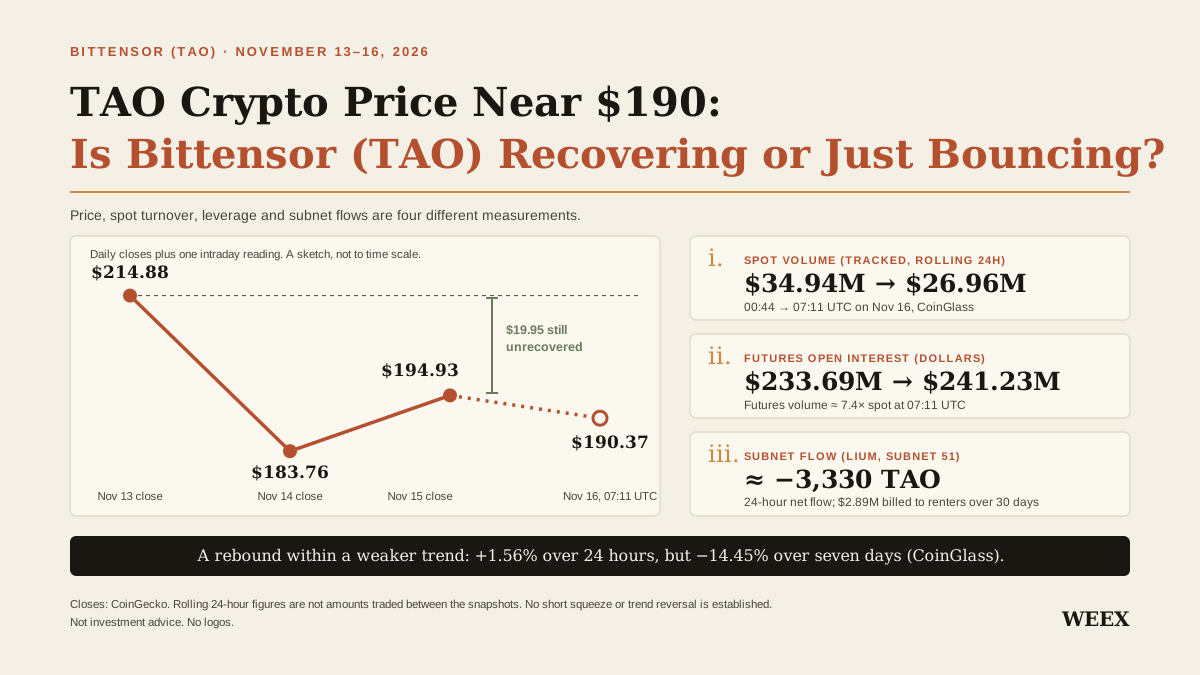
TAO Crypto Price Near $190: Is Bittensor (TAO) Recovering or Just Bouncing?
TAO bounced near $190. Compare spot volume, futures positioning, and Bittensor subnet flows to see what would confirm a more durable recovery.
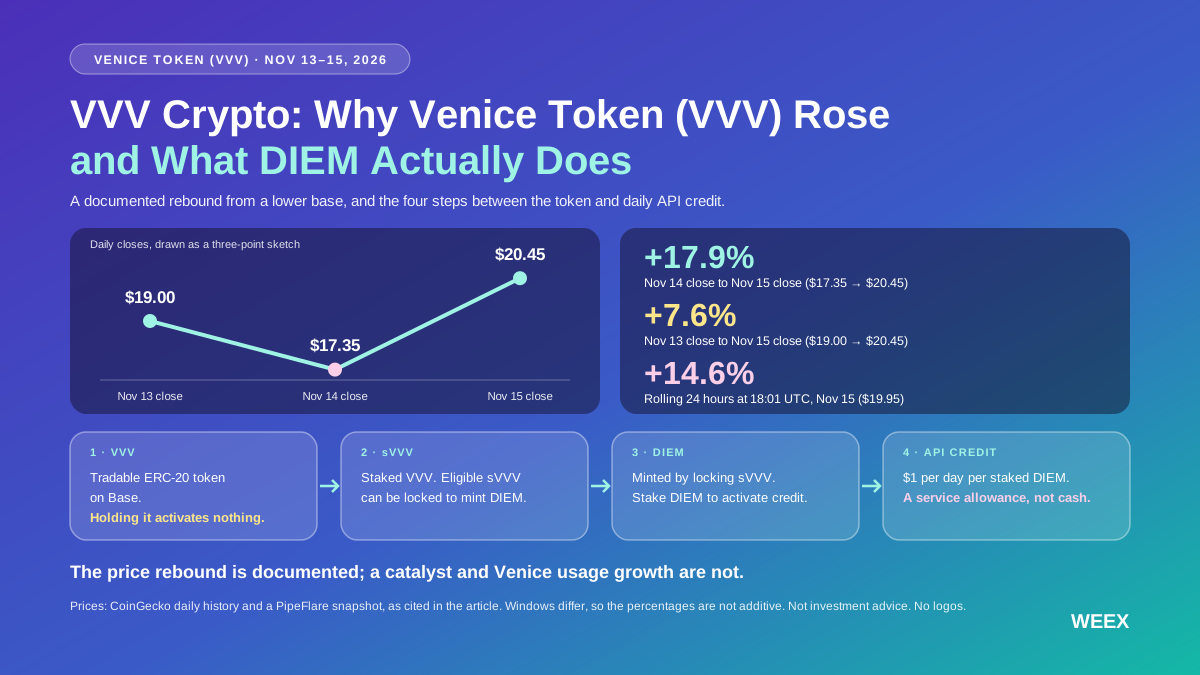
VVV Crypto: What Is Venice Token, Why Venice Token (VVV) Rose and What DIEM Actually Does
Venice Token rose about 14.6% in one November 15 snapshot. Learn what the data shows, how VVV staking works, and what DIEM’s daily API credit buys.
Silver Price Today: Why Silver (XAG) Spot and COMEX Futures Show Different Prices
Silver traded near $47–$48 on November 16. Compare XAG/USD spot, COMEX silver futures, and XAG/USDT perpetuals, and learn why their prices differ.
Options Big Bets | Nvidia's $118 Million Cross-Period CALL Spread Bets on Mid to Long-Term Upside; AMD's Bearish Spread Combined with Long-Term Bullish Spread, Underlying Tensions Between Bulls and Bears

Galaxy Securities: A-shares Market's Downward Risk Converges, Focus on Sector Rotation Opportunities

How $10,000 in stablecoins would have gained €420 without earning interest

Bitcoin now looks cheap by one measure after $1 billion in ETF outflows
These Bitcoin miners have halved their hashrate, while their AI revenues have doubled

Bitcoin: Should We Fear the Worst or Bet on Hopes for a Rebound?

This Under-the-Radar Stock Is Behind Steak 'n Shake's MAHA-Driven Growth. Should You Buy?
XDC vs XRP: Which Payment-Focused Blockchain is Superior?
The Privacy Paradox of Bitcoin: Satoshi Acknowledged It Long Ago, Have the Successors Solved It?

[Analysis] Two Barriers Preventing Bitcoin from Rising

No New Money Inflows in Dogecoin ETFs for a Month
XRP loans trigger 883 liquidations, and $53M remains at risk

CoreWeave and Nebius Group: 1 Soars, the Other 1 Plunges. A Tale of 2 Neoclouds

Research Reveals 3D Spatial Navigation Map of Hand in the Brain to Aid Brain-Machine Interface Development

Yen Fluctuations Highlight Current Trading Difficulties, Investors Have Huge Divergence on Long-term Outlook

BNY Mellon Adds to Invesco Galaxy Bitcoin ETF: What Changes with the Custody Filing?
South Korea Proposes Withdrawal Suspension for Cryptocurrency: What Happens When Exchanges Suspect a Hack
IoTeX adds quantum-resistant technology to developer portal
Shiba Inu Experiences Outflow of 300 Billion SHIB from Exchanges
Hacker moves over 34279.66 ETH from Binance after inactivity
Why Are Tokenized Stocks Seeing Strong Buying Pressure While Prices Keep Falling?
XRP holders demand Ripple burn 31.1 billion tokens by March 2027
Pump.fun Launches Prediction Market Feature in Collaboration with Polymarket
Latest articles




Latest coin listings on WEEX


