
LDP Proposes Establishing a Cyber Response Headquarters Ahead of Cybersecurity Crisis, Emphasizing Cryptocurrency Tracking and Post-Quantum Cryptography

 Prefer us on Google


Key Points of This Article
- Proposal to establish a government-led "Cyber Response Headquarters (tentative name)"
- Accelerating the transition to PQC in light of the 2030-31 transition in Europe and the U.S.
Proposal for Establishing a Government-Led Response Headquarters
The Liberal Democratic Party's National Cybersecurity Strategy Headquarters (Head: House of Representatives member Masaki Hirakawa) approved a proposal on the "Fundamental Strengthening of Cybersecurity Measures" on the 22nd at the party's policy deliberation council. The main pillar is the establishment of a government-led "Cyber Response Headquarters (tentative name)." The proposal also includes tracking illegally obtained cryptocurrencies and accelerating the transition to post-quantum cryptography (PQC).
The proposal was compiled by the headquarters on the 20th. It positions the current situation of repeated cyberattacks on domestic companies and leaks of personal information as the "eve of a cyber crisis." It also points out that the proliferation of generative AI is advancing the autonomy of attacks. It warns that "AI cyber saturation attacks," where AI automatically exploits vulnerabilities and launches simultaneous attacks on a scale that exceeds the defensive side's processing capacity, will become a reality in the near future.
The proposal calls for the response headquarters to serve as a command center for the entire government, urging that a headquarters meeting be convened promptly in the event of significant damage. It encourages the management of listed companies to build a system from peacetime. It also suggests establishing a new personnel and salary system for civil servants to attract highly skilled private sector personnel, such as white hat hackers, with compensation commensurate with market value.
Risks of Misuse of Next-Generation AI and Collaboration with U.S. AI Companies
In the section directed at the National Cyber Coordination Office (NCO), the risks of the misuse of next-generation AI models leading to the autonomy and sophistication of attacks are described as the so-called "Mythos problem." As a countermeasure, it promotes the "Project YATA-Shield," which advances early detection and response to vulnerabilities using AI on the defensive side, and indicates a policy to collaborate with the AI Safety Institute (AISI).
It also calls for establishing direct collaboration channels with major U.S. AI companies such as OpenAI and Google. The aim is to use AI to inspect government agency information systems and expedite vulnerability assessments. The proposal urges AISI not only to conduct AI diagnostics but also to aim for the automation and autonomy of vulnerability remediation (patch application).
Tracking Cryptocurrencies and Transitioning to Post-Quantum Cryptography
Direct references to cryptocurrencies are found in the section for the National Police Agency. It calls for proactive participation in international joint investigations with law enforcement agencies from various countries, such as the FBI and Europol. It states that there should be active execution of neutralizing the infrastructure used by criminals, such as command servers, and tracking illegally obtained cryptocurrencies, demonstrating a deterrent effect that makes attacks targeting Japan unprofitable.
The NCO is urged to expedite the transition to PQC. Major countries in Europe and the U.S. are expected to transition significant systems by around 2030-31. In light of this, it suggests that government agencies should set early deadlines for high-priority systems. The Ministry of Internal Affairs and Communications is advised to expedite the social implementation of dual protection technology that combines quantum key distribution (QKD) with PQC.
PQC refers to a class of cryptographic methods that are considered difficult to decipher even when quantum computers become practical. The widely used public key cryptography is at risk of being broken by future quantum computers, and similar issues have been pointed out regarding the electronic signatures of Bitcoin (BTC).
In the section for the Digital Agency, it calls for verifying the usefulness of decentralized IDs (DIDs) and verifiable credentials (VCs) as a "trust foundation for the web3 era" that is resistant to information leakage and tampering. By April 2027, reading IC chips of My Number cards and others for face-to-face identity verification will be mandated under the Act on Prevention of Transfer of Criminal Proceeds. In light of this, it includes considerations for accelerating the use of cards in the private sector and mandating card acquisition.
It calls on the Financial Services Agency and others to ensure that financial institutions steadily advance the "short-term measures" indicated in the request document dated May 22, under the involvement of their management. It also mentions strengthening initiatives through cross-industry cyber exercises and the Financial ISAC, where financial institutions share threat information.
-- Price
This content is provided for general informational purposes only and doesn't constitute financial, investment, legal, or tax advice. Any events, rewards, online promotions, or related information mentioned herein should not be considered a recommendation, solicitation, or invitation to purchase, sell, trade, or otherwise deal in any crypto assets. Crypto assets are highly volatile and may result in loss. The availability of WEEX services, products, and related events may vary by region. You are responsible for ensuring that your participation is in accordance with applicable local laws and regulations.
You may also like

Former FTX Executive Slams Netflix's New Series: Turning Financial Fraud into a 'Romantic Film' is Absurd

Delphi Digital: Why Speculation is the Theme of the Next Decade

Bitgo Launches AI Financial Application 'Gokubu' and Research Organization
"Millions of devices are vulnerable": Ledger CTO

Private Jets and Investor Pressure Force Polymarket CEO to Mature

Doctor Profit Warns of a Very Big Monero (XMR) Liquidation Event

Stuttgart Stock Exchange Gets Green Light to Trade and Settle Tokenized Securities
WEEX Exclusive:Tech Rebounds; Bitcoin Holds $81,000–$82,000 Support| WEEX TradFi Daily (October 20, 2026)
Tech Rebounds; Bitcoin Holds $81,000–$82,000 Support| WEEX TradFi Daily (October 20, 2026)
On October 19, tech rebounded. The three major indexes were mixed, with the Nasdaq relatively stronger. Intel rose after a JPMorgan upgrade, and SpaceX closed up more than 2%. Bitcoin traded near $81,000–$82,000, a zone traders viewed as strong support and a local bottom. Worldcoin (WLD) rose more than 10% in 24 hours, leading majors. October 20 focus includes earnings from SPCX and other listed names.
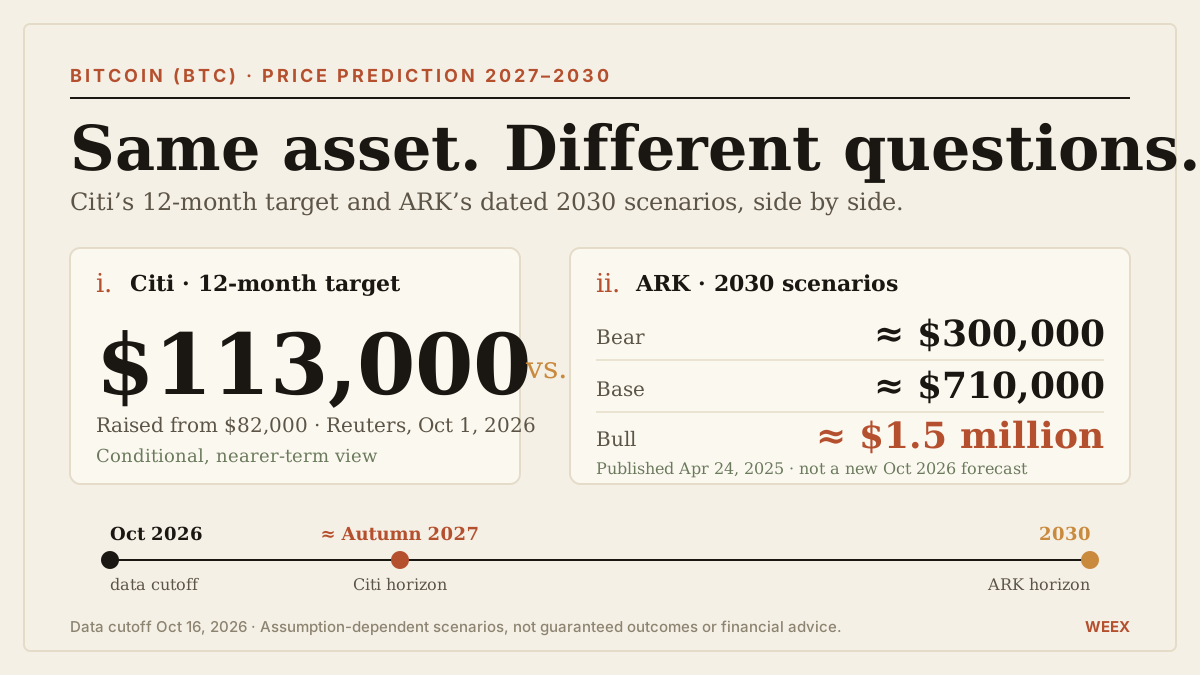
Bitcoin (BTC) Price Prediction 2027–2030: Citi’s $113,000 Target vs. Cathie Wood’s ARK Scenarios
Bitcoin price prediction for 2027–2030: compare Citi’s $113,000 target with ARK’s dated scenarios, demand assumptions, valuation math and key risks.

Crypto: 107 incidents and $1.18 billion stolen in Q3 2026

Is Pearl, Dreaming of Bitcoin in the AI Era, an Innovation or Just Simple Hype?

唐华斑竹 Analyzes Bitcoin Trends, Suggests Monitoring Support Levels

Howard Marks: If Everyone is Talking About a Bubble, Then the Bubble May Not Have Burst Yet

Quantum Alliance Established to Protect Blockchain from Quantum Computers

唐华斑竹 Analyzes the Current State of the Crypto Market, Advises Caution

U.S. Treasury Department's Survey Fails to Signal Debt Reduction, Bond Yields Rise with 10-Year Yield Back Above 5.12%
The Past and Present of Currency in the Age of Exploration

What Business Does Solana Want to Do in Shanghai?
Fractional Reserve: Reserve Requirement Abolished. Where is the Value?

Cyberattack on the ports of Marseille and La Rochelle? Hackers paid 1 dollar in crypto

G20 warns that stablecoins may lose value even if fully backed

[Legal Insights] Hard Wallet Hacking Incident: Is My Digital Asset Safe in Exchanges?

[Full Text] DAXA: "Digital Asset Taxation Should Be Linked to Basic Law Classification and Enforcement Infrastructure"

Crypto Billionaires Invest $100 Million to Disrupt UK Politics

Cybersecurity Incident Involving GoPax and PraBank in the Virtual Asset Industry

Financial Stability Board Highlights Unclear Bankruptcy Laws for Stablecoin Failures
The Era of Industry: Q3 2026 Virtual Asset Industry Investment Status Report – Tiger Research

Ledger Wallet Reveals Method of Unauthorized Components Reading Recovery Phrases from Screens

BCE Insider Reveals the Plan Behind the Debt Crisis in Europe
Former FTX Executive Slams Netflix's New Series: Turning Financial Fraud into a 'Romantic Film' is Absurd
Delphi Digital: Why Speculation is the Theme of the Next Decade
Bitgo Launches AI Financial Application 'Gokubu' and Research Organization
"Millions of devices are vulnerable": Ledger CTO
Private Jets and Investor Pressure Force Polymarket CEO to Mature
Doctor Profit Warns of a Very Big Monero (XMR) Liquidation Event


