
Morgan Stanley Research on China's Robot Market: Companies Still Want Humanoid Robots, but Large-Scale Deployment Will Have to Wait

 Prefer us on Google


TL;DR · 64% of surveyed companies plan to launch pilot or larger-scale projects for wheeled or legged humanoid robots in the next three years, slightly up from 62% last year, but this does not mean they have already made purchases. · Expectations for deployment of composite robots, wheeled humanoid robots, and legged humanoid robots by the end of 2027 have all been significantly lowered. · 72% of potential adopters believe that the price of a single unit suitable for widespread promotion should be below 100,000 yuan; 82% require a payback period of less than three years. · The proportion of those satisfied with existing humanoid robots has dropped from 23% to 18%, with reliability, functionality, total cost, and return on investment becoming the four core procurement criteria. · Demand for limited multitasking capabilities has increased, but actual implementation still relies on specific scenarios, system integration, and measurable improvements in production efficiency.
Morgan Stanley expects that the shipment of humanoid robots in China will reach 50,000 units in 2026 and 100,000 units in 2027; this is an institutional forecast and not a count of orders from this survey.
On October 25, 2026, Morgan Stanley released its second annual survey of Chinese humanoid robot companies. Compared to a year ago, companies' willingness to adopt remains high, but moving from demonstration and pilot to large-scale deployment will take longer.
The survey was conducted online in September 2026, covering 94 executives from Chinese companies directly involved in robot investment decisions, all of which have annual revenues of no less than 1 billion yuan. Among them, 60 respondents' companies plan to deploy wheeled or legged humanoid robots in the next three years, classified as "potential adopters." Metrics such as price, satisfaction, and procurement standards mainly come from this subsample.
Companies are increasingly clear about their requirements: robots need to adapt to existing production processes, reliably complete tasks, and recover investments within an acceptable timeframe. Insufficient data, limited cross-task and cross-scenario adaptability, and hardware reliability still constrain the commercialization process.
Willingness Remains High, Deployment Expectations Delayed by About a Year
In this survey, 64% of the surveyed companies plan to initiate pilot or larger-scale projects for wheeled or legged humanoid robots in the next three years, slightly higher than the 62% from the 2025 survey. However, the two surveys do not represent completely identical samples: the proportion of manufacturing companies increased from 51% to 65%, and manufacturing is generally a sector more likely to adopt robots early. This structural change may affect the year-on-year comparison of adoption willingness.
Actual deployments have increased, but coverage remains limited. Among companies that have initiated pilot or larger-scale projects, the corresponding proportions for composite robots are 19%, for wheeled humanoid robots 10%, and for legged humanoid robots 6%; last year, these were 14%, 6%, and 5%, respectively. These proportions reflect project initiation status and cannot be directly viewed as penetration rates for large-scale applications.
Expectations for the same future point have changed more significantly. In the 2025 survey, 64% of surveyed companies expected to deploy composite robots by the end of 2027, 58% expected to deploy wheeled humanoid robots, and 41% expected to deploy legged humanoid robots. This year, these proportions have dropped to 50%, 36%, and 22%, respectively. Based on this, Morgan Stanley judges that the overall adoption curve has shifted roughly one year later.
Even extending the timeline to the end of 2028, small-scale deployments still dominate. Among all surveyed companies, 46% expect to deploy 1 to 10 composite robots, 40% for wheeled humanoid robots, and 33% for legged humanoid robots; the proportion expecting to deploy more than 50 units is only 13%, 4%, and 4%, respectively. The three types of robots are counted separately and should not be summed.
Morgan Stanley believes that the next phase is more likely to see an increase in the number of pilots, while scale expansion will depend on the verification of reliability, scenario adaptability, and system integration. Composite robots and wheeled humanoid robots are expected to enter factories and warehouses earlier. For environments that are relatively flat and have fixed processes, wheeled mobility can meet many needs. Legged robots still have potential in complex terrains and high-value tasks, but technical requirements and reliability constraints may delay their widespread deployment.
More Cautious Procurement Budgets, 100,000 Yuan Becomes Mainstream Price Expectation
Potential adopters are still willing to increase investment in robots, but the expected increase has narrowed. 85% expect to increase robot investment in the next three years, down from 91% last year; the proportion expecting a "significant increase" has dropped from 30% to 22%.
The benefits companies hope to gain mainly include increased productivity, reduced labor costs, and fewer errors, with selection proportions of 82%, 78%, and 58%, respectively. In contrast, the proportion expecting robots to help launch new services or products has dropped from 36% to 22%. Procurement reasons are more focused on measurable benefits within existing businesses.
High upfront costs have become the most common barrier to adoption, chosen by 62% of potential adopters, followed by limited work capabilities or functions (60%), difficulties in integrating with existing systems (55%), maintenance and operating costs (52%), and technical limitations (47%).
For the price of a single unit suitable for widespread promotion, 45% of potential adopters chose between 50,000 and less than 100,000 yuan, up from 28% last year; the proportion choosing between 100,000 and less than 200,000 yuan dropped from 40% to 18%. A total of 72% believe the price should be below 100,000 yuan, higher than last year's 53%. This reflects buyers' judgment on economically feasible prices and does not represent the market's average transaction price.
Companies have also put forward clearer requirements for investment payback. 82% set the maximum acceptable payback period at less than three years, with Morgan Stanley estimating an average of about 26 months. Compared to other automation projects, 37% require the payback period for humanoid robots to be roughly the same, 28% require it to be shorter, and only 12% can accept a longer time, while another 22% say it depends on the application scenario.
Price acceptance still varies by industry. Among potential adopters in manufacturing, 25% can accept prices between 100,000 and less than 200,000 yuan, and 15% choose 200,000 yuan and above. Morgan Stanley believes that robots undertaking higher-value production tasks may still command higher pricing. Factors influencing procurement include actual productivity, equipment utilization, as well as integration and maintenance costs.
Manufacturing and Logistics Lead the Way, Multitasking Demand Exceeds Single Task
Based on equal weighting of the three surveyed industries—industrial, manufacturing, and services—manufacturing, logistics and warehousing, and R&D are the most focused deployment areas, with corresponding proportions of 90%, 85%, and 79%. This metric reflects potential adopters' choices of application areas and does not represent actual deployment rates in each field.
Specific demands are concentrated in replenishing production lines, in-warehouse transportation, loading and unloading, sorting, packaging, stacking, machine loading and unloading, and quality inspection. The output, labor savings, and safety improvements of these processes are relatively easy to measure, making it easier to verify whether robots can create economic value.
Dangerous, heavy, or unsuitable environments for long-term human operation represent another important demand. Respondents mentioned scenarios such as oil and gas production, high-temperature heat treatment, heavy lifting, inspections in hazardous areas, and low-temperature storage checks. In these tasks, improvements in safety and stability constitute important procurement reasons.
Companies' requirements for functionality are also changing. 70% of potential adopters hope robots will have "limited multitasking" capabilities, up from 49% last year; the proportion hoping to perform specific tasks has dropped from 72% to 50%; the proportion choosing general tasks has increased from 32% to 38%. These options can be selected simultaneously.
The demand for multitasking means that robots need to switch between related workflows, such as connecting transportation, inspection, and equipment operation. Respondents hope that robots can learn new production processes, adapt to customized products, and collaborate with existing automation equipment and enterprise systems. Human-robot collaboration, equipment interconnectivity, and autonomous learning are the most anticipated future capabilities.
This expectation still has a gap with current product performance. Only 18% of potential adopters are satisfied with existing humanoid robots, down from 23% last year; the proportion of those dissatisfied has risen from 25% to 28%, while 53% remain neutral.
The use of robots in the service industry is also expanding, including store reception, guiding, car sales explanations, customer Q&A, and commercial cleaning. However, Morgan Stanley believes that the industrial tasks that are relatively controllable and quantifiable in effect are still more likely to be the first to land. Whether robots can solve mobile operations, equipment interaction, and complex environmental tasks that existing fixed industrial robots find difficult to cover will affect their added value.
-- Price
Brand Preferences Still Early, Repurchase Rates More Persuasive than Customer Lists
Yushun remains the most frequently mentioned manufacturer among surveyed companies, but the lead has narrowed. 47% of potential adopters have interacted with or evaluated Yushun, while Yundong and UBTECH each account for 17%. For planned deployments in the next three years, Yushun accounts for 32%, down from 60% last year; Yundong and UBTECH each account for 13%. These proportions reflect interactions, evaluations, or future intentions and cannot be used as market share.
Procurement standards are converging. The selection proportions for reliability and safety, application adaptability and functionality, total cost, and expected return on investment are 85%, 83%, 82%, and 80%, respectively. Among these, the return on investment has increased by 16 percentage points compared to last year. Return on investment (ROI) measures the relationship between input and output, and is related but distinct from the payback period of "how long it takes to recover the investment."
Yundong received high scores in evaluations among eight manufacturers, but only 9 respondents evaluated it; UBTECH received evaluations from 9 respondents, while Yushun received evaluations from 25 respondents. The report also notes that some respondents may evaluate manufacturers based on their experience with other products, such as quadruped robots. Therefore, these results are not sufficient to prove that a company's humanoid robot platform has commercial advantages.
Morgan Stanley expects that shipments of humanoid robots in China will increase from 50,000 units in 2026 to 100,000 units in 2027, reaching 446,000 units by 2030. The institution anticipates that some pilots targeting specific tasks may gradually expand deployment starting in 2027, but the speed of expansion remains uncertain.
In the supply chain, Morgan Stanley continues to favor component suppliers such as Hengli Hydraulic, Green Harmonic, and Shuanghuan Transmission. Their judgment is that complete machine manufacturers will increase pilots to obtain real scene data, which may drive demand for components even if the end market has not fully ramped up.
The report states that Green Harmonic received approximately 400,000 orders for humanoid robot-related reducers in the first three quarters of 2026, with about 100,000 units for the entire year of 2025; the company plans to increase its monthly production capacity from about 90,000 units to 120,000 units by the end of 2026. This statistic refers to the number of components and cannot be directly compared with the shipment volume of complete robots. Rapid expansion and price competition may also put pressure on suppliers' profit margins.
For Yushun, Morgan Stanley is optimistic about its motion control, hardware integration, and cost control capabilities, as well as its potential to develop into a full-stack intelligent robot platform, but believes that its intelligent capabilities and repeatable commercial deployment still need further proof.
The next verification focus will be whether customers repurchase, whether robots are promoted to multiple production bases, and whether individual projects expand from a few units to more than ten. Companies' willingness to adopt provides a starting point for the industry, while large-scale deployment still depends on whether robots can continuously and stably complete tasks and deliver measurable returns.
This content is provided for general informational purposes only and doesn't constitute financial, investment, legal, or tax advice. Any events, rewards, online promotions, or related information mentioned herein should not be considered a recommendation, solicitation, or invitation to purchase, sell, trade, or otherwise deal in any crypto assets. Crypto assets are highly volatile and may result in loss. The availability of WEEX services, products, and related events may vary by region. You are responsible for ensuring that your participation is in accordance with applicable local laws and regulations.
You may also like

BNB Chain contract deployments nearly triple to 12.3M in Q3

Coinbase and Thunes Tie Stablecoins to Local Bank and Wallet Payouts

Morgan Stanley Raises Global Electricity Growth Forecast: Who Will Share the $500 Billion Increment in the Power Market Beyond AI?

Ritual Raises $30 Million to Launch Token: AI Game Changer or Retail Investor Trap?

Can Derive V3 Maintain Its Leadership in the Growing On-Chain Options Market?

After a 95% Drop in TVL, Sony's L2 Soneium is Finally Launching Its Token

Onchain Fees: Crypto Protocols Earn $4 Billion in the Third Quarter

Why Is Quant (QNT) Crypto Up Today? What Price and Volume Really Show
Why is Quant (QNT) up today? Review price and volume evidence, the banking partnership timeline, token-demand assumptions, and risks before trading.
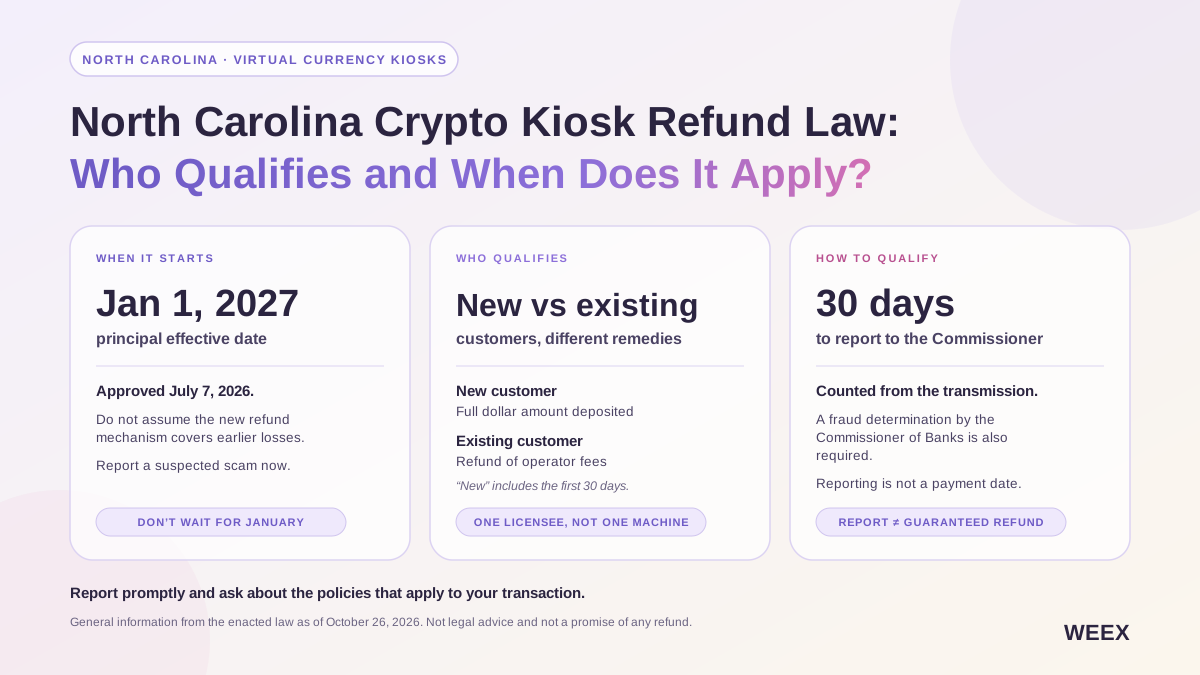
North Carolina Crypto Kiosk Refund Law: Who Qualifies and When Does It Apply?
Understand North Carolina’s crypto kiosk refund law: the January 2027 start date, who qualifies, reporting deadlines, and documents victims should keep.

AI Reduces Vulnerability Discovery Costs, Crypto Industry Divided in Response

Ethereum: Glamsterdam postponed after risks detected on 13 contracts

Who is Making Money from Digital Dollars? Profit Sharing Among Stablecoin Issuers, Distributors, and Payment Providers

[ETH Letter] Meritz Securities Reviews Tokenization of Korean Securities Based on OP Stack

Ethereum Releases CALLSTATUS Instruction EIP Draft

Paradigm Releases Audited Built-in JIT Compiled New EVM evm2
Weekly: $68,000 Theft from Ukrainian in Trust Wallet, Circle's Lawsuit Against Trump Over $2 Billion in UAE, and Historic Solana Update

Delay of the Glamsterdam Update on Ethereum Postpones Activation on Hoodi

Arbitrum Launches Developer Guild, Offchain Labs Becomes First Member
Hyperliquid L2 Elysium to Deploy Node at TheHUB in Tokyo

Heatbit's $899 Water Heater Element Mines Bitcoin While It Heats Your Tank

Ethereum Delays Test of Glamsterdam Update

Cryptocurrency Exchange Acknowledges Error After Reports of Millions in Losses

Ethereum Hoodi Testnet Glamsterdam Hard Fork Delayed
A Midnight privacy-vault demo needs outside signers to release Ethereum tokens

Robinhood Chain Surpasses Ethereum in Revenue: $51 Million vs $41 Million in Q3

CoinDCX Deposit Address Used for 10 Months, $15.8 Million User Deposits Untracked

Earning Millions Monthly: How Crypto Frontends Make So Much Money?
Why earning XRP yield through this wallet could actually cost you money
Kaspa finalizes 3 standards for native tokens and covenant apps

Zebec Network reports $100,000 buyback of 40.5M ZBCN in Q3
BNB Chain contract deployments nearly triple to 12.3M in Q3
Coinbase and Thunes Tie Stablecoins to Local Bank and Wallet Payouts
Morgan Stanley Raises Global Electricity Growth Forecast: Who Will Share the $500 Billion Increment in the Power Market Beyond AI?
Ritual Raises $30 Million to Launch Token: AI Game Changer or Retail Investor Trap?
Can Derive V3 Maintain Its Leadership in the Growing On-Chain Options Market?
After a 95% Drop in TVL, Sony's L2 Soneium is Finally Launching Its Token


