
Stock Market Crash: What History Says Comes Next After the Market's Big Single-Day Dip.

 Prefer us on Google


Earlier this month, on Nov. 5, the stock market experienced one of its biggest one-day declines in over a year. The S&P 500 (^GSPC -0.29%) dropped 4.3%, and the Nasdaq Composite (^IXIC -0.54%) sank 5.5%. That was the market's worst day since April 2, 2025, when President Trump announced his import tariffs.
While the tariff-induced declines could have signaled a broader sell-off, they weren't, and the market fully recovered all its losses in just over a month. While this type of market rebound may seem unusual, it's not.
In fact, since 1981, the S&P 500 has recovered from its 10-worst single day declines within two months, eight of those times. Importantly, the S&P 500 has also generated a positive return one year after these big market dips nine out of 10 times, with an over 20% return on eight occasions.
| Date | Event | 1-Day Decline | Days to Recover | Annual Return After 1 Year | Annual Return After 3 Years | Annual Return After 5 Years |
|---|---|---|---|---|---|---|
| 1. Oct. 19, 1987 | Black Monday | -20.5% | 264 | 23.2% | 11.6% | 13% |
| 2. March 16, 2020 | Covid | -12% | 19 | 66.1% | 18.4% | 18.8% |
| 3. March 12, 2020 | Covid | -9.5% | 20 | 59% | 15.9% | 17.7% |
| 4. Oct. 15, 2008 | The Great Recession | -9% | 15 | 20.8% | 10.5% | 13.3% |
| 5. Dec. 1, 2008 | The Great Recession | -8.9% | 6 | 35.9% | 15.1% | 17.2% |
| 6. Sept. 2, 2008 | The Great Recession | -8.8% | 410 | -4.1% | 1.6% | 8.9% |
| 7. Oct. 26, 1987 | Black Monday Aftershock | -8.3% | 5 | 23.6% | 10.2% | 12.9% |
| 8. Oct. 9, 2008 | The Great Recession | -7.6% | 3 | 17.8% | 8.3% | 12.7% |
| 9. March 9, 2020 | Covid | -7.6% | 57 | 41.1% | 12.6% | 16% |
| 10. Oct. 27, 1997 | Asian Financial Crisis | -6.9% | 8 | 21.5% | 16.3% | 0.5% |
Source: Data shown is for the S&P 500 Price Index as of 12/31/25. Morningstar, Ned Davis Research, and Hartford Funds.
As such, history says that this market dip could be one of the best times to buy stocks.
On top of that, the market is entering one of its most bullish historical periods. Since 1938, the S&P 500 has risen in 95% of midterm election years from November through November of the following year. This period also tends to be the market's strongest stretch, with the S&P 500 generating an average annual return of 14.5% during these 12 months.
Key Data Points
Day's Range
7,550.84 - 7,600.37
52wk Range
6,316.91 - 7,844.52
History would also indicate that a quick rebound could be in store. In midterm election years, the S&P 500 has produced positive returns in Q4 84% of the time, with an average return of 6.6%. The first quarter of the following year tends to be even better, with the market up 95% of the time with an average yearly return of 7.4%. The second quarter of the year after midterm elections also tends to see stocks do well, with the S&P 500 up 74% of the time with an average return of 5%.
It also doesn't matter much which party wins the midterms or which holds the presidency. That said, the combination of a Republican president and a Democratic Congress tends to produce the weakest market gains, with an average return of 4.9%. The S&P 500 has tended to perform much better when Congress is divided, with an average return of 17% when there is a Democratic president and a split Congress, and 13.7% when there is a Republican president and a split Congress.
Image source: Getty Images.
How to play the dip
History suggests a quick recovery from this dip, so I would be a buyer on this pullback.
Tech stocks were among the hardest-hit sectors with the recent pullback, as many newly elected officials called for a pause on the ongoing data center build-out. However, large hyperscalers already appear to have contingency plans, with the potential to shift spending overseas and toward Republican stronghold states like Wyoming. There is also the future potential to build data centers offshore, underwater, and then eventually in outer space.
In my view, the pullback could be a great opportunity to buy top AI semiconductor stocks, like Broadcom (AVGO +4.85%) and Advanced Micro Devices (AMD +2.88%), as well as hyperscalers like Alphabet (GOOGL +0.80%) (GOOG +0.70%) and Amazon (AMZN +2.29%).
In general, though, I think the best core strategy in any market is to consistently dollar-cost average into index exchange-traded funds (ETFs), and if you have a little extra money on the sidelines, investing a little more after big down days is a great option. My top ETF to buy in this sell-off is the Invesco QQQ Trust (QQQ -0.40%), which tracks the Nasdaq-100 index. This gives you significant exposure to the top tech names in the market. Meanwhile, an S&P 500-tracking ETF, like the Vanguard S&P 500 ETF (VOO -0.34%), is always a great long-term holding.
-- Price
This content is provided for general informational purposes only and doesn't constitute financial, investment, legal, or tax advice. Any events, rewards, online promotions, or related information mentioned herein should not be considered a recommendation, solicitation, or invitation to purchase, sell, trade, or otherwise deal in any crypto assets. Crypto assets are highly volatile and may result in loss. The availability of WEEX services, products, and related events may vary by region. You are responsible for ensuring that your participation is in accordance with applicable local laws and regulations.
You may also like

Anthropic Yet to Go Public, Crypto Players Already Cashing In

Interpretation of FATF Report on Scam Compound Funds: Virtual Assets Become Core Money Laundering Channels

How Much Is Anthropic Really Worth?
Research Reveals 3D Spatial Navigation Map of Hand in the Brain to Aid Brain-Machine Interface Development

Michael Dempsey: Crypto Venture Capital Stagnates, Talent Shifts to AI

Yen Fluctuations Highlight Current Trading Difficulties, Investors Have Huge Divergence on Long-term Outlook

Bloom Energy vs. Constellation Energy: On-Site Power or Grid Power, Which Wins the Data Center?
Former Polychain Partner Launches Startup: Enters Tokenized Real Estate, Secures $50 Million Seed Round Funding to Create the 'S&P 500' of Real Estate

Seminar: The History of Hyperliquid and On-Chain Finance Guest: Takuya Fujita (11/18 19:30 @ Gentosha)
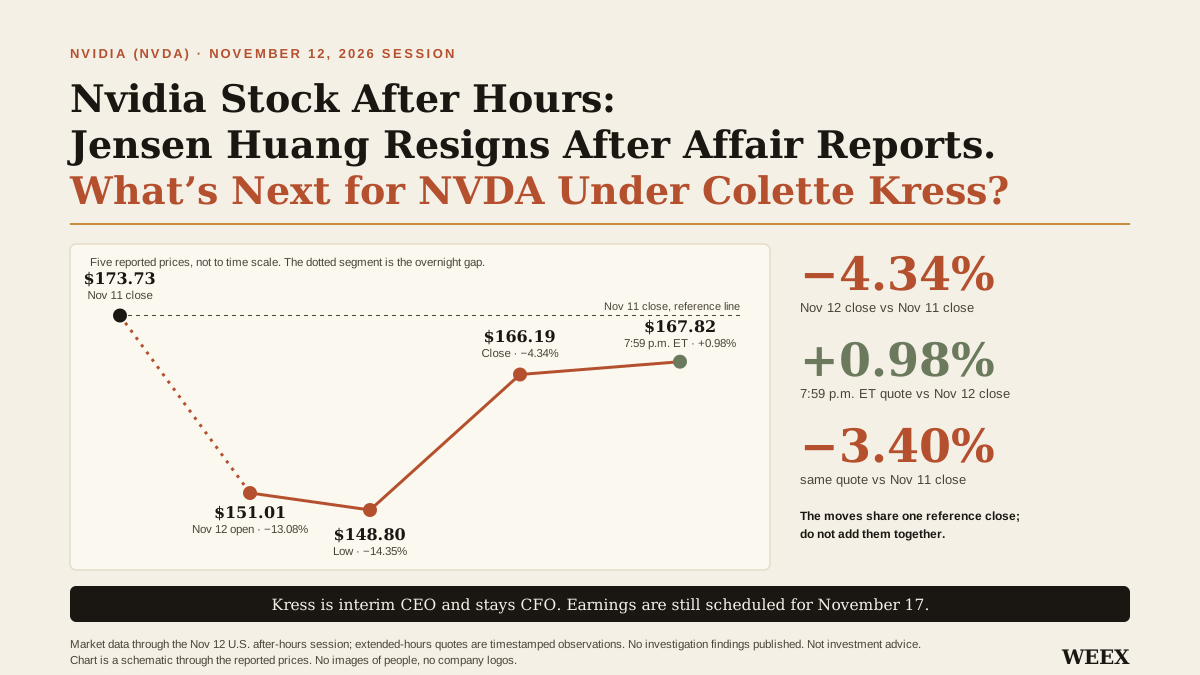
Nvidia Stock After Hours: Jensen Huang Resigns After Affair Reports. What’s Next for NVDA Under Colette Kress?
Nvidia fell 4.34% after Jensen Huang resigned, then rose 0.98% after hours. See what Colette Kress’s appointment means for NVDA and November 17 earnings.
Jensen Huang's Sudden Departure Raises Questions: Did the White House Intervene? Is a Return Possible?
In-Depth Interview | Fu Peng: I Have No Faith in BTC

Cerebras Conference Call: Secures Major Deal with Microsoft, HBM Shortage Becomes an Opportunity, WSE-5 Chip to Enter Mass Production Next Summer

SoundHound AI Stock Is Down Almost 60% in 2026, but Wall Street Thinks It Can Soar 155% By the End of 2027. Here’s Why It Could Be One of the Best Buys Amid the Tech Sell-Off.
What is being said at the tables: the market begins to see 2027 as an all-or-nothing scenario
Kalshi Negotiates New Round of Financing, Valuation Expected to Reach $65 Billion

Republican Senator Wants to Freeze AI Data Center Boom as Congress Pushes to Expand It

Why the Path to Quantum Resistance Runs Uphill for Bitcoin Wallet Makers

Pimco CEO Warns: AI Companies Risk Borrowing "Too Much" ($10 Trillion)

Silver ETF vs. Silver Miners ETF: Which Has Held Up Better This Year?

Why AMD Shares Are Surging and What a $10,000 Investment in the Stock Could Be Worth in 3 Years

Cardano Academy launches practicum with on-chain credentials
Warren Buffett Doesn't Follow His Own S&P 500 Advice. Should You?

A $776 Car Payment Is a Warning for Ford and General Motors

2 Chip Stocks to Buy Instead of Nvidia Right Now

History Says This Is the Smartest ETF to Buy During the Next Bear Market

EU to Continue Providing Financial and Military Aid to Ukraine
The market demanded liquidity and the Economy granted it: what to expect for interest rates after the Treasury auction

Qualcomm CEO on Tech Stock Plunge: "There is No AI Sector Correction for Us"
Worried that AI will take your job? Tony Robbins says it's time to create a self-reinvention plan
Anthropic Yet to Go Public, Crypto Players Already Cashing In
Interpretation of FATF Report on Scam Compound Funds: Virtual Assets Become Core Money Laundering Channels
How Much Is Anthropic Really Worth?
Research Reveals 3D Spatial Navigation Map of Hand in the Brain to Aid Brain-Machine Interface Development
Michael Dempsey: Crypto Venture Capital Stagnates, Talent Shifts to AI
Yen Fluctuations Highlight Current Trading Difficulties, Investors Have Huge Divergence on Long-term Outlook
Latest articles




Latest coin listings on WEEX


