
Russian Crypto Market May Be Easier to Isolate from Global Market, Says Finam

 Prefer us on Google


The Russian crypto market may become a more convenient target for external isolation: wallets of Russian exchanges, brokers, and digital depositories will be easier to track if foreign authorities decide to tighten sanctions pressure. This was stated by Kirill Pitskov, head of product development at the financial group Finam. According to him, assets passing through such addresses may acquire a high-risk status.
Why Transparency of the Russian Market May Become a Problem
Kirill Pitskov links this risk to updated regulations. After changes in legislation, market operators must legalize themselves, and the addresses of liquidity providers and the movement of assets become more noticeable for external analysis. In this logic, the decisions of regulators are also important: the Central Bank sets the rules for the admission of instruments, while the Bank of Russia determines which assets can circulate in the legal framework.
The new framework is built around controlling market participants and the movement of digital assets. In it, the Central Bank is responsible for the rules for admitting instruments and infrastructure, while Rosfinmonitoring is connected with financial monitoring and checking suspicious transactions. In practice, this enhances the transparency of the legal framework but simultaneously makes it more noticeable for external compliance checks.
The sanctions environment creates additional context. Sanctions related to Russia's invasion of Ukraine are already affecting financial channels, and the transparency of crypto infrastructure may simplify attempts to separate Russian platforms from international liquidity. If the addresses of legal participants are clearly visible, foreign services will be able to scrutinize the cryptocurrency associated with them more closely.
The more noticeable the addresses of legal Russian participants become, the easier it is for external services to link them to the movement of assets and assess such coins as more risky.
For the owner of digital assets, this means practical difficulties:
- A foreign exchange may request confirmation of the origin of funds;
- A custodial provider may scrutinize coins that have passed through a Russian legal platform more closely;
- Additional questions may arise when withdrawing through a foreign online digital currency exchange service;
- In a stricter scenario, the transfer may be rejected.
Which Assets Are Allowed and Where the Risk Is Higher
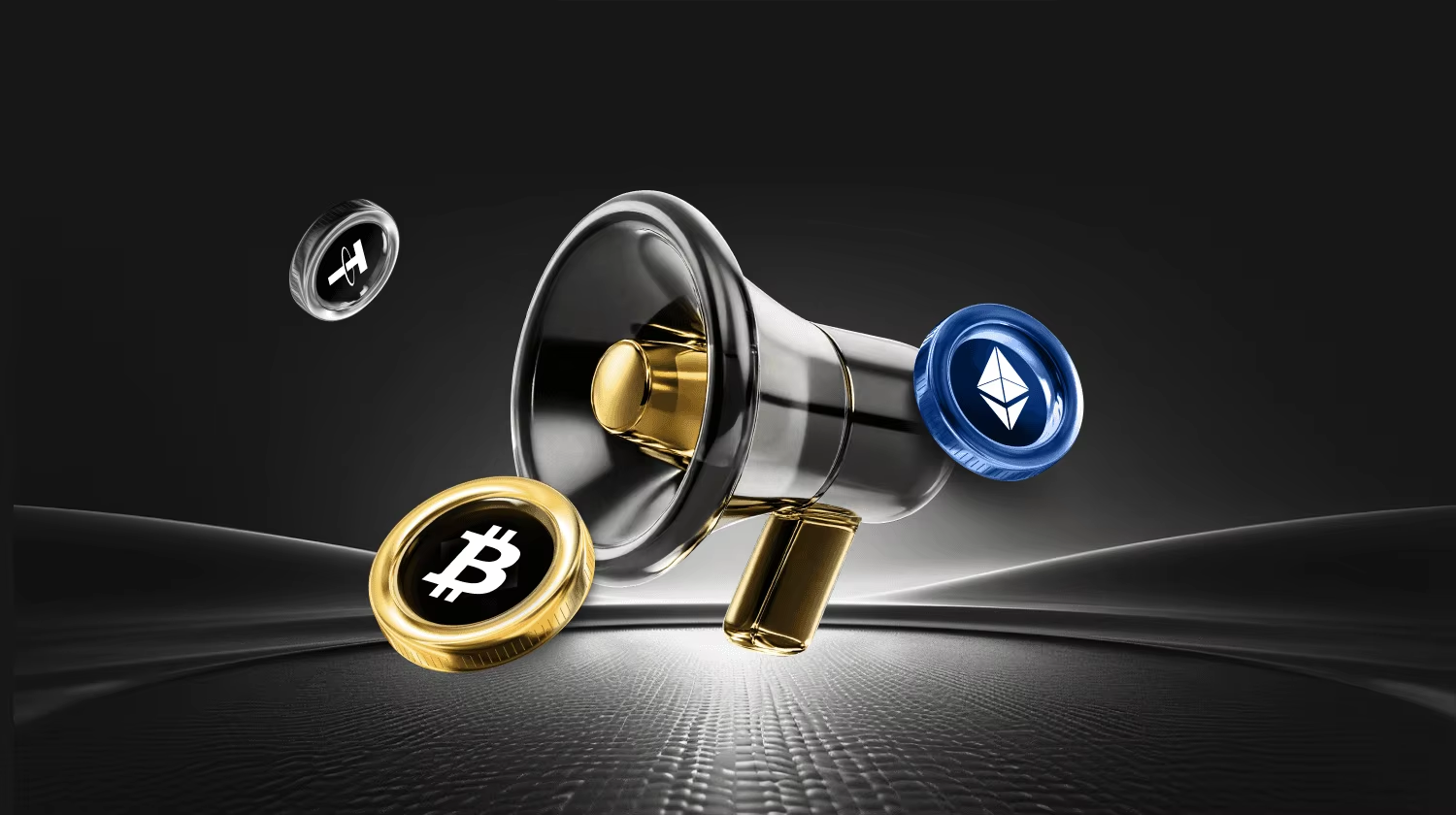
By the will of the Bank of Russia, only three assets are available in legal circulation:
- Bitcoin — allowed in the legal framework, but the origin of funds may be checked when transferring to foreign platforms.
- Ethereum — also available in legal circulation; risks are not related to the asset itself but to the route of its movement through Russian infrastructure.
- USDT — allowed, but appears more sensitive due to sanctions and compliance risks, as Tether is technically capable of freezing tokens on holders' addresses.
This list alone does not make the assets problematic but limits the depth of the market. For an investor accustomed to regulated investments and infrastructure like the Moscow Exchange, such a format may seem clearer; however, the crypto market operates under different rules: each transaction may be assessed through the lens of the origin of assets.
Pitskov allows that Bitcoin and Ethereum purchased on a Russian platform can be stored on a hardware wallet. However, when attempting to transfer them to an international exchange, use a foreign custodial service, or withdraw through a foreign exchange, questions may arise.
With USDT, according to the expert, the situation is more sensitive. The issuer of the stablecoin, Tether, is technically capable of freezing tokens on holders' addresses, so for this asset, sanctions and compliance risks appear higher.
Limits for non-qualified investors and a short list of available assets do not color cryptocurrency by themselves but may make the internal market less deep.
Demand Will Remain, but Prices May Diverge
Kirill Pitskov does not single out any specific norm that creates a market for marked cryptocurrencies by itself. According to him, the risk arises from the combination of new regulations and the sanctions environment. In practice, this may reduce arbitrage between Russian and foreign platforms and lead to the formation of a separate price contour with a discount to international quotes.
The further dynamics of the Russian cryptocurrency market will depend on whether channels with external liquidity remain open. If they remain operational, the legal segment will be able to develop alongside the global market. If checks and restrictions are tightened, a scenario of stagnation or harsher isolation with separate prices within the country is likely to emerge.
At the same time, the legal market in Russia, according to estimates from Finam, will still be in demand. For mass investors, the following are important:
- purchasing in rubles;
- working through a familiar broker;
- legal protection;
- clear tax accounting.
For more experienced participants, the price difference within the country and beyond, as well as the ability to withdraw assets to their own wallet, will be significant.
Among the notable participants in such a market are exchanges, brokers, digital depositories, and liquidity providers. A legal contour will form around them, which, on the one hand, provides investors with clearer rules, while on the other hand, increases the risk of external marking of related assets.
The same logic applies not only to trading. Participants for whom mining, long-term investments, or regular transactions with digital assets are important will evaluate not only the price but also the future liquidity of the asset outside the Russian contour.
Real demand largely depends on whether Russian participants can maintain operational channels with external liquidity and prevent the legal market from turning into a completely closed system.
The chairman of the board of the Finam group, Vladislav Kochetkov, had previously warned about the risk of isolation of the Russian cryptocurrency market. According to his estimates, a separate market for marked cryptocurrencies with a significant discount to international benchmarks may arise in the country. In this context, government decisions are also significant: changes in legislation passed through the State Duma, and the law on cryptocurrency control was signed by Vladimir Vladimirovich Putin.
-- Price
This content is provided for general informational purposes only and doesn't constitute financial, investment, legal, or tax advice. Any events, rewards, online promotions, or related information mentioned herein should not be considered a recommendation, solicitation, or invitation to purchase, sell, trade, or otherwise deal in any crypto assets. Crypto assets are highly volatile and may result in loss. The availability of WEEX services, products, and related events may vary by region. You are responsible for ensuring that your participation is in accordance with applicable local laws and regulations.
You may also like

Bitwise HYPE ETF adds $10.5m after four-day pause

Inside the 15-minute trading pulse that moves $14 billion in Bitcoin perpetual futures

Tokenized Assets: The Next Crypto Liquidity Driver According to Wintermute

TRON Account Growth Reaches 402 Million: Can It Challenge Ethereum in the Stablecoin Market?
350 Bitcoins Move After 16 Years, Valued at $28 Million

What is Delta Hedging: A Method to Neutralize the Risks of Spot Holdings

The Surge of 'Buybacks' in the Cryptocurrency Market
Revolut Euro Stablecoin Trials for Customers in Denmark, Poland, and Portugal

Ripple: Brad Garlinghouse Links Slow Gold Movement to Cryptocurrency Value
Touch Grass Conducts Stock Token Reward Experiment on Robinhood Chain
Stablecoins in Brazil: 80% of the Cryptocurrency Market
Shiba Inu Profile Update: Kusama Changes Bio and Sparks Community

How to Use ChatGPT for Trading?
Despite Limited Purchases by the BCRA, Reserves Increased by Nearly $1 Billion in the Week

Tokenization of Real Estate Credit Unites BB, Caixa, and Cooperatives
Importing Phones Requires IMEI Code Registration from September 4

Base Loan Balance Reaches $2.337 Billion, Concentrated in Morpho
PL Deputy Proposes Gun Carrying Rights for Cryptocurrency Investors and Industry Executives
Why GENIUS could leave digital dollars vulnerable to sudden blockchain network ‘bank runs’
Gold Reaches Key Level After Correction and Recovery

Cybercrime, Child Gambling, and Underground Banking
Increased Likelihood of the UK Returning the Falklands to Argentina

US Employment Surprises Threefold, Renewing Tightening Concerns... Dollar and Interest Rates Rise Together
Full Sail Shuts Down After Switchboard Incident

Tornado Cash Mentioned in 107 Investigations, Not Scale of Processing

Cryptocurrency Dollarization: Why Bitcoin May Challenge the US Dollar
Canary Capital teases staked TRX ETF launch
Kalshi adds 5 crypto perpetuals for U.S. traders
AIINU Price Prediction After 27% Drop: Rebound or More Losses?
Notional Finance faces suspected $1.7M exploit
Bitwise HYPE ETF adds $10.5m after four-day pause
Inside the 15-minute trading pulse that moves $14 billion in Bitcoin perpetual futures
Tokenized Assets: The Next Crypto Liquidity Driver According to Wintermute
TRON Account Growth Reaches 402 Million: Can It Challenge Ethereum in the Stablecoin Market?
350 Bitcoins Move After 16 Years, Valued at $28 Million
What is Delta Hedging: A Method to Neutralize the Risks of Spot Holdings
Contents
Latest articles





Latest coin listings on WEEX


