
Self-Rescue and Breakthrough in the Cold Winter: How Can Crypto Lending Find New Growth?

 Prefer us on Google


Author: Nancy, PANews
The crypto market has suddenly encountered a "cold wave," and the lending market, like a duck sensing the warmth of spring water, faces a dual test of funds and demand.
However, lending players have not been idle. As traditional growth models driven by crypto assets and leverage gradually lose momentum, many players are not retreating but are instead seeking new collateral, funding sources, and profit spaces.
A layout around the next round of growth is unfolding in the market's winter.
From Expanding Assets to Strengthening Risk Control, Liquidity Contraction Forces Transformation
In the face of a market environment characterized by declining risk appetite and continuous leverage contraction, the crypto lending market is still actively seeking new growth spaces. Behind the market's counter-cyclical layout are persistent financing demands and the driving forces brought about by the maturity of underlying infrastructure and changes in the external environment.
On one hand, the market's demand for liquidity has not disappeared. For long-term holders, directly selling assets may mean giving up future gains, but operations, investments, and daily expenses still require liquidity. Borrowing fiat or stablecoins using crypto assets as collateral allows holders to retain their original asset exposure while meeting their liquidity needs.
At the same time, the maturity of underlying infrastructure has lowered the entry barriers for institutions into this market. Lending protocols like Morpho and Aave are gradually transforming from DeFi applications into infrastructures available for institutional use, providing core functions such as lending, liquidation, and risk management, enabling more institutions to quickly launch their own branded products without building lending systems from scratch.
Moreover, the gradual clarification of regulatory pathways, increasing pressure to retain institutional clients, and the continuous enrichment of product forms are also driving the market to expand its business boundaries and seek new growth points.
The expansion of compliant channels has opened up new market spaces for lending businesses. On November 18, Coinbase announced that it had received approval from the New York State Department of Financial Services (NYDFS) to expand its on-chain collateralized lending service, Coinbase Borrow, based on the Morpho protocol on the Base network to New York State. This service now covers all 50 states in the U.S., further expanding its business scope in the U.S. market.
Diversification of collateral is another important path. Following protocols like Aave, Jupiter recently announced that it will launch a licensed lending market on Jupiter Lend, initially supporting stocks listed on the New York Stock Exchange, such as Bullish, as collateral for users to borrow other assets. Morpho has also recently launched Robinhood stock tokens, allowing users to use stock tokens as collateral to borrow stablecoins; Maple Finance has also disclosed plans to provide loans backed by tokenized stocks, viewing this as an important development direction for 2027 to reduce reliance on crypto collateral.
In addition to introducing traditional financial assets, Aave will support native BTC as collateral. Aave DAO recently proposed to support native Bitcoin collateral through Babylon Trustless Bitcoin Vaults (TBV) on Aave V4. At that time, Bitcoin holders can lock native BTC through self-custody and borrow assets like USDT and USDC without relying on wrapped tokens, cross-chain bridges, or third-party custody protocols.
Furthermore, controlling risk exposure and optimizing asset structures have also become key focuses for lending protocols. Aave has recently proposed to adjust the asset allocation of its maximum lending market, V3 Core, shifting its focus to more liquid blue-chip collateral assets. According to the relevant adjustment plan, collateral assets worth approximately $1.52 billion, supporting about $1.17 billion in debt, may be migrated out of the V3 Core market; Lido is also advancing lending operations that emphasize risk isolation, with its Lido Lend launched based on Morpho Blue, planned to go live in the fourth quarter, focusing on low-volatility blue-chip asset trading pairs and controlling risks through market isolation and exit mechanisms.
The crypto asset management platform Abra has partnered with the Intercontinental Exchange (ICE) to launch an institutional digital asset collateralized lending service, supporting borrowing dollars against BTC, ETH, and SOL as collateral, with collateral assets held in isolated custody accounts at ICE Digital Trust during the loan period, without re-staking, to reduce the risks associated with the reuse of collateral assets.
It is evident that while seeking to expand lending scale, various platforms are simultaneously broadening the range of collateral by introducing traditional stocks and native Bitcoin into on-chain lending; on the other hand, they are adjusting asset structures and improving risk management mechanisms to reduce reliance on single crypto assets and enhance the market's resilience in volatile environments.
The Lending Market Continues to Cool, This Round of De-leveraging May Be Healthier
While lending platforms actively explore business expansion, the entire market has still not escaped the predicament of scale contraction and liquidity pressure.
According to Blockworks data, as of November 18, the overall scale of the crypto lending market is approximately $71.32 billion, a decrease of about 47.5% from last year's peak of $135.78 billion. In just the past month, the market size has decreased by $10.82 billion. Among them, the leading protocol Aave is the largest source of this contraction, with a scale reduction of $4.04 billion, accounting for about 37.3% of the total market decline; the second and third-ranked Morpho and Spark have also seen significant declines, with a cumulative reduction of nearly $2.68 billion.
As the market scale contracts, the profitability of lending businesses is also under pressure. Currently, the weekly revenue of the crypto lending market is only $2.717 million, a decrease of about 78.6% from the peak of $12.669 million in 2025.
With both scale and revenue declining, the market is not only facing capital contraction, but lending demand and business activity are also cooling simultaneously.
However, compared to the previous bear market, this round of market contraction is somewhat different. A report by Galaxy Research previously pointed out that although the scale of the lending market has significantly shrunk, the outstanding loan balance shows a stable, stepwise decline rather than a sharp collapse in a short period. This relatively gentle pace indicates that the current de-leveraging process is much healthier, mainly driven by market participants actively contracting rather than forced liquidations or chain reactions caused by institutional defaults and bankruptcies.
Specifically, the decline in asset prices is an important reason for the shrinkage of the lending market scale this round. As the prices of major collateral assets like BTC and ETH continue to fall, the dollar-denominated value of collateral within protocols also decreases. Even if users do not actively withdraw funds, the depreciation of collateral valuations will directly lower the book size of the lending market.
At the same time, the tightening macro environment further weakens market demand. The two-year U.S. Treasury yield has risen sharply, putting pressure on risk assets, and risk appetite for capital has declined accordingly. Some funds have shifted from high-risk areas like the crypto market to relatively safe assets, leading to weakened lending demand and net outflow pressure on protocol deposits.
The contraction of stablecoin supply has further exacerbated the liquidity pressure in the lending market. As an important source of funds for on-chain lending, the decline in stablecoin scale means reduced dollar liquidity available for lending. Blockworks data shows that since the total supply of stablecoins peaked at $299.3 billion in March this year, the scale of stablecoins in the lending market has shrunk by over 53%, currently remaining at about $5.8 billion, excluding centralized exchanges (CEX).
In addition, large-scale liquidation events and frequent security incidents continue to impact market confidence, while the declining attractiveness of lending yields has also weakened the willingness of funds to remain in protocols.
For lending platforms, in the winter of the market, the focus of industry competition may no longer be limited to the comparison of lending scale and yield, but rather shift to a comprehensive competition in asset supply, institutional capital introduction, and risk management capabilities. Whether they can expand business boundaries while maintaining risk bottom lines and establish stable, sustainable profit models will be key for platforms to navigate through market cycles.
-- Price
This content is provided for general informational purposes only and doesn't constitute financial, investment, legal, or tax advice. Any events, rewards, online promotions, or related information mentioned herein should not be considered a recommendation, solicitation, or invitation to purchase, sell, trade, or otherwise deal in any crypto assets. Crypto assets are highly volatile and may result in loss. The availability of WEEX services, products, and related events may vary by region. You are responsible for ensuring that your participation is in accordance with applicable local laws and regulations.
You may also like

Animoca Co-Founder Criticizes Traditional Bank Checking Accounts, AI Agents and DeFi May Reshape Financial Services

The Arrogance and Prejudice of a16z

WBTC Expands Into Confidential DeFi, STRK Rewards and Institutional Lending

Lido’s lending plan could block loan repayments without stopping interest

XRP loans trigger 883 liquidations, and $53M remains at risk

RWA Weekly: NYSE to Use Avalanche for Settling Tokenized Stocks; Goldman Sachs, Citigroup Commit Approximately $270 Million to Joint Stablecoin Project

Analyst: HYPE Buyback Outperforms PUMP, AAVE, and JUP
Alta raises $47.5M for blockchain backed by crypto skeptic Jack Zhang

US card debt hits $1.29 trillion as Bitcoin loans expose a collateral divide

Valour Lists Eight New Crypto ETPs Including Canton, Morpho and Raydium
Chainalysis Report: Why Did Western Europe Withstand the Global Crypto Market Chill?
Tokenized gold can now back a Coinbase loan. The price feed takes weekends off

Raycash Launches on Ethereum Mainnet, Offering Privacy Stablecoin Payments and Yield Features
Groma Launches Permissioned Asset GRO on Uniswap v4, Supporting On-Chain Trading

OAK Research: Stablecoin Revenue Not Flowing to Public Chains

What Makes Erebor, Dubbed the 'Next Silicon Valley Bank', Attractive to SBI and Robinhood?

Total Deposits of reUSD and reUSDe Exceed $400 Million, reUSD Launches on Monad

Onlend Unveils No-Code Infrastructure to Launch Custom Onchain Lending Apps

Morpho Loans Exceed $5.8 Billion: Growth Driven by Application Traffic or Reward Subsidies?

The Same Bad Debt: Five Points of Loss Recognition in DeFi Treasuries
Spark's Q3 Lending Market Share Rises to 13.2%, Net Income Drops 30%

1kx Blockchain Industry In-Depth Report: Who is Really Making Money?

USDD Reports Strong Treasury Performance, Growth in Key Metrics, and Ecosystem Expansion

Morpho RWA deposits pass $2B as loans approach $900 million

Birch Hill Completes $4 Million Seed Round Financing Led by Multicoin Capital

A New Wave of TGE? 19 Projects Expected to Launch Intensively in Q4
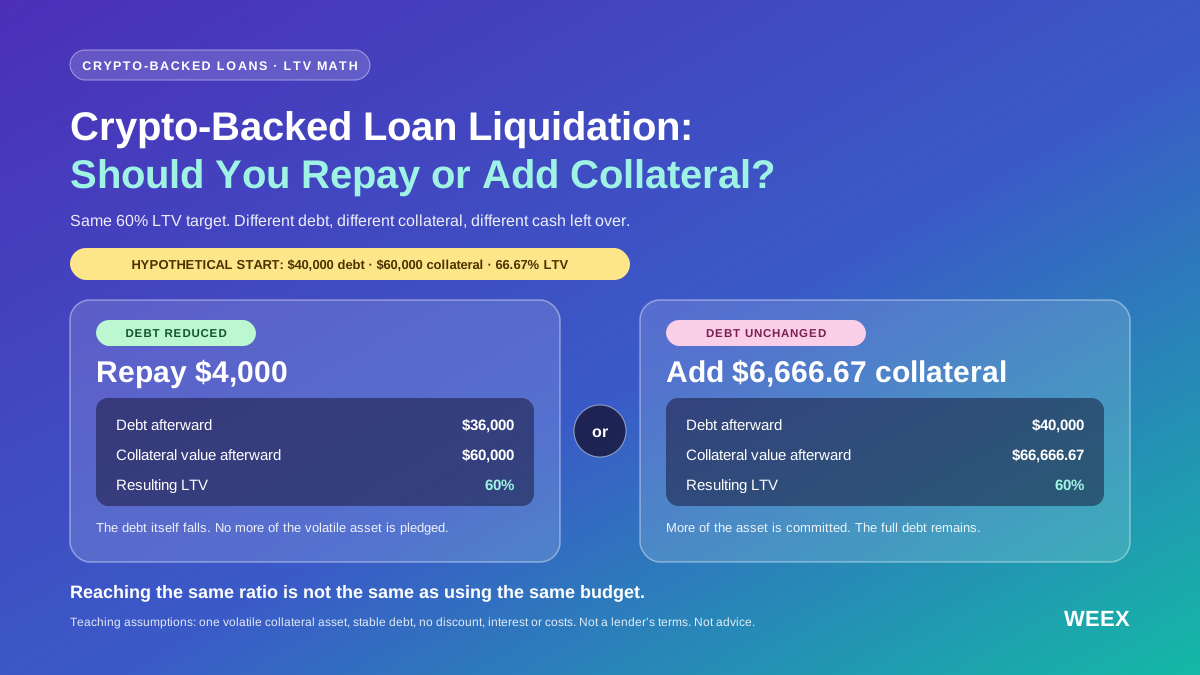
Crypto-Backed Loan Liquidation: Should You Repay or Add Collateral?
Facing crypto-backed loan liquidation? Compare repayment and collateral top-ups using equal budgets, LTV calculations, stress tests and protection limits.

Who Holds Tokenized Stocks? A Large Number of Retail Investors with Highly Concentrated Assets
Stablecoin Deposits in DeFi Grow to $24 Billion

Five DeFi Projects Under Observation: From Tiered Vaults to On-Chain Perpetual Order Books
Animoca Co-Founder Criticizes Traditional Bank Checking Accounts, AI Agents and DeFi May Reshape Financial Services
The Arrogance and Prejudice of a16z
WBTC Expands Into Confidential DeFi, STRK Rewards and Institutional Lending
Lido’s lending plan could block loan repayments without stopping interest
XRP loans trigger 883 liquidations, and $53M remains at risk
RWA Weekly: NYSE to Use Avalanche for Settling Tokenized Stocks; Goldman Sachs, Citigroup Commit Approximately $270 Million to Joint Stablecoin Project
Latest articles


Latest coin listings on WEEX


