
The Hook Ecosystem Begins to Stir! Who Will Be the Next Dark Horse?

 Prefer us on Google


The number of ecological projects around Uniswap V4 Hook is increasing, but projects that can establish real businesses relying on Hook still need time to filter.
Written by: KarenZ, Foresight News
In the world of DeFi, Uniswap has never lacked imitators, but recently, a batch of new projects has begun to try to create something different based on Uniswap.
Some focus on trading fees, some attempt to redistribute arbitrage profits, some explore new liquidity management methods, and others hope to implement more complex execution rules for token trading.
A common technical keyword behind these projects is: Hook.
Hook is not a new feature recently introduced by Uniswap. It has been one of the core innovations of this version since Uniswap v4 officially launched in January 2025. Now, as projects built around Hook continue to emerge, this originally developer-oriented technical concept is beginning to enter the sight of more crypto investors.
This article will sort out eight relatively popular Hook ecosystem projects (not investment recommendations): Hookr, StonkBrokers, What The Hook, Bordrless, The Standard Reserve, Programmable, Claus, and Fables Finance, and see what developers are doing with Hook.
What is Hook? Adding "Custom Rules" to Uniswap Trading Pools
In simple terms, Uniswap provides basic trading facilities, while Hook allows developers to write additional operational rules for specific trading pools.
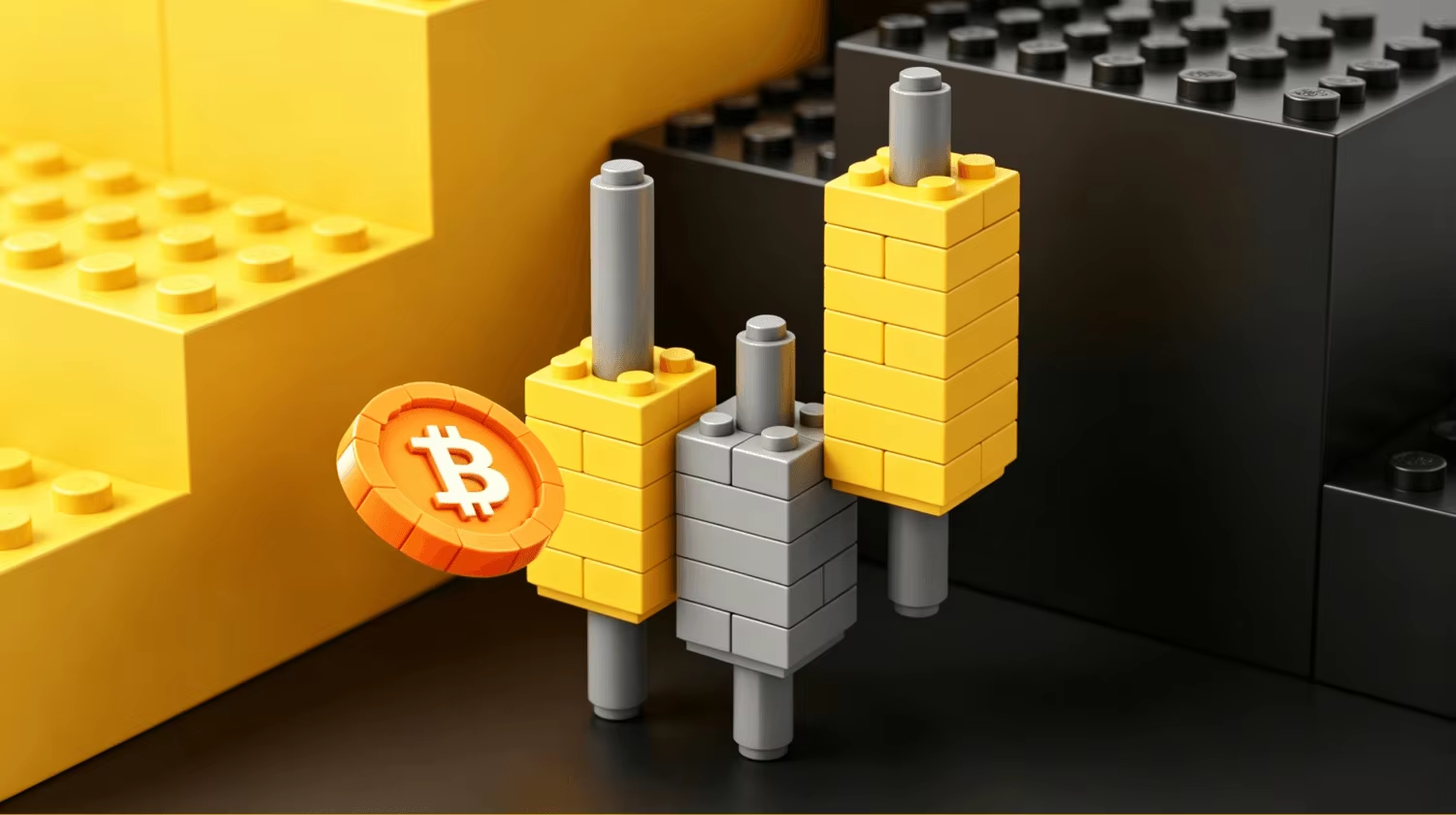
In Uniswap v4, Hook is an external smart contract attached to liquidity pools. It can execute custom logic before and after operations such as pool creation, liquidity addition or removal, and trading, allowing developers to design different rules for different markets.
For example, fees can be adjusted according to market changes, trades can trigger rewards, and liquidity pools can also incorporate specialized pricing or order mechanisms.
Behind the Popularity: Triple Risks of Early Projects
Of course, compared to mature DeFi protocols, some of the currently popular Hook ecosystem projects are still in the product and market validation stage.
First is the risk of technology and smart contracts. Hook can execute custom logic in the trading process, but this also expands the range of code that needs to be reviewed. The infrastructure of Uniswap v4 has been developed and tested, but that does not mean that any third-party Hook automatically inherits the same level of security. Complex trading logic may also lead to unexpected execution results. Custom accounting, external oracles, dynamic fees, and upgradeable permissions can all affect transaction and liquidity security.
Second is the risk of market liquidity and price volatility. Early tokens may experience significant fluctuations due to the small size of the trading pool, with noticeable rises and falls on small amounts of buying and selling. Investors need to pay attention not only to token prices and market capitalization but also to check actual tradable liquidity, token concentration, bundling degree, token issuance permissions, and the trading behavior of large holders.
Finally, there is the risk of a disconnect between product value and token value. A Hook that can achieve useful functions does not necessarily mean that the tokens issued can capture protocol revenue. The trading volume, fees, buyback mechanisms, or revenue distribution promoted by the project all need to be carefully considered.
It is especially important to note that being deployed on Uniswap v4 does not equate to receiving official endorsement from Uniswap; using Hook technology does not mean that the project has established a sustainable business model.
Therefore, the following projects are more suitable as early ecological observation lists rather than investment recommendations.
Several Hook-Related Projects Worth Observing
Hookr
Hookr focuses on making it easier for developers and project parties to combine, deploy, and use Hook. The platform operates on the Robinhood Chain, supports new token issuance, and also allows for the establishment of new Uniswap v4 pools for existing assets. Creators can choose dynamic fees, anti-sniping, automatic burning, and LP rewards as Hook Blocks to configure different rules for different pools.
Its product range has extended to Builder (creating pools or deploying Hooks with Hook), Hook directory, SDK, and HookrScan (to see ratings). Thus, Hookr's highlights lie not only in issuing tokens but also in whether it can lower the threshold for using Hook: making rules understandable for traders, enabling developers to reuse modules, and allowing other products to access these markets.
However, the more combinable functions there are, the more specific pool configurations need to be checked. The official website also clearly states that the contracts have undergone adversarial reviews but have not yet accepted external audits.
According to GMGN data, the current market value of Hookr token HOOKR is $26.5 million, with a peak market value of $31.43 million.
StonkBrokers
StonkBrokers is a DeFi infrastructure and experimental suite running on the Robinhood Chain, focusing on stock tokens, Uniswap v4 Hooks, and liquidity pools.
It combines DeFi tools with tokenized U.S. stocks on the Robinhood Chain while providing NFT communities, Launchpad, and incubation functions. The team claims to act as an "on-chain Y Combinator" through Special Projects, providing tracks, liquidity, and community distribution for early projects.
On October 14, Beijing time, StonkBrokers utilized Uniswap v4 Hook functionality, in collaboration with Hookr, to create a new type of token called "Pair Token," which is a hybrid, auto-compounding ERC-20.
The principle is to merge two tokens into a new token (for example, ETH + NVDA = ETHNVDA, or NVDA + TSLA = NVDATSLA). Each pair token represents a proportional share of the corresponding full-range Uniswap v4 liquidity pool.
Using the new primitives created with Uniswap v4 Hook, two tokens (e.g., ETH + NVDA = ETHNVDA) are merged into an auto-compounding ERC-20, representing a share of the full-range Uniswap v4 liquidity position. It can be minted, traded, and redeemed, with fees automatically reinvested (stock tokens also have a dividend compounding effect). In terms of fees, minting and redeeming are free. A 10% fee is charged on LP fees during compounding, used for STONKBROKER buybacks.
According to GMGN data, the current market value of STONKBROKER is $15 million, with a peak market value of $95.75 million on August 12.
What The Hook
What The Hook (WTH) has a relatively clear product entry point: redistributing arbitrage profits between trading pools.
In AMM trading, different liquidity pools may experience temporary price differences due to trading activities. Arbitrage traders can profit by buying and selling upon discovering these differences, prompting prices in different markets to converge.
What The Hook aims to change is not the arbitrage behavior itself but who ultimately receives the arbitrage profits.
According to its official documentation, What The Hook checks for price differences between related trading pools on Robinhood through Uniswap v4 Hook, executing arbitrage and distributing the actual profits when conditions are met and costs are deducted.
Its documentation lists two profit distribution methods:
- WTH's own trading pool: traders receive 10% of the captured arbitrage profits, while the WTH treasury receives 90%.
- Third-party access trading pools: profits are defaulted to distribute 5% to traders, 45% to liquidity pools, 40% to the WTH treasury, and 10% to referral partners.
It is important to emphasize that these ratios pertain to successfully captured arbitrage profits, and the distribution ratios for specific cooperative deployments can be adjusted.
The business logic of WTH is that if more third-party trading pools access its Hook, the protocol may earn revenue from more arbitrage activities. However, it also faces practical limitations: arbitrage opportunities do not arise with every trade, and competitive arbitrage mechanisms, trading costs, market depth, and the number of access pools can all affect final profits.
More importantly, the income received by the WTH treasury does not equate to direct dividends for WTH token holders.
According to GMGN data, the current market value of WTH is $6.4 million.
-- Price
Programmable (@ProgrammableHQ)
Programmable is a token and custom project issuance platform based on Uniswap v4, providing a modular issuance method without programming and a custom issuance interface for developers. The platform currently supports Ethereum mainnet and Robinhood Chain networks.
The platform mainly offers two paths:
The first is Module Mode: select compatible modules and configure parameters on the website without needing to write a complete smart contract.
The second is Custom Launch: developers can use their own tokens, Hooks, or other supporting contracts to prepare project issuance via API.
It, along with Hookr, is lowering the deployment threshold for customized markets. For such platforms, long-term competitiveness may depend more on module quality, integration capabilities, and actual usage rather than just short-term issuance numbers.
As of the time of writing, among the tokens issued through Programmable, sorted by market value, the Claus token (see introduction below) has a market value of $6.42 million, and the official Programmable token on the Robinhood Chain network currently has a market value of approximately $4.64 million. Another project, Temo, has a market value of $450,000.
Claus
Claus (CLAUS) is an experimental project built on Ethereum's Uniswap v4 Hook. Its core feature is that after the token is issued, it can increase, modify, or remove functions by updating the Hook contract without needing to reissue the token. The CLAUS token is issued through Programmable.
Fables
Fables Finance is a decentralized exchange built on Robinhood Chain based on Uniswap v4 Hook, combining the ve(3,3) token economic model with a programmable trading pool mechanism, aiming to enhance liquidity incentives and the flexibility of trading fee distribution.
Its core feature is utilizing Hook to set dynamic fees for different trading pools, adjusting trading costs based on market fluctuations and other conditions to improve the yield structure for liquidity providers. At the same time, Fables introduces the ve(3,3) mechanism, combining token locking, governance voting, and liquidity incentives, allowing participants to influence incentive distribution.
The Standard Reserve
The Standard Reserve uses Hook for an on-chain monetary policy experiment. Its designated ETH/STANDARD trading pool tracks net ETH flow, and the "central bank" contract adjusts issuance based on this: continuous inflows correspond to issuance expansion and reserve accumulation, while outflows correspond to issuance contraction, complemented by a buyback and burn mechanism.
According to GMGN data, the current market value of the STANDARD token is $26.17 million.
Bordrless
Bordrless needs to be mentioned separately, as it uses a Hook mechanism developed independently on Solana, rather than being directly based on Uniswap v4 Hook.
It has built its own token standard, DEX, and issuance platform on Solana, allowing developers to write custom rules for token transfers, minting, burning, and trading.
For example, developers can design mechanisms where a portion of the amount automatically enters a designated account during token trading, and a portion of the tokens is burned; they can also change fee rules based on holding time, market conditions, etc.
The idea is to give the tokens themselves richer programmability while supporting trading and issuance activities through the accompanying DEX and Launchpad.
As of the time of writing, only two tokens issued through the Bordrless Launchpad have market values between $100,000 and $200,000, while the rest are in the thousands to tens of thousands of dollars.
According to GMGN data, the current market value of Bordrless token BORDR is $6.4 million.
Conclusion
From these product paths, it can be seen that Hook is enabling trading pools to take on more functions: combining issuance rules, distributing arbitrage profits, managing reserves, providing governance signals, and responding to market risks of different assets.
What is more worth observing next is whether custom rules create real value? Are there external users or projects willing to continue using? And can these usage activities form verifiable protocol revenue?
While more projects capable of writing Hook may emerge, those that can establish real businesses relying on Hook still need time to filter.
This content is provided for general informational purposes only and doesn't constitute financial, investment, legal, or tax advice. Any events, rewards, online promotions, or related information mentioned herein should not be considered a recommendation, solicitation, or invitation to purchase, sell, trade, or otherwise deal in any crypto assets. Crypto assets are highly volatile and may result in loss. The availability of WEEX services, products, and related events may vary by region. You are responsible for ensuring that your participation is in accordance with applicable local laws and regulations.
You may also like

SCEX Increases Capital by 1,500 Times, Qualifies to Establish Crypto Exchange

US deposit rates choke USDC adoption, and a BIS model reveals why

Lido DAO exposes token flaw and forces a budget review
Is Crypto in a Bear Market in 2026? 7 Indicators to Watch

Bank of America Fund Manager Survey: Tech Stock Overweight Hits Six-Year High, Semiconductors Become Most Crowded Trade

Artificial Intelligence Limits $190 Billion Risk in XRP and ZEC Networks
a16z Rethinks KYC: Institutions Embrace On-Chain Without Being Stuck in Traditional KYC Frameworks

KRX After-Hours Market Marks One Month, 90% of Transactions from Retail Investors

Analyzing DRV Through Citrini's 'Breaking The Wall' Logic: The Charging Entry of On-Chain Derivatives Under AI and RWA Narratives

Anthropic Tests Autonomous AI Replication on 8 Nodes in 4 Out of 5 Trials

NEXTPredict Paid $12,000 to Hedge Its Conference on a Prediction Market

Aptos Mainnet Launches Encrypted Memory Pool, Keeping Transaction Content Encrypted Until Confirmation

USDe: Nearly 70% Shrinkage from Peak One Year After the '1011 Crash'
IMF: What Conditions Are Needed for Tokenization to Realize Value?
Crypto week ahead: 5 events traders should watch
Budget 2027: stablecoins, exit tax, wallets, are you affected by Tuesday's revote?

Aave’s USDG rollover plan has a yield below most quoted borrowing rates
How far can PaperTrade's 1000x leverage experiment go, even if it means queuing to lose money?

Top Crypto Communities in 2026

Tokenized stocks can carry the same rights without the same trading protections

Bitcoin companies are learning that holding forever takes cash
Post-World Cup Analysis of the Prediction Market Industry Landscape and Trends
The Harsh Truth of the VC Industry: Why Most Funds Haven't Returned Principal After Nine Years?

Agentic Payments on XRPL Exceed 13 Million Transactions

"Increased Redemption Uncertainty During USDT Bank Run"... Warning from Bitcoin DAT Company in SEC Filing

Why I Stopped Pursuing Web3 Payments
ETH fee burns cover just 2% of new coins printed in 2026
Stablecoins: The Fed Proposes 2 Days for Redemption
唐华斑竹 Announces JST Holders Can Participate in TRON DeFi Summer S3
Kevin O'Leary's Latest Interview: The Next Stop for AI is Not Models, But Energy
SCEX Increases Capital by 1,500 Times, Qualifies to Establish Crypto Exchange
US deposit rates choke USDC adoption, and a BIS model reveals why
Lido DAO exposes token flaw and forces a budget review
Is Crypto in a Bear Market in 2026? 7 Indicators to Watch
Bank of America Fund Manager Survey: Tech Stock Overweight Hits Six-Year High, Semiconductors Become Most Crowded Trade
Artificial Intelligence Limits $190 Billion Risk in XRP and ZEC Networks


