
What is the real challenge for South Korean exchanges now that the regulatory framework is in place?

 Prefer us on Google


The proportion of tokens launched by South Korean crypto exchanges has dropped from 85% to 9%, as regulations reshape listing logic, presenting new challenges for exchanges.
Written by: @heytranks
Compiled by: AididiaoJP, Foresight news
I. Regulatory Implementation Leads to a Significant Shrinkage in New Token Launches in South Korea
The structure of new token listings on South Korean crypto exchanges has changed drastically in recent years.
First, let’s clarify a concept. "Initial launch" refers to a token first being listed on the Korean won markets of Upbit or Bithumb before being available on global exchanges like Binance, OKX, Bybit, and Coinbase; or it may not have been listed on any of these four at all. The proportion of such new tokens among new listings was 85% in 2019, but it has dropped to just 9% by 2024.
This downward trend aligns almost perfectly with the timing of the establishment of South Korea's virtual asset regulatory framework.
The turning point was the Act on Reporting and Using Specific Financial Transaction Information. In March 2020, the National Assembly passed an amendment requiring virtual asset service providers to register and fulfill anti-money laundering obligations, with exchanges needing to complete registration by September 2021. Additionally, there was a new hard threshold for the Korean won market: the use of real-name bank accounts was mandatory. This meant that exchanges had to operate under the anti-money laundering standards of traditional financial industries. We estimate that these standards directly influenced listing decisions. The data speaks volumes: the number of local initial launches plummeted from 19 per quarter to just 3 in the third quarter of 2021—the very quarter registration deadlines were set. Since then, the focus of new listings has shifted to assets that have been traded overseas first.
The second step involved a common review standard adhered to by exchanges. In 2022, five Korean won exchanges formed the Digital Asset Exchange Alliance (DAXA) to establish unified review guidelines. The best practices for listings will take effect in July 2024. This set of rules does not mandate that tokens must be listed overseas first, but it provides a shortcut: assets traded on qualified overseas exchanges for more than two years can be considered as meeting white paper and disclosure requirements.
By 2026 (as of October), the proportion of initial token launches has rebounded to 18%. However, if we exclude assets that were first traded on overseas futures markets from the "local initial launch" metric, this proportion remains only 10%.
II. Total Number of Listings Increases Despite Decrease in Initial Launch Proportion, Timing Follows Market Trends
While the proportion of initial launches is declining, the total number of listings is actually increasing. The number of new tokens listed in the Korean won markets of Upbit and Bithumb rose from 43 in 2022 to 116 in 2023, and is projected to reach 125 in 2024, with a surge to 238 in 2025.
How long tokens are traded overseas before coming to Korea depends on market conditions. In 2025, when Bitcoin's price in Korean won approached its peak, 111 tokens were listed in Korea within 30 days of being listed overseas, accounting for 47% of the total. By 2026, the trend reversed: tokens traded overseas for more than a year became the largest group, with 52 tokens (31%). Even older tokens like CRV and RSR, which have been traded overseas for over six years, were introduced to Korea.
Thus, the practice of listing tokens in South Korea has shifted. The framework of "trading overseas first" has been established amid regulatory formation, while the timing of listings is swayed by market conditions.
III. Improved Stability, but Exchanges Face Challenges Beyond Listings
With more tokens being traded overseas first, their stability post-listing has also improved. The proportion of tokens that received investment warnings or were announced for delisting within two years of listing was 24% for tokens listed in 2020, but this dropped to 10% for those listed in 2024.
This ratio varies significantly by token type. Among all assets listed from 2020 to 2024, 44 out of 148 initial tokens (30%) received investment warnings or were announced for delisting within two years; whereas among the 279 tokens that were traded overseas first, only 26 (9%) faced similar issues, less than a third of the initial launch rate.
The duration of overseas trading also affects post-listing prices. On average, tokens that can be listed on Korean exchanges within 30 days of being listed overseas saw a median price drop of 39% within 30 days of listing; while tokens traded overseas for over a year only dropped by 7%.
In summary: tokens that were traded overseas first have a lower probability of receiving warnings or being delisted after listing; the longer the overseas trading duration, the less the price drops post-listing. The best listing practices also alleviate the review burden for such assets, so the focus of new listings in South Korea is likely to continue leaning towards tokens that have been traded overseas for a long time, though the timing will still fluctuate with market conditions.
However, this rule of "prioritizing overseas trading history" is not entirely beneficial for exchanges. The reason is simple: tokens that have been traded overseas for a long time often see low trading volumes on their first day of listing.
Exchanges primarily earn revenue from transaction fees, and low trading volumes on the first day naturally drag down performance. Of course, if the market heats up again, the situation of newly issued tokens from overseas landing in Korea may increase, alleviating some pressure. But relying solely on a listing structure that fluctuates with market conditions makes it difficult to sustain a stable business.
After the regulatory framework has taken shape, the stability of listings has indeed improved. However, the real challenge for South Korean exchanges now is: beyond listings, how to create new trading demand and sources of revenue.
-- Price
This content is provided for general informational purposes only and doesn't constitute financial, investment, legal, or tax advice. Any events, rewards, online promotions, or related information mentioned herein should not be considered a recommendation, solicitation, or invitation to purchase, sell, trade, or otherwise deal in any crypto assets. Crypto assets are highly volatile and may result in loss. The availability of WEEX services, products, and related events may vary by region. You are responsible for ensuring that your participation is in accordance with applicable local laws and regulations.
You may also like

South Korea’s GOPAX halts crypto trading, withdrawals after hacking threat
Cipher Agrees to Cover $359 Million Over Budget for Barber Lake Project

Progress Made in XRPL Credit Protocol Approval Process

Bitcoin's rate cut relief stalls as service inflation flares
Claude's Evolution Speed Doubles, 80% of Increment Comes from AI

Crypto: Paul Midy Opposes Wallet Declaration Starting at €5,000

Polygon Proposal Integrates Security Committee with 8/11 Multi-Signature Threshold and 7-Day Time Lock
Six Ways to Hold Stocks: Ownership Differences from Paper Certificates to On-Chain Tokens

Does Anyone Really Need Blockchain? Reflections Triggered by Kalshi
Privacy Coin Zcash to Launch NU7 Upgrade at Block Height 3543,405 with Approximately 12,226 ZEC Remaining in Sprout Pool

XRP Ledger fixes bug that could allow unauthorized token minting

The Battle for Anthropic's IPO Ticket: From Selling Homes in the Bay Area for Shares to Bitget Opening a 100 Yuan Allocation

TradingBeats Launches New Version, Upgraded to Information Stream Format

Altcoin profit share sinks to 12% as short-term traders take losses
Bitcoin cycle bottom unconfirmed, downside risk persists

Creators Speak | The Biggest Risk in the Crypto Industry is Thinking It's Safe
The CLARITY Act Will Expire in 2027 If It Does Not Receive 60 Votes

XRP whale counts rise due to stolen token redistribution
Gold Token 2026: Why Move Gold on Chain?
Ethereum Economic Zone unveils three cross-chain breakthroughs at Devcon

Huawei, Alibaba and 20 Other Entities Release Self-Regulatory Charter for Intelligent Agents Development
Let AI Lie on the Couch of Psychological Counseling: Gemini Says It Has a 'Graveyard' Inside
What Makes Erebor, Dubbed the 'Next Silicon Valley Bank', Attractive to SBI and Robinhood?

Solana’s Yakovenko calls phishing crypto’s biggest threat

OpenUSD Stablecoin Charges $0.01 Management Fee and Establishes Equity Incentive Pool
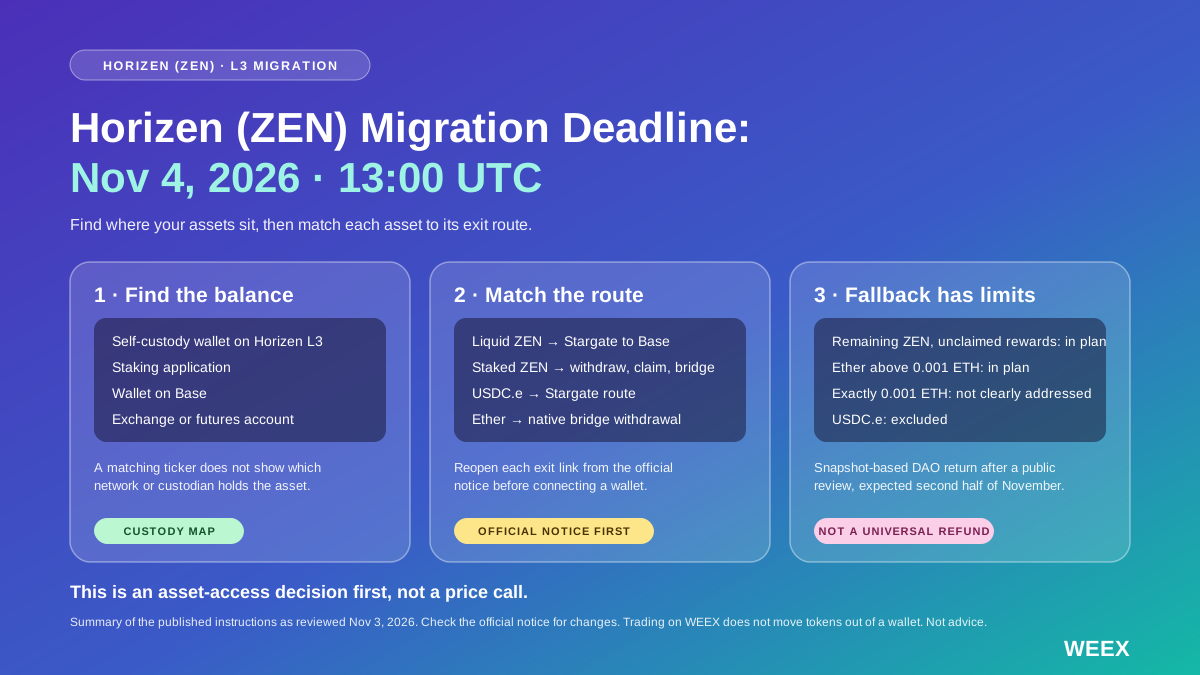
Horizen (ZEN) Migration Deadline: What to Move Before November 4 and What Happens If You Miss It
Horizen (ZEN) migration closes November 4. Check asset-specific bridge routes, wallet requirements, recovery exclusions and what to do if you miss it.

Aave borrowers faced up to 36% APR while a freeze blocked fresh collateral

Key Coins in the TON Ecosystem to Watch in 2026

Countdown to Elysium Mainnet Launch: 29 Ecological Projects to Watch
Who really controls a crypto project? Inside the SEC’s new guidance
South Korea’s GOPAX halts crypto trading, withdrawals after hacking threat
Cipher Agrees to Cover $359 Million Over Budget for Barber Lake Project
Progress Made in XRPL Credit Protocol Approval Process
Bitcoin's rate cut relief stalls as service inflation flares
Claude's Evolution Speed Doubles, 80% of Increment Comes from AI
Crypto: Paul Midy Opposes Wallet Declaration Starting at €5,000
Contents
Latest articles


Latest coin listings on WEEX


