Dominion Energy Stock: Dividend, Merger News and 2026 Outlook

Dominion Energy stock has shifted from a traditional utility dividend story into a merger, income and regulated-power-demand story. After NextEra Energy and Dominion Energy announced their proposed all-stock combination on May 18, 2026, investors now have to look at D stock through two lenses: Dominion’s standalone utility fundamentals and the value of the fixed exchange ratio into NextEra shares.
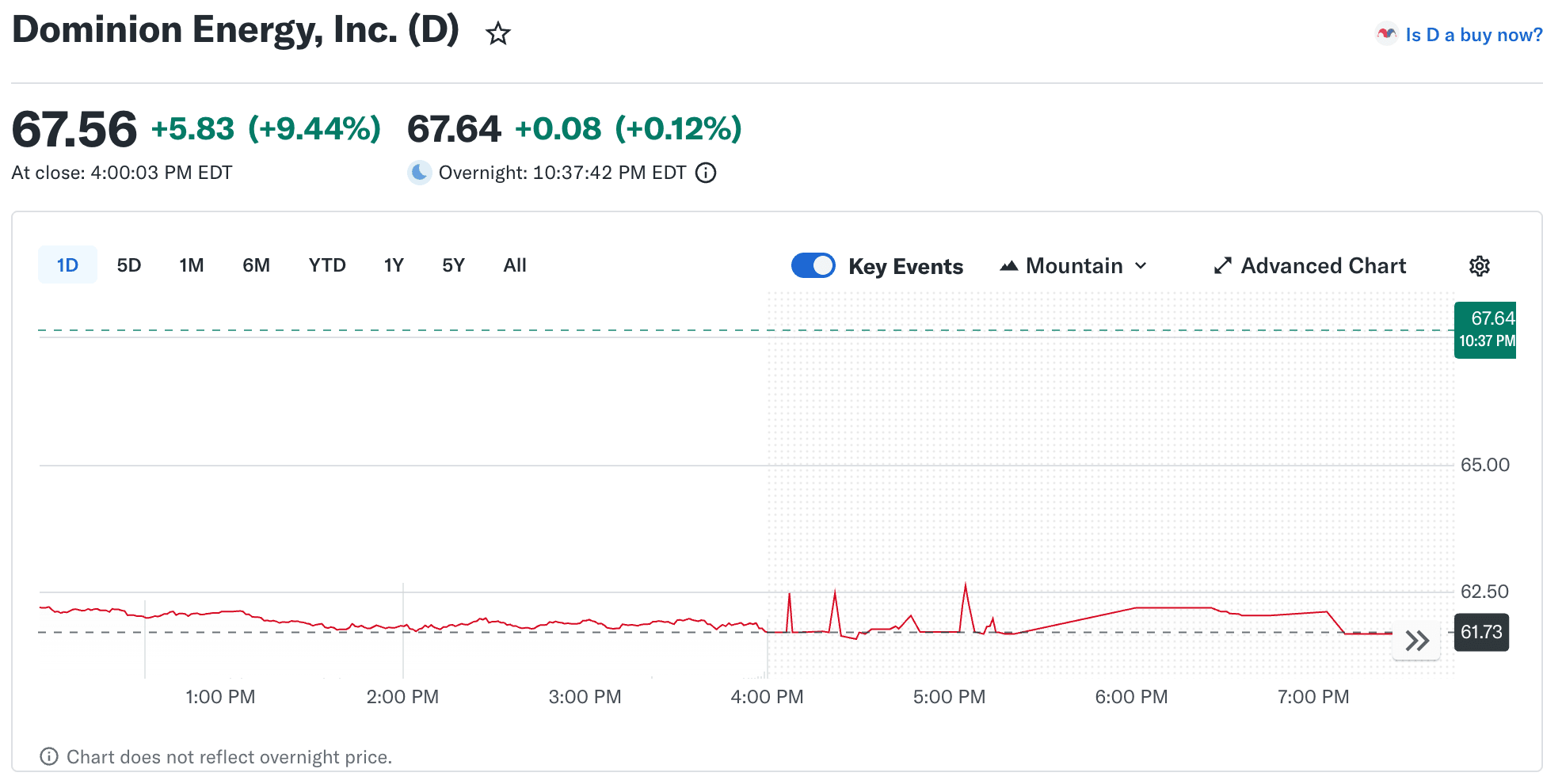
That makes Dominion Energy stock more complicated than a simple “buy for yield” utility pick. The dividend still matters, but the bigger question is whether the proposed NextEra deal improves the long-term growth, balance-sheet and dividend outlook enough to offset regulatory risk, execution risk and the wait before closing.
Dominion Energy Stock Key Facts
| Item | Detail |
|---|---|
| Company | Dominion Energy, Inc. |
| Ticker | NYSE: D |
| Sector | Regulated utility |
| Main business | Electric and natural gas utility operations |
| Key regions | Virginia, North Carolina and South Carolina |
| Latest major event | Proposed all-stock combination with NextEra Energy announced May 18, 2026 |
| Exchange ratio | 0.8138 NextEra shares for each Dominion share at closing |
| Q1 2026 operating EPS | $0.95 |
| 2026 operating EPS guidance | $3.45 to $3.69 |
| Quarterly dividend | $0.6675 per share declared for Q1 2026 |
| Main risks | Regulatory approval, interest rates, capital spending, dividend policy changes and deal completion risk |
Why Dominion Energy Stock Is Back in Focus
Dominion Energy stock moved back into the spotlight after NextEra Energy and Dominion Energy announced plans to combine. Under the announced terms, Dominion shareholders would receive 0.8138 shares of NextEra Energy for each Dominion share they own when the transaction closes.
That fixed exchange ratio is important. If NextEra stock rises, the implied value of the Dominion deal rises. If NextEra stock falls, Dominion shareholders are exposed to that downside. In other words, D stock now trades partly as a utility stock and partly as a merger-linked security.
The companies said the combination would create the world’s largest regulated electric utility business by market capitalization. The strategic logic is clear: U.S. electricity demand is rising because of AI data centers, manufacturing reshoring, electrification and broader grid investment needs. Dominion’s Virginia footprint is especially relevant because the state is a major data center market.
But investors should not treat the deal as finished. Utility mergers need shareholder approvals and regulatory clearance. State regulators, federal agencies and customer advocates may focus on power bills, service reliability, local investment and whether the combination benefits ratepayers.
Dominion Energy Dividend: Income Still Matters
Dominion Energy stock remains relevant for dividend-focused investors. In January 2026, Dominion declared a quarterly dividend of $0.6675 per share, payable March 20, 2026. The company also said this represented the 392nd consecutive dividend paid by Dominion Energy or its predecessor company.
For income investors, that history is meaningful. Utility stocks are often held for predictable cash flow rather than explosive growth. However, the proposed NextEra transaction changes the dividend question. Dominion shareholders are expected to continue receiving Dominion’s current quarterly dividend through closing, but after the deal closes, former Dominion holders would own NextEra shares and would be subject to NextEra’s dividend policy.
That means the dividend analysis should not stop at Dominion’s current yield. Investors need to compare three things: Dominion’s current dividend, the implied income from the NextEra shares they would receive, and the long-term growth outlook of the combined company.
Earnings and Growth Outlook
Dominion reported Q1 2026 operating earnings of $0.95 per share, compared with $0.93 per share in Q1 2025. The company also reaffirmed 2026 operating earnings guidance of $3.45 to $3.69 per share, with a midpoint of $3.57.
The standalone Dominion thesis has been built around regulated capital investment, grid modernization, renewable power, natural gas infrastructure and rising electricity demand. The stronger part of the story is demand: data centers and electrification can support long-term load growth. The harder part is cost recovery. Utilities can spend billions on infrastructure, but shareholder returns depend on regulatory approvals, allowed returns, financing costs and customer bill affordability.
That is why interest rates matter for Dominion Energy stock. Higher rates can pressure utility valuations because income investors have more alternatives in bonds and money-market products. Higher rates can also increase financing costs for capital-intensive utilities.
What the NextEra Deal Changes
The proposed NextEra-Dominion merger gives D stock a new valuation anchor. Investors are no longer looking only at Dominion’s earnings multiple or dividend yield. They are also looking at the value of 0.8138 NextEra shares.
| Factor | Why It Matters for D Stock |
|---|---|
| NextEra share price | Determines the implied value of Dominion’s fixed exchange ratio |
| Regulatory approval | A blocked or delayed deal could pressure D stock |
| Dividend treatment | Dominion income stream may change after closing |
| Rate environment | Utilities are sensitive to interest rates and financing costs |
| Data center demand | Supports power-demand growth but may require heavy investment |
| Customer bill credits and commitments | May influence regulatory and political reception |
The bull case is that Dominion shareholders gain exposure to a larger utility platform with scale, renewable development expertise and stronger access to capital. The bear case is that investors underestimate approval risk, integration risk and the possibility that the implied deal value moves lower if NextEra stock weakens.
WEEX Teaching: How to Compare Stock Risk With Crypto Market Risk
Investors researching Dominion Energy stock are usually thinking about income, lower volatility and long-term portfolio stability. That is very different from crypto trading, where prices can move sharply because of liquidity, leverage, sentiment and 24/7 market structure. Still, comparing the two markets can help investors understand risk more clearly.
On WEEX, beginners can start with the Risk Management Guide for WEEX Traders before placing any trade. The main lesson is position sizing: a trade should be small enough that a wrong move does not damage the whole account. This applies to both stocks and crypto, but the urgency is higher in crypto because leverage and volatility can accelerate losses.
For users who want to understand derivatives, the How to Trade Futures on WEEX 2026 guide explains how crypto futures work, including leverage and liquidation risk. Before trading, users should also review WEEX spot and futures trading fee rules, because fees and funding costs can affect results, especially for active traders.
The key point is not that crypto is a substitute for Dominion Energy stock. It is that every market has its own risk engine. Dominion Energy stock is mainly driven by dividends, regulation, rates, earnings and the NextEra deal. Crypto futures are driven by volatility, liquidity, leverage, funding rates and trader behavior. A disciplined investor studies the risk engine before chasing returns.
Is Dominion Energy Stock a Buy in 2026?
Dominion Energy stock may appeal to investors who want utility exposure, dividend income and potential upside from the NextEra combination. But it is not a clean standalone utility decision anymore. Buying D stock now means taking a view on the merger, NextEra’s share price and the approval timeline.
For existing shareholders, the main question is whether they want to become NextEra shareholders under the proposed exchange ratio. For new buyers, the question is whether the current Dominion share price offers enough discount to the implied deal value to compensate for regulatory and market risk.
A conservative investor should watch:
| What to Watch | Better Signal | Risk Signal |
|---|---|---|
| Regulatory process | Smooth approvals and clear customer benefits | Delays, opposition or added concessions |
| NextEra stock price | Stable or rising NEE share price | Falling NEE price reduces implied D value |
| Dividend policy | Clear income outlook after closing | Uncertainty around post-close dividend income |
| Interest rates | Lower rates support utility valuations | Higher rates pressure yield stocks |
| Capital spending | Projects earn approved returns | Cost overruns or weak cost recovery |
The better reading is that Dominion Energy stock is now a merger-sensitive utility position. It may still suit income investors, but the risk profile has changed. Investors should not evaluate it only by dividend yield.
Dominion Energy Stock Forecast: Practical Scenarios
| Scenario | What It Could Mean |
|---|---|
| Deal closes on expected terms | D holders convert into NextEra shares and participate in the combined company |
| Deal is delayed | D stock may trade with a wider discount to implied deal value |
| Deal faces heavy concessions | Long-term benefits may be reduced if regulators demand costly commitments |
| NextEra stock declines | Dominion’s fixed exchange ratio becomes less valuable |
| Utility demand stays strong | Long-term regulated investment case remains attractive |
The strongest case for Dominion Energy stock depends on two things happening together: the deal closes without severe concessions, and the combined company turns rising electricity demand into regulated earnings growth. If either side weakens, the upside case becomes less compelling.
FAQ
What is Dominion Energy stock’s ticker?
Dominion Energy trades on the New York Stock Exchange under the ticker D.
What happened between Dominion Energy and NextEra Energy?
On May 18, 2026, NextEra Energy and Dominion Energy announced a proposed all-stock combination. Dominion shareholders would receive 0.8138 NextEra shares for each Dominion share at closing, subject to required approvals.
Does Dominion Energy still pay a dividend?
Yes. Dominion declared a quarterly dividend of $0.6675 per share in January 2026. Investors should still confirm the latest dividend record date, payment date and post-merger dividend treatment before making decisions.
Why is Dominion Energy stock sensitive to interest rates?
Utilities often compete with bonds and other income assets. When interest rates rise, utility dividend yields may look less attractive, and borrowing costs for capital-heavy utility projects can increase.
Is Dominion Energy stock the same kind of risk as crypto?
No. Dominion Energy stock is an equity tied to utility regulation, dividends, earnings, interest rates and merger risk. Crypto assets can be much more volatile and may involve leverage, custody, liquidity and counterparty risks.
Conclusion
Dominion Energy stock is no longer just a regulated utility dividend play. In 2026, it is also a NextEra merger story, an interest-rate-sensitive income asset and a bet on long-term electricity demand from data centers and grid investment.
For investors, the most important issue is not whether Dominion is a “good company” in isolation. The better question is whether the proposed exchange into NextEra shares offers enough value after accounting for regulatory approvals, dividend changes, financing costs and deal timing. D stock may still fit some income-focused portfolios, but it now requires more careful monitoring than a normal utility holding.
Risk Warning
Dominion Energy stock can decline in value, and dividends are not guaranteed. Utility stocks face interest-rate risk, regulatory risk, capital-spending risk, weather risk, merger approval risk and execution risk. Crypto assets and crypto futures involve higher volatility and may result in partial or total loss, especially when leverage, thin liquidity, funding costs, liquidation risk or poor custody practices are involved. This article is for informational purposes only and is not financial advice.