Sandisk Stock Price Prediction 2026–2030: Can SNDK Reach $3,000?





Sandisk stock received a $3,000 price target from Bernstein analyst Mark Newman on June 30, the day before the stock fell 10% to open Q3 at approximately $2,023. That timing is an almost perfect illustration of why short-term price movements and long-term price targets occupy completely different conversations, and why understanding which one you are in matters for making sense of either.
Sandisk stock at $3,000 represents roughly 48% appreciation from current levels. For a stock that has already gained over 720% in 2026 alone, 48% sounds almost conservative. For a stock trading at a $300 billion market capitalization after the kind of single-year run that Sandisk has had, 48% requires the business to keep delivering results that justify continued re-rating.
The question is whether it can.
What Bernstein's $3,000 Target Is Actually Based On
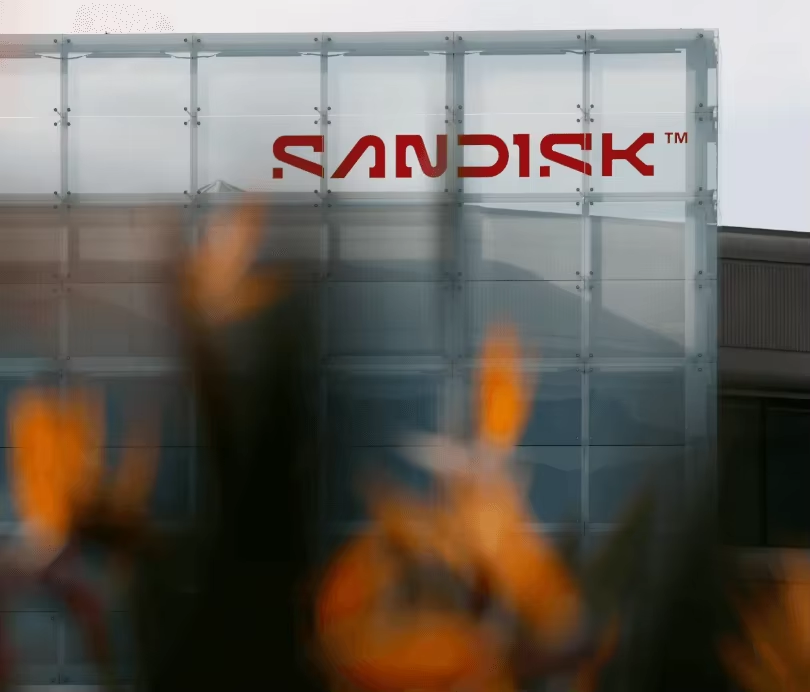
Bernstein's Mark Newman raised the target from $1,700 to $3,000, maintaining an Outperform rating. The note argued that Sandisk's customer contracts are becoming more powerful, a specific reference to the five multi-year supply agreements with financial guarantees that Sandisk has signed with major customers.
The logic connecting contracts to price target is more sophisticated than it might initially appear. A memory company whose revenue is substantially contracted at agreed prices behaves differently in analyst models than a company with full spot market exposure. The earnings volatility that has historically defined memory stocks gets dampened when a meaningful percentage of revenue is guaranteed regardless of spot NAND pricing. That reduced volatility justifies a higher earnings multiple, and a higher multiple applied to growing earnings produces a higher target price.
Bank of America and Citigroup both have $2,500 targets. The average across 22 analysts sits at approximately $1,863, which is below the current price but reflects a distribution that includes pre-rally estimates that have not yet been updated. The upper end of the analyst range, anchored by Bernstein at $3,000, represents the most optimistic but not implausible view of where the business is heading.
The Earnings Trajectory That Would Support $3,000
At $3,000, Sandisk's market capitalization would be approximately $447 billion. On fiscal 2027 EPS estimates of $133.84, that implies a price-to-earnings multiple of approximately 22 times — not dramatically different from where many high-growth technology companies trade today.
The math is actually coherent. If Sandisk delivers the fiscal 2027 EPS that analysts are modeling, $3,000 per share at a 22 times multiple is a straightforward arithmetic outcome rather than a stretch scenario. The entire question is whether the fiscal 2027 earnings materialize as projected.
The fiscal 2027 EPS estimate of $133.84 requires continued revenue growth from the Q4 fiscal 2026 run rate, maintained gross margins in the 65% to 78% range, and the contracted supply agreements delivering revenue at the agreed prices. None of those conditions are guaranteed, but all of them are consistent with current guidance and management commentary.
The QLC Stargate and Next-Generation Products
The near-term business story is about delivering on existing contracts. The 2027 to 2030 story is about what comes after the current product cycle.
Sandisk's QLC Stargate solutions represent the next generation of data center storage technology. QLC refers to quad-level cell NAND, which stores four bits of data per cell rather than the three that TLC NAND stores. The density advantage is significant: QLC enables higher-capacity drives at lower cost per gigabyte, which is exactly what hyperscalers want as AI workloads continue scaling.
Management indicated that revenue shipments of QLC Stargate solutions were beginning in Q3 2026, with meaningful ramp expected through fiscal 2027. If that product achieves the adoption trajectory that enterprise SSDs have seen in the data center segment, it adds a second revenue growth driver on top of the existing TLC-based business that is already accelerating.
The development of even denser chips beyond QLC represents the 2028 to 2030 opportunity. Each generation of NAND technology that increases storage density expands the addressable market for applications that previously required too much physical space or cost per terabyte to use flash storage. The migration of traditional spinning hard drive applications to flash, accelerated by AI data center requirements, has further to run than the current products alone capture.
Three Scenarios for Sandisk Stock by 2030
In a strong scenario, QLC Stargate achieves broad hyperscaler adoption, the contracted supply agreements deliver revenue at or above modeled prices, next-generation NAND development stays ahead of competitive pressure from Chinese manufacturers, and the market assigns a premium multiple reflecting the contracted revenue's reduced cyclicality. In this environment, $3,000 becomes achievable by 2027 and 2030 prices could be significantly higher depending on the product development trajectory. Bernstein's target represents the near end of this scenario rather than its ceiling.
In a moderate scenario, the contracted revenue delivers as modeled, QLC Stargate ramps but at a pace below the most optimistic projections, margins compress somewhat as supply additions gradually normalize the NAND market by 2028, and the market applies a more cautious multiple reflecting the historical cyclicality of the memory industry despite the contracted revenue improvement. Sandisk stock likely reaches somewhere between $2,500 and $3,200 by 2030 in this scenario, strong appreciation from current levels but arriving more gradually than the H1 2026 pace implied.
In a cautious scenario, the spot NAND pricing environment deteriorates faster than contracted revenue can offset, Chinese NAND manufacturers ramp supply that compresses industry margins, and the market re-rates Sandisk toward a multiple more consistent with its commodity memory history. The approximately 60% of fiscal 2027 output that is unhedged becomes a source of significant earnings uncertainty, and the stock could spend an extended period below $1,500 before recovering as the next product cycle begins.
What Makes Sandisk Different From Previous Memory Cycles
The bear case on Sandisk is essentially a call that it will behave like memory stocks have historically behaved: dramatic outperformance during supply-constrained upswings followed by brutal corrections when supply normalizes. That pattern has played out multiple times in the past three decades.
The bull case argues that Sandisk in 2026 is structurally different from previous memory cycles for specific reasons that go beyond AI optimism.
The five long-term supply agreements with financial guarantees represent a structural change in how Sandisk sells its products. Previous memory cycles saw all revenue priced at spot rates, which meant every dollar of earnings was exposed to the next move in the commodity market. Contracting a meaningful percentage of revenue at agreed prices for multiple years removes that exposure for the contracted portion.
The net cash balance sheet and $6 billion buyback authorization represent financial discipline that was absent in previous boom cycles, when memory companies typically levered up to fund capacity expansion. A memory company that is buying back stock during a boom is making a different kind of bet than one that is building factories.
The product differentiation from commodity NAND is also more pronounced than in previous cycles. The 256TB enterprise SSD that hyperscalers are buying is not interchangeable with the consumer memory products that characterized the most volatile phases of previous cycles. Specialized products for specific high-value applications carry higher margins and more stable pricing than commodities.
Whether these structural differences are sufficient to prevent the kind of correction that has followed every previous memory boom is the central question that the next several years of business results will answer.
For investors tracking stock, WEEX provides access to stock trading products, including the First Stock Trade Protected campaign offering eligible users additional protection on their first stock trade.
Conclusion
Sandisk stock reaching $3,000 by 2027 is Bernstein's base case, not a stretch scenario. The arithmetic works at current earnings estimates and a reasonable earnings multiple. The path involves QLC Stargate achieving commercial adoption, the contracted supply agreements delivering revenue as modeled, and the market maintaining the multiple expansion that the reduced-cyclicality story justifies.
By 2030, the range of outcomes is wider. The strong scenario produces prices significantly above $3,000 as next-generation products extend the enterprise storage growth runway. The moderate scenario produces steady appreciation toward $3,000 to $3,500 as the contracted revenue story matures. The cautious scenario produces a significant correction before recovery as supply normalizes faster than contracts can buffer.
For investors evaluating Sandisk stock today after the 10% Q3 opening decline, the immediate question is whether the selloff was technical profit-taking that will be reversed as business fundamentals reassert themselves, or an early warning that the supply-demand balance is closer to normalizing than current guidance suggests. Bernstein's $3,000 target, maintained through today's decline, is the clearest statement from the analyst community about which interpretation it believes.
FAQ
1. Can Sandisk stock reach $3,000?
Bernstein set a $3,000 price target on June 30, 2026, maintained through the July 1 selloff. At approximately 22 times fiscal 2027 EPS estimates of $133.84, $3,000 is arithmetically coherent rather than speculative. It requires delivering the contracted revenue as modeled and maintaining margins in the projected range.
2. What is Sandisk's fiscal 2027 EPS forecast?
Analysts expect fiscal 2027 EPS of approximately $133.84, up roughly 165% from fiscal 2026 estimates of $50.53, which themselves represent approximately 2,739% growth year over year.
3. What is Bernstein's price target for Sandisk stock?
Bernstein analyst Mark Newman raised the price target to $3,000 from $1,700 on June 30, 2026, maintaining an Outperform rating and citing the increasing power of Sandisk's customer contracts.
4. What is Sandisk's QLC Stargate and why does it matter?
QLC Stargate is Sandisk's next-generation data center storage product using quad-level cell NAND technology. It offers higher density and lower cost per gigabyte than existing TLC-based products, targeting the same hyperscaler customers that have driven the existing product cycle's extraordinary growth.
5. What is the biggest risk to Sandisk stock reaching $3,000?
Approximately 60% of fiscal 2027 NAND output is unhedged to spot market pricing. If supply additions from Samsung, SK Hynix, and Micron normalize NAND pricing faster than contracted revenue can offset, the earnings trajectory that supports $3,000 faces meaningful downside risk.
Disclaimer
This content is provided for general informational and educational purposes only and should not be considered financial, investment, legal, or tax advice. Nothing in this article constitutes an offer, recommendation, solicitation, or invitation to buy, sell, or trade any crypto asset or use any specific service. Crypto assets are highly volatile and involve a high degree of risk. You may lose some or all of the value of your investment and should not invest funds you cannot afford to lose. WEEX services may not be available in all regions and are subject to applicable laws, regulations, and user eligibility requirements. Please c
You may also like
META Stock Price Prediction 2026: Can Meta Stock Hit $1,000 in July?
META stock price prediction 2026: Can Meta hit $1,000? Analyst targets, AI cloud pivot, and how to buy META stock on WEEX explained.
USER Crypto Price Prediction 2026: Can USER Crypto Reach $1?
Is USER a good investment? Learn what is USER crypto, current price at $0.00140, and realistic USER price prediction 2026. Energy-AI narrative token analysis.
Introducing Morpho ($MORPHO): Open Credit Network and Price Prediction
Morpho is an open credit network for onchain lending, drawing attention as Morpho Midnight and ecosystem integrations expand.
MU Stock Price Prediction 2026-2030: Can Micron Hit $4,000 as AI Memory Demand Explodes?
Can MU stock reach $4,000 by 2030? Get the latest MU stock price prediction 2026-2030, analyst targets, and learn how to buy MU stock today.
$SYN Airdrop on WEEX: Complete Guide to Synapse and Claim Free $SYN
Learn Synapse tokenomics, cross-chain governance utility, and how to claim free tokens in the WEEX 50,000 USDT SYN airdrop before July 8, 2026.
MSFT Stock Analysis 2026: Why Microsoft's 33% Drop Could Be a Generational Buying Opportunity?
Top 5 TradFi Assets to Trade in 2026: Are TradFi Assets Worth Investing?
Trade Tesla, Gold, Silver, Nasdaq & Nvidia on WEEX TradFi. Compare top TradFi assets, leverage options, and how to invest in TradFi assets with USDT.
What is NVIDIA(NVDA) Coin? Everything You Need to Know About NVDA/USDT Perpetual Futures on WEEX
NVIDIA (NVDA) Coin on WEEX refers to the USDT‑margined perpetual futures tracking NVIDIA Corporation’s stock price rather than…
What is NVIDIA(NVDA) Coin? Everything You Need to Know and How to Trade NVDA/USDT on WEEX
NVDA/USDT perpetual futures were newly listed on WEEX, with trading opened on July 2, 2026. This derivative tracks…
Can NVDA Reach $250 in 2026? NVDA Price Prediction
KEY TAKEAWAYS Current price: NVDA/USDT futures trade near $196.13 at publication time. Required move: around +27.5% is needed…
NVIDIA (NVDA) Price Prediction: July 2026 Forecast, Technical Levels, and Strategy
NVIDIA (NVDA) has become the bellwether for AI risk appetite, and traders can access its crypto-settled exposure via…
What Is Sandisk and Why Did It Go From $40 to $2,000 in One Year?
Sandisk stock went from approximately $40 in early 2025 to over $2,000 in 2026, a gain exceeding 4,900% in roughly eighteen months. This guide explains what Sandisk actually is, why it was ignored for years, and what changed to produce one of the most extraordinary stock price moves in recent market history.
Sandisk Stock Falls 10% to Start Q3: Is the AI Memory Rally Finally Over?
Sandisk stock dropped approximately 10% on July 1, the first trading day of Q3, after surging over 720% in the first half of 2026. The selloff had nothing to do with the company's business. This guide examines what actually triggered the decline, whether it signals the end of the AI memory rally, and what investors should actually be watching.
What is Synapse(SYN) Coin? Everything You Need to Know for Cross‑Chain Trading and Investing
Synapse (SYN) is a cross-chain interoperability protocol enabling secure asset transfers, messaging, and smart contract calls across multiple…
SK Hynix Stock Price Forecast 2026–2027: Structural HBM Shortage Analysis
Expect a clear look at how the AI-driven memory cycle and a structural HBM bottleneck could shape SK…
Can SK Hynix Reach $2000 in 2026? SK Hynix Price Prediction
KEY TAKEAWAYS Current price: $1523, based on live market data today from major crypto trackers. Required move to…
If You Can’t Buy SK Hynix Stocks, What Are the Trading Alternatives?
If your broker doesn’t support SK Hynix or you want 24/7 access, you can still trade SK Hynix…
Buy, Sell, or Hold VRT Stock? Vertiv Forecast 2026–2027 AI Data Center Boom
This article breaks down whether to buy, sell, or hold VRT through 2026–2027, using fresh fundamentals, trend structure,…
META Stock Price Prediction 2026: Can Meta Stock Hit $1,000 in July?
META stock price prediction 2026: Can Meta hit $1,000? Analyst targets, AI cloud pivot, and how to buy META stock on WEEX explained.
USER Crypto Price Prediction 2026: Can USER Crypto Reach $1?
Is USER a good investment? Learn what is USER crypto, current price at $0.00140, and realistic USER price prediction 2026. Energy-AI narrative token analysis.
Introducing Morpho ($MORPHO): Open Credit Network and Price Prediction
Morpho is an open credit network for onchain lending, drawing attention as Morpho Midnight and ecosystem integrations expand.
MU Stock Price Prediction 2026-2030: Can Micron Hit $4,000 as AI Memory Demand Explodes?
Can MU stock reach $4,000 by 2030? Get the latest MU stock price prediction 2026-2030, analyst targets, and learn how to buy MU stock today.
$SYN Airdrop on WEEX: Complete Guide to Synapse and Claim Free $SYN
Learn Synapse tokenomics, cross-chain governance utility, and how to claim free tokens in the WEEX 50,000 USDT SYN airdrop before July 8, 2026.
MSFT Stock Analysis 2026: Why Microsoft's 33% Drop Could Be a Generational Buying Opportunity?