


What Are the WEEX VIP Levels? Benefits, Requirements, and WEEX VIP Fees Tier
WEEX VIP levels run from VIP 0 to VIP 8. Your level determines the published maker and taker fee tiers for spot and futures trading, as well as access to benefits such as higher withdrawal limits and dedicated support. WEEX evaluates qualifying trading volume, WXT holdings, and asset balance, with a separate announced restriction for reaching VIP 8. To check the level and rates that apply to you, sign in to the WEEX VIP Program page and review the rates shown for your account before placing a trade.
The most useful way to assess WEEX VIP benefits is to start with your actual trading pattern. A lower taker rate can matter to someone who frequently places immediately filled orders; a lower maker rate matters when orders add liquidity. The September 2026 VIP 8 criteria announcement also makes older tier tables unreliable as a sole reference. Published tables explain the program, but your account’s current level and displayed trading rate are the practical checks.
What Are the WEEX VIP Levels?
The WEEX VIP program has nine published levels: VIP 0 through VIP 8. VIP 0 is the starting tier. Higher tiers have different published spot and futures trading rates, while additional benefits can include withdrawal allowances, service access, and VIP activities.
WEEX’s VIP benefits and qualification guide describes four ways to qualify for a level:
- 30-day futures trading volume, measured in USDT.
- 30-day spot trading volume, measured in USDT.
- WXT holdings, evaluated over the stated 24-hour period.
- Average asset balance, evaluated over five days and measured in USDT.
For VIP 1 through VIP 7, the published thresholds work on a “meet any one” basis. A user who meets a tier’s spot volume requirement does not also need to meet its futures volume, WXT, and balance requirements. WEEX awards the highest level for which the user qualifies.
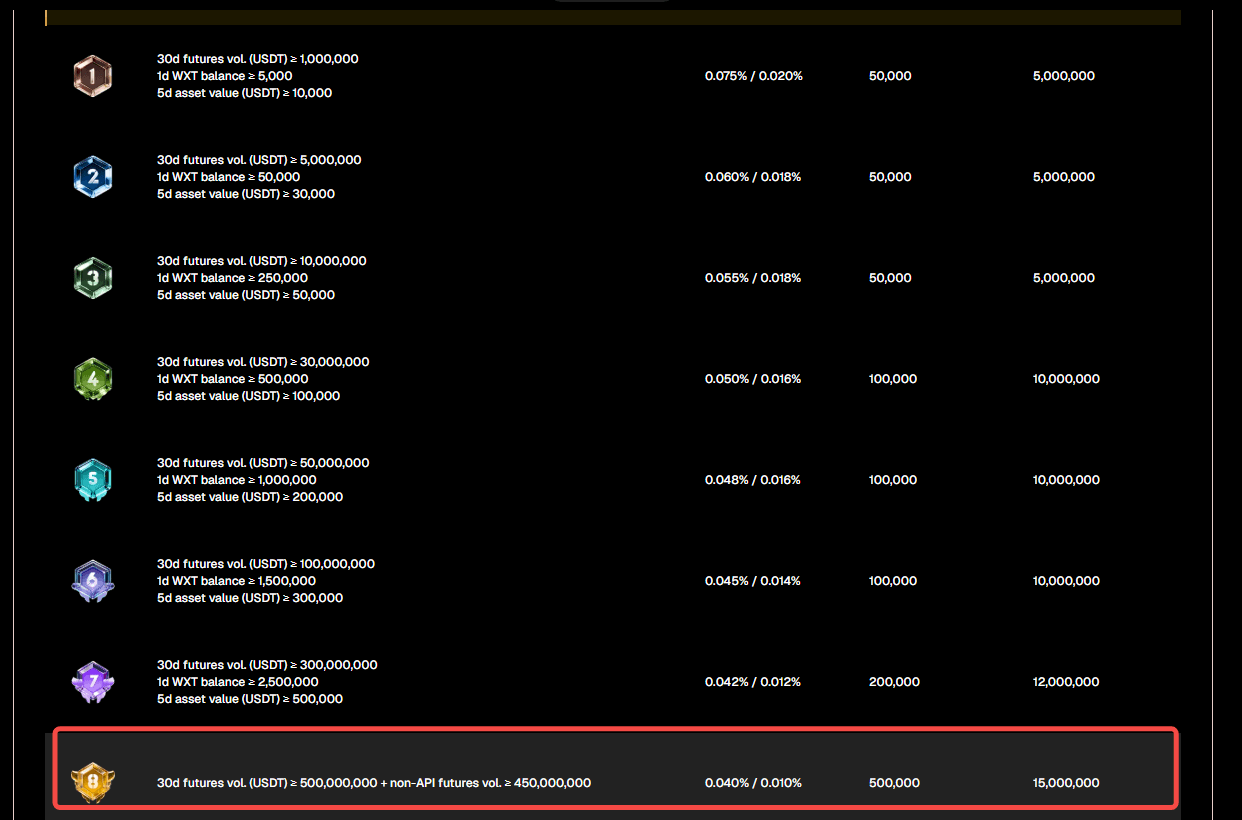
VIP 8 needs a separate check. In its notice updating VIP 8 upgrade criteria, WEEX said it would remove WXT holdings and asset balance as standalone VIP 8 upgrade paths and add non-API trading volume requirements to the two volume paths. The notice said the change was expected to take effect on September 21, 2026, and directed users to the platform for the final applicable rules. If you are pursuing VIP 8, check your signed-in VIP page rather than relying on an older four-path table.
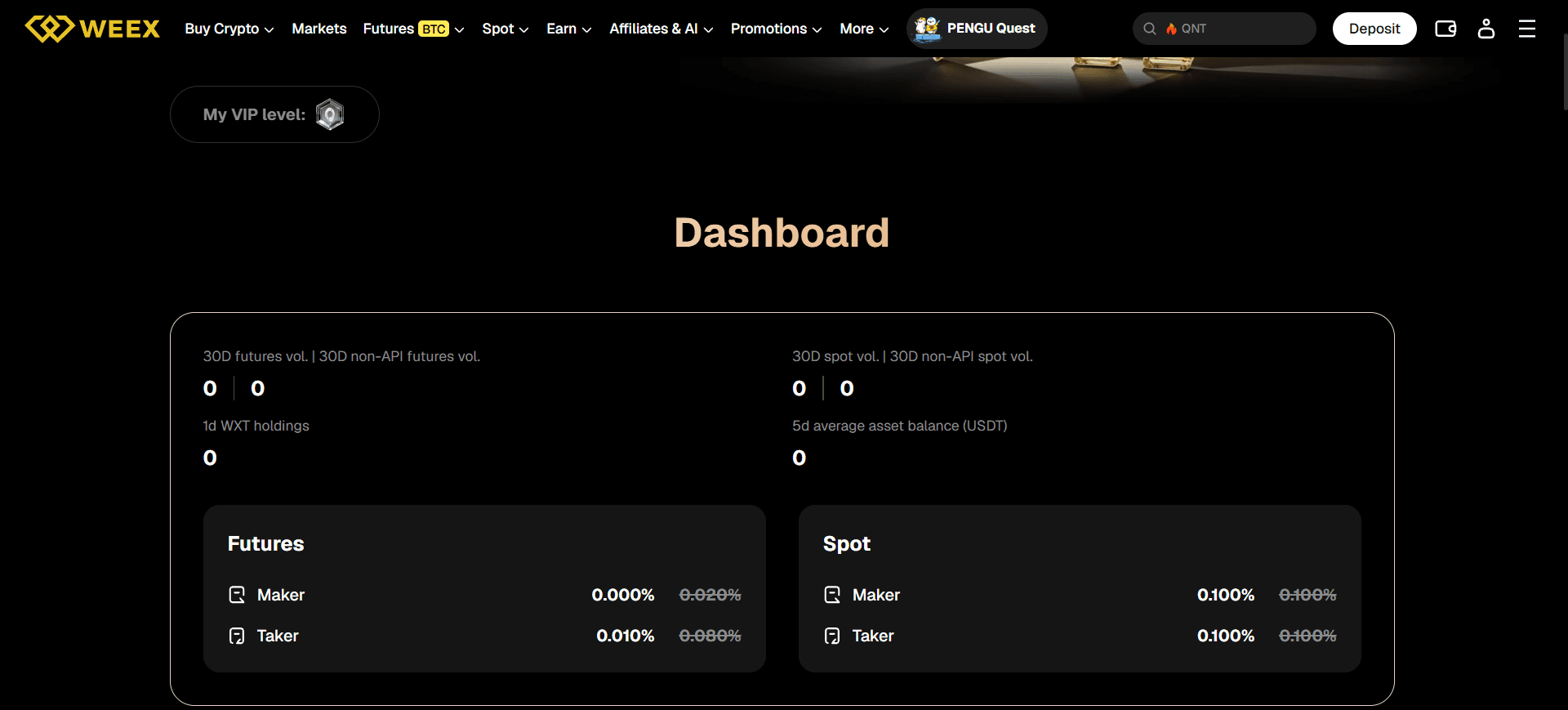
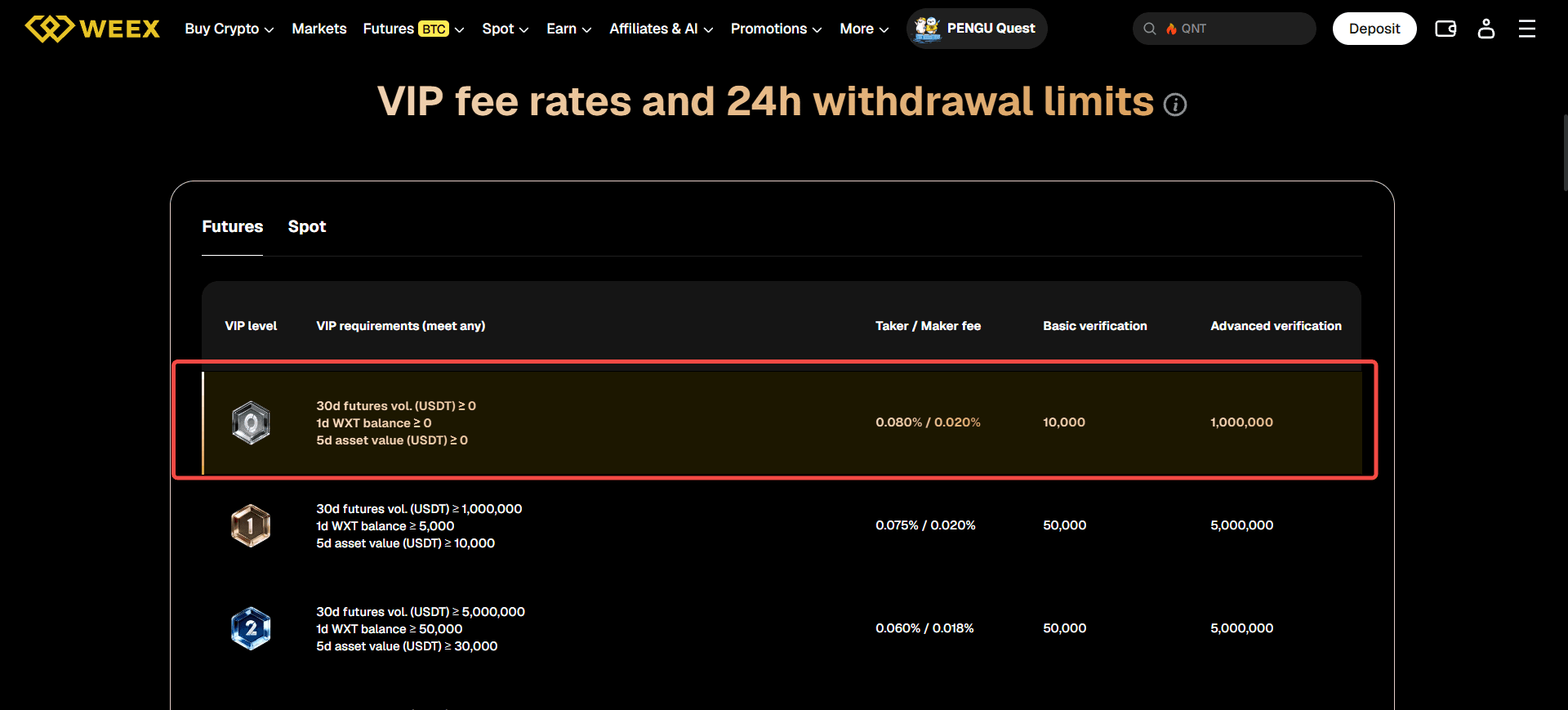
What Are the Requirements for WEEX VIP 1 Through VIP 8?
The table below combines the published qualification paths for VIP 1–7 with WEEX’s separate VIP 8 criteria announcement. Each of the first seven rows means that meeting any one listed threshold can qualify you for that row’s level. Figures are thresholds, not amounts you must meet in every column.
| VIP Level | 30-Day Futures Volume | 30-Day Spot Volume | 24-Hour WXT Holdings | 5-Day Average Asset Balance |
|---|---|---|---|---|
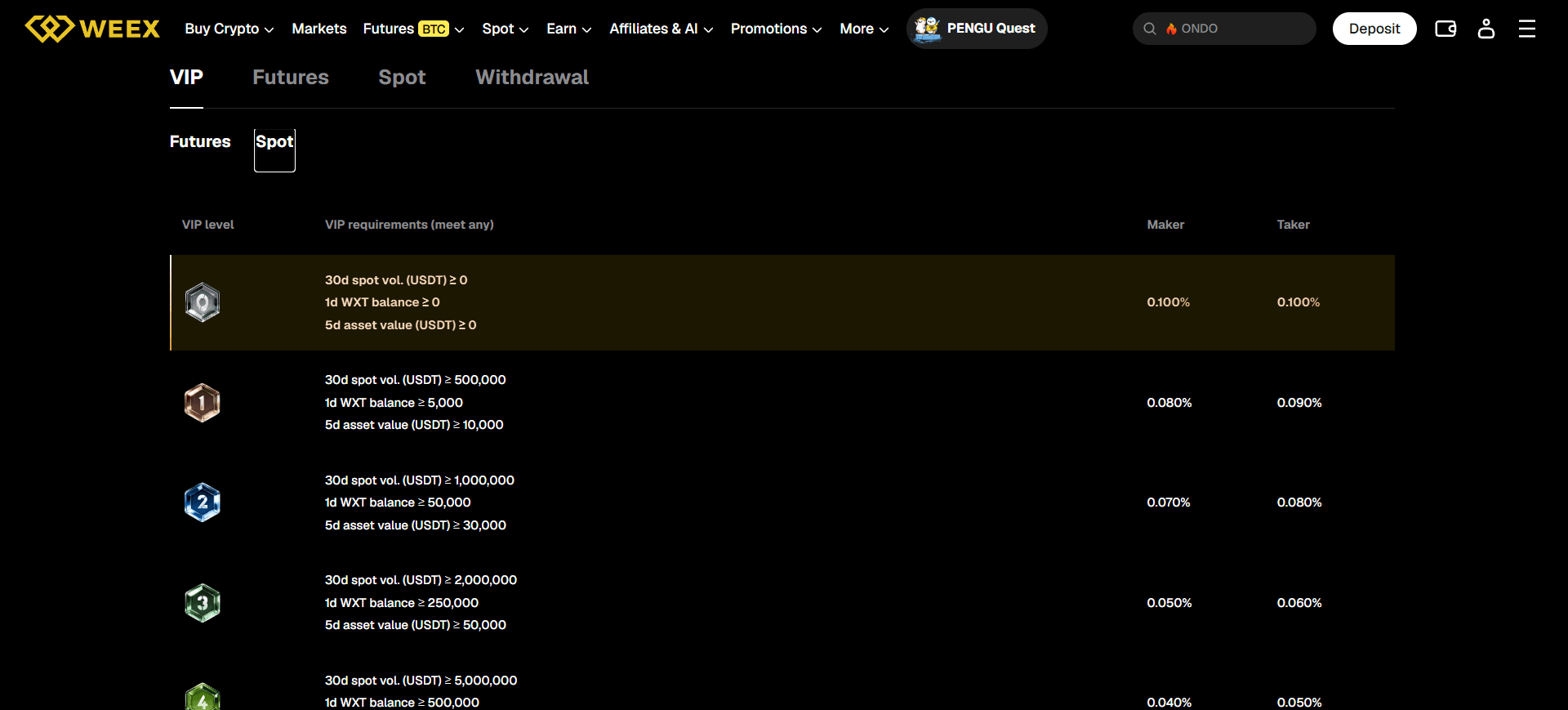
| VIP 1 | ≥ 1,000,000 USDT | ≥ 500,000 USDT | ≥ 5,000 WXT | ≥ 10,000 USDT |
| VIP 2 | ≥ 5,000,000 USDT | ≥ 1,000,000 USDT | ≥ 50,000 WXT | ≥ 30,000 USDT |
| VIP 3 | ≥ 10,000,000 USDT | ≥ 2,000,000 USDT | ≥ 250,000 WXT | ≥ 50,000 USDT |
| VIP 4 | ≥ 30,000,000 USDT | ≥ 5,000,000 USDT | ≥ 500,000 WXT | ≥ 100,000 USDT |
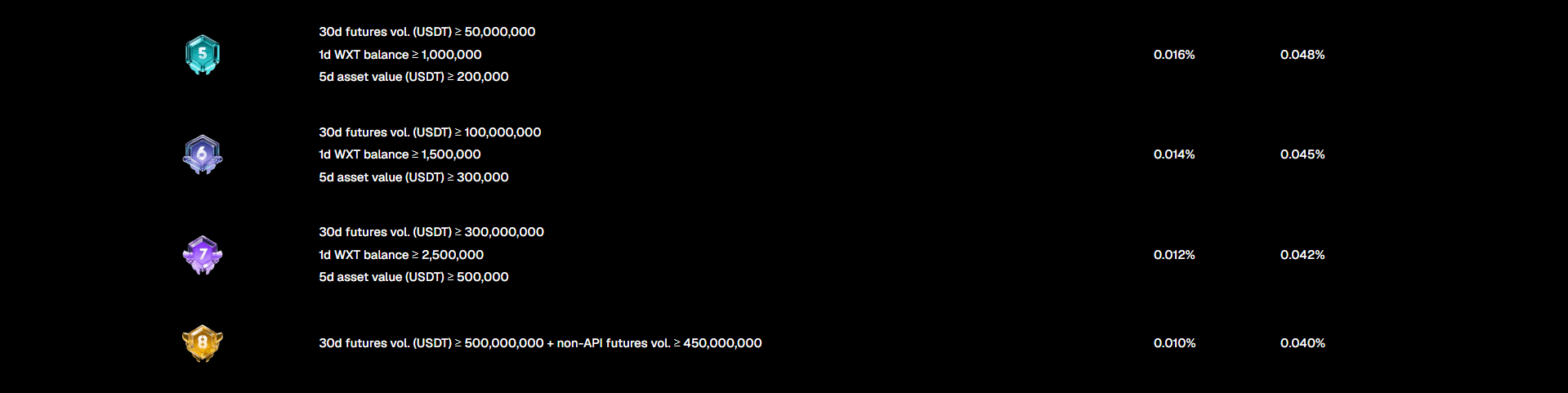
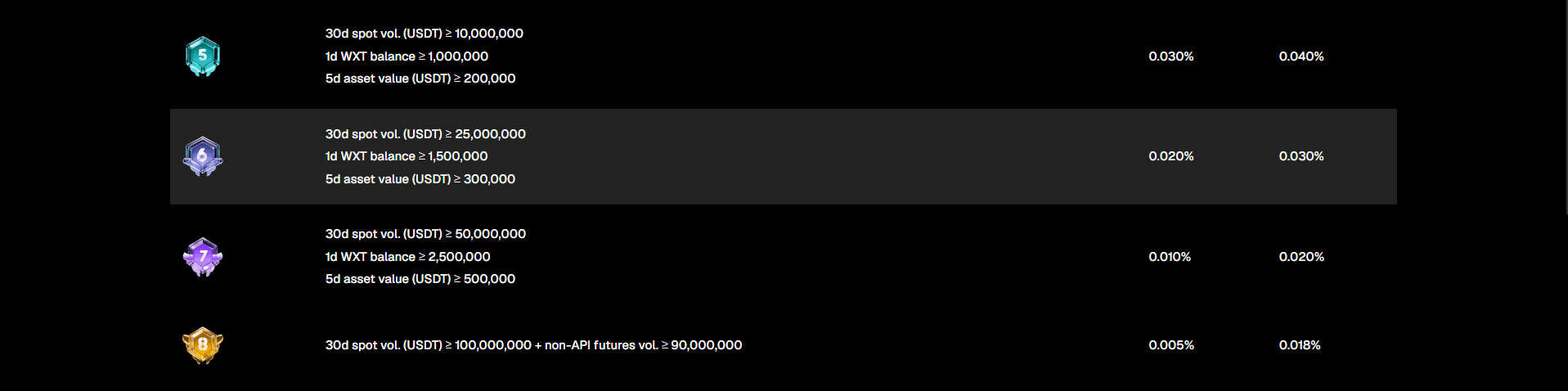
| VIP 5 | ≥ 50,000,000 USDT | ≥ 10,000,000 USDT | ≥ 1,000,000 WXT | ≥ 200,000 USDT |
| VIP 6 | ≥ 100,000,000 USDT | ≥ 25,000,000 USDT | ≥ 1,500,000 WXT | ≥ 300,000 USDT |
| VIP 7 | ≥ 300,000,000 USDT | ≥ 50,000,000 USDT | ≥ 2,500,000 WXT | ≥ 500,000 USDT |
| VIP 8 — announced updated criteria | ≥ 500,000,000 USDT, including ≥ 450,000,000 USDT in non-API volume | ≥ 100,000,000 USDT, including ≥ 90,000,000 USDT in non-API volume | No standalone WXT path under the announced update | No standalone balance path under the announced update |
For VIP 8, the notice says API trading volume may count toward the applicable total, but must not exceed 10% of that total. It describes two alternative upgrade paths: the futures threshold or the spot threshold. It does not say that a user needs to meet both.
Here is how to read the rest of the table:
- If you mainly trade spot, compare your qualifying 30-day spot volume with the spot column. A published VIP 2 threshold of 1,000,000 USDT in spot volume does not imply that you also need 5,000,000 USDT in futures volume.
- If you hold WXT, compare your eligible holdings with the WXT column for VIP 1–7. The published measurement is over 24 hours; a brief balance increase should not be assumed to produce an immediate tier change.
- If you rely on asset balance, compare the relevant five-day average with the balance column for VIP 1–7. A balance visible today is not necessarily the five-day average used in the VIP calculation.
- If you use an API and aim for VIP 8, pay particular attention to the announced non-API minimum. Total trading volume alone may no longer establish eligibility for that tier.
For the underlying four-path table, read WEEX’s VIP qualification explanation. For the VIP 8 exception and its stated effective-date condition, read the VIP 8 update notice. The signed-in VIP page is the place to check how WEEX currently evaluates your own account.
What Are the WEEX VIP Fee Tiers for Spot and Futures?
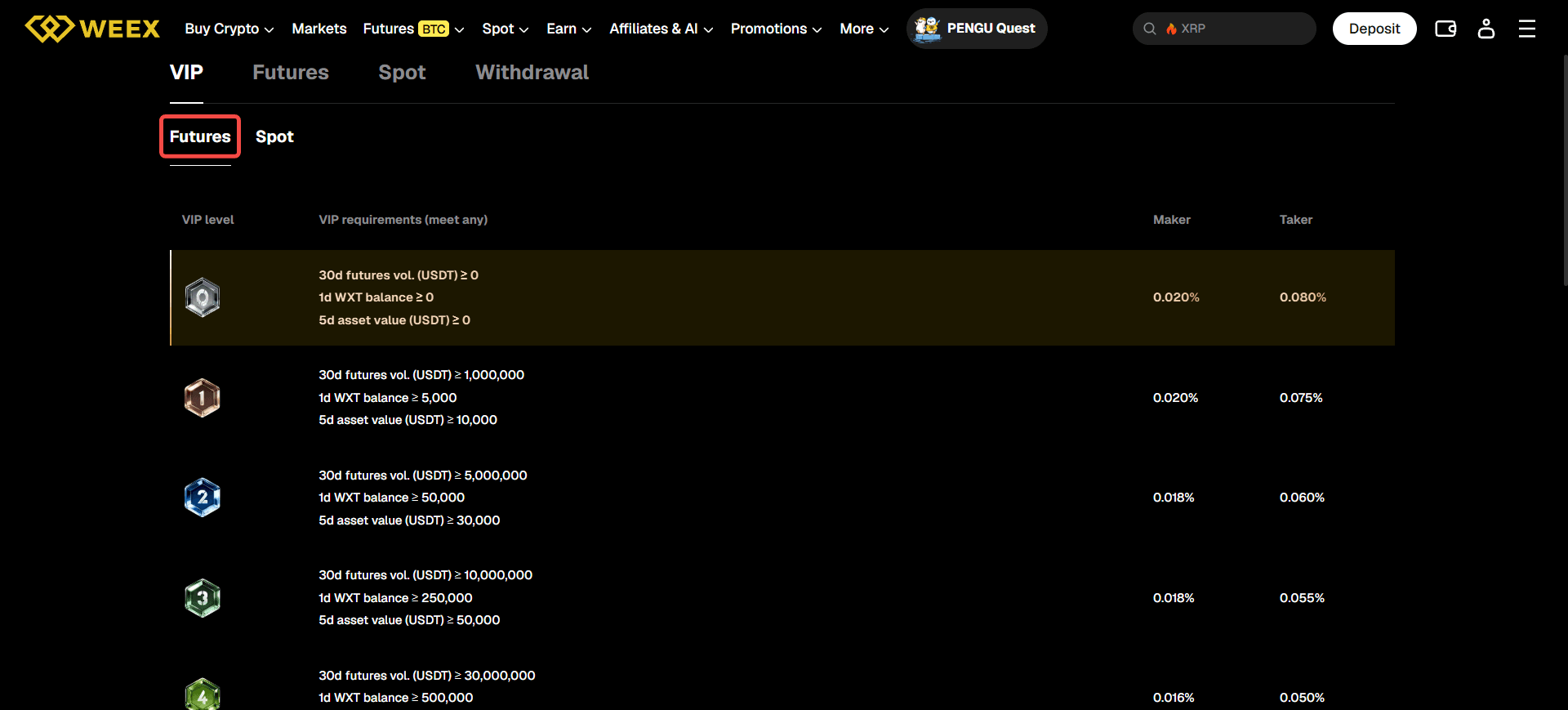
The published WEEX VIP fee schedule distinguishes spot from futures, and maker from taker. The table below puts those four rates side by side. It draws on WEEX’s VIP rate guide, futures fee adjustment notice, and VIP 8 spot fee adjustment notice.
| WEEX VIP Level | Spot Maker | Spot Taker | Futures Maker | Futures Taker |
|---|---|---|---|---|
| VIP 0 | 0.100% | 0.100% | 0.020% | 0.080% |
| VIP 1 | 0.080% | 0.090% | 0.020% | 0.075% |
| VIP 2 | 0.070% | 0.080% | 0.018% | 0.060% |
| VIP 3 | 0.050% | 0.060% | 0.018% | 0.055% |
| VIP 4 | 0.040% | 0.050% | 0.016% | 0.050% |
| VIP 5 | 0.030% | 0.040% | 0.016% | 0.048% |
| VIP 6 | 0.020% | 0.030% | 0.014% | 0.045% |
| VIP 7 | 0.010% | 0.020% | 0.012% | 0.042% |
| VIP 8 | 0.0048% | 0.018% | 0.010% | 0.040% |
Read these as published reference rates, then verify your applicable rate on WEEX. WEEX’s VIP 8 spot adjustment notice specifically says actual applicable fees are subject to the rates displayed on the trading page. Pair-specific arrangements, campaigns, or later changes should not be inferred from a general VIP table.
The distinction between maker and taker is about how an order executes, not simply whether you selected “limit” or “market.” An order that sits on the book and adds liquidity is generally a maker order. An order that immediately matches existing liquidity is a taker order; a market order is a common example. A limit order can also execute immediately and incur a taker rate. WEEX’s trading fee guide explains the order types and fee mechanics in more detail.
For example, suppose a 10,000 USDT spot trade executes entirely as a taker, with no separate promotion affecting the rate. At the published VIP 0 taker rate of 0.100%, the illustrative fee is 10 USDT. At the published VIP 3 taker rate of 0.060%, it is 6 USDT. The difference is 4 USDT for that executed trade. This example demonstrates the percentage calculation; it is not a quote for a particular account, market, or order.
Futures fees require another distinction: opening and closing a position are separate executions, so a round trip can involve two trading fees. Perpetual futures funding, if applicable, is a separate cost or payment and is not part of the VIP maker/taker rate. The WEEX trading fee guide explains these charges; use the rate standards page and your trading screen to check the rates available when you trade.
Which WEEX VIP Benefits Come With a Higher Level?
Lower published trading fees are the easiest VIP benefit to compare, but they are not the whole program. The WEEX VIP Program page also lists dedicated customer support, exclusive airdrops, a VIP anniversary pack, VIP events, group chats, and special rewards. WEEX’s VIP benefits update additionally identifies higher withdrawal limits and access to WE-Launch opportunities.
These benefits need to be read according to their own rules:
- Trading fee tiers vary by VIP level and by whether the trade is spot or futures, maker or taker. Check the relevant rate before submitting an order.
- Withdrawal limits can differ according to account verification status and VIP tier. A higher limit concerns how much an eligible account may withdraw during the stated period; it should not be confused with a reduced blockchain withdrawal fee.
- Dedicated support and VIP groups provide service channels or access associated with the program. The general benefits list does not, by itself, establish that every member receives the same named account manager or an identical response time.
- Events, anniversary packs, airdrops, and WE-Launch opportunities may have separate participation dates, eligibility rules, or claiming steps. Check each event’s current page before treating a listed benefit as an automatic reward.
There is also a more specific benefit for users of the futures Guaranteed Price feature. WEEX’s July 2026 announcement about daily free Guaranteed Price uses lists an allowance rising from 2 uses per day at VIP 0 to 25 at VIP 8, with intermediate allowances for the other tiers. The announcement says the uses reset daily at 00:00 (UTC+8) and do not carry over. Read that announcement and its linked feature guide if this tool is relevant to you; the allowance is distinct from a spot or futures maker/taker fee discount.

How Do You Check Your WEEX VIP Level and Applicable Fees?
Start with the WEEX VIP Program page while signed in. Find your displayed level and the progress shown for the qualifying metrics. If you are comparing your account with a published threshold, check that you are comparing the same measurement window: 30 days of trading volume, the stated WXT holding period, or a five-day average asset balance.
Next, check the fee relevant to the trade you intend to place:
- Identify whether the order is for spot or futures.
- Check whether the execution is likely to be maker or taker. Do not assume every limit order receives a maker fee.
- Read the rate shown on the relevant WEEX trading interface or the rate standards page.
- If a rate or tier differs from an article’s table, use the account-specific platform display as the immediate reference and check for a newer WEEX notice.
WEEX’s published VIP FAQ says levels are recalculated daily at 18:00 UTC and that updated benefits take effect once the level changes. Another WEEX VIP explainer describes the daily update as 02:00 (UTC+8), which is the same moment expressed in a different timezone. This is a scheduled recalculation; crossing a displayed threshold should not be treated as proof that an account has already been upgraded.
If your displayed level does not match what you expect, first check whether the relevant lookback period has completed and whether the volume or assets are eligible under the current rules. For a VIP 8 question, read the September criteria notice and check the signed-in rules, especially if API volume is involved. Then contact WEEX support with the metric, period, expected tier, and a screenshot of the discrepancy. Conceal balances and account identifiers before sharing a screenshot publicly.
What Happens If You No Longer Meet a VIP Threshold?
WEEX has announced 14-day VIP downgrade protection. Its benefits upgrade notice says that when a user no longer meets VIP requirements, the account can retain VIP benefits, including fee discounts, during the protection period; after that, the level is determined using current data.
A later WEEX VIP explainer describes protection as available for up to 14 days after reaching VIP 1 or upgrading through futures or spot trading. Because those descriptions differ in specificity, do not assume every qualification path receives an identical protection period in every circumstance. Check the protection status and applicable rules in your account if you are about to depend on an expiring fee tier.
A simple example shows why this matters. If your 30-day spot volume falls below the threshold that previously qualified you for VIP 4, yesterday’s VIP 4 rate may not describe the rate on an order you place after your status changes. Check the displayed tier and rate when you trade, especially around the daily recalculation.
WEEX VIP Levels and Fees: Frequently Asked Questions
1. Is VIP 0 a VIP Membership Level?
Yes. VIP 0 appears as the starting row in WEEX’s published tier and fee tables. It provides a baseline against which the higher VIP fee tiers can be compared. You do not have to meet a higher tier’s trading volume or holding threshold to appear in the VIP 0 row.
2. Do I Need to Meet Every Requirement to Reach VIP 1–7?
No. The published qualification paths use “meet any one.” For example, the VIP 1 table lists 1,000,000 USDT in 30-day futures volume, 500,000 USDT in 30-day spot volume, 5,000 WXT over the stated holding period, or a 10,000 USDT five-day average asset balance. Eligibility and the level actually assigned are still determined by WEEX’s current account calculation.
3. Can WXT Holdings or Asset Balance Alone Get Me to VIP 8?
WEEX’s VIP 8 criteria update says these two standalone VIP 8 paths will be removed. It gives revised futures and spot volume criteria that include minimum non-API volume. Because the notice described an expected implementation date and directed users to the platform for final rules, confirm the active VIP 8 criteria in your account before relying on either the older table or the announcement alone.
4. Are WEEX VIP Trading Fees the Same for Spot and Futures?
No. Each level has separate published spot maker, spot taker, futures maker, and futures taker rates. For instance, the published VIP 1 rates are 0.080%/0.090% spot maker/taker and 0.020%/0.075% futures maker/taker. Check the actual rate displayed for your market and account before trading.
5. Does a VIP Level Reduce Withdrawal Network Fees?
The cited VIP materials describe higher withdrawal limits, which are different from network-specific withdrawal fees. The asset, network, and current fee still matter when withdrawing. Consult the WEEX rate standards page for the relevant withdrawal information rather than assuming that a higher VIP tier makes every withdrawal free.
The WEEX Editorial View on VIP Tiers
A VIP comparison is only useful when it separates qualification, the rate applied to an order, and conditional rewards. The old approach of listing one futures fee table and treating WXT holdings as a permanent route to every level misses the spot fee tiers and the announced VIP 8 restriction. Readers should use the tables here to understand the program, then verify their signed-in level and applicable trading rate before acting. If WEEX implements or revises the VIP 8 criteria differently from its announcement, this article’s VIP 8 row should be updated promptly to match the platform’s final rules.

Gainers


