
Lighter (LIT) Futures: Cross vs Isolated Margin on a 17% Range

 Prefer us on Google


LIT futures are a trade on the most volatile large token in the perp-DEX sector, and the margin mode you pick decides whether a bad day costs you one position or your whole account. Lighter's token printed a 17% daily gain on 5 September 2026, set an all-time high of $5.30 on 9 September, and as of 16 September trades at $4.18, down 3.4% on the day and 21% below that peak (CoinMarketCap). A token that regularly moves 15–20% in a session punishes both the default settings: cross margin, which quietly puts every other position up as collateral, and isolated margin at high leverage, which liquidates before the move has finished. This guide explains how each mode works on the WEEX LIT-USDT perpetual, works through what a 17% move does to a position in each, and covers the tokenomics events, above all the December 2026 unlock cliff, that make LIT's volatility structural rather than incidental.
What Lighter is, and why LIT trades the way it does
Lighter is a perpetual futures exchange built as an application-specific zk-rollup on Ethereum. Its distinguishing claim is verifiable order matching and liquidations, and its distinguishing economics are zero maker and taker fees for retail accounts, with protocol revenue coming from the LLP liquidity pool, liquidation fees and a USDC revenue-share arrangement with Circle. In August 2026 the platform ran open interest above $1 billion and about $39.5 billion in monthly trading volume, and Robinhood integrated Lighter into its own perpetual futures offering with 11 million LIT allocated as user rewards (CoinMarketCap, 5 September).
The token's supply schedule explains much of the price behaviour. Total supply is 1 billion LIT, of which 250 million, or 25%, is circulating. Team (26%) and investor (24%) allocations sit behind a one-year cliff that started at the December 2025 token generation event, so the first large unlocks arrive from December 2026, with the remaining 75% of supply released in phases after that. Against that, the protocol runs daily buybacks funded by revenue, repurchasing 927,800 LIT in August, and a July tokenomics overhaul introduced permanent supply reduction and revenue-funded burns. Stakers receive roughly 6% APR from trading revenue.
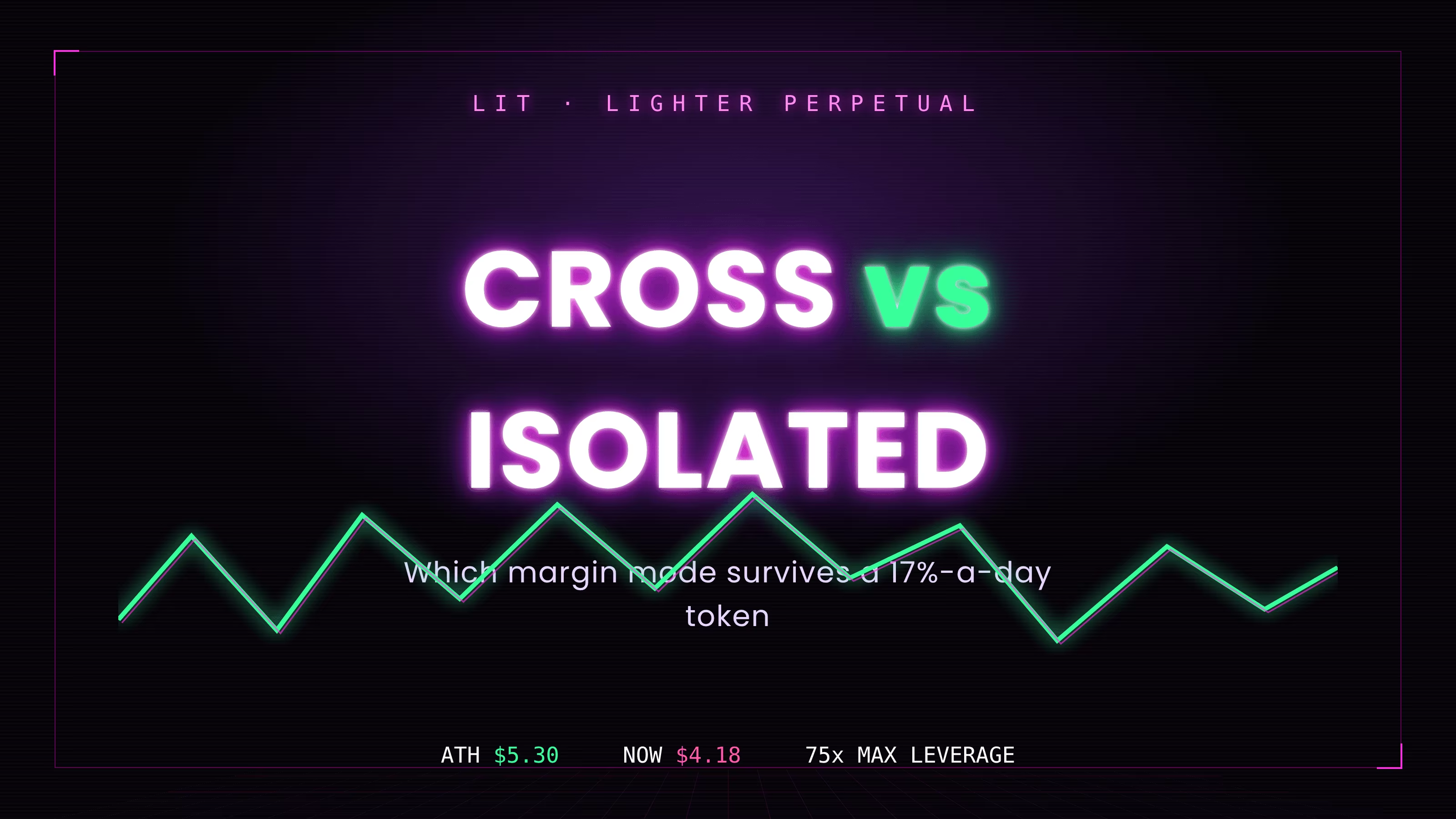
The result is a token with a small float, a visible buyback bid and a large overhang three months out. Small floats move a long way on modest flows in both directions, which is why LIT went from an all-time low of $0.78 on 31 March 2026 to $5.30 in under six months, and why a 21% retrace from the high took a week. For a futures trader the implication is simple: the daily range on LIT is routinely wider than the entire margin cushion at anything above 5x leverage.
Cross margin vs isolated margin: What each mode does to a LIT position
WEEX offers both modes on the LIT-USDT perpetual, which allows leverage up to 75x as of 17 September 2026. The difference is where the collateral comes from when the trade goes against you.
In isolated margin, the position has its own margin bucket. You assign, say, 200 USDT to a LIT long; if the position loses 200 USDT less the maintenance requirement, it is liquidated, and the rest of your futures balance is untouched. You can add margin manually to push the liquidation price further away, but nothing is added automatically.
In cross margin, the entire available futures balance backs every open position. WEEX's cross margin mode guide describes this as using the whole account balance as shared collateral: a losing LIT position draws on unrealized profit from other positions and on free balance, so it tolerates a larger adverse move before liquidation. The cost is that liquidation, when it comes, is of the account, not the position.
WEEX's position-tier rules interact with this in a way that matters for LIT specifically. Maintenance margin rate rises and maximum leverage falls as position size grows. In isolated mode the tier is calculated separately for each direction; in cross mode long and short positions on the same contract are combined into one tier. A trader hedging a LIT long with a LIT short in cross mode may find both legs pushed into a higher tier than either would occupy alone.
A 17% LIT move in each margin mode: Worked examples
Take LIT at $4.18 and a trader with 1,000 USDT in the futures account.
Isolated, 10x: the trader opens a long of 500 LIT (position value $2,090) with 209 USDT of isolated margin. A 17% fall to $3.47 produces an unrealized loss of $355, well beyond the 209 USDT posted, so the position is liquidated on the way down, somewhere around $3.85 once the maintenance margin is consumed. Loss: roughly 209 USDT plus the liquidation fee. Remaining balance: about 790 USDT. The trade was wrong, the account survives.
Cross, 10x: same 500 LIT long, same 209 USDT initial margin, but now the whole 1,000 USDT balance stands behind it. The 17% move costs $355, which the account absorbs; the position is still open at $3.47 with about 645 USDT of equity remaining. If LIT bounces, the trade recovers. If LIT extends the move to a 40% drawdown, roughly $2.50, the loss reaches $840 and the account approaches liquidation as a whole. Cross margin bought time; it also converted a 209 USDT risk into a 1,000 USDT risk without any explicit decision.
Isolated, 3x: 500 LIT long with 697 USDT margin. The 17% move costs $355, about half the margin, and liquidation sits near $2.95, roughly 30% below entry. The position survives the kind of day LIT has been producing, with the stop-loss, not the exchange, deciding the exit.
The pattern across the three cases is that the margin mode does not change the size of the loss on a given move. It changes who pays for it and when. Isolated margin makes the loss explicit and capped; cross margin makes it implicit and open-ended. On a token with LIT's daily range, the explicit version is almost always the right choice for a directional trade, and low leverage does more for survival than either mode.
-- Price
When cross margin makes sense on LIT
Cross margin is not wrong; it is wrong as a default for a single directional bet on a volatile token. It earns its place in three situations.
- Hedged books. A trader long LIT spot on WEEX and short the LIT-USDT perpetual as a hedge into the December unlock wants the two legs to share collateral, so that a spike against the short is funded by the gain on the spot side rather than liquidating the hedge at the worst moment.
- Basis and funding trades. When LIT funding runs strongly positive during a rally, a short perpetual against long spot earns funding on the short. Cross margin keeps that position alive through short-term squeezes that would liquidate an isolated short at high leverage.
- Deliberate account-level risk. Some traders run cross margin at low leverage on purpose, treating the whole balance as the position's cushion and sizing the position so that even a 50% move does not threaten the account. That is a valid approach, but it is a decision to make explicitly, with the numbers, not a setting to leave on because it was the default.
Outside those cases, a LIT long or short opened in cross margin next to other open positions is a way of betting positions you did not intend to bet.
How to open a LIT-USDT perpetual on WEEX with the margin mode set deliberately
- Open the LIT-USDT perpetual on WEEX and confirm the pair, current mark price and funding countdown.
- Set the margin mode before entering size. The mode selector sits next to the leverage selector; changing it after the position is open is either restricted or requires closing, depending on the state of the account.
- Set leverage. For a directional LIT trade sized to survive a 20% adverse move, 3–5x is the practical range. The 75x maximum exists for very small scalps, not for a hold through a session.
- Choose order type and size. A limit order at a level inside the recent range is preferable to a market order on LIT, because spreads on a $95 million-per-day token widen sharply during moves.
- Attach a stop-loss on mark price and a take-profit before submitting. In isolated mode, check that the stop sits well inside the liquidation price shown on the ticket; in cross mode, check the account-level margin rate after the order fills, not just the position.
- If the position moves in your favour and you want to defend it, add margin in isolated mode rather than switching to cross. Adding margin moves the liquidation price away while keeping the loss capped.
The unlock calendar is the risk most LIT traders are not pricing
The December 2026 cliff is the single most important date for anyone holding a LIT position for more than a few days. Team and investor allocations totalling 50% of supply begin unlocking then, against a circulating float of 25% today. The buyback programme is meaningful (927,800 LIT repurchased in August) but small relative to the scale of the unlock, and the Robinhood reward allocation of 11 million LIT adds sell pressure from recipients who did not pay for the tokens.
None of that dictates direction. Unlocks are known in advance and often front-run, and Lighter's revenue base has been growing. What it does dictate is that LIT's volatility is structural: a token with a visible three-month overhang and a small float will keep producing 15–20% days in both directions. That is the environment the margin-mode decision has to survive. Isolated margin at low leverage, with the stop set before the order fills, is the configuration that lets a trader be wrong on LIT and still be trading it next week.
LIT futures reward traders who respect the token's range. Choose the margin mode on purpose, size for a 20% move, and treat cross margin as a tool for hedged positions rather than a way to postpone a loss.
FAQ: LIT futures margin modes
1. What is the maximum leverage on the WEEX LIT-USDT perpetual?
Up to 75x as of 17 September 2026. Maximum leverage falls as position size increases under WEEX's position-tier rules.
2. Is isolated margin safer than cross margin for LIT?
For a single directional trade, yes: the loss is capped at the margin assigned to that position. Cross margin can tolerate a larger move but exposes the whole futures balance to liquidation.
3. Can I switch a LIT position from cross to isolated after opening it?
Switching margin mode on an open position is restricted; plan the mode before entering the order. Adding margin to an isolated position is the usual way to extend its liquidation distance.
4. Why does LIT move 15–20% in a day?
Only 25% of the 1 billion supply is circulating, so modest flows move the price a long way. The token rose from $0.78 on 31 March 2026 to $5.30 on 9 September, and retraced 21% in the following week.
5. When do LIT team and investor tokens unlock?
Team (26%) and investor (24%) allocations sit behind a one-year cliff from the December 2025 token generation event, so unlocks begin from December 2026 and continue in phases.
6. Does cross margin combine my long and short LIT positions into one tier?
Yes. WEEX's position-tier rules calculate tiers separately per direction in isolated mode, and combine long and short positions on the same contract into one tier in cross mode.
Risk Warning
LIT is a low-float, high-volatility crypto asset that has moved more than 15% in a single day several times in September 2026, and LIT futures amplify that volatility through leverage. In cross-margin mode a losing position can draw on and liquidate your entire futures balance; in isolated mode a position can be liquidated on a move that later reverses. Scheduled token unlocks from December 2026, thin order-book liquidity during fast moves, and funding payments on positions held through settlement all add to the risk. You may lose part or all of the funds you commit. Trade only with money you can afford to lose and verify current LIT-USDT contract parameters on WEEX before opening a position.
This content is provided for general informational purposes only and doesn't constitute financial, investment, legal, or tax advice. Any events, rewards, online promotions, or related information mentioned herein should not be considered a recommendation, solicitation, or invitation to purchase, sell, trade, or otherwise deal in any crypto assets. Crypto assets are highly volatile and may result in loss. The availability of WEEX services, products, and related events may vary by region. You are responsible for ensuring that your participation is in accordance with applicable local laws and regulations.
You may also like
What Is a Funding Rate? How Perpetual Futures Charge Longs and Shorts
XRP Futures: How to Long or Short XRP After the Clarity Act Vote
What Is ZCAT and Is It Worth Buying? Anonymous Cat (ZCAT) Guide for 2026

MU Stock Reclaims $1,000 Again: What's Actually Different This Time
GPT-6 Astra and Crypto: The AI Token Bid and the Cyber Risk
StonkFun Just Became Solana's Hottest Launchpad: STONK Surges 250% to Prove It

What Is Tangem Wallet? A Complete Beginner's Guide
AAPL Under Ternus: What Apple's CEO Change Means for Traders
PONS Robinhood Chain Token: What the Buyback Rally Rests On
Cathie Wood’s $50 Million Crypto Stock Bet Explained: What Did ARK Invest Buy?
BISCOTTI Crypto: Robot Dog Token Behind Emblem Vault's Debut
Is CyberLeek (CYBERLEEK) Safe? Price Crash and Key Token Risks Explained

CyberLeek Price Prediction 2026: Can CYBERLEEK Recover After the Crash?
Is Crypto Legal in Pakistan? PVARA Rules Traders Must Know

NVIDIA (NVDA) Earnings Date: When Q2 FY2027 Reports and What to Watch
JazzCash P2P Trading: Merchant Vetting, Payment Limits, and the Hidden Account Freeze Risk
Plasma Released 88.89 Million XPL Tokens Today—Why the Allocation Matters
Choosing a Crypto Exchange in Pakistan Before the Sept 5 Deadline

XST Coin Price Prediction: What Happens to AI Narrative Tokens After the Initial Hype Fades
Pakistan Crypto Exchange Comparison: Which Platform Works Best for PKR Traders in 2026
JPMorgan Says Buy the Chip Dip but Morgan Stanley Says Sell: What the SOXL Analyst Disagreement Actually Means
How to Call a Crypto Exchange API Without Getting Blocked
What Is a Crypto Exchange API and Which Permissions to Enable
Broadcom (AVGO) Earnings Date: September 2, 2026 (Confirmed) — Japan Time and What to Watch
XSolut Company: What Is the Team Behind XST Coin and What Do They Actually Disclose
Stock Market News Today: Why Bonds Are Setting the Tape
MSTR Stock Trades Below Its Bitcoin. Here's the Catch
MU Stock Price Targets Range From $1,150 to $1,625: What UBS and New Street's AI Memory Thesis Actually Requires
Musk's SpaceX Stake: 48.4% Equity vs 82.4% Voting Power
XST Coin Tokenomics Explained: What 1 Billion Supply and 100% Circulation Actually Mean
What Is a Funding Rate? How Perpetual Futures Charge Longs and Shorts
XRP Futures: How to Long or Short XRP After the Clarity Act Vote
What Is ZCAT and Is It Worth Buying? Anonymous Cat (ZCAT) Guide for 2026
MU Stock Reclaims $1,000 Again: What's Actually Different This Time
GPT-6 Astra and Crypto: The AI Token Bid and the Cyber Risk
StonkFun Just Became Solana's Hottest Launchpad: STONK Surges 250% to Prove It


