
XRP Futures: How to Long or Short XRP After the Clarity Act Vote

 Prefer us on Google


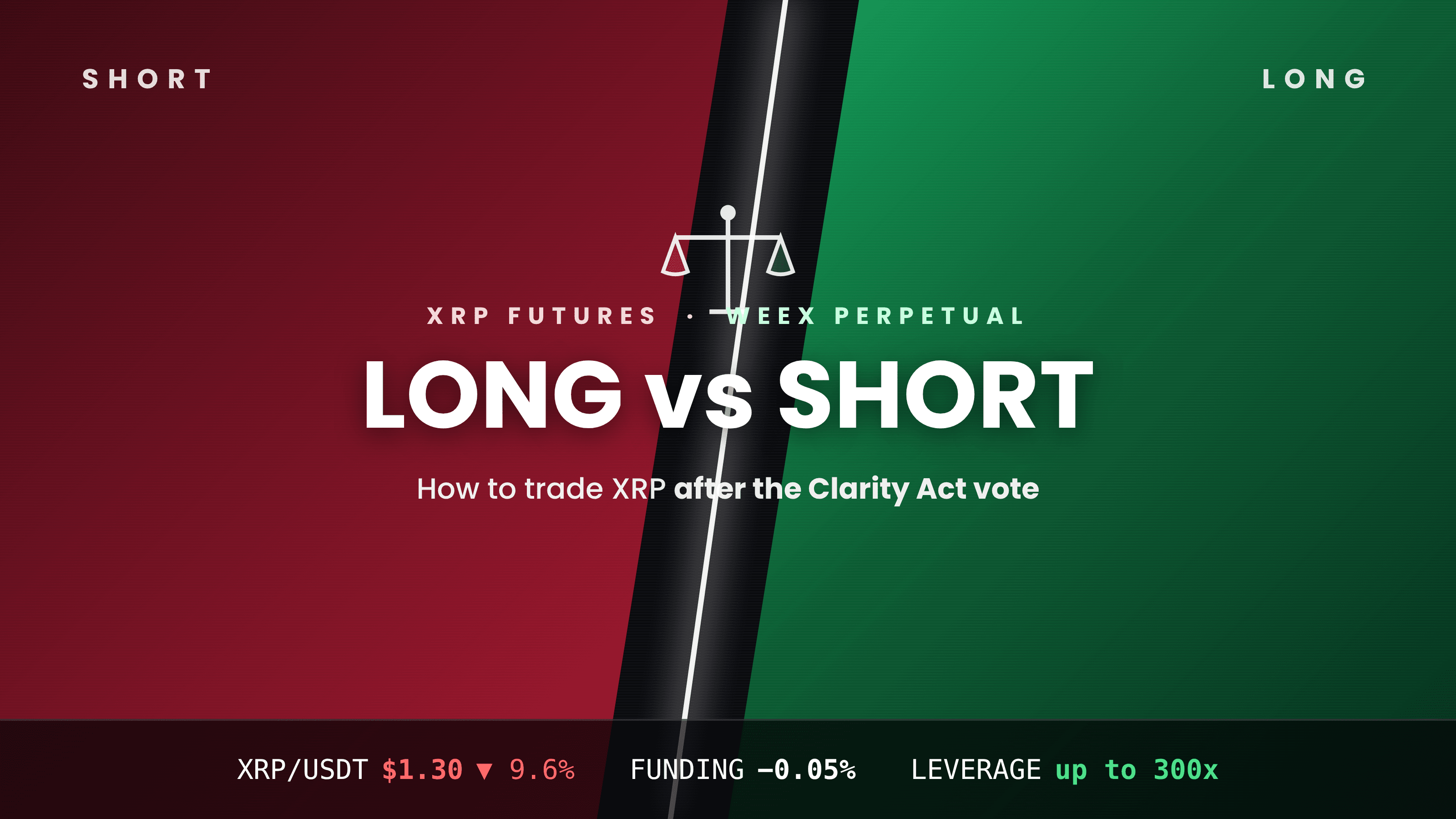
XRP futures let you profit from XRP going down as easily as from XRP going up, and after this week that matters more than usual. On 16 September 2026 the US Senate failed to advance the Clarity Act in a 49–50 procedural vote (60 were needed), and XRP fell almost 10% to about $1.30 in Asian hours, the worst move among large-cap coins according to CoinDesk. A perpetual contract is the instrument most traders reach for in that situation, because it allows a long or a short with the same collateral, and because it never expires. This guide explains how a long and a short XRP perpetual position are built, what the funding rate does to each side, where the liquidation price sits, and why the crowded-short setup going into the vote changes the risk calculus for anyone shorting now.
What the Clarity Act vote changed for XRP futures traders
The vote removed the single biggest scheduled catalyst XRP had in the third quarter. For most of August and September, prediction markets priced a pass, and analysts framed the bill as the event that would push XRP through $1.47–$1.52. Instead, the cloture motion failed after several Republicans joined Democrats in voting no, with Senator Elissa Slotkin citing ethics provisions that were "simply too thin". XRP went from $1.39 on 15 September (up 3.9% on the day, per 24/7 Wall St.) to roughly $1.30 the next morning. Coinbase shares fell almost 9% and Circle more than 9% in the same session, so this was a sector-wide de-rating of US regulatory optimism, not an XRP-specific problem.
Three things about the setup matter for anyone trading XRP futures this week:
- Funding was already negative before the vote. 24/7 Wall St. noted on 15 September that "funding reads negative with shorts stacked, so short holders pay long holders". A market that is already short-heavy and then gets its bearish confirmation tends to see one of two outcomes: a continued grind lower as longs are liquidated, or a sharp squeeze when the shorts try to take profit into thin bids. Both are tradable; neither is safe with high leverage.
- The technical levels are close together. Support at $1.33 has already broken. $1.30 is being tested, and $1.21 is the next level analysts flagged before the vote. Resistance sits at $1.41, then $1.47 and $1.52. With XRP at $1.30, a move to either $1.21 or $1.41 is roughly 7–8%, which at 10x leverage is a 70–80% swing in margin.
- The next catalysts are procedural, not binary. Attention has shifted to the SEC's proposed Reg Crypto framework and tokenized-securities rules. These move markets, but they do not produce the clean pass/fail moment the Senate vote did, so expect grinding volatility rather than one gap.
How a long XRP perpetual position works
A long XRP perpetual is a bet that XRP-USDT will trade higher than your entry, settled in USDT rather than by delivering XRP. On WEEX the XRP-USDT perpetual offers leverage up to 300x as of 17 September 2026, though nobody trading a 10% headline move should be anywhere near that number.
Suppose you open a long of 1,000 XRP at $1.30 with 10x leverage in isolated margin. Your position value is $1,300 and your initial margin is $130. If XRP recovers to $1.41 (the first resistance), your unrealized profit is $110, or about 85% of the margin you posted. If XRP instead falls to $1.21, you lose $90, roughly 69% of your margin, and you are close to the point where the maintenance margin requirement forces liquidation.
The exact liquidation price depends on the maintenance margin rate for your position tier, which WEEX sets higher for larger positions and lower leverage. WEEX defines margin rate as (position margin + unrealized PnL) ÷ position value, and liquidation triggers when that rate falls to the maintenance rate. For a 10x isolated long from $1.30, the liquidation price sits a little above $1.17 rather than at the $1.17 that 10% below entry would suggest, because the maintenance margin is consumed before the full 10% is lost. Run your own numbers in the XRP futures calculator before you commit; the calculator returns PnL, ROI and liquidation price for a given entry, size and leverage.
One point that longs often miss after a headline crash: negative funding pays you. If the funding rate stays negative, shorts pay longs at each settlement, and that income accrues to your position regardless of leverage, because WEEX calculates the funding fee as funding rate × position value, not × margin. On a $1,300 position, a funding rate of −0.05% per settlement is $0.65 per settlement. Small, but over several days of holding it offsets part of a drawdown, and it is a signal in itself: the market is paying you to take the other side of a crowded trade.
How to short XRP with a perpetual contract
A short XRP perpetual is the mirror image. You sell XRP-USDT you do not own, post margin, and profit if XRP falls. Mechanically it is the same order ticket: choose Sell/Short instead of Buy/Long, set leverage, set size, and choose isolated or cross margin.
Using the same 1,000 XRP at $1.30 with 10x isolated margin, a fall to $1.21 earns $90, and a rally to $1.41 costs $110. The asymmetry is the first thing to understand about shorting: the price can only fall to zero, but it can rise without limit, so the loss on a short has no theoretical cap, while the loss on a long is capped at the position value. In practice both are capped at your margin by liquidation, but a short caught in a squeeze can be liquidated faster because the move against it is often violent and gap-like.
The second thing to understand is the cost of the position. With funding negative, shorts pay. If you short XRP at $1.30 and the rate is −0.05%, you pay about $0.65 per settlement on a $1,300 position. That is cheap while the trend is with you and painful when the price is going sideways and you are paying for the privilege of waiting. Check the current settlement schedule and rate on the pair's funding page; WEEX states that settlement times vary by pair and are typically on the hour, and that funding is exchanged between users rather than charged by the exchange.
The third thing is who else is short. The pre-vote positioning data showed shorts stacked. Some of those shorts took profit into the 10% drop, but the ones that did not are now sitting on gains and will defend them. If XRP reclaims $1.33 and then $1.41, forced buying from short liquidations can carry it further than the news justifies. A trader shorting at $1.30 today is late to the trade the market already made; the better entry is usually on a failed bounce into resistance, with a stop above the level, not a chase into support.
-- Price
Long vs short XRP: Which side has the edge this week?
Neither side has a clean edge, and pretending otherwise is how people lose money after headline events. What the setup does tell you is where the risk sits on each side.
The case for a tactical long: the news is out, the sell-off has already happened, funding pays you to hold, and the first resistance at $1.41 is within a normal daily range. The risk is that $1.30 breaks and $1.21 comes quickly, because the market has lost its main bullish narrative for the quarter.
The case for a tactical short: the regulatory story that supported XRP's 2026 premium over other large caps is gone for now, the Fed decision on 16 September adds macro uncertainty, and every bounce is likely to be sold by traders who bought the Clarity Act rumour. The risk is the squeeze described above, and the cost of paying negative funding while you wait for the break.
In practice, the traders who handle this kind of week best do three things. They size the position so that a move to the far side of the range (roughly 8% either way) costs them a defined amount they can absorb, which typically means 3–5x leverage rather than 20x. They set the stop on mark price, not last price, so a single wick on the order book does not close them. And they respect that a market moving 10% on a Senate vote can move 10% on a committee statement, so they do not hold unhedged size into scheduled announcements.
How to open a long or short XRP position on WEEX
The order flow is the same for both directions; only the button changes.
- Open the XRP-USDT perpetual on WEEX and confirm the contract shows XRP-USDT with the current mark price, index price and funding countdown.
- Choose the margin mode. Isolated margin limits the loss to the margin assigned to this position; cross margin draws on the whole futures balance. For a headline trade, isolated margin is the conservative default because it caps the damage if you are wrong.
- Set leverage. The contract allows up to 300x, but the arithmetic above shows why 3–10x is the practical range for an 8% expected move.
- Select Buy/Long or Sell/Short, then choose the order type. A limit order at your level avoids paying the spread; a trigger order lets you enter only if XRP breaks $1.33 upward or $1.30 downward, which is useful when you want confirmation rather than a guess.
- Attach a take-profit and stop-loss before you submit. For a long from $1.30, a stop below $1.27 and a target at $1.41 gives roughly a 3.5:1 reward-to-risk ratio. For a short from $1.38 after a failed bounce, a stop above $1.42 and a target at $1.30 gives about 2:1.
- After the order fills, check the liquidation price shown on the position panel and compare it to your stop. The stop must be well inside the liquidation price, or the exchange closes you before your own risk management does.
What experienced XRP futures traders watch after a crash like this
A few practical observations from how these weeks usually play out. The first bounce after a regulatory shock is usually sold; the second bounce, after the weak longs are gone, is the one that tends to hold. Open interest that keeps rising while price falls means new shorts are entering late, which raises squeeze risk. Open interest that falls with price means longs are being liquidated, which is healthier for anyone wanting to buy the dip. Funding flipping from negative to positive is often the signal that the short-covering phase is over and the market has reset.
And the mistake that shows up most often: traders who were bullish on the Clarity Act refuse to accept that the thesis failed, average down a leveraged long, and are liquidated on the move to $1.21 that the analysts flagged weeks in advance. A perpetual is not a place to argue with the news. It is a place to trade the reaction to the news, in either direction, with a stop.
XRP futures give you both directions and a contract that never expires. What they do not give you is protection from being on the wrong side of a crowded trade. Treat the long and the short as equally valid, size for the range, and let funding and open interest tell you which side is getting crowded.
FAQ: XRP futures after the Clarity Act vote
1. Can I short XRP without borrowing XRP?
Yes. A perpetual contract lets you open a short position with USDT margin and no XRP borrowed. Your profit or loss is settled in USDT based on the difference between your entry and exit prices.
2. Why did XRP fall 10% on the Clarity Act vote?
The Senate's 49–50 cloture vote on 16 September 2026 fell short of the 60 needed to advance the bill, removing the main regulatory catalyst XRP had priced in. Crypto equities such as Coinbase and Circle fell around 9% in the same session.
3. What does negative funding mean for a long XRP position?
When funding is negative, short positions pay long positions at each settlement. A long earns that payment as long as it stays open through settlement, which partly offsets holding costs after a crash.
4. What leverage should I use to trade XRP futures around news?
There is no correct number, but with XRP's key levels roughly 8% apart, 3–10x leaves room for normal volatility. At 20x or above, a move to the far side of the range wipes out most of the margin before the thesis has a chance to play out.
5. Is my liquidation price based on the last traded price?
No. WEEX liquidates on mark price, which is derived from the index price and funding, to reduce the effect of order-book wicks. Set your stop-loss on mark price as well so the two are consistent.
6. What is the maximum leverage on the WEEX XRP-USDT perpetual?
As of 17 September 2026 the WEEX XRP-USDT perpetual offers up to 300x leverage. Maximum leverage falls as position size rises under the position-tier system.
Risk Warning
XRP and other crypto assets are highly volatile, and leveraged XRP futures amplify that volatility: a 10% move against a 10x position removes the entire margin. Regulatory headlines such as the Clarity Act vote can gap the price beyond your stop-loss level, and funding payments on a short that stays open for days add a cost that is easy to underestimate. Crowded positioning raises the chance of a liquidation cascade in either direction. You can lose part or all of the margin you post, and in cross-margin mode losses can extend to your full futures balance. Trade only with funds you can afford to lose, and check the current contract parameters on WEEX before opening a position.
This content is provided for general informational purposes only and doesn't constitute financial, investment, legal, or tax advice. Any events, rewards, online promotions, or related information mentioned herein should not be considered a recommendation, solicitation, or invitation to purchase, sell, trade, or otherwise deal in any crypto assets. Crypto assets are highly volatile and may result in loss. The availability of WEEX services, products, and related events may vary by region. You are responsible for ensuring that your participation is in accordance with applicable local laws and regulations.
You may also like
What Is a Funding Rate? How Perpetual Futures Charge Longs and Shorts
Lighter (LIT) Futures: Cross vs Isolated Margin on a 17% Range
What Is ZCAT and Is It Worth Buying? Anonymous Cat (ZCAT) Guide for 2026

MU Stock Reclaims $1,000 Again: What's Actually Different This Time
GPT-6 Astra and Crypto: The AI Token Bid and the Cyber Risk
StonkFun Just Became Solana's Hottest Launchpad: STONK Surges 250% to Prove It

What Is Tangem Wallet? A Complete Beginner's Guide
AAPL Under Ternus: What Apple's CEO Change Means for Traders
PONS Robinhood Chain Token: What the Buyback Rally Rests On
Cathie Wood’s $50 Million Crypto Stock Bet Explained: What Did ARK Invest Buy?
BISCOTTI Crypto: Robot Dog Token Behind Emblem Vault's Debut
Is CyberLeek (CYBERLEEK) Safe? Price Crash and Key Token Risks Explained

CyberLeek Price Prediction 2026: Can CYBERLEEK Recover After the Crash?
Is Crypto Legal in Pakistan? PVARA Rules Traders Must Know

NVIDIA (NVDA) Earnings Date: When Q2 FY2027 Reports and What to Watch
JazzCash P2P Trading: Merchant Vetting, Payment Limits, and the Hidden Account Freeze Risk
Plasma Released 88.89 Million XPL Tokens Today—Why the Allocation Matters
Choosing a Crypto Exchange in Pakistan Before the Sept 5 Deadline

XST Coin Price Prediction: What Happens to AI Narrative Tokens After the Initial Hype Fades
Pakistan Crypto Exchange Comparison: Which Platform Works Best for PKR Traders in 2026
JPMorgan Says Buy the Chip Dip but Morgan Stanley Says Sell: What the SOXL Analyst Disagreement Actually Means
How to Call a Crypto Exchange API Without Getting Blocked
What Is a Crypto Exchange API and Which Permissions to Enable
Broadcom (AVGO) Earnings Date: September 2, 2026 (Confirmed) — Japan Time and What to Watch
XSolut Company: What Is the Team Behind XST Coin and What Do They Actually Disclose
Stock Market News Today: Why Bonds Are Setting the Tape
MSTR Stock Trades Below Its Bitcoin. Here's the Catch
MU Stock Price Targets Range From $1,150 to $1,625: What UBS and New Street's AI Memory Thesis Actually Requires
Musk's SpaceX Stake: 48.4% Equity vs 82.4% Voting Power
XST Coin Tokenomics Explained: What 1 Billion Supply and 100% Circulation Actually Mean
What Is a Funding Rate? How Perpetual Futures Charge Longs and Shorts
Lighter (LIT) Futures: Cross vs Isolated Margin on a 17% Range
What Is ZCAT and Is It Worth Buying? Anonymous Cat (ZCAT) Guide for 2026
MU Stock Reclaims $1,000 Again: What's Actually Different This Time
GPT-6 Astra and Crypto: The AI Token Bid and the Cyber Risk
StonkFun Just Became Solana's Hottest Launchpad: STONK Surges 250% to Prove It


