
100 believers, 10 ETH: How should early-stage crypto projects raise funds?

 Prefer us on Google


First, create a product, then find 100 tech-savvy individuals to invest small amounts, releasing funds gradually based on milestones.
Written by: @hmalviya9
Compiled by: AididiaoJP, Foresight News
I believe the approach to early-stage financing for crypto projects needs to be rethought.
No need for flashy pitch decks, no promises of "changing the world in five years," and no need to issue a fully diluted token valued at a billion dollars right from the start. What is needed is a hardcore developer to tackle any part of the social trilemma—identity, reputation, or privacy—while exploring a completely new design space. Once they have created an early MVP (Minimum Viable Product), then give them 10 ETH. It should be after the product is done, not before.
Developers should first spend their own money to create something, prove that the technology works at a fundamental level, and then find 100 individuals who truly understand what they are investing in.
First round limited to 100 people, 0.1 ETH each
The first round is limited to 100 people, each contributing 0.1 ETH, totaling 10 ETH.
These 100 spots cannot be filled through whitelist lotteries, KOL relationships, or quick fingers. It should be based on whether a person understands the technology, the problems the developer aims to solve, and the product they are investing in.
Imagine having 100 investors who can clearly articulate: why this privacy protocol is important, what problem it solves, and where the technology might fail. This creates a completely different investor base. You are raising not just money, but an early community—people who understand the product enough to help make it successful.
Moreover, during the first milestone period, shares should not be transferable unless preset exit or refund rules are triggered. We don’t want those who will flip their positions the very next morning.
Investors must contribute as well
Once developers receive 10 ETH, they commit to a three-month roadmap and then start delivering. But investors also need to make commitments.
Some can test the product, some can find security vulnerabilities, some can write documentation, recruit users, translate interfaces, or help other developers integrate protocols.
Not everyone needs to write code, but everyone should understand why their contribution is important. The core idea is to shift from passive capital to productive capital. It’s not about buying tokens and waiting for others to pump the price, but about helping create value for what they hold.
We can introduce commitment-based rewards: investors who complete useful, verifiable tasks receive additional benefits; those who accept specific commitments but fail to deliver may lose the collateral for those commitments. Note, this does not mean confiscating all investments. The goal is not to punish token holders but to give economic weight to commitments.
Developers must also have something to lose
Developers should not receive all funds upfront. The initial 10 ETH should go into a milestone escrow contract, released gradually based on progress. Developers commit to delivering specific features by certain deadlines.
For example, the first month requires a functioning public testnet, the second month requires independently tested privacy or identity features, and the third month requires applications usable by real users. These milestones must be measurable; vague statements like "we are building the future of decentralized identity" do not count. That’s narrative, not a milestone.
Developers should also have founder’s collateral or unallocated token shares. If there are objectively verifiable violations, such as misusing escrow funds or fabricating milestone evidence, this portion can be forfeited. However, if the issues are more challenging than expected, leading to missed deadlines, it should not automatically mean losing everything. There should be review, dispute resolution, and clear extension rules.
We want hardcore developers who dare to take technical risks, not those who will be destroyed by a single failed experiment and thus only dare to work on safe projects.
-- Price
Let the market discover valuation through delivery
Assuming developers complete the first milestone. The product is usable, user numbers are increasing, technology is advancing, and the community is growing. Why should the second round raise funds at the same valuation? It certainly shouldn’t.
Set four funding stages: seed round of 10 ETH after MVP release; second round of 20 ETH after the first month milestone is completed; third round of 40 ETH after the second month milestone is completed; public round of 100 ETH after the third month milestone is completed. A total of up to 170 ETH, provided milestones are met and enough investors are found.
Each round should aim for a higher valuation, but the market should determine whether that valuation is reasonable. Developers propose valuations based on progress, investors submit bids, and a transparent auction discovers the clearing price. If the market does not accept this valuation, that round does not proceed at that price.
Each round must have a deadline. Fundraising cannot be indefinite, and it cannot be increased just because the market is bullish. Each new round of funding should be contingent on the commitments made in the previous round being fulfilled.
Allow early investors to exit without crashing the price
When the second round opens, early investors should have the opportunity to sell part or all of their shares to new investors. This is not unrestricted market dumping but a structured secondary allocation.
New investors can choose to purchase newly issued tokens to fund development or buy existing shares from early supporters. The allocation ratio between primary and secondary should be fixed and disclosed before each round begins.
This creates liquidity without requiring the project treasury to back investors' exits. No one is forced to sell. Those who want to stay can stay, and those who want to leave can do so when there is real buying interest.
Reward those who stay and contribute
Imagine someone who invested in the seed round, spent three months testing the product, recruiting users, reporting bugs, and helping the project grow. Why should they receive the same returns as someone who comes in during the final public round?
We can introduce non-transferable contribution reputations, milestone participation scores, and long-term holding incentives. Additional tokens can be unlocked based on verified contributions. Governance rights can be tied to reputation, with safeguards in place to prevent wealthy early investors from permanently controlling the protocol.
Investors should not receive more rewards simply for being early; they should earn more rewards for staying and helping create value. All reward rules, dilution, and vesting schedules should be made public before the first investor sends money.
Make commitments programmable
Ethereum has already given us usable building blocks: ERC-20 for transferable tokens, ERC-721 or ERC-1155 for participation certificates, and when applicable, ERC-8004-style proxy reputation infrastructure, with account abstraction to manage commitments.
Add in escrow contracts, milestone proofs, challenge periods, and forfeiture mechanisms. The result will resemble a "market of human commitments" rather than a traditional Launchpad.
One side commits to delivery, while the other commits to contribution. Both parties stake something, and both receive rewards upon measurable completion of commitments. The system should distinguish between malicious behavior and honest failure.
The public round should be the last step, not the first
For years, we have been doing this backward: issuing tokens first, creating hype, raising millions, and then slowly doing the work. I want to reverse this order.
First, create something. Find 100 tech-savvy believers. Raise 10 ETH. Deliver over three months. Discover valuation through progressively larger rounds. Allow early investors to choose to exit or continue. Reward real contributions. Only when the product is usable, the technology has been tested, and real adoption occurs should the project attempt a public round of 100 ETH.
Build hype around real progress. Let adoption happen before tokens are widely circulated. Let the technology speak for itself.
Of course, securities laws and fundraising restrictions still apply. Smart contracts alone cannot make investment issuance legally compliant.
But this mechanism is worth exploring. Because I don’t believe the crypto industry needs another thousand Launchpads. What we need is a market where capital makes commitments, developers make commitments, and code executes the protocol as reasonably as possible.
If both parties fulfill their commitments, both should share in the upside. If we can build this right, perhaps the next generation of crypto wealth will come from those who truly helped build something useful, not just those who entered the market ahead of everyone else.
This content is provided for general informational purposes only and doesn't constitute financial, investment, legal, or tax advice. Any events, rewards, online promotions, or related information mentioned herein should not be considered a recommendation, solicitation, or invitation to purchase, sell, trade, or otherwise deal in any crypto assets. Crypto assets are highly volatile and may result in loss. The availability of WEEX services, products, and related events may vary by region. You are responsible for ensuring that your participation is in accordance with applicable local laws and regulations.
You may also like

Who Will Succeed Nvidia as the Next 'Victim' After the Democrats Take Control of Both Houses?

Anthropic Yet to Go Public, Crypto Players Already Cashing In

Interpretation of FATF Report on Scam Compound Funds: Virtual Assets Become Core Money Laundering Channels

How Much Is Anthropic Really Worth?
Research Reveals 3D Spatial Navigation Map of Hand in the Brain to Aid Brain-Machine Interface Development

Michael Dempsey: Crypto Venture Capital Stagnates, Talent Shifts to AI

Yen Fluctuations Highlight Current Trading Difficulties, Investors Have Huge Divergence on Long-term Outlook

Bloom Energy vs. Constellation Energy: On-Site Power or Grid Power, Which Wins the Data Center?

Former Polychain Partner Launches Startup: Enters Tokenized Real Estate, Secures $50 Million Seed Round Funding to Create the 'S&P 500' of Real Estate
Seminar: The History of Hyperliquid and On-Chain Finance Guest: Takuya Fujita (11/18 19:30 @ Gentosha)
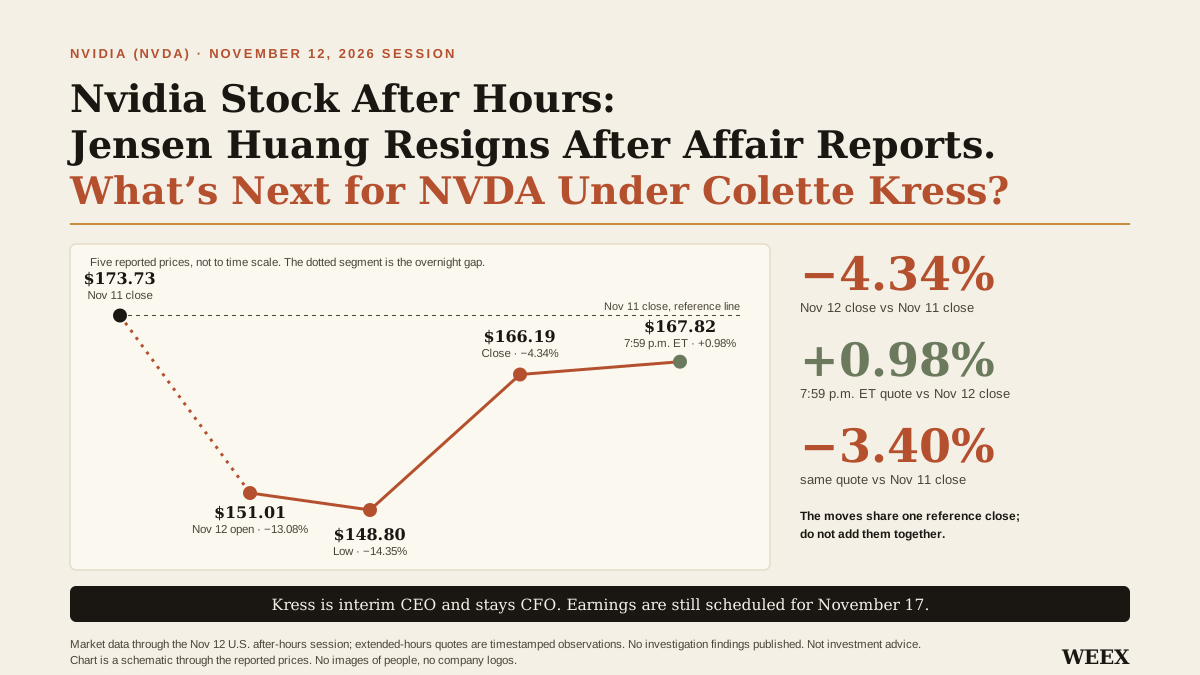
Nvidia Stock After Hours: Jensen Huang Resigns After Affair Reports. What’s Next for NVDA Under Colette Kress?
Nvidia fell 4.34% after Jensen Huang resigned, then rose 0.98% after hours. See what Colette Kress’s appointment means for NVDA and November 17 earnings.

Jensen Huang's Sudden Departure Raises Questions: Did the White House Intervene? Is a Return Possible?
In-Depth Interview | Fu Peng: I Have No Faith in BTC

Cerebras Conference Call: Secures Major Deal with Microsoft, HBM Shortage Becomes an Opportunity, WSE-5 Chip to Enter Mass Production Next Summer

SoundHound AI Stock Is Down Almost 60% in 2026, but Wall Street Thinks It Can Soar 155% By the End of 2027. Here’s Why It Could Be One of the Best Buys Amid the Tech Sell-Off.
What is being said at the tables: the market begins to see 2027 as an all-or-nothing scenario

Kalshi Negotiates New Round of Financing, Valuation Expected to Reach $65 Billion

Republican Senator Wants to Freeze AI Data Center Boom as Congress Pushes to Expand It

Why the Path to Quantum Resistance Runs Uphill for Bitcoin Wallet Makers

Pimco CEO Warns: AI Companies Risk Borrowing "Too Much" ($10 Trillion)

Silver ETF vs. Silver Miners ETF: Which Has Held Up Better This Year?

Why AMD Shares Are Surging and What a $10,000 Investment in the Stock Could Be Worth in 3 Years
Cardano Academy launches practicum with on-chain credentials
Warren Buffett Doesn't Follow His Own S&P 500 Advice. Should You?

A $776 Car Payment Is a Warning for Ford and General Motors

2 Chip Stocks to Buy Instead of Nvidia Right Now

History Says This Is the Smartest ETF to Buy During the Next Bear Market

EU to Continue Providing Financial and Military Aid to Ukraine
The market demanded liquidity and the Economy granted it: what to expect for interest rates after the Treasury auction

Qualcomm CEO on Tech Stock Plunge: "There is No AI Sector Correction for Us"
Who Will Succeed Nvidia as the Next 'Victim' After the Democrats Take Control of Both Houses?
Anthropic Yet to Go Public, Crypto Players Already Cashing In
Interpretation of FATF Report on Scam Compound Funds: Virtual Assets Become Core Money Laundering Channels
How Much Is Anthropic Really Worth?
Research Reveals 3D Spatial Navigation Map of Hand in the Brain to Aid Brain-Machine Interface Development
Michael Dempsey: Crypto Venture Capital Stagnates, Talent Shifts to AI
Latest articles




Latest coin listings on WEEX


