
Bull Signal for Bitcoin: In 4 out of 5 Past Instances, Prices Increased

 Prefer us on Google


According to CryptoQuant's analysis based on on-chain indicators, Bitcoin has completed its early bullish phase and has entered a bull market stage. In four out of five past instances of this transition, prices continued to rise. The influx of approximately $2.98 billion into U.S. spot Bitcoin ETFs over seven consecutive trading days also indicates that buying in the market is ongoing.
Conversely, pressure continues on companies issuing stocks and debt instruments to accumulate Bitcoin. The losses in these companies' market values and the difficulties they face in accessing financing present a different picture on the institutional side.
Critical Threshold for Bull Market in Bitcoin Surpassed
On September 26, Axel Adler Jr. evaluated the ratio of the 30-day moving average of the adjusted MVRV indicator to its 365-day average. This ratio surpassed its own 365-day moving average on August 20, signaling an early bull market. At that time, Bitcoin was trading at $71,255.
MVRV compares Bitcoin's market value with the realized value reflecting the average acquisition cost of investors. This helps assess whether market participants are generally in profit or loss.
The early bull phase lasted for 31 days, during which Bitcoin rose by 13%. With the ratio surpassing the 1.0 threshold on September 20, the short-term MVRV average exceeded the annual average. According to Adler's assessment, Bitcoin transitioned to the bull market stage at the level of $80,691.
According to the latest data shared in the analysis, the ratio is 1.018, and the Bitcoin price is at $84,156. Adler emphasized that maintaining the ratio above 1.0 is crucial for preserving the bullish structure. According to the analyst, in four out of the previous five instances of this transition seen since 2012, the price remained above the level where the bull market began.
On the ETF side, inflows continue. According to SoSoValue data, U.S. spot Bitcoin ETFs recorded a total net inflow of $134.47 million on September 25. Thus, the uninterrupted inflow series that began on September 17 reached seven trading days.
The highest inflow of the day was $96.99 million for BlackRock's IBIT fund. Fidelity's FBTC fund saw an inflow of $49.32 million, while Bitwise's BITB fund experienced an outflow of $11.85 million. No net inflow or outflow occurred in other funds.
The total inflow over the last seven trading days reached approximately $2.98 billion. The funds saw their highest daily net inflow of the year at $999 million on September 21. Subsequently, inflows were $714.7 million on September 22, $347 million on September 23, $190.7 million on September 24, and $134.47 million on September 25.
With these movements, IBIT's cumulative net inflow rose to $65.28 billion, while FBTC's reached $11.06 billion. The total cumulative net inflow of all U.S. spot Bitcoin ETFs reached $57.55 billion.
Value Loss Deepens in Companies Accumulating Bitcoin
According to Bitcoin Treasuries data, the total market value of the 50 publicly traded companies holding the most Bitcoin fell from $150 billion in July 2025 to $67 billion last month. Thus, approximately $83 billion was wiped out over a little more than a year. In the comparison for the last 12 months, the total value dropped from $124 billion to $57 billion.
According to a Financial Times review, 43 of the 50 companies were trading below their levels before announcing Bitcoin acquisition plans. Of these, 35 lost more than half of their value. The review focused on companies that switched to a Bitcoin reserve strategy, excluding cryptocurrency exchanges, miners, and businesses holding Bitcoin in their current operations.
This model relied on the companies' stocks trading at a premium relative to the net asset value of the held Bitcoins. Companies were acquiring more Bitcoin with the funds raised through issuing stocks or convertible bonds, expecting that the growing reserves would boost stock prices and facilitate new financing.
However, the simultaneous decline in Bitcoin and stock prices reversed this cycle. The loss of premium in stocks led to new issuances further diluting the shares of existing investors. As the cost of financing through bonds and preferred shares increased, some companies began selling Bitcoin or returning to their core operations.
According to Bitcoin Treasuries data, the top 50 corporate Bitcoin holders sold approximately 2,500 BTC more than they acquired in July. This net sale, valued at around $160 million, marked the first monthly net sale since the trend of accumulating Bitcoin reserves became widespread.
A significant portion of the value loss stemmed from Strategy. According to the FT, the market value of the world's largest corporate Bitcoin holder fell by approximately $79 billion from last year's peak. At the time of FT's calculations, Bitcoin was around $78,000, down about 30% from a year ago. The losses in the stocks of companies that built reserves through debt and stock issuance exceeded the decline in Bitcoin.
Eric Benoist, a technology and data research expert at Natixis, noted that it is not easy for small companies to follow Strategy's model by sourcing from the markets every week. Benoist viewed the Bitcoin sales and the scaling back of operations as part of the market's restructuring process.
-- Price
This content is provided for general informational purposes only and doesn't constitute financial, investment, legal, or tax advice. Any events, rewards, online promotions, or related information mentioned herein should not be considered a recommendation, solicitation, or invitation to purchase, sell, trade, or otherwise deal in any crypto assets. Crypto assets are highly volatile and may result in loss. The availability of WEEX services, products, and related events may vary by region. You are responsible for ensuring that your participation is in accordance with applicable local laws and regulations.
You may also like

OG.com Submits Application for US Stock Perpetual Contracts to CFTC Following Coinbase, Kalshi, and Kraken's Parent Company Payward

Solana’s Alpenglow upgrade reaches devnet with 150ms finality target

唐华斑竹: Quantum Computing Becomes a Core Risk Point in the Cryptocurrency Field

DeltaForesight Announces Completion of 324 Million Yen Financing to Develop Over-Collateralized Yen Stablecoin JPYdf

IBEX 35 Outlook 2026: Can Spain's Stock Market Reach 20,000 Again?

Goldman Sachs: AI Capital Expenditure to Reach $1.73 Trillion in 2026-2027

Federal Reserve Plans to Raise Regulatory Thresholds for Large Banks

Crypto in France: Binance, taxes, digital euro, what changes by 2027
LTC Airdrop 2026: How to Claim 50,000 USDT Rewards on WEEX

Dom Kwok Expects a Sudden Surge in Crypto Prices

Exclusive Interview with Frontier Technology Investor Zheng Di: SEC's 'Innovation Exemption' Opens the Door to a Compliant Bull Market, Which Assets Are Potential Stocks?

XRPL to Implement Major Upgrade on October 5: Adding Permission Delegation Feature

67% of the wealthy own digital assets, but the crypto adoption gap remains huge
How to Rewrite Internet Rules When Everyone Has an Indefatigable Agent

The End of the Blank Prompt: Why Trading AI Needs a Playbook

Cardano proposal slashes fees by 55%, but it comes with a cost for small pools

The Evolution of AI: The Boundaries and Truth of Recursive Self-Improvement (RSI)
The Quantum Issue: You Never Really Know The Future

Security and fees hold back deeper crypto use among wealthy investors: Nexo report

Bitcoin Developers Concerned About Mining Subsidy

VVV Hits All-Time High: Founder’s Perspective on Models, Privacy, and Crypto

XRPL fixes critical pre-mainnet flaw, but client apps remain at risk
Glassnode Indicates Shift Towards Altcoin Season

Crypto: Kalshi accused of inflating its volumes with thousands of identical orders

HODLing ETH: Should You Choose Staking for Yield or Collateralized Lending?

SEC Clarity Meets Fed Rate Hike: How WEEX TradFi Lucky Eggs S2 Taps Into Cross-Market Opportunities

How Significant Are Changes in Overseas AI Investment?
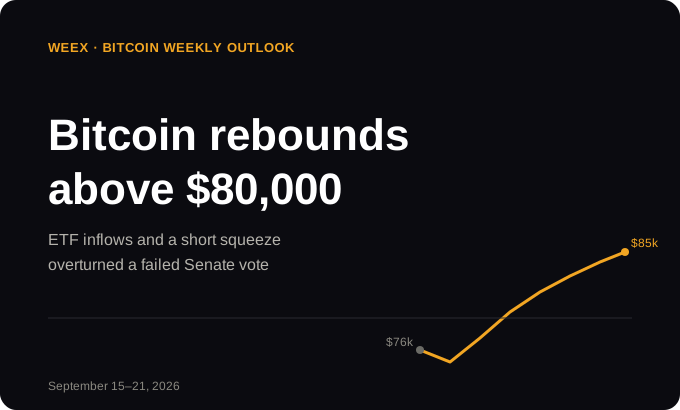
WEEX Bitcoin Weekly Outlook: Why Did Bitcoin Rebound Above $80,000 After the CLARITY Act Vote?
Bitcoin rebounded above $80,000 as SEC and CFTC action, renewed ETF inflows, and a short squeeze outweighed the failed CLARITY Act vote.

$8 Makes a Comeback, This Time X Money Rewrites the Logic of NFT Issuance
AMD Jumps Nearly 10%, Market Cap Tops $1 Trillion| WEEX TradFi Daily Brief (September 22, 2026)
Global markets on September 22 focus on a repair in AI-compute pricing. On September 21 the three major equity indexes closed higher. AMD rose nearly 10% and its market cap crossed $1 trillion for the first time, while Intel and Arm also surged. Brent crude fell about 3.4% to $100.34 and the 10-year Treasury yield eased to about 4.96%, lowering discount-rate pressure on long-duration tech. Bitcoin briefly broke above $87,000 and total crypto market cap returned above $3 trillion. Investors next watch consumer and housing earnings plus PMI flash prints.
OG.com Submits Application for US Stock Perpetual Contracts to CFTC Following Coinbase, Kalshi, and Kraken's Parent Company Payward
Solana’s Alpenglow upgrade reaches devnet with 150ms finality target
唐华斑竹: Quantum Computing Becomes a Core Risk Point in the Cryptocurrency Field
DeltaForesight Announces Completion of 324 Million Yen Financing to Develop Over-Collateralized Yen Stablecoin JPYdf
IBEX 35 Outlook 2026: Can Spain's Stock Market Reach 20,000 Again?
Goldman Sachs: AI Capital Expenditure to Reach $1.73 Trillion in 2026-2027
Contents
Latest articles


Latest coin listings on WEEX


