
Collector Crypt CEO: The Real Threshold of Digital Card Drawing Platforms Lies in These Four Aspects

 Prefer us on Google


From VRF to After-Sales: The True Threshold of Digital Unpacking Platforms Is Not On-Chain.
Written by: Thomas Holmberg, CEO of Collector Crypt
Compiled by: AididiaoJP, Foresight News
This article is quite technical. The goal is to clarify two things: the degrees of freedom in packaging for digital card drawing platforms, and what true transparency means. The discussion is based on the common multi-tier model: announcing probabilities by tier, with equal probability for each card within the same tier.
Collector Crypt CEO Thomas Holmberg breaks this down into four pillars. These four pillars cannot replace each other; if any one of them has a problem, the entire business cannot sustain itself.
First Element: Complete Inventory List
Many countries that allow card drawing products require the disclosure of all possible cards in a pack. If only the "top ten popular" cards are displayed without a complete list of ordinary cards, the platform can hide its cut within the value of the ordinary cards. Without a complete card list, transparency cannot be discussed; simply showing the top ten popular images does not count as transparency.
Collector Crypt provides a public API, allowing anyone to pull the complete card list. Thomas believes this should become an industry standard and a mandatory requirement.
Second Element: Verifiable Randomness
This is where most platforms easily make mistakes. Some platforms deliberately abuse it, while others are unaware of its importance. To achieve complete transparency, a verifiable random function (VRF) is a hard requirement; operationally, the proof must be submitted on-chain, allowing anyone to verify it.
There are several layers of requirements.
- First, all possible assets must be disclosed before opening the pack.
- Second, the seed input for the random number must come from outside the platform, such as the user's wallet, RPC, and transactions built on Solana, rather than from the platform's server.
- Third, it must be mathematically possible to trace the published results back to that input and the key that generated it. This tracing process is the proof.
Some platforms say, "We use VRF to select packs on our server," or claim, "The random function on our server has been audited." This misses the point. That is not proof, just a verbal promise. The server side can certainly produce "provably random" results, but the public cannot verify whether a grand prize was skipped. Server-side randomness can always show that a result is random, but it cannot prove that this random number was generated for the first time, rather than the second or third. The server can write a few lines of code: if this card is drawn, jump to the next random number display. No one audits these lines, and they can be added after the audit.
Collector Crypt's approach is: the result is determined before you see the card draw. Its VRF public key is registered on Solana and frozen, meaning it cannot be rotated, replaced, or "updated" afterward, and anyone can check it. When users sign transactions, the transaction itself is the input, constructed by the wallet, RPC, and Solana, not by the platform. The frozen public key, combined with the platform's unavoidable input, corresponds to only one valid output, so there is no space for "jumping to the second number."
The platform operates on RFC 9381 ECVRF, which is the standard used in the crypto industry; when opening packs, it submits the proof and the hash commitment of the user input on-chain and publishes the proof. Anyone in the world can take the published proof, the on-chain commitment, and the frozen public key to re-verify without logging into Collector Crypt.
If the card a user receives does not match the card calculated mathematically, the platform can be caught cheating. Users do not need to calculate the random number themselves; they only need to check whether the platform has cheated. This is the key. The platform is only responsible for reading the results and issuing cards. The validator, program address, and open-source code are all at vrf.collectorcrypt.com, so this is not just empty talk.
Conversely, if your VRF solution relies on data from the platform's server, and this data has not been submitted on-chain before opening the pack, then you do not have VRF, only a statement of "trust me." "Trust me" is suitable for bar bets, not for users spending real money on card packs.
Collector Crypt opens this entire solution to anyone on Solana, using it as public infrastructure. The code can be forked and deployed independently. Any project that needs random numbers can use it for free, only paying additional gas, with costs two orders of magnitude lower than existing alternatives. If card drawing platforms do not use this publicly verifiable VRF, why not? There is no reason not to.
Third Element: Expected Value
This is the most difficult and ambiguous aspect. Collector Crypt sometimes makes mistakes and is working on improvements. Perfection is unattainable; the key is to establish a mechanism for continuous improvement and how to handle errors.
How much is a card really worth? When the platform calculates and displays the expected value (EV) of a pack, it must make assumptions about the value of each card in the pack. Collector Crypt has been collecting data from eBay, alt.xyz, and Fanatics for 14 months and has even purchased a database that can be traced back for years. Even for high-traffic cards that trade multiple times a week, the highest and lowest transaction prices for the same card in the same month and rating can differ by 20%.
Some price differences are easily explained: a seller from Croatia with only one review auctions in dollars and charges $45 for shipping. Some are due to buyers forgetting to bid while drinking beer at a bar during double overtime. Others come from small circles on Instagram: holding 100 PSA 10 Bubble Mew cards, raising the price of 3 on eBay, hoping that the 5 they list at a high price on Fanatics will sell. There are various situations in between. Ultimately, the "market price" is less of an exact number and more of an emotion.
This topic deserves a separate article because the "subtle violence" lies here. How the platform prices the cards included in the pack determines the expected value (EV) of the pack, which in turn determines how many cards users will keep, how many they will sell back, and how much the platform can take as a cut.
Assume there is a platform called HotRips. HotRips claims to have a buyer network, but in reality, it is just someone pricing cards in a garage based on alt.xyz. They tell dealers at trade shows: I buy cards for 10% less than alt.xyz prices for $100,000. Dealers then know they can spend $100,000 and understand where the arbitrage opportunity lies.
When each card arrives at the booth, dealers will open alt.xyz to compare recent transaction prices with platform quotes. Suppose someone brings a card: alt.xyz quotes $4000, and the recent transaction price is $3500. The dealer knows this card can be sold to HotRips for $3600; however, they tell the seller, "We have the highest acquisition price at the trade show, 10% less." They show the seller the recent transaction of $3500, buy it for $3150, and then sell it to HotRips for $3600, making a net profit of $450. Both sides claim a 10% discount, but the reference price tags are not the same, and the price difference is thus made profitably. HotRips thinks it has built a buyer network, but in reality, it has built an automatic vending machine that only benefits dealers.
This vending machine only accepts one type of currency: cards that are overvalued by price tags. If alt.xyz quotes high, dealers sell to HotRips; if it quotes low, dealers do not sell, list on eBay, keep them, or sell to someone nearby who buys at real transaction prices. HotRips will never see that card. Therefore, the $100,000 inventory arriving at HotRips is not a market sample but a sample of cards that are "advantageous to dealers" due to mispriced tags. The data is biased even before HotRips opens the spreadsheet. Averaging the entire pool, this machine is structurally bound to overestimate. No one is cheating; it is just that the filter at the entrance only lets in overvalued cards.
HotRips takes the cards received for $3600 and puts them into digital unpacking at the alt.xyz price of $4000. Not every card is off by this much, but when mixed together, the advertised EV of the pack of $55 might only be $50 at real market prices. HotRips may not even intend to cheat; it is just following external price tags.
Adding user choices to the mix. If a user draws that $4000 card, the platform offers $3600 for buyback, and the user will definitely choose the buyback because the real market price is $3500. The user might even be quite pleased: a $50 pack turns into $3600. But they will not realize that the false EV is an invisible tax levied on every pack they draw. This is the subtle violence: no one is robbed, but everyone pays.
If a card is undervalued, users will keep it. For example, a $4000 card priced at $3500 in the machine, with a buyback price of $3150. Users will feel that this card is undervalued, choose to keep it, redeem it for physical goods, and then sell it on eBay for a price far exceeding $3150. Over time, undervalued cards are taken away, overvalued cards are sold back, and cycled into the pool, forcing the machine's EV to be high.
The only way is to accurately price each card in the machine. Collector Crypt has spent 14 months building a pricing oracle for Pokémon and One Piece cards, and next will tackle sports cards. They compare this system with alt.xyz and cardladder over the long term, measuring the standard deviation between the last predicted price of each card and the next actual transaction price, with an error rate about 30% lower than the best alternative. Even with a 30% lead in accuracy, each card still requires manual review after minting and pricing. This is not because they do not trust the model, but because combining manual input with the model yields better results; manual corrections will also become training data, making the next prediction more accurate.
This also means that third-party websites tracking EV and ranking platforms by "best EV per pack" miss key information. They rely on the EV and card prices reported by the platform. The author states that using their pricing oracle to run other platforms can confirm that most competitors (not all) have overestimated card prices by 10% to 20%. It is not necessarily the top cards on the homepage, but rather the ordinary cards that account for 99% of user draws, found on pages two and beyond.
-- Price
Fourth Element: Shipping and Customer Service
The fourth element is unrelated to the chain; it concerns people and services, and it is also something no one would write a white paper about.
In the U.S. and most developed countries, the benchmark for e-commerce fulfillment has been raised by Amazon: orders placed in the morning can be delivered to the doorstep by the afternoon; if items are damaged or incorrect, returns and exchanges are accepted without question. Users who collect cards also buy things on Amazon, naturally applying this standard to card platforms.
The current state of the card collecting circle is: slow shipping, fraud, unresponsive customer service, and damaged transport. Everyone has somewhat gotten used to it; the worst part is that they have truly become accustomed to it. Users open a crushed card box and merely shrug; this is the expectation they have been trained to have. Collector Crypt collaborates with OmniVault to enhance the redemption experience; the customer service team covers Discord, email, and AI chatbots, staffed by real people who can solve problems.
Customer service and fulfillment experience are also part of the friction. Users spend real money on collections and should be treated seriously when issues arise. If the platform sends a box claiming to be "sealed" but is clearly re-sealed, the platform must take responsibility and cannot use customs or similar reasons as excuses. If users receive crushed card boxes or cracked grading shells, they should be able to return or exchange them without question, as they did not pack them.
Therefore, it is best for the platform to own the vault; at the very least, they should have the phone number of the vault manager. When issues arise, the platform can call the vault manager and know how to respond to angry users within minutes. Users fill out a ticket, receive an automated reply three days later, and then wait weeks for the platform to "investigate"—this does not count as customer service; it is merely a delay. "We will follow up" is not a status update; it is the beginning of the ticket sinking into oblivion.
Thomas admits that customer service has not yet achieved perfection and will never achieve it. What can be done is to establish a culture that forms a process of continuous improvement, accepting that this work never has an endpoint. The vault manager at Collector Crypt was previously an Amazon warehouse manager; he knows where the standards should be set because he was once the person who demanded this standard from others.
The Four Elements Cannot Compensate for Each Other
Thomas claims to have seen competitors struggle with these aspects. The four elements cannot compensate for each other: as long as one part has a problem, the entire business will fail.
Not disclosing a complete card list renders VRF meaningless: if you do not disclose what is in the pool, no matter how beautiful the random proof is, it cannot verify whether the drawn card is from the disclosed pool. Having VRF and a complete card list but using lazy third-party pricing will also fail: randomness and inventory are transparent, but the EV is false, and the money users pay does not match the value they receive.
Having a complete card list without VRF is more direct: the card list is real, but the drawing process cannot be verified; the platform claims that whatever card is drawn is the one drawn. Even if the first three aspects are done well, if the cards arrive crushed in a bubble envelope six weeks later, users will not care about your proof. No matter how complete the proof is, if the experience is bad, the business will still fail to retain people.
This content is provided for general informational purposes only and doesn't constitute financial, investment, legal, or tax advice. Any events, rewards, online promotions, or related information mentioned herein should not be considered a recommendation, solicitation, or invitation to purchase, sell, trade, or otherwise deal in any crypto assets. Crypto assets are highly volatile and may result in loss. The availability of WEEX services, products, and related events may vary by region. You are responsible for ensuring that your participation is in accordance with applicable local laws and regulations.
You may also like

Crowded, Confused, and Missing the Boat: Multiple Extreme Signals Emerge in Global Markets

When will the next crypto bull run happen?

Midterm Election Predictions: Why Use Four Contracts to Measure Senate Control?

Why is Strive More Aggressive than Strategy in Financing Bitcoin?

Morpho RWA deposits pass $2B as loans approach $900 million

Key Institutional Prerequisite for Tokenization: Issuer Authorization

Kalshi Discusses User Protection Measures with Regulators, Willing to Raise Participation Age to 21

A New Wave of TGE? 19 Projects Expected to Launch Intensively in Q4

OCC Finalizes Stablecoin Issuance Guidelines in the U.S.

Reviewing the US, India, and South Korea: How Retail Investors Ignite the Options Market?

Looking Ahead to Tonight's Federal Reserve Meeting: A Pause in Rate Hikes in October is Almost Certain, How It Affects December Rate Hike Probabilities Becomes the Focus
On-Chain Options Blue Ocean: The Real Battlefield is in Retail Distribution

Robinhood Predicts Market Gains, But Crypto Revenue Halves

Bitcoin: Small Holders Leave, Big Buyers Step In

Bitcoin: Hyperliquid Whales Go Short for the First Time Since March

Why JPMorgan Raised the Target Price for Yushu Technology to 995 Yuan
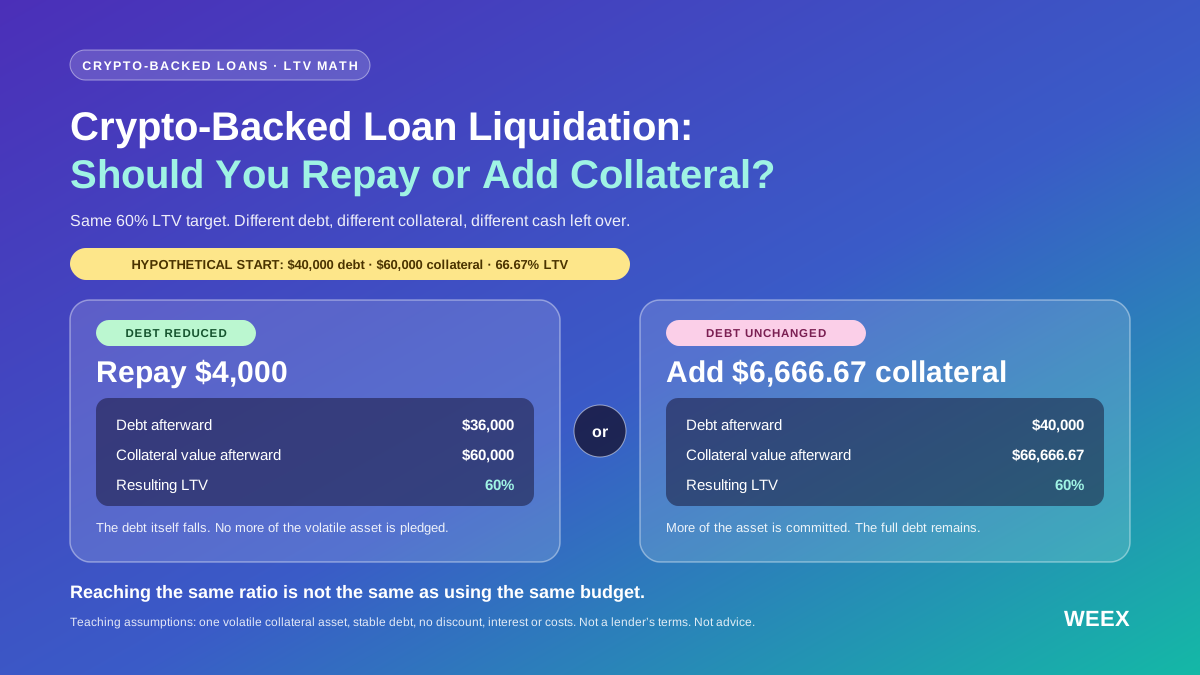
Crypto-Backed Loan Liquidation: Should You Repay or Add Collateral?
Facing crypto-backed loan liquidation? Compare repayment and collateral top-ups using equal budgets, LTV calculations, stress tests and protection limits.

Turbulent Middle Eastern Crypto Market Welcomes Leadership Change

Ritual Raises $30 Million to Launch Token: AI Game Changer or Retail Investor Trap?

Global Markets in the Last 24 Hours: Brent Oil Reaches $115.81, Bitcoin Drops to $79,818

The Mismatch Between Capital Frenzy and Deployment Economics in the Embodied Industry Clock Cycle
One Week Countdown to Midterm Elections! Will Crypto Change?

Bitcoin at $90,000: The $68 Million Bet on the U.S. Midterm Elections

BisonFi: How an Aggregator Captured Orders with Over $2 Billion in Weekly Trading Volume?

Anthropic IPO Filing Lifts AI Sentiment; BTC Holds Near $80,000 | WEEX TradFi Daily (October 27, 2026)
All three major indexes closed higher on October 26. Anthropic formally filed for a listing, rekindling AI speculation; the Philadelphia Semiconductor Index rose about 3% on the day, and Tesla reached a more-than-three-month high. Bitcoin was near $80,200, down for three consecutive weeks and testing $80,000 for a third time. Local assets plunged after the election result. The October 27 focus is the opening of the Federal Reserve meeting and earnings from Visa, PayPal and others.

WEEX Exclusive:Anthropic IPO Filing Lifts AI Sentiment; BTC Holds Near $80,000 | WEEX TradFi Daily (October 27, 2026)
How Optimism’s draft manual silently strips tokenholder elections

Tom Lee Did It Again. Bitmine Spent $24 Million on Ethereum, but Purchases Are Decreasing

Miden Partner Mainnet Launches, Plans Transition to Public Mainnet in Coming Months
Elon Musk's Grand Scheme to Undermine New Cloud Providers
Crowded, Confused, and Missing the Boat: Multiple Extreme Signals Emerge in Global Markets
When will the next crypto bull run happen?
Midterm Election Predictions: Why Use Four Contracts to Measure Senate Control?
Why is Strive More Aggressive than Strategy in Financing Bitcoin?
Morpho RWA deposits pass $2B as loans approach $900 million
Key Institutional Prerequisite for Tokenization: Issuer Authorization
Contents
Latest articles


Latest coin listings on WEEX


