
[Column] The On-Chain Transformation of Financial Markets Accelerated by the U.S.

 Prefer us on Google


The U.S. Securities and Exchange Commission (SEC). Source=Wikimedia Commons Kim Hyobong's Legal Crypto is a column series focusing on domestic and international digital asset legislation and policy trends. Experts including Kim Hyobong, a lawyer at the law firm Pacific, accountant Choi Hee-kyung, and lawyer Woo Ji-won share the latest regulatory developments in digital assets.
Recently, on my way to work, I received a message from a close client who is also considering token securities issuance (STO) that there was an important regulatory change overnight. This was the Innovation Exemption announced by the SEC.
The Innovation Exemption consists of two main components: the first is to exempt a tokenized securities trading platform (Tokenized Securities Venue, TSV) that meets certain requirements from the definition of "exchange" as stipulated in the Exchange Act (§3(a)(1)). The second is to exempt liquidity providers (Covered Firms) supplying their own capital to an automated market-making liquidity pool (hereinafter referred to as "AMM liquidity pool") from the definition of "dealer" under the Exchange Act (§3(a)(5)). Both exemptions will be effective for five years from September 17, 2026, to September 17, 2031.
To put the SEC's first exemption measure in simpler terms, it temporarily exempts regulations for the secondary market of tokenized U.S. stocks where it is difficult to apply existing exchange law regulations, and instead requires a "regulatory sandbox-type market structure" with separate safeguards. This is intended to test the actual market and gather data before designing a more permanent system.
For the Innovation Exemption to apply to TSVs, several conditions must be met:
(1) The smart contracts used in the TSV must be publicly available and auditable.
(2) They must be deployed on an unlicensed public blockchain.
(3) Participants in actual stock trading must be limited to verified authorized participants.
The SEC states that this authorization structure can be utilized to manage risks related to sanctions and money laundering. Therefore, businesses wishing to operate TSVs under this exemption in the U.S. must implement not only smart contract development but also participant identity verification, wallet credentialing, sanctions screening, asset transfer restrictions, and transaction monitoring.
Additionally, one of the most important substantive requirements in this exemption measure is the "same rights and privileges" requirement. TSVs must ensure that the tokenized securities being traded provide the same rights and privileges as traditionally issued securities.
Specifically, it must be confirmed that there are the same equity rights regarding the underlying company, the same rights to receive dividends and voting rights, and the same claims to distribution of residual assets upon liquidation of the company.
If a third party arbitrarily tokenizes a specific listed stock, the TSV must notify the issuer of that stock in writing at least 30 days before the trading start date, and if the issuer submits a written objection, the token cannot be traded on the TSV.
As a result, going forward, the arbitrary tokenization and trading of listed stocks by third parties, regardless of the issuer's intent, may be partially restricted. It is also important to note that this exemption measure applies only to the secondary market, not the issuance market.
The SEC's second exemption measure is the "Covered Firm Exemption." The SEC has exempted liquidity providers supplying tokenized U.S. listed stocks to AMM liquidity pools from dealer regulations if they meet certain requirements. Consequently, it is also possible to make price quotes or commit to trades using their own capital.
However, liquidity providers must limit their activities to trading tokenized U.S. listed stocks related to the AMM liquidity pool provided by the TSV, must trade on their own account, and must not hold or manage customer assets. Additionally, they are required to maintain records regarding liquidity supply contracts, fees, rebates, incentives, and sufficient liquidity, and to notify the SEC of their role.
Meanwhile, the SEC significantly limits the trading volume that such liquidity providers can offer, which is intended to restrict the impact on the traditional stock market if the prices in the tokenized market deviate from those in the traditional stock market. Furthermore, if trading halts occur in the traditional stock market, trading in tokenized stocks will also be halted simultaneously, thus preventing the tokenized market from moving independently from the existing market.
The recent announcement on the SEC's transfer agent system reform, along with the ongoing regulatory measures related to the tokenization of financial products, suggests that the SEC has a larger vision of integrating blockchain and digital assets into the financial market. At this point, with the announcement of a more advanced "token securities policy direction," I hope we can have deeper discussions about the integration of blockchain and digital assets into the capital market.
-- Price
This content is provided for general informational purposes only and doesn't constitute financial, investment, legal, or tax advice. Any events, rewards, online promotions, or related information mentioned herein should not be considered a recommendation, solicitation, or invitation to purchase, sell, trade, or otherwise deal in any crypto assets. Crypto assets are highly volatile and may result in loss. The availability of WEEX services, products, and related events may vary by region. You are responsible for ensuring that your participation is in accordance with applicable local laws and regulations.
You may also like

Coinbase scammer gets 4–12 years for nearly $16M theft

唐华斑竹 reports that BNB Chain will return to Seoul on October 2
Masayoshi Son is borrowing money again, betting billions on OpenAI

MERGE Madrid 2026: Institutional Crypto Settles in Madrid

Ethereum: 'Any teenager' can derail the Glamsterdam test

Former Zora CEO Jacob Horne Joins Polymarket to Oversee DeFi Product Upgrades

Reserve Bank of Australia Launches Consultation on Tokenized Market Settlement Services

Fed's Williams Calls Inflation Top Priority, Current Interest Rates Appropriate

Crypto Treasuries No Longer Attracting Investors

BlackRock Portfolio Launch Sends ONDO Above $0.50: The Token Jumped Over 22% in 24 Hours
BlackRock developed custom model portfolio strategies for Ondo's new tokenized products and ONDO jumped over 22% the same day the launch went live.

Solana DEX volume spike hides circular trades, and automated bots are blamed

Bitget Was Hacked for $351 Million: What This Means for Where You Keep Your Crypto
Bitget lost $351.6 million to a hot wallet hack, its largest breach ever, cold storage and a $464M protection fund kept it from becoming a crisis.
Bitcoin, Ethereum outlook as US Iran talks revive Hormuz reopening hopes

Magic Eden undergoing possible exploit as thousands of NFTs move for 0 ETH
Crypto outlook clouded by 5.2% Treasury yield and stalled US bill
26 Companies Including Toshiba Join Japan's Blockchain-Based Stablecoin EJPY Pilot
Tether says EQIBank exposure below 0.034% after U.S. seizure
Robinhood: Tenev Sees Crypto Outpacing Sports
![[Column] Which Coins Strengthen as Prices Rise](/public-static/050_2dc4cf2ce9.png?format=avif)
[Column] Which Coins Strengthen as Prices Rise
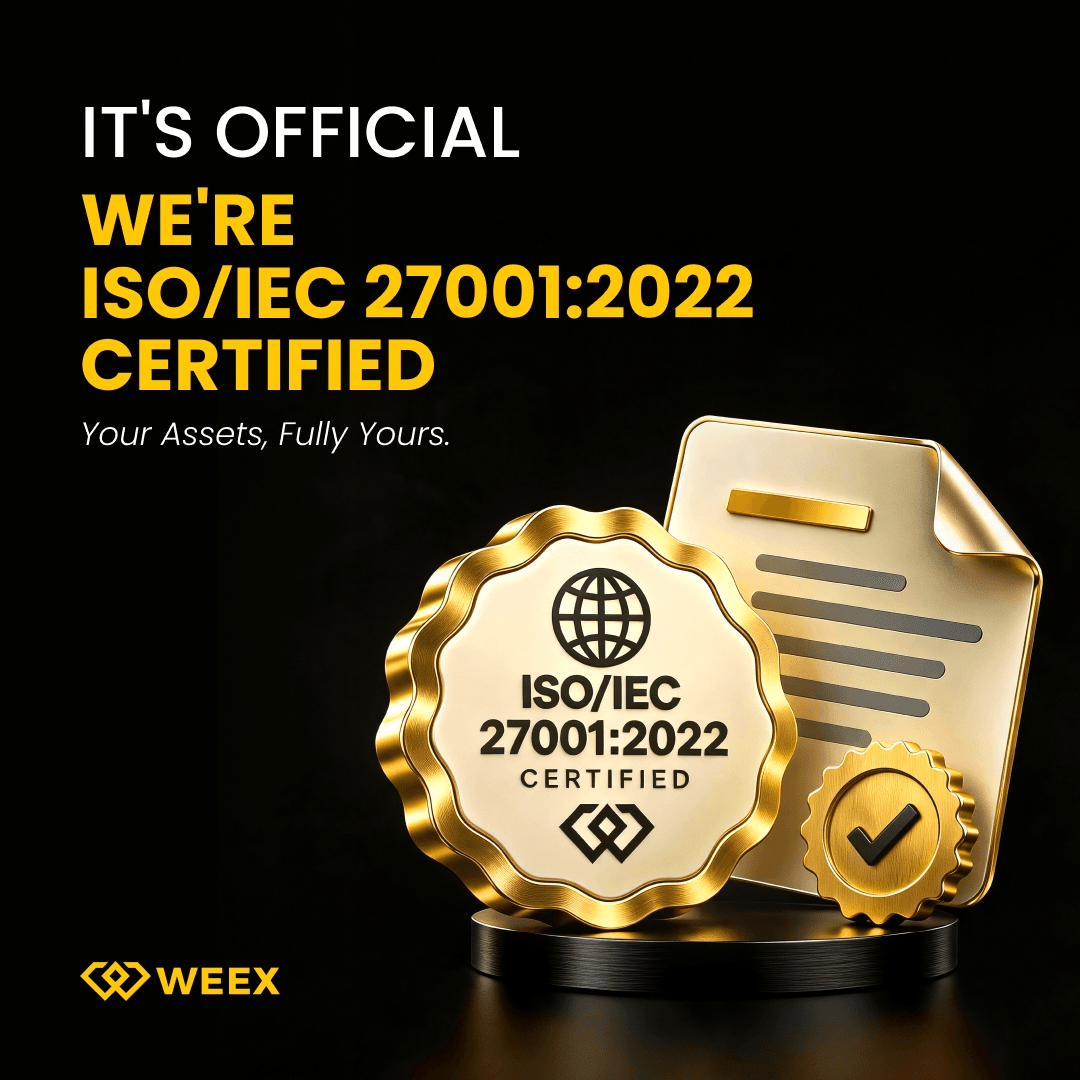
The WEEX License Story: Why ISO/IEC 27001 Certification Is the Proof Behind Every Security Claim
From a BSP license in El Salvador to a global ISO/IEC 27001 certification — here's what's actually being verified, and why it matters

US Considers Global Expansion and Adoption of Dollar-Denominated Stablecoins to Stimulate Treasury Demand

ONDO Tokenized Smart-Portfolio Narrative Builds| WEEX TradFi Daily Brief (September 25, 2026)
Global markets on the morning of September 25 Beijing time focus on rate pricing and a split in AI infrastructure. On September 24 ET the S&P 500 was near 7,704 and almost unchanged, the Nasdaq edged higher and the Dow fell 0.31%. The 10-year yield rose to about 5.18% and the 30-year to about 5.47%. Bitcoin last traded around $84,400.

Two obscure pools fuel 2.8B XRPL volume, but only 185 trades caused it

Compute Finance: The Financial Layer Being Built by the AI Economy, 0G is Constructing a New Paradigm for Computing Assets

The Illusion of $1 Billion in Trading Volume? Testing the Real Selling Pressure of Coinbase Stock Tokens During U.S. Market Closure
Mr&强 Analyzes NEAR's Recent Performance, Cross-Chain Trading Volume Exceeds $29 Billion

唐华斑竹 Analyzes Growth in Gate BTC Spot Trading Volume Share

WEEX Trade & Win Ends Sept 27: Join the Sept 29 GoGoGo Live & Apple Prize Draw
Wall Street Legend Bill Miller: Why Did I Bet Half My Fortune on Bitcoin?

The Stronger the AI, the Lower the Wages: Your Education is Becoming the Most Expensive Devalued Asset
Coinbase scammer gets 4–12 years for nearly $16M theft
唐华斑竹 reports that BNB Chain will return to Seoul on October 2
Masayoshi Son is borrowing money again, betting billions on OpenAI
MERGE Madrid 2026: Institutional Crypto Settles in Madrid
Ethereum: 'Any teenager' can derail the Glamsterdam test
Former Zora CEO Jacob Horne Joins Polymarket to Oversee DeFi Product Upgrades



