
Enforcement Cases Against Public Companies by Wall Street Regulators Drop to 16-Year Low

 Prefer us on Google


The U.S. Securities and Exchange Commission (SEC), the top securities regulator, has seen the number of enforcement actions against public companies hit a new low not seen in at least 16 years. Under Chairman Paul Atkins, the agency has scaled back its enforcement efforts against white-collar crime in the world’s largest securities market.
An analysis by Cornerstone Research and the Pollack Center for Law and Business at New York University shows that in the 12 months ending September 30, the SEC initiated only 16 enforcement cases against public companies and their subsidiaries, the lowest since the agency began tracking this data in 2010.
During the same period, the SEC recovered a total of $184 million in fines and illegal gains from such defendants, also the lowest level since at least 2010.
Experts say the significant drop in case numbers is partly due to the relaxed enforcement standards under Atkins’ leadership and partly due to a large number of SEC employees accepting buyout packages offered by the Trump administration, leading to severe staff turnover.
Stephen Choi, a co-author of the report and a professor at NYU School of Law, stated, "The current pace of enforcement is highly aligned with the priorities articulated by Atkins." The SEC's current goal is to promote more corporate IPOs.
This week, the SEC released its first complete set of enforcement data for the fiscal year following Trump’s return to the White House: including both companies and individuals, a total of 348 cases were filed throughout the year, about a 50% decrease from the previous eight-year average of 710 cases.
In the last fiscal year, the SEC recovered a total of $1.1 billion in fines and illegal gains, the lowest since 2008.
David Woodcock, head of the SEC's enforcement division, said in a speech on Tuesday, "The number of enforcement cases and the effectiveness of enforcement cannot be equated; any objective and comprehensive assessment must take this into account."
He added that Atkins "gives us space to prioritize improving the enforcement system rather than maximizing the number of cases in a single year."
Under Atkins, who was nominated by Trump, the SEC plans to eliminate quarterly reporting requirements and adopt a more lenient regulatory approach to crypto securities and all-weather trading.
Atkins stated that the SEC will abandon the previous administration's model of "enforcement as regulation" and return to a "back to basics" approach, focusing on combating insider trading, market manipulation, and other offenses.
One of the most notable penalties against a public company this year was forcing Archer Daniels Midland (ADM) to pay $40 million in settlement. The company was accused of misleading investors regarding the performance of its nutrition business segment.
As enforcement cases decrease, the SEC has seen significant staff turnover since Trump began his second term. By the fiscal year ending September 2025, nearly 20% of SEC employees are expected to leave.
The SEC's five-member commission currently has only two members left. In September, the SEC passed a rule allowing the agency to operate with just one member.
Harvard Law School professor John Coates said, "The obvious risk is that as enforcement weakens, the risk of fraud rises. The trend is very clear, and the decline is quite remarkable."
Coates also pointed out that the five-year statute of limitations for securities enforcement is longer than the current administration's term, and a future new president could potentially shift back to stricter regulation.
After the Democratic Party's significant victory in last week's midterm elections, securing control of Congress and some state attorney general positions, public companies may face a new round of scrutiny.
Democratic lawmakers will gain subpoena power after taking control of the majority in Congress in January, and they have indicated they will investigate industries such as cryptocurrency and private equity.
-- Price
This content is provided for general informational purposes only and doesn't constitute financial, investment, legal, or tax advice. Any events, rewards, online promotions, or related information mentioned herein should not be considered a recommendation, solicitation, or invitation to purchase, sell, trade, or otherwise deal in any crypto assets. Crypto assets are highly volatile and may result in loss. The availability of WEEX services, products, and related events may vary by region. You are responsible for ensuring that your participation is in accordance with applicable local laws and regulations.
You may also like

Anthropic Yet to Go Public, Crypto Players Already Cashing In

Interpretation of FATF Report on Scam Compound Funds: Virtual Assets Become Core Money Laundering Channels

How Much Is Anthropic Really Worth?
Research Reveals 3D Spatial Navigation Map of Hand in the Brain to Aid Brain-Machine Interface Development

Michael Dempsey: Crypto Venture Capital Stagnates, Talent Shifts to AI

Yen Fluctuations Highlight Current Trading Difficulties, Investors Have Huge Divergence on Long-term Outlook

Bloom Energy vs. Constellation Energy: On-Site Power or Grid Power, Which Wins the Data Center?

Former Polychain Partner Launches Startup: Enters Tokenized Real Estate, Secures $50 Million Seed Round Funding to Create the 'S&P 500' of Real Estate

Seminar: The History of Hyperliquid and On-Chain Finance Guest: Takuya Fujita (11/18 19:30 @ Gentosha)
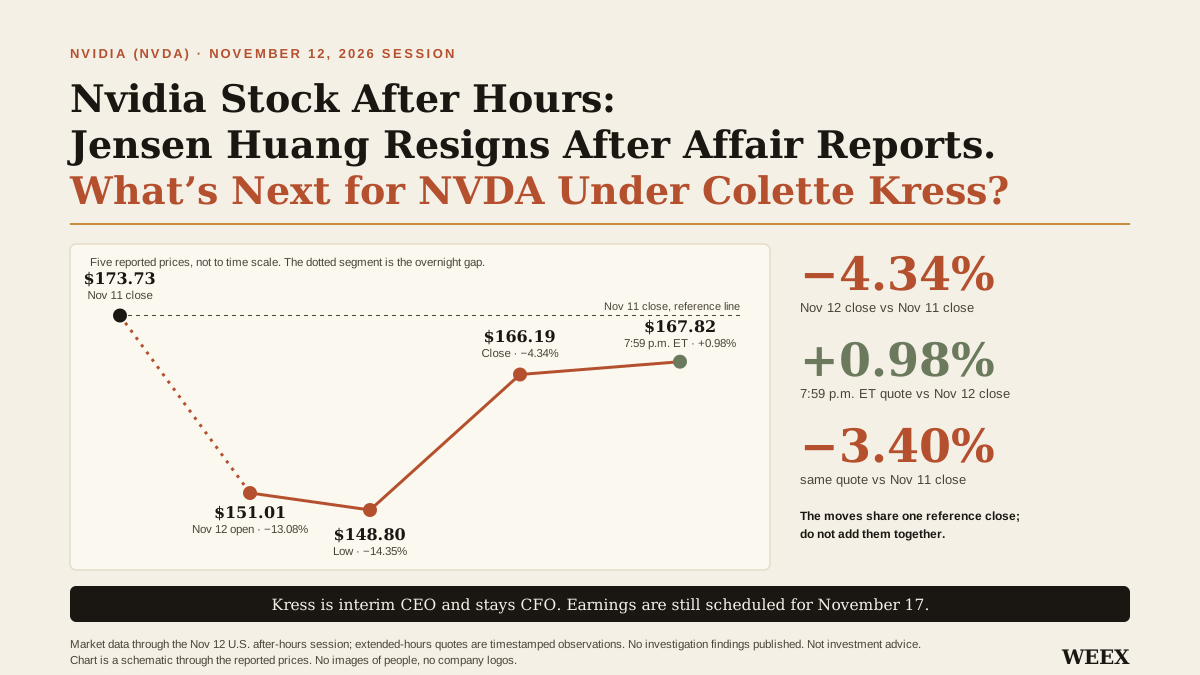
Nvidia Stock After Hours: Jensen Huang Resigns After Affair Reports. What’s Next for NVDA Under Colette Kress?
Nvidia fell 4.34% after Jensen Huang resigned, then rose 0.98% after hours. See what Colette Kress’s appointment means for NVDA and November 17 earnings.

Jensen Huang's Sudden Departure Raises Questions: Did the White House Intervene? Is a Return Possible?
In-Depth Interview | Fu Peng: I Have No Faith in BTC

Cerebras Conference Call: Secures Major Deal with Microsoft, HBM Shortage Becomes an Opportunity, WSE-5 Chip to Enter Mass Production Next Summer

SoundHound AI Stock Is Down Almost 60% in 2026, but Wall Street Thinks It Can Soar 155% By the End of 2027. Here’s Why It Could Be One of the Best Buys Amid the Tech Sell-Off.
What is being said at the tables: the market begins to see 2027 as an all-or-nothing scenario

Kalshi Negotiates New Round of Financing, Valuation Expected to Reach $65 Billion

Republican Senator Wants to Freeze AI Data Center Boom as Congress Pushes to Expand It

Why the Path to Quantum Resistance Runs Uphill for Bitcoin Wallet Makers

Pimco CEO Warns: AI Companies Risk Borrowing "Too Much" ($10 Trillion)

Silver ETF vs. Silver Miners ETF: Which Has Held Up Better This Year?

Why AMD Shares Are Surging and What a $10,000 Investment in the Stock Could Be Worth in 3 Years

Cardano Academy launches practicum with on-chain credentials
Warren Buffett Doesn't Follow His Own S&P 500 Advice. Should You?

A $776 Car Payment Is a Warning for Ford and General Motors

2 Chip Stocks to Buy Instead of Nvidia Right Now

History Says This Is the Smartest ETF to Buy During the Next Bear Market

EU to Continue Providing Financial and Military Aid to Ukraine
The market demanded liquidity and the Economy granted it: what to expect for interest rates after the Treasury auction

Qualcomm CEO on Tech Stock Plunge: "There is No AI Sector Correction for Us"
Stock Market Crash: What History Says Comes Next After the Market's Big Single-Day Dip.
Anthropic Yet to Go Public, Crypto Players Already Cashing In
Interpretation of FATF Report on Scam Compound Funds: Virtual Assets Become Core Money Laundering Channels
How Much Is Anthropic Really Worth?
Research Reveals 3D Spatial Navigation Map of Hand in the Brain to Aid Brain-Machine Interface Development
Michael Dempsey: Crypto Venture Capital Stagnates, Talent Shifts to AI
Yen Fluctuations Highlight Current Trading Difficulties, Investors Have Huge Divergence on Long-term Outlook
Latest articles




Latest coin listings on WEEX


