
How Should Heirs Legally Withdraw Cryptocurrency Left by Deceased Relatives?

 Prefer us on Google


Can virtual currency be inherited as part of an estate? Will exchanges cooperate with a death certificate and inheritance notarization? If the private key has been found, can the coins be transferred directly? If there are other heirs, who has the right to decide the fate of these assets?
Written by: Gao Mengyang
After a family member passes away, one might find a hardware wallet, a piece of paper with mnemonic phrases, or a logged-in account on an overseas exchange on their phone while sorting through their belongings. The family knows these assets may have significant value but does not know where to start:
Can virtual currency be inherited as part of an estate? Will exchanges cooperate with a death certificate and inheritance notarization? If the private key has been found, can the coins be transferred directly? If there are other heirs, who has the right to decide the fate of these assets?
Traditional inheritances usually have relatively mature registration and inquiry systems. For example, bank deposits can be verified through the bank, and real estate can be confirmed through property registration. However, virtual currencies are different; assets may be scattered across multiple exchanges, non-custodial wallets, or on-chain protocols. Some assets lack centralized institutions to assist with inheritance procedures. Even if heirs have legal rights to the corresponding property, they may be unable to control the assets due to a lack of private keys, mnemonic phrases, or multi-signature permissions.
Therefore, when dealing with digital asset inheritance, it is essential to clarify three issues: whether these assets legally belong to the deceased's estate, how heirs can prove their rights, and whether they have the actual ability to control and dispose of the assets after obtaining legal inheritance qualifications.
These three issues are interrelated but cannot replace each other.
1. Can virtual currency be inherited? First, it must be determined whether it is personal legal property.
When discussing the inheritance of virtual currency, two completely opposite understandings often arise. One view holds that virtual currency has economic value and can therefore be inherited; the other believes that China prohibits virtual currency-related trading activities, so family members cannot claim any inheritance rights. Both judgments are overly simplistic.
Article 1122 of the Civil Code of the People's Republic of China states that an estate consists of the personal legal property left by a natural person upon death, excluding property that cannot be inherited by law or by its nature. Article 127 further stipulates that if there are regulations on the protection of data and network virtual property, they shall be followed. This means that the digital form of existence does not inherently exclude property rights, but it cannot be directly assumed that all virtual currencies can be inherited, traded, or liquidated without restriction simply because they belong to network virtual property.
It is particularly important to note the notice issued in February 2026 titled "Notice on Further Preventing and Handling Risks Related to Virtual Currency" (Yin Fa [2026] No. 42). This document reiterates that virtual currencies such as Bitcoin, Ethereum, and Tether do not possess legal tender status and should not and cannot be circulated as currency in the market. It also prohibits illegal financial activities related to the exchange of domestic legal tender and virtual currencies, as well as exchanges between virtual currencies. Furthermore, the document clarifies that personal investments in virtual currencies and related products that violate public order and good customs are invalid, and any resulting losses shall be borne by the investor.
Therefore, under the legal framework of mainland China, the issue of digital asset inheritance should be examined separately from the regulatory issues of virtual currency trading activities, but they cannot be treated in isolation.
For example, if the deceased held a certain type of digital asset for a long time and can provide purchase records, holding records, and wallet control information, this differs fundamentally from digital assets that the deceased held on behalf of others due to suspected illegal financial activities. Even if a wallet is controlled by the deceased with a private key, it cannot be directly assumed that all assets within it belong to their estate.
For family members, what needs to be confirmed is not just whether there are coins in the wallet, but how these assets were acquired, who actually enjoys the rights, whether there are third-party rights, and whether the relevant rights can be recognized as part of the estate under applicable laws.
2. With inheritance proof, why might it still not be possible to withdraw the coins?
This is the most noteworthy distinction between digital asset inheritance and traditional property inheritance.
Traditional financial accounts are usually managed by banks, securities companies, and other institutions. After heirs obtain valid legal documents, they can apply to inquire, transfer, or handle other procedures according to the requirements of the relevant institutions. However, non-custodial wallets do not have such account managers, and the blockchain network will not automatically recognize heirs and transfer assets to a new address simply because someone has passed away.
Therefore, legal inheritance rights and technical asset control capabilities are two different mechanisms.
Suppose the deceased used a hardware wallet to hold BTC, and the family found the device but did not know the unlock password and could not find the mnemonic phrase. Even if family members have reached an agreement on the inheritance share and have obtained valid legal documents, it does not mean they can restore the wallet's signing authority. For non-custodial wallets that use secure cryptographic mechanisms, if the necessary keys or recovery conditions cannot be obtained, the assets may remain in the original address for a long time without being transferred.
Conversely, if a family member discovers the mnemonic phrase while sorting through belongings and can technically control the wallet, it does not mean they can transfer all digital assets to their personal account without the consent of other heirs. The mnemonic phrase addresses signing and transfer capabilities but does not directly answer who the ultimate rights holder is, whether there is joint property between spouses, the shares of other heirs, and whether the estate still needs to be used to settle legally owed debts.
This also determines that digital asset inheritance cannot rely solely on traditional inheritance procedures, nor can it depend solely on technical personnel to restore the wallet. Legal rights confirmation and technical control condition verification often need to be advanced simultaneously.
3. Where the assets are stored determines how the inheritance procedures should be handled.
The path of digital asset inheritance primarily depends on who holds the assets. This directly affects the entities heirs need to contact, the materials they need to prepare, and whether they can actually obtain the assets.
First scenario: Assets stored in centralized exchanges.
If the deceased held assets such as BTC, ETH, or USDT in an overseas exchange account, heirs typically need to apply through the estate handling procedures provided by the platform, rather than logging in directly with the deceased's account and password to sell or transfer the assets.
Currently, some large trading platforms have provided relatively clear inheritance application channels. For example, Binance's official help center has an "Inheritance Appeal" feature, where applicants can submit the deceased's account information and valid inheritance documents, and the platform will process the application according to applicable laws, service terms, and review results. Coinbase's official process requires applicants to provide a death certificate, estate certification or estate management authorization documents, identification, and asset handling instructions signed by authorized personnel.
These public rules at least indicate one thing: some overseas trading platforms recognize the existence of inheritance relationships that need to be handled after the death of digital asset holders, but the provision of inheritance application channels by the platform does not mean that all applicants can directly claim the assets.
The platform still needs to confirm account ownership, the legal qualifications of the applicant, applicable judicial jurisdiction, asset status, and compliance requirements. If the account involves freezing, debts, abnormal transactions, or other ownership disputes, the handling process may become further complicated. Additionally, the same platform entity may have different document and operational requirements in different countries and regions, and heirs cannot simply replicate the successful experiences of users in other regions.
Second scenario: Assets stored in personally controlled non-custodial wallets.
If the deceased used a hardware wallet, mobile wallet, or other non-custodial wallets, the situation is entirely different. Trading platforms typically cannot assist heirs in recovering private keys, and wallet software developers may not have any authority to assist in transferring assets.
At this point, two types of information need to be distinguished: wallet addresses can help family members identify on-chain holdings and verify historical transactions, but to complete the asset transfer, the corresponding private key, mnemonic phrase, or other signing conditions are usually required. Even if a blockchain explorer shows that a certain address holds a large amount of BTC, it cannot be assumed that it necessarily belongs to the deceased based solely on the address, nor can control be obtained directly from it.
For these types of assets, lawyers need to work with technical personnel to verify the source of the wallet, address usage history, purchase and transfer records, and assess existing recovery conditions under legal authorization. Technical work should prioritize preserving evidence and asset security, avoiding rash actions while the rights relationship remains unclear.
Third scenario: Assets in multi-signature wallets, on-chain protocols, or other complex control structures.
Some Web3 practitioners do not hold assets individually but use multi-signature wallets to manage investments, project treasuries, or company funds. Suppose a wallet requires two out of three signers to jointly authorize a transfer, and one signer passes away; this does not necessarily prevent the transfer of assets. However, if their signing authority is irreplaceable and the remaining number of signatures cannot meet the threshold, technical handling may face difficulties.
More importantly, assets in multi-signature wallets may not belong to any one signer's personal property. Signers may merely be financial officers of a company, DAO management members, or custodians, and their signing authority does not imply personal ownership of the corresponding asset rights.
Therefore, when encountering such wallets, it is essential to first verify the actual ownership of the assets, signing rules, relevant agreements, and member permissions before discussing whether the deceased left behind inheritable property rights or management permissions that cannot be directly disposed of as personal estate.
4. With multiple heirs in the family, who has the right to decide how the coins in the wallet are distributed?
In digital asset inheritance, there is also a risk that is easily overlooked: family members often equate "who controls the wallet" with "who is responsible for inheritance."
For example, after a father passes away, children may find a trading account on his phone, or one family member may know the mnemonic phrase for the hardware wallet, and they prepare to transfer the assets to their own wallet before discussing distribution with other relatives. This approach may technically be feasible but may not comply with legal estate management and distribution procedures.
According to China's Civil Code, after inheritance begins, if there is a will, it should be handled according to the provisions of the will; if there is no will or special arrangements, the statutory heirs should be determined according to the law. The first-order statutory heirs include spouses, children, and parents. If the relevant digital assets belong to community property, the spouse's original property share must be determined according to law before confirming the portion that belongs to the deceased's estate. Just because digital assets are registered or stored in accounts controlled by the deceased does not mean that all assets can be directly regarded as part of the estate.
This is especially important in the context of digital assets. Traditional estate transfers usually require institutional verification of ownership documents, but non-custodial wallets only verify signing authority and do not check whether the operator is the sole heir. If a family member holds the private key, they can transfer assets to a new on-chain address, and other heirs may not be able to discover this in time, making it even more difficult to prevent subsequent transfers through ordinary account freezing methods.
Therefore, when there is a dispute over estate distribution, the management rights issue should be resolved first. Article 1145 of the Civil Code stipulates the method for determining the estate administrator, while Article 1147 clarifies the responsibilities for clearing the estate, making lists, preventing estate damage or loss, handling debts, and dividing the estate according to law. If heirs cannot reach an agreement on the estate administrator, they can also apply to the people's court for designation.
Specifically regarding digital assets, the estate administrator or legally authorized personnel should organize the verification of relevant wallets, platform accounts, and asset lists, preserve materials that can prove holdings and transaction history, and clarify who manages the devices, who has access to the keys, and which operations require joint confirmation. For assets that have already been discovered, the verification time, quantity, and relevant transaction status should also be recorded to avoid new disputes during subsequent divisions, such as "how many coins were there initially" or "who operated which transfer."
Additionally, if the deceased had any outstanding legal debts or other property obligations that need to be handled according to law, heirs cannot only discuss how to divide the coins without considering the overall settlement and distribution arrangements of the estate.
The uniqueness of digital asset inheritance lies in the fact that the technical transfer may be completed before the legal distribution. The easier it is to directly transfer the assets, the more necessary it is to clarify management rights and inheritance shares in advance.
5. What Should Heirs Do First? It’s Not Necessarily to Open the Wallet Immediately
For family members lacking experience with digital assets, the most common reaction upon learning that a relative has left behind cryptocurrency is to find someone who can operate the wallet, hoping to transfer the assets as soon as possible. However, if the types of assets, control conditions, and inheritance relationships have not yet been confirmed, directly proceeding with technical operations may create new problems.
A more prudent sequence is to first verify the assets, secure evidence, confirm rights, and then decide how to handle them.
First, it is essential to sort out the digital asset accounts and wallets that the deceased may have used during their lifetime. Registration emails from exchanges, deposit and withdrawal notifications, purchase orders, historical bank records, hardware wallet devices, and related asset lists can all help family members determine whether the assets exist. After discovering the wallet address, they can also verify the asset balance and transaction history based on the public information of the corresponding public chain. However, it should be noted that holding assets at an on-chain address and the ownership of those assets by the deceased are two different proof issues.
Second, efforts should be made to preserve materials related to the source and control of the assets. If the deceased purchased digital assets through an exchange, they can organize legally obtained account records, orders, transfer vouchers, and other materials. If assets were transferred from the exchange to a personal wallet, it is necessary to verify the relevant on-chain transactions and their correspondence with the individual's account. For assets held long-term and transferred across multiple platforms, historical records often provide more insight into the asset formation process than a current balance screenshot.
Third, legal documents should be prepared according to the actual inheritance relationship. Death certificates, materials proving kinship, wills, inheritance notarization documents, court rulings, and estate administrator identification may play different roles in different cases. It is particularly important to note that a death certificate only proves that the deceased has passed away and does not independently prove that the applicant has the right to obtain all assets. When multiple heirs are involved, there are disputes over the validity of the will, or when dealing with overseas platforms, it is often necessary to further clarify whether the applicant is an heir, executor of the will, or a legally authorized estate administrator.
Finally, the subsequent procedures should be determined based on the actual method of asset preservation. For centralized exchange accounts, it is essential to first verify the official inheritance application channels and document requirements. For non-custodial wallets, individuals with the appropriate permissions should handle them based on completed ownership and security assessments. For assets with joint inheritance or third-party interests, the corresponding authorization and distribution issues should be resolved first.
Throughout this process, there are two types of operations that require particular caution.
One type is the unauthorized use of the deceased’s exchange account. Even if family members can log in through a mobile verification code or device, it does not mean they have obtained the platform-recognized account disposal rights. Especially for overseas platforms, there may be local regulations regarding unauthorized access to computer systems, platform service agreements, and account identity verification rules. The other type is handing over private keys or mnemonic phrases to unidentified "asset recovery agencies" or connecting wallets and signing on-chain transactions at the request of strangers. Once the complete mnemonic phrase is leaked, it may allow others to gain control over the assets, and on-chain transfers are usually difficult to reverse.
For heirs, safeguarding wallet information among the deceased's belongings is part of asset protection; whether they have the right to operate this information requires separate judgment.
6. What Legal and Compliance Steps Are Needed for Assets Held in Overseas Exchanges?
For individuals living, working, or investing in digital assets across borders, inheritance becomes more complex: the deceased may be a resident of mainland China, but the exchange account is serviced by an overseas entity, and the heirs may also be distributed across different countries and regions.
In this case, it is first necessary to determine which laws apply to the inheritance, as one cannot assume that all assets necessarily follow the same mainland Chinese inheritance procedures simply because the heir holds a Chinese ID card.
For example, Article 31 of China’s "Law on the Application of Laws for Foreign-related Civil Relations" stipulates that the law of the habitual residence at the time of the deceased’s death generally applies to statutory inheritance, while the law of the location of the real estate applies to real estate statutory inheritance. Articles 32 and 33 also provide regulations on the applicable laws for the form and validity of wills. However, the legal nature of digital assets, their storage locations, and platform service relationships can be quite complex, and the specific applicable laws still need to be judged based on actual disputes and cross-border factors.
If it is necessary to submit a death certificate, proof of kinship, or other legal documents issued in mainland China to an overseas exchange, the platform may also require translation, certification, or other forms of verification, and confirm whether the applicant has the authority to handle the estate according to local regulations. Some platforms allow account assets to be transferred through a specialized inheritance procedure, while others may require the designation of a legally authorized representative to receive them uniformly.
Even if the heir passes the platform review, subsequent asset reception and disposal may still be restricted by local laws, platform customer admission policies, and anti-money laundering requirements. Especially for residents of mainland China, one cannot assume that because the assets are obtained through inheritance, subsequent activities such as cryptocurrency exchanges, cross-border settlements, or fiat currency deposits are naturally exempt from current regulatory constraints.
The inheritance process determines who has the right to obtain the assets, while financial regulation determines how the assets can be held and disposed of after acquisition. Both must be judged separately.
7. What Should Digital Asset Holders Arrange in Advance?
From a risk prevention perspective, the most worth discussing aspect of digital asset inheritance is not just what family members should do after the holder's death, but why many individuals managing high-value on-chain assets do not leave any executable arrangements for after their passing.
Bank accounts can typically initiate inquiry procedures through identity and inheritance materials, but digital wallets that are entirely managed by individuals heavily rely on key management. If the holder does not inform family members about the existence of assets on which platforms or wallets, and does not leave behind a legal, secure, and executable access arrangement, their estate may be legally recognized but practically unattainable due to a lack of technical control conditions.
Therefore, for individuals holding a significant amount of digital assets, mature estate planning should not only specify "who will inherit the cryptocurrency" but also consider asset lists, ownership materials, will arrangements, estate administrators, and how private keys or multi-signature permissions will be safely transferred after inheritance occurs.
However, this does not mean that all mnemonic phrases should be directly written into the will or handed over to all family members in advance. Wills and inheritance documents may need to be presented to others in specific procedures, and once the mnemonic phrase is leaked, it often means the wallet loses its security. A more reasonable approach is to design the property distribution arrangements separately from the key management arrangements, ensuring information security while allowing those legally entitled to handle the estate to obtain the necessary operational conditions when needed.
For founders, fund managers, or Web3 practitioners managing project treasuries, it is also essential to distinguish between personal assets and assets managed on behalf of others, to avoid affecting the security of the company or other rights holders' assets due to unclear handover of wallet control permissions after an individual's death.
In Conclusion
Virtual currency inheritance, on the surface, is about how relatives obtain the digital assets in the wallet after a family member passes away, but it essentially connects various systems including inheritance law, digital asset ownership, cryptographic control, transaction platform rules, and cross-border financial regulation.
Some individuals possess complete inheritance documents but cannot recover the wallet; some can open the wallet but are not the only ones entitled to dispose of the assets; and some have already passed the inheritance review of overseas exchanges but still face new legal restrictions in subsequent holding and fund disposal stages.
These scenarios collectively illustrate that digital asset inheritance cannot be viewed solely from the perspective of "whether there are coins" or "whether there are private keys."
The law determines who has the right to inherit, evidence helps confirm asset ownership, technology determines whether assets can be practically controlled, and regulatory rules dictate how they can be disposed of afterward.
For heirs, the most important thing is not to complete an on-chain transfer as quickly as possible, but to first clarify these layers of relationships. Only by confirming that the assets indeed belong to the estate, clarifying the corresponding inheritance rights, and resolving the necessary control and authorization conditions can a foundation be established for subsequent legal disposal.
For digital asset holders, completing estate planning in advance is also part of asset management. After all, whether a wealth can truly be passed on depends not only on how the holder manages it during their lifetime but also on whether those who are legally entitled to rights after their passing can find, prove, and safely manage these assets.
This article is written based on relevant laws and regulations and publicly available rules of trading platforms effective until October 2026, primarily discussing the inheritance legal framework in mainland China while appropriately introducing the handling methods of overseas platforms. Specific inheritance qualifications, asset nature, applicable cross-border laws, and subsequent disposal should be judged based on individual cases.
-- Price
This content is provided for general informational purposes only and doesn't constitute financial, investment, legal, or tax advice. Any events, rewards, online promotions, or related information mentioned herein should not be considered a recommendation, solicitation, or invitation to purchase, sell, trade, or otherwise deal in any crypto assets. Crypto assets are highly volatile and may result in loss. The availability of WEEX services, products, and related events may vary by region. You are responsible for ensuring that your participation is in accordance with applicable local laws and regulations.
You may also like

Total Inflows in XRP ETFs Reach $1.8 Billion

A Midnight privacy-vault demo needs outside signers to release Ethereum tokens

Ripple teams up with $10B payments firm Arf to expand RLUSD use on XRPL

DFINITY Founder Accuses NEAR Intents of Misappropriating Proprietary Technology

U.S. Blockchain Association Calls for Advancement of Digital Asset Tax Legislation

Are Meme Stock Tokens a Passing Fad or a New Gateway to Traditional Securities Markets?

One billion dollars in three days is not enough. Bitcoin faces a significant challenge

Lido’s proposed exits would pay lenders with borrower collateral
Countdown to the U.S. Midterm Elections: How Will Changes in Congressional Control Affect Cryptocurrency Market Pricing?

From Ledger to Bitget: What Are the Overlooked 'Trust Blind Spots' in Crypto Security?

France Proposes Accountability for Crypto Platforms in DeFi Events
SpaceX’s $194 billion share unlock exposes a major risk in Aave’s tokenized stock ambitions

The Global Illusion of 'Zero Tax' on Crypto: No Capital Gains Tax Does Not Mean Tax-Free Profits

Decibel launches Aptos Encrypted Mempool to protect traders from MEV
DekaBank launches Bitcoin trading for Sparkassen customers
Solana Surpasses Robinhood Chain with 1.5 Million Tokenized Shareholders

Elon Musk Discusses National Debt, Reflections on DOGE, and the Robot Economy, Revealing the Truth About Superintelligence Going Out of Control

Kraken’s $80 stablecoin fee gap exposes hidden costs

Money Here: What the New Cryptocurrency Regulations Change
Cardano Leios targets 3–5x capacity through staged Dijkstra rollout
Pump.fun’s 79% first-day dropout rate fuels memecoin trader fatigue

Dragonfly Executive Haseeb Qureshi: AI Agents Don't Need Cryptocurrency, What They Need is Us Humans
After Disassembling a Genuine Ledger, TBC Discusses the True Boundaries of Self-Custody
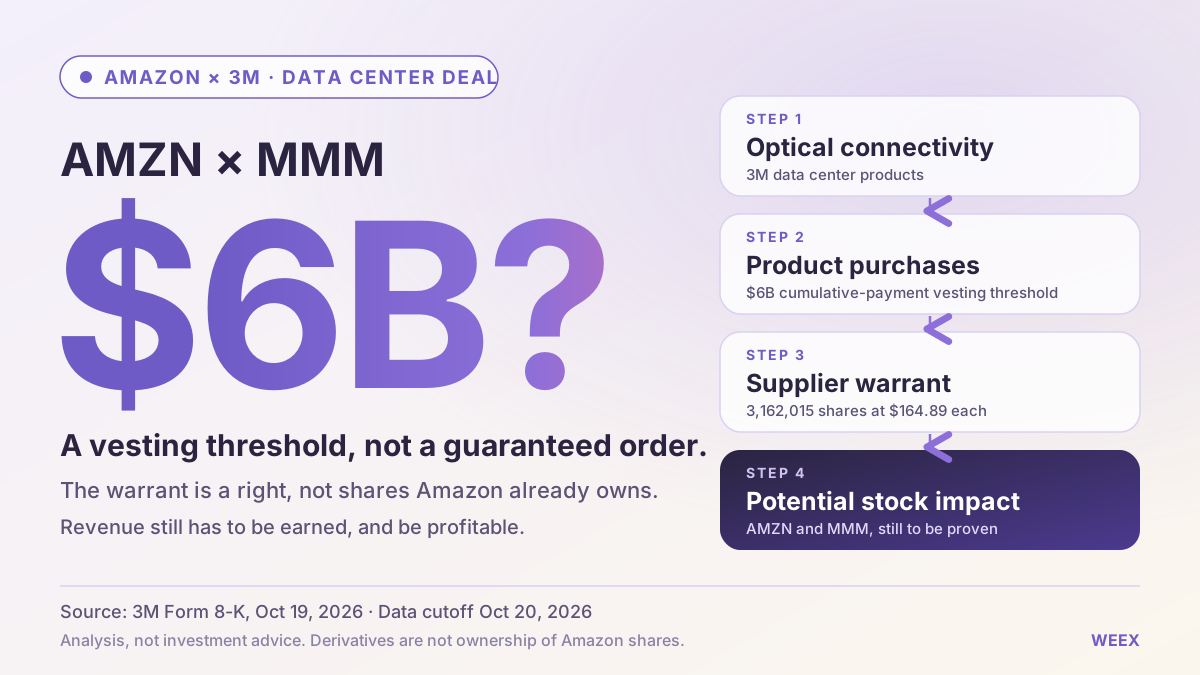
Amazon’s 3M Data Center Deal: What It Means for Amazon (AMZN) and 3M (MMM) Stock
Assess Amazon’s 3M data center deal, the $6 billion warrant threshold, potential dilution, and what the agreement could mean for AMZN and MMM stock.
CFTC Chair: Breaking State-Level Fragmentation to Make the U.S. a Global Crypto Hub
NDV: Where Did the Money Go? A Review of the 16 Years of Stagflation and Wealth Erosion in the United States

XRP Ledger Bug Fixes to Be Implemented on Friday!

Ethereum: Tom Lee Links Crypto Decline to AI Concerns
Why Is Ethena (ENA) Rising? Price Recovery, USDe Growth and Token Risks

Aero Says Goodbye to ve(3,3) Economic Model After Two Delays and Merges Online
Total Inflows in XRP ETFs Reach $1.8 Billion
A Midnight privacy-vault demo needs outside signers to release Ethereum tokens
Ripple teams up with $10B payments firm Arf to expand RLUSD use on XRPL
DFINITY Founder Accuses NEAR Intents of Misappropriating Proprietary Technology
U.S. Blockchain Association Calls for Advancement of Digital Asset Tax Legislation
Are Meme Stock Tokens a Passing Fad or a New Gateway to Traditional Securities Markets?





