
Meta Stock Earnings: What to Watch in Meta Platforms’ Q3 2026 Results

 Prefer us on Google


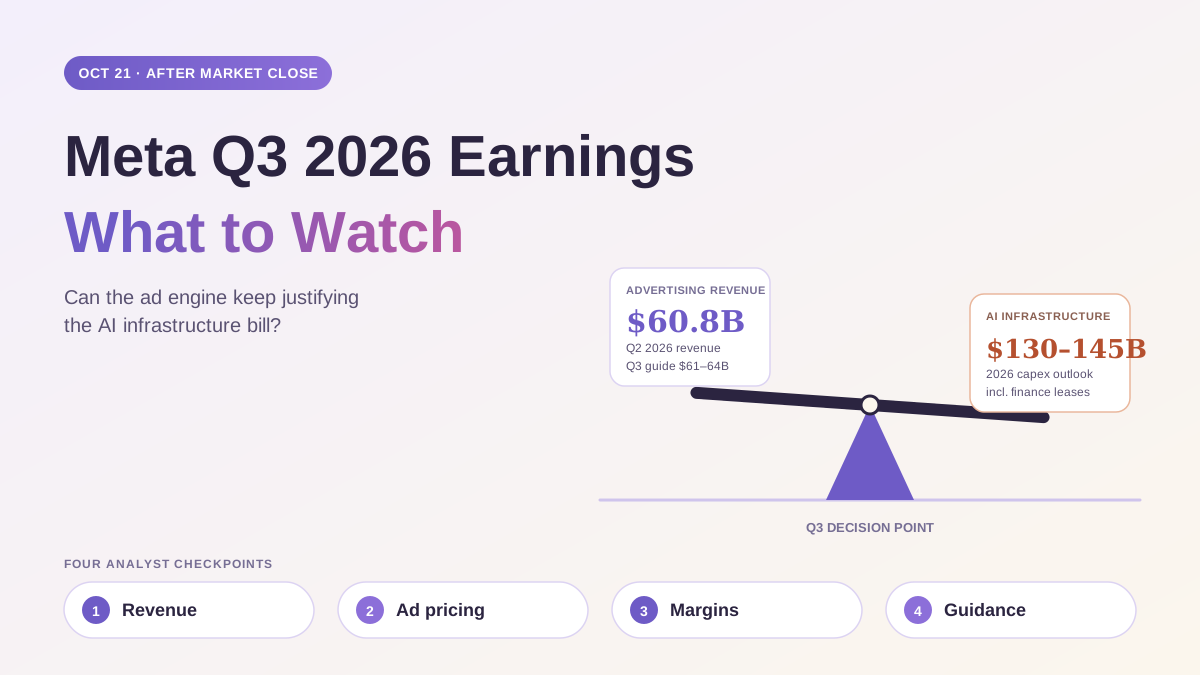
Meta Platforms will release its third-quarter 2026 financial results after the market closes on Wednesday, October 21. For Meta stock, the essential question is not simply whether revenue grows: investors will be watching whether the company’s advertising engine is still improving fast enough to justify its much larger AI infrastructure bill, and whether management’s next guidance changes that balance.
Our view is that Q3 is primarily a credibility test for Meta’s AI spending. Strong ad revenue alone may not settle the debate if costs and capital expenditure keep rising faster than the evidence of future returns. Conversely, a solid result paired with disciplined spending commentary could matter more than an isolated headline beat.
Meta’s Q3 2026 Earnings Date and Why It Matters
Meta has confirmed that it will report Q3 2026 results after market close on October 21, followed by an earnings call at 4:30 p.m. Eastern Time. That timing matters because investors will have to process the report, management commentary, and any updated outlook before the next regular trading session.
The company enters the report after a Q2 in which revenue reached $60.8 billion, while diluted earnings per share were $6.18. Meta also guided for Q3 revenue of $61 billion to $64 billion and raised its 2026 capital-expenditure outlook to $130 billion to $145 billion, including principal payments on finance leases.
Those figures explain why the next report is more nuanced than a standard “beat or miss” event. Revenue growth can confirm that Meta’s advertising business remains resilient. But investors will also look for evidence that AI investment is improving ad performance, user engagement, or future monetization enough to support the spending trajectory.
The Four Signals That Could Move Meta Stock
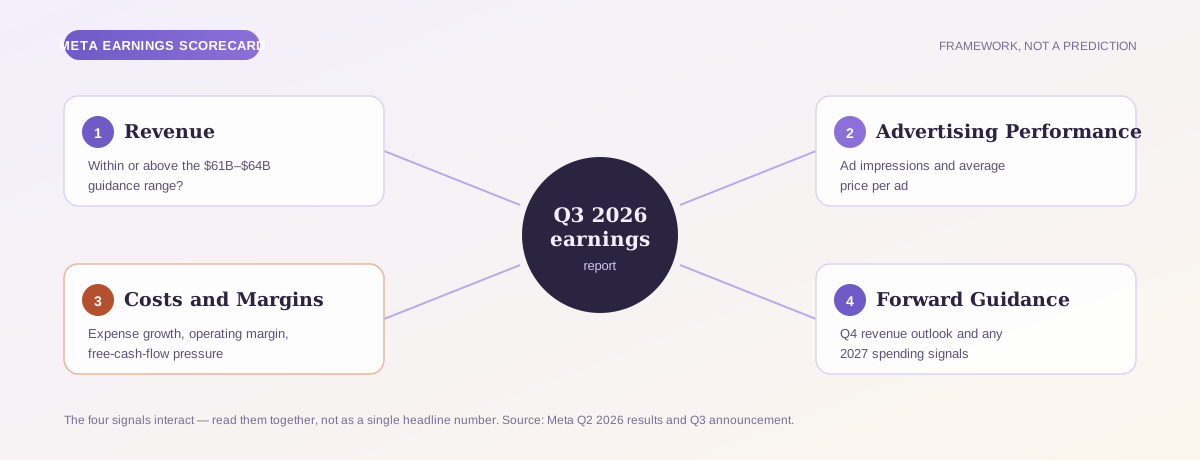
A useful Meta earnings read should separate operating performance from valuation expectations. The table below is not a prediction; it is a framework for interpreting what the report actually says.
| Signal | What Investors Will Watch | Why It Matters |
|---|---|---|
| Revenue | Whether Q3 revenue lands within or above Meta’s $61 billion to $64 billion guidance range | It tests the durability of the company’s core advertising growth |
| Advertising performance | Ad impressions and average price per ad | These show whether demand, targeting, and AI-driven ad tools are translating into business results |
| Costs and margins | Expense growth, operating margin, and free-cash-flow pressure | High AI spending can weaken earnings quality even when revenue is strong |
| Forward guidance | Q4 revenue outlook and any 2027 spending signals | Investors price the next phase of the AI investment cycle, not only the completed quarter |
The most important point is that these signals interact. Revenue above guidance may be viewed positively, but that reaction can fade if management simultaneously signals a much larger spending burden without explaining the expected return. The opposite can also happen: a merely solid revenue result can be received well if expenses, capital intensity, and forward guidance are more manageable than investors feared.
Advertising Is Still the Operating Core
Meta’s long-term AI narrative is increasingly prominent, but advertising remains the company’s primary financial engine. That makes the health of the ad business the first place to look when evaluating Q3.
Investors should pay attention to the two metrics Meta regularly uses to explain advertising growth: ad impressions delivered and average price per ad. Rising impressions can show that Meta is serving more ads across its platforms. Higher average pricing can indicate stronger advertiser demand, improved targeting, changing geographic mix, or a combination of these factors.
AI is relevant here because Meta has argued that its investment is improving the tools behind content recommendations, ad delivery, and advertiser performance. The real earnings question is whether that benefit continues to show up in measurable commercial outcomes—not merely in product announcements or investment plans.
A strong quarter therefore needs more than a broad statement that “AI is working.” Investors will look for whether management connects AI investment to advertiser demand, engagement, and revenue in a way that makes the spending case more concrete.
-- Price
The AI Spending Test Is Now About Returns, Not Ambition
Meta has already made clear that it intends to invest heavily in AI infrastructure. The issue for the Q3 call is no longer whether the company is ambitious. The issue is whether management can show how the investment supports an expanding profit pool rather than simply a rapidly growing cost base.
This is where market expectations can become difficult. Investors may welcome higher AI investment when it supports advertising efficiency or opens credible new revenue opportunities. They may be less patient when spending rises but the financial return remains distant, vague, or disconnected from the company’s core business.
The most valuable commentary on the call may come from management’s explanation of three links:
- How AI investment is improving the current advertising business.
- Which future products or services could generate incremental revenue.
- How Meta plans to manage the cost, timing, and scale of infrastructure investment.
That is a more useful lens than asking whether Meta is simply “bullish” or “bearish” on AI. The company’s strategy may be bold and still require financial discipline. In the current market, that discipline is part of the growth story.
What Would a Bullish or Bearish Meta Earnings Read Look Like?
Meta stock can react to the relationship between the results and prior expectations, not only to the reported numbers. A report that looks strong in isolation may still disappoint if investors expected more. Equally, a mixed quarter can receive a better reaction if it resolves a major concern around costs or cash generation.
A relatively constructive reading could include revenue near the high end of guidance, healthy advertising metrics, and commentary that shows AI investment is supporting the core business without a material deterioration in margins. Clear, measured guidance could reinforce that view.
A more cautious reading could emerge if revenue slows, advertising growth weakens, or expenses rise faster than investors expected. The market may also react negatively if management increases future spending expectations without offering a clear explanation of the revenue, product, or operating benefits expected in return.
This is why a one-number approach to Meta earnings is weak. Earnings per share, revenue, and capital expenditure need to be read together.
Meta Stock and the WEEX TradFi Prediction Event
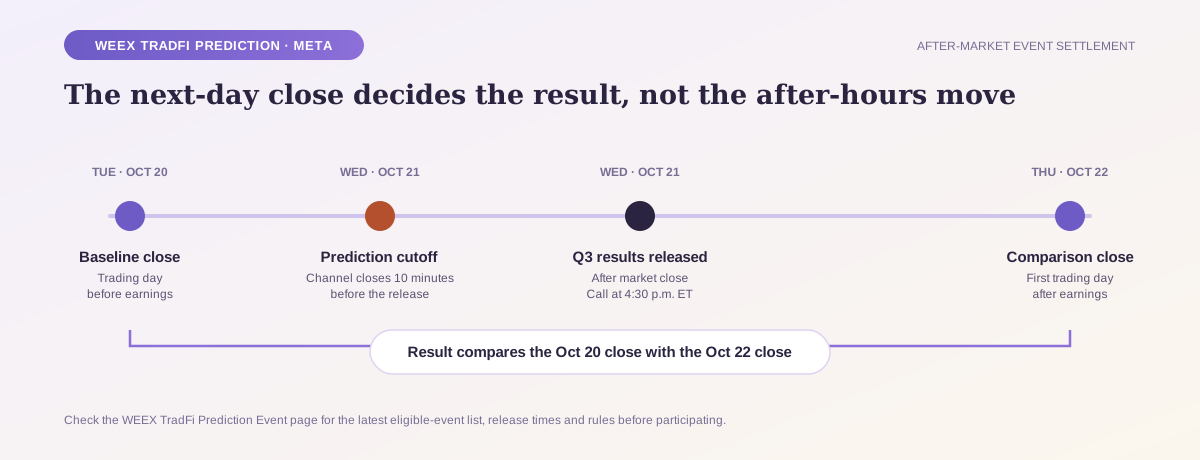
For readers following this earnings event, the WEEX TradFi Prediction Event runs from October 6 to November 6, 2026. Participants can register once, then use activity points to choose a bullish or bearish direction for eligible earnings events. Each prediction requires at least one point, and the prediction channel closes 10 minutes before the scheduled earnings release.
For an after-market report such as Meta’s October 21 release, the activity’s result is determined by comparing the closing price on the trading day before earnings with the close on the first trading day after earnings. In practical terms, this means the market’s next-day reaction matters more than an immediate after-hours move. Before participating, users should review the latest eligible-event list and rules on the activity page.
A Better Way to Prepare for the Meta Earnings Call
Rather than trying to guess the exact headline number, readers can prepare a simple before-and-after checklist.
Before the report, identify the company’s Q3 revenue guidance range, the latest capital-expenditure outlook, and the key concern you believe the market is focused on. For Meta, that concern is likely to be the balance between advertising strength and AI-related spending.
After the report, compare the actual results with that checklist. Did revenue meet the company’s own range? Were ad impressions and pricing supportive? Did management clarify the cost path? Did the Q4 outlook make the investment case more convincing or more demanding?
This method is useful because it prevents a common earnings mistake: reacting to a single headline without checking the rest of the report. A revenue beat does not automatically answer the margin question. Higher spending does not automatically mean strategy failure. The relevant issue is whether management has made the trade-off more or less credible.
WEEX View: Meta Must Show That AI Is Improving Economics, Not Just Capability
Meta does not need to prove that it can spend aggressively on AI. It has already shown that. What it needs to prove in Q3 is that the investment is improving business economics in a visible and repeatable way.
The strongest outcome would be a report in which ad performance remains healthy, AI’s contribution to the core business becomes clearer, and future spending is presented with enough discipline to preserve investor confidence. The weak outcome is not necessarily a revenue miss; it is a wider gap between investment ambition and financial explanation.
For Meta stock, October 21 is therefore best understood as an earnings-quality test. The market will not only ask what Meta earned. It will ask what the company must spend next, and what that spending is likely to produce.
FAQs
1. When Is Meta’s Q3 2026 Earnings Date?
Meta is scheduled to release its third-quarter 2026 results after market close on Wednesday, October 21, 2026.
2. What Will Investors Watch in Meta’s Q3 Earnings?
The main areas are revenue against guidance, advertising performance, operating costs and margins, capital expenditure, and management’s forward guidance.
3. Why Is AI Spending Important for Meta Stock?
Meta is investing heavily in AI infrastructure. Investors want to see whether that spending improves advertising performance, supports new revenue opportunities, and remains financially sustainable.
4. How Does the WEEX TradFi Prediction Event Settle Earnings Predictions?
For eligible events, the result compares the closing price on the trading day before earnings with the closing price on the first trading day after earnings. The activity page lists the latest rules and eligible events.
Sources
- Meta: Q3 2026 Results Announcement — accessed October 15, 2026
- Meta: Q2 2026 Results — accessed October 15, 2026
- WEEX TradFi Prediction Event — activity period: October 6 to November 6, 2026
This content is provided for general informational purposes only and doesn't constitute financial, investment, legal, or tax advice. Any events, rewards, online promotions, or related information mentioned herein should not be considered a recommendation, solicitation, or invitation to purchase, sell, trade, or otherwise deal in any crypto assets. Crypto assets are highly volatile and may result in loss. The availability of WEEX services, products, and related events may vary by region. You are responsible for ensuring that your participation is in accordance with applicable local laws and regulations.
You may also like

One Order Book for Dollars and Stablecoins. How It Works

Cyberattack on the ports of Marseille and La Rochelle? Hackers paid 1 dollar in crypto
![[Exclusive] Coinbase Transaction Data Shows 100 Million Trades Misrepresented... Data Analysis Firm Corrects Errors](/public-static/20_9098579959.png?format=avif)
[Exclusive] Coinbase Transaction Data Shows 100 Million Trades Misrepresented... Data Analysis Firm Corrects Errors

Wall Street Morning Report: U.S. Inflation Resurfaces, AI Credit Risks Spread, Chip Stocks Fall for Six Consecutive Days
Arthur Hayes: Focus on Established DeFi Projects with Cash Flow

Anthropic Reports $16.8 Billion Revenue in Q3, IPO Feasibility Strengthened

Hot CPI Lifts Hike Bets; Risk Assets Pull Back | WEEX TradFi Daily(October 15, 2026)
Major indexes closed lower on October 14, with the Nasdaq leading the decline. September unadjusted CPI rose to 3.7% year on year, above forecasts, and core CPI also beat expectations. Traders sharply raised this month’s hike probability to about 43.7% and fully priced two more hikes by the end of January. Chip stocks were sold again. Bitcoin broke below $83,000 and last traded near $81,700, while spot gold and silver fell. Crypto-related stocks were under pressure, but PYTH rose against the tape. October 15 brings PPI, retail sales and key
WEEX Exclusive:Hot CPI Lifts Hike Bets; Risk Assets Pull Back | WEEX TradFi Daily(October 15, 2026)

Sam Price Observes Changes in Bitcoin ETF Net Inflows

G20 warns that stablecoins may lose value even if fully backed

Starting a Business with Crypto Payments: What Changes in 2027

September CPI in the US: What Inflation Tells the Investor

Why Only 2% of $10 Billion in US Treasury Bonds Enter DeFi?

Ethereum ETF Funds Break Out of Outflow Series with Inflows of $24.8 Million

Arca: Four Investment Directions for Crypto Assets

When Will Bitcoin Surpass Its Previous High? Insights from ChatGPT, Claude, and Gemini

When Currency Becomes Programmable, the Next Stop for the Crypto Industry May Be to Rewrite Token Rules

The Hook Ecosystem Begins to Stir! Who Will Be the Next Dark Horse?
"CARF Introduced Before Virtual Asset Taxation... Need for Review of Implementation Basis"

Liquidity Structure of Domestic Cryptocurrency Exchanges and Conditions for Introducing LP – Bitplanet

Tencent Tests Personal Investment Analysis Assistant Rena, Supports WeChat Connection

Financial Stability Board Highlights Unclear Bankruptcy Laws for Stablecoin Failures

Why Most Public Chains Are Doomed to Fail, According to Real Vision Founder

The Era of Industry: Q3 2026 Virtual Asset Industry Investment Status Report – Tiger Research

Paul Tudor Jones Expects Challenges for US Stocks in 2027, Shorting US Stocks Throughout the Year While Holding Long Positions in Oil

唐华斑竹 Reports Han Lin to Speak at Oxford Union

We Overestimate the Value of Stablecoin Issuance While Underestimating the Power of Localized Financial Services

Mesh Acquires Bluvo to Accelerate Global Payment Network Development

A Generation's P2P

Ethereum Staking: Interactive Brokers Launches Service for Eligible Clients via ZeroHash
One Order Book for Dollars and Stablecoins. How It Works
Cyberattack on the ports of Marseille and La Rochelle? Hackers paid 1 dollar in crypto
[Exclusive] Coinbase Transaction Data Shows 100 Million Trades Misrepresented... Data Analysis Firm Corrects Errors
Wall Street Morning Report: U.S. Inflation Resurfaces, AI Credit Risks Spread, Chip Stocks Fall for Six Consecutive Days
Arthur Hayes: Focus on Established DeFi Projects with Cash Flow
Anthropic Reports $16.8 Billion Revenue in Q3, IPO Feasibility Strengthened
Contents
Latest articles


Latest coin listings on WEEX


