
Midterm Election Risks Disrupt Helix AI Infrastructure Project, Increasing Uncertainty for Samsung Investments

 Prefer us on Google


The AI infrastructure project in the United States, jointly funded by six affiliated companies under Samsung Group, including Samsung Electronics, is facing increasing uncertainty.
As political uncertainties surrounding the development of AI Data Centers (AIDC) continue to expand before and after the U.S. midterm elections, the core power supply companies involved in the investment have officially confirmed that the project's progress will be delayed, leading to increased uncertainty for Samsung's participation in this investment.
The prerequisites for AIDC development—power assurance and the project timeline—are now subject to change, which will inevitably affect the subsequent business opportunities for Samsung's subsidiaries.
Vistra, a U.S. power company, stated in a conference call earlier this month regarding its third-quarter performance that it has adjusted the expected funding disbursement time for the AI infrastructure investment company Helix Digital Infrastructure (hereinafter referred to as Helix) from this year to 2027.
Vistra's CEO, Jim Burke, said, "The political environment has caused a slowdown in some business activities across multiple markets. We expect the actual funding payments to Helix will be later than initially anticipated, postponed until next year."
Previously, in the second-quarter performance report released in August, approximately $500 million earmarked for Helix in this year's capital expenditure plan was removed from the third-quarter performance report, with this funding being adjusted to the expected capital expenditure for 2027. This means that Vistra has delayed the disbursement of Helix's funding by a year in just three months.
The delay in Vistra's funding timeline is highly correlated with whether the Helix project can be substantively initiated. Vistra is a large private power generation company with gas and nuclear power facilities deployed across the United States and is also Helix's primary power supply partner. This means they are the main funder responsible for providing the essential power supply for AIDC development, and their official statement indicates a slowdown in the project's pace.
Helix is an AI infrastructure investment platform established by the global private equity firm KKR in June. Six subsidiaries, including Samsung Electronics, Samsung C&T, Samsung SDS, Samsung SDI, Samsung Life Insurance, and Samsung Fire & Marine Insurance, have agreed to invest a total of $1 billion in Helix. Of the total $1 billion funding from Vistra, $500 million is conditional funding: additional funding will only be provided if the power supply business based on existing power generation assets meets the agreed conditions.
A comparison chart of Vistra's capital expenditure outlook. ------ A comparison of Vistra's capital expenditure expectations for the second quarter of 2026 (top) and the third quarter (bottom), with the yellow-highlighted $500 million funding for Helix, which has been adjusted from 2026 to 2027. (Source: Vistra earnings call presentation materials)
If the progress of the AIDC + power integrated development project promoted by Helix slows down, the equipment supply and EPC engineering plans for Samsung's affiliated companies will also face increased uncertainty. KKR, responsible for actual fund management, has not disclosed the actual payment and funding investment progress related to Helix. In the third-quarter earnings call held on the 9th local time, KKR acknowledged that market fluctuations after the U.S. midterm elections might increase, but stated that it would maintain a long-term investment approach.
Samsung's investment in Helix is not merely a financial investment; it is part of the group's strategy to extend the business landscape of its subsidiaries into the full-chain AI infrastructure. In particular, Samsung Electronics' Device Experience (DX) division, leveraging the acquisition of Flakt Group, is expanding its existing air conditioning business into the AIDC cooling sector; it originally hoped that the Helix investment would help expand customers for this new business. Samsung C&T also invested $200 million in Helix, hoping to seize opportunities for large-scale AIDC development projects in Texas, USA.
Industry insiders have stated, "The political uncertainties in the U.S. are indeed dragging down the originally planned investment plans across multiple markets, and actual fund disbursements are likely to hit the brakes and slow down."
-- Price
This content is provided for general informational purposes only and doesn't constitute financial, investment, legal, or tax advice. Any events, rewards, online promotions, or related information mentioned herein should not be considered a recommendation, solicitation, or invitation to purchase, sell, trade, or otherwise deal in any crypto assets. Crypto assets are highly volatile and may result in loss. The availability of WEEX services, products, and related events may vary by region. You are responsible for ensuring that your participation is in accordance with applicable local laws and regulations.
You may also like

Anthropic Yet to Go Public, Crypto Players Already Cashing In

Interpretation of FATF Report on Scam Compound Funds: Virtual Assets Become Core Money Laundering Channels

How Much Is Anthropic Really Worth?
Research Reveals 3D Spatial Navigation Map of Hand in the Brain to Aid Brain-Machine Interface Development

Michael Dempsey: Crypto Venture Capital Stagnates, Talent Shifts to AI

Yen Fluctuations Highlight Current Trading Difficulties, Investors Have Huge Divergence on Long-term Outlook

Bloom Energy vs. Constellation Energy: On-Site Power or Grid Power, Which Wins the Data Center?

Former Polychain Partner Launches Startup: Enters Tokenized Real Estate, Secures $50 Million Seed Round Funding to Create the 'S&P 500' of Real Estate

Seminar: The History of Hyperliquid and On-Chain Finance Guest: Takuya Fujita (11/18 19:30 @ Gentosha)
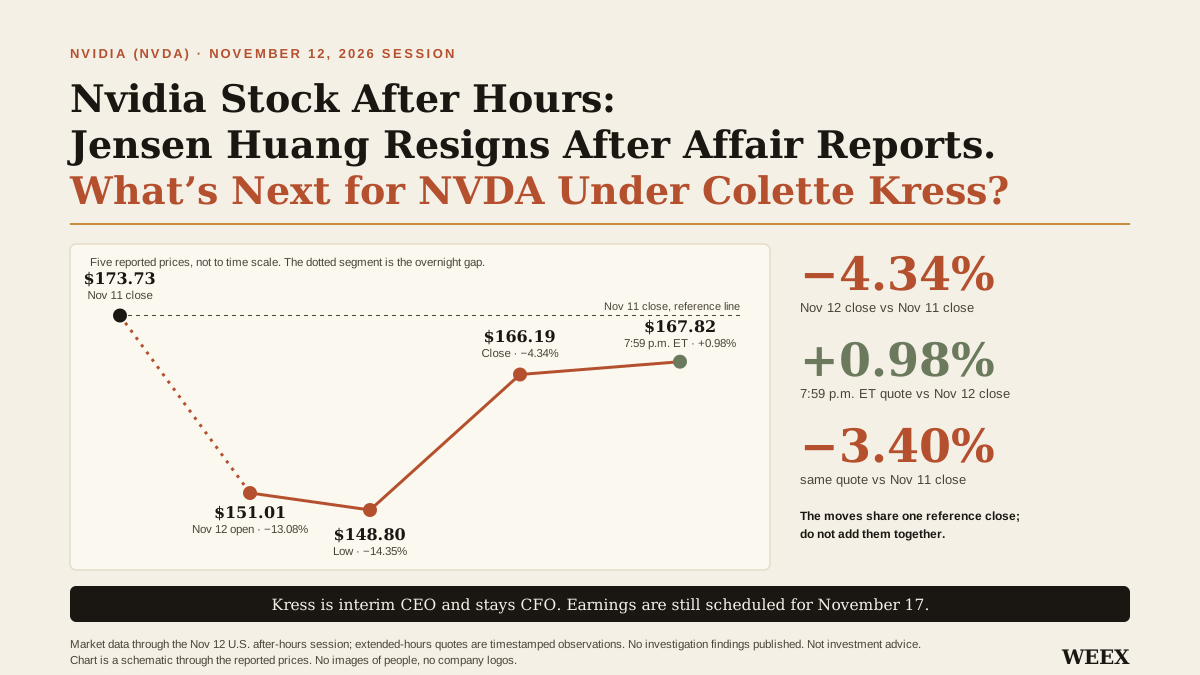
Nvidia Stock After Hours: Jensen Huang Resigns After Affair Reports. What’s Next for NVDA Under Colette Kress?
Nvidia fell 4.34% after Jensen Huang resigned, then rose 0.98% after hours. See what Colette Kress’s appointment means for NVDA and November 17 earnings.

Jensen Huang's Sudden Departure Raises Questions: Did the White House Intervene? Is a Return Possible?
In-Depth Interview | Fu Peng: I Have No Faith in BTC

Cerebras Conference Call: Secures Major Deal with Microsoft, HBM Shortage Becomes an Opportunity, WSE-5 Chip to Enter Mass Production Next Summer

SoundHound AI Stock Is Down Almost 60% in 2026, but Wall Street Thinks It Can Soar 155% By the End of 2027. Here’s Why It Could Be One of the Best Buys Amid the Tech Sell-Off.
What is being said at the tables: the market begins to see 2027 as an all-or-nothing scenario

Kalshi Negotiates New Round of Financing, Valuation Expected to Reach $65 Billion

Republican Senator Wants to Freeze AI Data Center Boom as Congress Pushes to Expand It

Why the Path to Quantum Resistance Runs Uphill for Bitcoin Wallet Makers

Pimco CEO Warns: AI Companies Risk Borrowing "Too Much" ($10 Trillion)

Silver ETF vs. Silver Miners ETF: Which Has Held Up Better This Year?

Why AMD Shares Are Surging and What a $10,000 Investment in the Stock Could Be Worth in 3 Years

Cardano Academy launches practicum with on-chain credentials
Warren Buffett Doesn't Follow His Own S&P 500 Advice. Should You?

A $776 Car Payment Is a Warning for Ford and General Motors

2 Chip Stocks to Buy Instead of Nvidia Right Now

History Says This Is the Smartest ETF to Buy During the Next Bear Market

EU to Continue Providing Financial and Military Aid to Ukraine
The market demanded liquidity and the Economy granted it: what to expect for interest rates after the Treasury auction

Qualcomm CEO on Tech Stock Plunge: "There is No AI Sector Correction for Us"
Stock Market Crash: What History Says Comes Next After the Market's Big Single-Day Dip.
Anthropic Yet to Go Public, Crypto Players Already Cashing In
Interpretation of FATF Report on Scam Compound Funds: Virtual Assets Become Core Money Laundering Channels
How Much Is Anthropic Really Worth?
Research Reveals 3D Spatial Navigation Map of Hand in the Brain to Aid Brain-Machine Interface Development
Michael Dempsey: Crypto Venture Capital Stagnates, Talent Shifts to AI
Yen Fluctuations Highlight Current Trading Difficulties, Investors Have Huge Divergence on Long-term Outlook
Latest articles




Latest coin listings on WEEX


