
QCP Capital: The Current Bitcoin Rally is Primarily Driven by Spot Funds, but Market Structure Remains Fragile

 Prefer us on Google


QCP Capital has released its latest market analysis, stating that BTC has broken out of the previous trading range of $82,500 to $85,700 that lasted for a week, reaching a high of $86,913 during the day, the highest since September 23. It is currently trading around $85,900, up 14.6% from the low of $74,968 on September 15. QCP points out that during this rally, the annualized funding rate for perpetual contracts was only 5.4%, indicating that the market is primarily driven by spot funds rather than leveraged trading. QCP believes that this rally diverges from traditional macro market signals. In September, the yield on the U.S. 30-year Treasury bond rose to 5.62%, and the 10-year yield reached 5.29%, while gold recorded its worst month of the year. Although rising real interest rates typically exert pressure on gold and risk assets, BTC continues to rise.
QCP believes that this market movement is more consistent with concentrated capital trading driven by institutional fund inflows, regulatory catalysts, and technical improvements, rather than a simple currency depreciation trading logic. Regarding institutional funds and regulatory factors, U.S. Bitcoin spot ETFs recorded net inflows of approximately $3.5 billion and $2.6 billion in August and September, respectively. QCP notes that the innovative exemption policy released by the U.S. SEC on September 17 provided a new regulatory catalyst for the market, but since the CLARITY Act failed to pass in the Senate, market structure legislation may be delayed until 2027. Therefore, current regulatory support comes more from the administrative level, and long-term policy certainty remains limited.
In the options market, yesterday's options trading had a nominal amount of about $2.5 billion, involving 54 trades with a nominal amount exceeding $5 million each. Among them, one client sold in batches call options expiring on October 30 with a strike price of $90,000, totaling over 4,000 contracts with a nominal amount of $346 million; at the same time, they actively bought call options with the same strike price expiring on November 27. QCP believes that this operation reflects that some traders are rolling their positions from October to November to position for the U.S. midterm elections, quarterly Treasury refinancing, and market volatility around the December Federal Reserve meeting.
On the macroeconomic front, the Federal Reserve will hold a monetary policy meeting from October 27 to 28. QCP states that after Federal Reserve official Williams indicated that there is no need to rush further policy adjustments and that the August core PCE was below expectations, market expectations for maintaining interest rates in October have warmed. However, the market still expects an approximately 80% probability of a 25 basis point rate hike in December. The U.S. non-farm payroll report for September, to be released tonight, will be an important short-term test, with the market expecting an increase in non-farm payrolls of between 84,000 and 93,000, an unemployment rate of 4.1%, and an average hourly wage growth rate of 3% year-on-year.
From a technical perspective, the support level of $82,500 has been tested three times in the past week, while $87,400 is the location of the September high and is a key resistance for BTC to further challenge the $90,000 mark. The implied volatility term structure in the options market is in a contango state, with a 7-day implied volatility of 30.3 and a 90-day implied volatility of 37.1; the 30-day risk reversal indicator is about -2.5 volatility points, indicating an increase in demand for short-term put protection. QCP believes that although BTC has shown resilience in the macro environment of rising real interest rates, the market is still primarily driven by capital flows and position changes, and it cannot be considered that macro risks have been eliminated. U.S. employment data, Treasury supply, and the upcoming series of policy events in the coming weeks may still trigger market volatility.
-- Price
This content is provided for general informational purposes only and doesn't constitute financial, investment, legal, or tax advice. Any events, rewards, online promotions, or related information mentioned herein should not be considered a recommendation, solicitation, or invitation to purchase, sell, trade, or otherwise deal in any crypto assets. Crypto assets are highly volatile and may result in loss. The availability of WEEX services, products, and related events may vary by region. You are responsible for ensuring that your participation is in accordance with applicable local laws and regulations.
You may also like

Why Are Tokenized Stocks Seeing Strong Buying Pressure While Prices Keep Falling?

XRP holders demand Ripple burn 31.1 billion tokens by March 2027
Pump.fun Launches Prediction Market Feature in Collaboration with Polymarket

ARTEX AI tool breaches networks in under 3 hours, FBI warns

Gnosis Safe wallet reportedly drained of $6.45M in suspected exploit

Thailand Stablecoin Transfer Limit: What the SEC Draft Proposes

Tesla Autopilot Team Veterans Found Simulation Startup Valued at $1 Billion
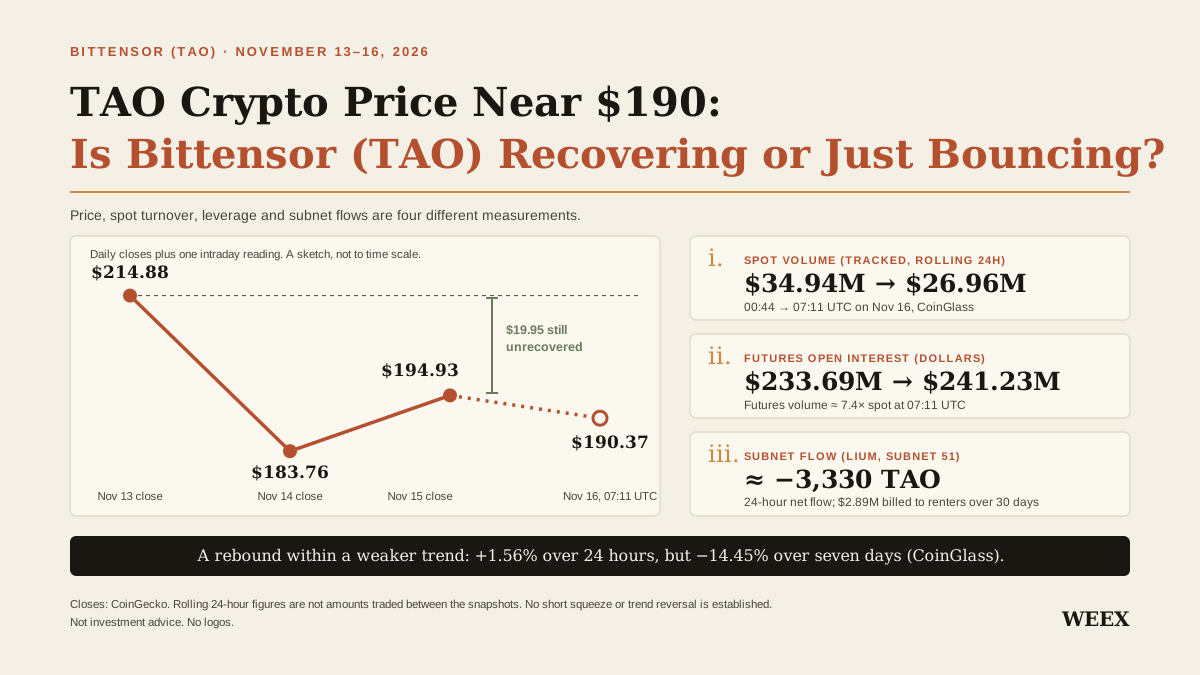
TAO Crypto Price Near $190: Is Bittensor (TAO) Recovering or Just Bouncing?
TAO bounced near $190. Compare spot volume, futures positioning, and Bittensor subnet flows to see what would confirm a more durable recovery.
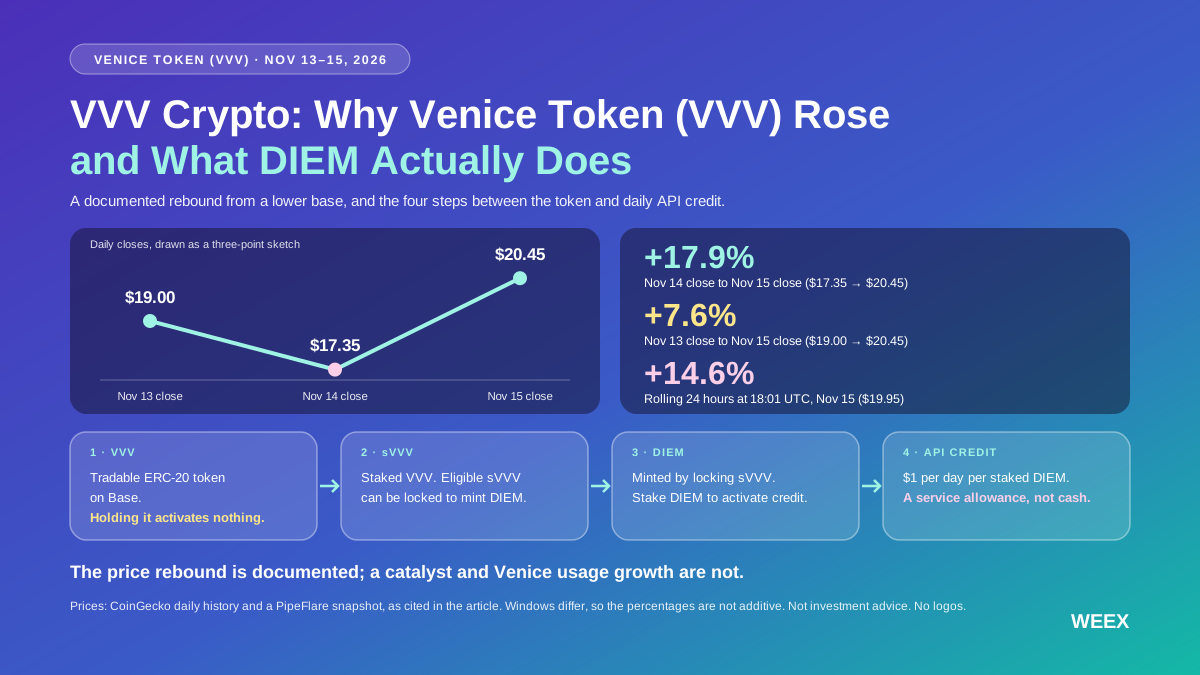
VVV Crypto: What Is Venice Token, Why Venice Token (VVV) Rose and What DIEM Actually Does
Venice Token rose about 14.6% in one November 15 snapshot. Learn what the data shows, how VVV staking works, and what DIEM’s daily API credit buys.
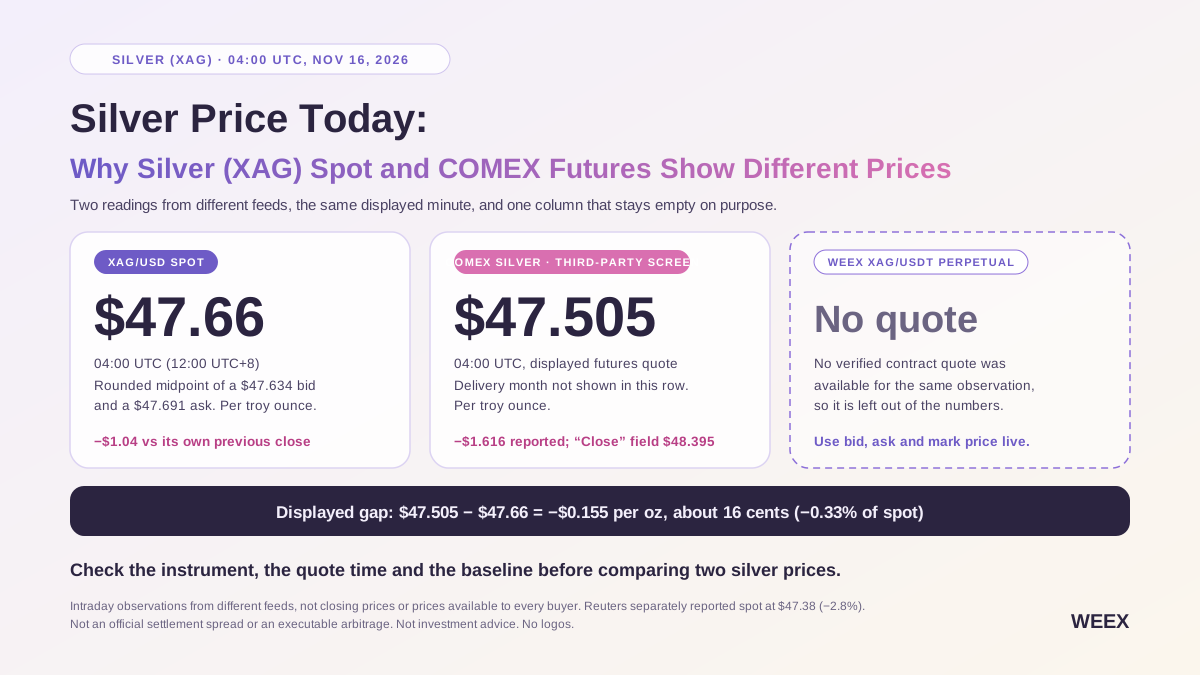
Silver Price Today: Why Silver (XAG) Spot and COMEX Futures Show Different Prices
Silver traded near $47–$48 on November 16. Compare XAG/USD spot, COMEX silver futures, and XAG/USDT perpetuals, and learn why their prices differ.

Options Big Bets | Nvidia's $118 Million Cross-Period CALL Spread Bets on Mid to Long-Term Upside; AMD's Bearish Spread Combined with Long-Term Bullish Spread, Underlying Tensions Between Bulls and Bears

Galaxy Securities: A-shares Market's Downward Risk Converges, Focus on Sector Rotation Opportunities

How $10,000 in stablecoins would have gained €420 without earning interest

Bitcoin now looks cheap by one measure after $1 billion in ETF outflows
These Bitcoin miners have halved their hashrate, while their AI revenues have doubled

Bitcoin: Should We Fear the Worst or Bet on Hopes for a Rebound?

This Under-the-Radar Stock Is Behind Steak 'n Shake's MAHA-Driven Growth. Should You Buy?

XDC vs XRP: Which Payment-Focused Blockchain is Superior?

The Privacy Paradox of Bitcoin: Satoshi Acknowledged It Long Ago, Have the Successors Solved It?

[Analysis] Two Barriers Preventing Bitcoin from Rising

No New Money Inflows in Dogecoin ETFs for a Month
XRP loans trigger 883 liquidations, and $53M remains at risk

CoreWeave and Nebius Group: 1 Soars, the Other 1 Plunges. A Tale of 2 Neoclouds

Research Reveals 3D Spatial Navigation Map of Hand in the Brain to Aid Brain-Machine Interface Development

Yen Fluctuations Highlight Current Trading Difficulties, Investors Have Huge Divergence on Long-term Outlook

BNY Mellon Adds to Invesco Galaxy Bitcoin ETF: What Changes with the Custody Filing?
South Korea Proposes Withdrawal Suspension for Cryptocurrency: What Happens When Exchanges Suspect a Hack

Exclusive: Canton Strategic CEO warns MEV could raise costs for tokenized stock traders

CARF Customer Transaction Information Report: What Data Processing is Required from On-Chain Transactions to Tax Reporting?

Bottomline Completes First USDC Transfers Inside Its Enterprise Payments Platform
Why Are Tokenized Stocks Seeing Strong Buying Pressure While Prices Keep Falling?
XRP holders demand Ripple burn 31.1 billion tokens by March 2027
Pump.fun Launches Prediction Market Feature in Collaboration with Polymarket
ARTEX AI tool breaches networks in under 3 hours, FBI warns
Gnosis Safe wallet reportedly drained of $6.45M in suspected exploit
Thailand Stablecoin Transfer Limit: What the SEC Draft Proposes
Latest articles





Latest coin listings on WEEX


