
Treasuries at 21-Year High: Impact on Stocks and Interest Rates

 Prefer us on Google


The yield on 30-year U.S. Treasury bonds reached its highest level since 2004 on Thursday. This is the highest level in 21 years for the bond that serves as a barometer of confidence in the fiscal and monetary trajectory of the United States. The movement knocked down the major indices in New York and reignited the debate about how far the global repricing of risk will go.
This is not just a number. When the 30-year yield rises with such intensity, it recalibrates the cost of capital for the entire economy. Mortgages become more expensive, valuations of growth stocks are compressed, and risk appetite diminishes. The selling of bonds was widespread and affected different maturities, signaling a structural distrust, not just a momentary one.
Why Treasuries Are Rising So Much
The most straightforward explanation is fiscal. The market is looking at the high U.S. deficit and the absence of any credible consolidation plan. The expectation of two additional 25 basis point hikes by the Federal Reserve only reinforces the pressure on the yield curve. The Fed, which already maintains the base rate at a restrictive level, may be entering a cycle where each additional tightening generates diminishing returns in combating inflation and increasing costs in debt sustainability.
There is a relevant technical component. Institutional investors, especially pension funds and foreign central banks, have reduced their exposure to Treasuries in recent quarters. With fewer marginal buyers, the growing supply of bonds finds less demand, which naturally pushes yields up. This is a dynamic that, as we have seen in global market coverage, tends to feed on itself.
The Cascading Effect on Technology Stocks
The sector most penalized by the rise in long-term interest rates is precisely the one that led the U.S. stock market in recent years: technology. Software companies and those linked to artificial intelligence rely on future cash flows discounted to present value. When the discount rate rises, the present value falls, and the market reprices.
Oracle, for example, fell more than 5% in trading after reports indicated that the company would invoke force majeure clauses to protect itself from delays in a data center project in New Mexico. This is the kind of news that, in a low-interest environment, would be digested calmly. With the 30-year yield above any level seen in two decades, it becomes a trigger for selling.
The pattern repeats: high long-term interest rates act as a permanent stress test for high-multiple stocks. Those who bought Nasdaq thinking about AI and exponential growth now have to compete with a real return on fixed income that hasn’t been seen since the Bush administration. It’s a regime shift, as we analyzed in our coverage of big techs and AI.
Geopolitics Adds Layers of Uncertainty
In addition to fiscal and monetary issues, the geopolitical context contributes to volatility. The meeting between Xi Jinping and Donald Trump in the United States keeps the market on alert, although expectations are for few concrete advances in trade negotiations. The relationship between the two largest economies in the world continues to be marked by tariffs, technological restrictions, and strategic disputes.
On the commodities front, Brent crude returned to $107 per barrel amid the lack of progress in negotiations between American and Iranian authorities. The high oil price fuels cost inflation, complicates the Fed's work, and adds another variable to the already complex equation of long-term interest rates.
For Brazilian investors, the scenario has direct implications. The interest rate differential between Brazil and the U.S. narrows when Treasuries rise, which reduces the relative attractiveness of Brazilian bonds and pressures the exchange rate. This is a dynamic that affects everything from the Ibovespa to the cost of domestic credit, as we detailed in previous analyses on the impact of U.S. interest rates in Brazil.
-- Price
What Changes in Risk Calculation for the Investor
The symbolic mark of the highest yield in 21 years forces a reassessment of assumptions. During the era of zero interest rates, the market became accustomed to treating Treasuries as a risk-free and return-free asset. Now, 30-year bonds offer a nominal return competitive with stocks, fundamentally altering portfolio allocations.
Global funds are already beginning to recalibrate the ratio between fixed income and equities. The 60/40 model (60% stocks, 40% bonds), declared dead in 2022, makes sense again when bonds pay attractive yields. The problem is that this migration drains money from the stock market and amplifies the correction in stocks.
The corporate credit market also feels the impact. Companies that need to roll over debt face higher costs, which compresses margins and could lead to a wave of rating downgrades in the coming quarters. The most leveraged sectors, such as commercial real estate and utilities, are the most vulnerable.
The question that the market has yet to answer is whether this rise in yields is a momentary adjustment or the beginning of a new permanent regime of higher interest rates. If it is the latter, the last decade of stretched valuations, cheap leverage, and growth at any cost may be left behind for good.
This content is provided for general informational purposes only and doesn't constitute financial, investment, legal, or tax advice. Any events, rewards, online promotions, or related information mentioned herein should not be considered a recommendation, solicitation, or invitation to purchase, sell, trade, or otherwise deal in any crypto assets. Crypto assets are highly volatile and may result in loss. The availability of WEEX services, products, and related events may vary by region. You are responsible for ensuring that your participation is in accordance with applicable local laws and regulations.
You may also like

Solana DEX volume spike hides circular trades, and automated bots are blamed
Oracle Stock vs. KRAFTON Stock: Why Are Investors Questioning Two Growing Companies?
Compare Oracle and KRAFTON stocks through their latest results, share-price questions and the different growth tests investors face in 2026.

John Templeton: "Bull markets are born in pessimism"

The Death of Hsin-Ju: A Prelude to Conspiracy

LTC Airdrop 2026: How to Claim 50,000 USDT Rewards on WEEX

Raiffeisen’s crypto deal could reach 18 million customers. How many can actually trade?

TRON Surpasses $30T in Total Transaction Volume as it Secures its Place as Leading Chain for Stablecoins

HTX DeepThink: Opportunities Concentrate on Profitable and Fund-Supported Assets, BTC Still Has Room for Recovery After Consolidation
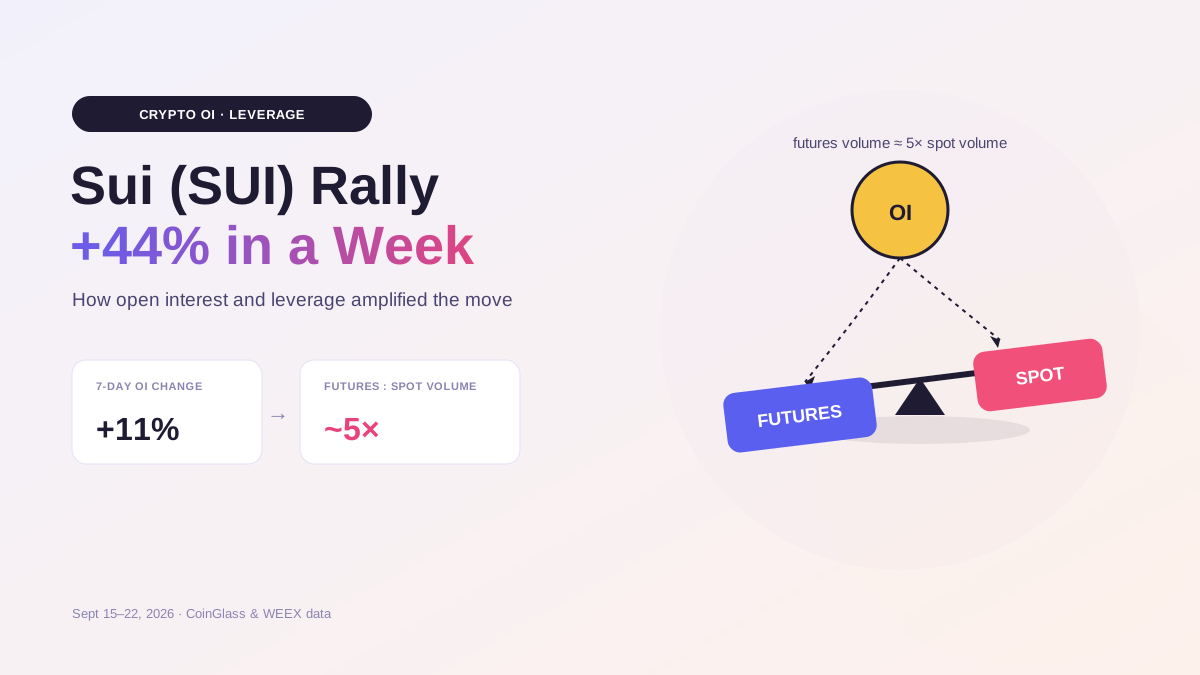
Why Did Sui (SUI) Crypto Price Jump 44%? Crypto OI and Leverage Explain the Rally
See why Sui (SUI) jumped 44%, how crypto OI and leverage amplified the rally, what the pullback means, and how to trade SUI on WEEX.

Circle expands CCTP to EURC and cirBTC on Arc

Bitcoin, Sports, and Politics: Predictive Markets Target $10 Trillion

AI Agent Jev Expects On-Chain Innovation Through Automated Judgment

The End of the Blank Prompt: Why Trading AI Needs a Playbook

Stablecoins hold nearly $200 billion in US debt, but money funds bought the surge
How Did a Hacker Create 46 Billion Fake Bitcoin in the Symbiosis Exploit? Decodes Bitcoin Hacker With WEEX Now
How two Symbiosis bridge bugs let a hacker mint 46.1 billion unbacked syBTC, drain Bitcoin pools and expose critical bridge risks.

CFTC's Selig Emphasizes the Need to Prepare for the Era of Large-Scale Tokenization in the U.S.

The IMF opens an office in Venezuela to supervise an economy that has already migrated to USDT

SOXL Stock Jumped 12% Yesterday: Three Companies Explain the Entire Move

Bitcoin's Hashrate Rises as Miners Reactivate Their Machines

Bitcoin 2x Leveraged ETF Launches on Cboe, But Doesn't Buy Bitcoin: Here's Why

Crypto: The ECB Enters the Tokenized Bond Market
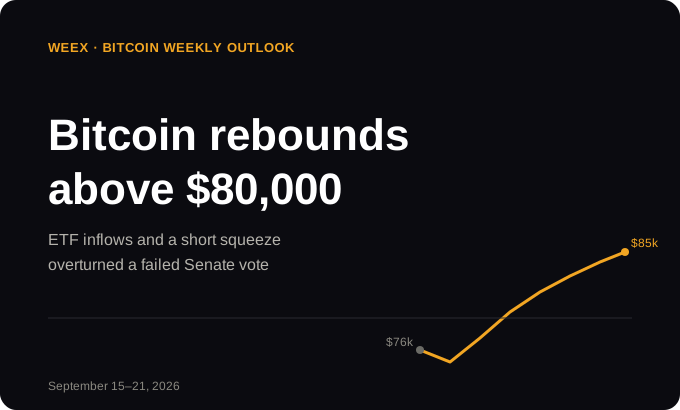
WEEX Bitcoin Weekly Outlook: Why Did Bitcoin Rebound Above $80,000 After the CLARITY Act Vote?
Bitcoin rebounded above $80,000 as SEC and CFTC action, renewed ETF inflows, and a short squeeze outweighed the failed CLARITY Act vote.
Coldcard whitehats move 52.37 BTC to recovery trust

Bitcoin's Rise Does Not Mean the Bull Market Has Returned; Don't Create Stories for Yourself
Deutsche Bank: Markets May Underestimate Rate Peaks After Central Banks' Coordinated Rate Hikes
Hyperliquid Opens Market for Bitcoin Volatility

Tom Lee Discusses Entry into Digital Asset Bull Market and AI Fund Movements

Micron Stock Price Target: Do the $1,500 to $2,000 Estimates Still Make Sense
Micron price targets range from $1,295 consensus to $1,500- lus individual calls, while options pricing implies an 11% swing on September 30 earnings, the actual results will settle which
![[ETH Letter] Ethereum Aims to Activate Sepolia Testnet on October 6](/public-static/26_2e1840f602.png?format=avif)
[ETH Letter] Ethereum Aims to Activate Sepolia Testnet on October 6
Fypher Partners with Korea Medical Tourism Promotion Association for Digital Dollar Payment
Solana DEX volume spike hides circular trades, and automated bots are blamed
Oracle Stock vs. KRAFTON Stock: Why Are Investors Questioning Two Growing Companies?
Compare Oracle and KRAFTON stocks through their latest results, share-price questions and the different growth tests investors face in 2026.
John Templeton: "Bull markets are born in pessimism"
The Death of Hsin-Ju: A Prelude to Conspiracy
LTC Airdrop 2026: How to Claim 50,000 USDT Rewards on WEEX
Raiffeisen’s crypto deal could reach 18 million customers. How many can actually trade?




