
Why Did Sui (SUI) Crypto Price Jump 44%? Crypto OI and Leverage Explain the Rally

 Prefer us on Google


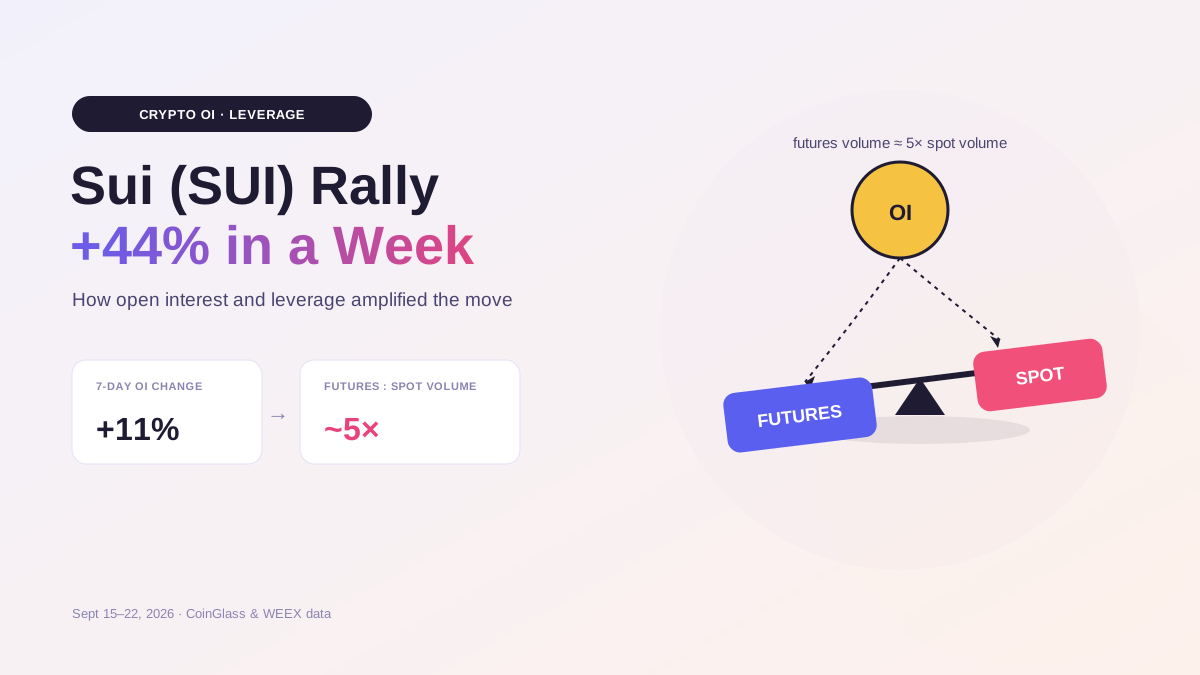
Sui (SUI) crypto price jumped roughly 44% over the week ending September 22, 2026, as Bitcoin’s move above $85,000 encouraged a rotation into Layer-1 tokens, spot trading accelerated and crypto OI increased by about 11%. The simultaneous rise in price, volume and futures positioning suggests that new leveraged exposure amplified the rally rather than spot demand carrying the entire move.
My view is that this was a real market rally with an unstable engine. Sui had legitimate catalysts and broader altcoin momentum behind it, but futures activity grew much faster than the evidence for sustainable spot accumulation. The subsequent decline back below $1 shows why calling the 44% move a clean fundamental repricing would be misleading.
At a Glance
- SUI recovered from approximately $0.67 to as high as $1.08 during the weekly move.
- The token gained about 44% over seven days and nearly 18% during its strongest daily advance.
- Daily trading volume reportedly increased by approximately 31%.
- SUI derivatives open interest increased by about 11% during the rally.
- By September 24, SUI had pulled back to around $0.96 while open interest remained near $816 million.
- Current futures volume was approximately five times reported spot volume, showing how strongly derivatives influenced price discovery.
- SUI spot trading remains available on WEEX, but the WEEX SUI/USDT futures page showed a circuit breaker at the data cutoff.
What Happened to the Sui (SUI) Crypto Price?
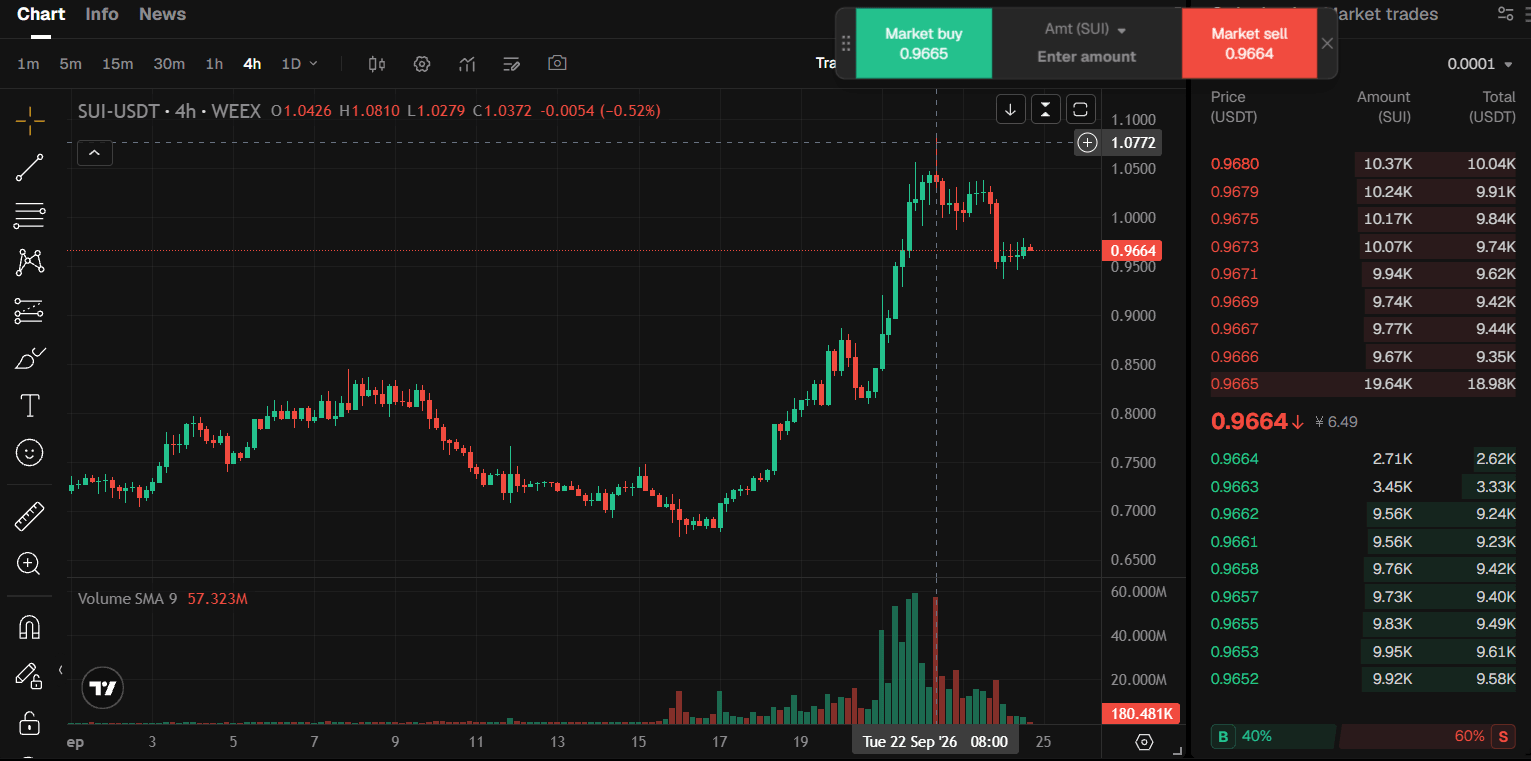
SUI began the observed weekly period near a low of approximately $0.67. As Bitcoin moved above $85,000 and capital rotated toward larger Layer-1 assets, SUI accelerated above the psychologically important $1 level.
The token traded near $1.05 on September 22 and briefly reached approximately $1.08. That represented a weekly gain of around 44% and a recovery of roughly 57% from the $0.67 intraperiod low.
The move did not hold in a straight line. By September 24, CoinGlass showed SUI around $0.96, down approximately 6% over 24 hours but still up roughly 34% over seven days. The difference between the earlier 44% figure and the later seven-day return reflects the subsequent pullback and rolling measurement window.
Sui (SUI) Rally Timeline
| Period | SUI Price or Market Signal | Interpretation |
|---|---|---|
| Weekly low | Approximately $0.67 | Starting point of the sharp recovery |
| Strongest daily advance | Nearly 18% | Breakout above $1 accelerated momentum |
| Weekly peak | Approximately $1.08 | Roughly 44% weekly gain at the reported observation point |
| September 24 | Approximately $0.96 | Profit-taking and leverage adjustment followed |
| Current crypto OI | Approximately $816M | Derivatives exposure remained substantial |
The price sources did not provide an exact intraday timestamp for every figure. The values should therefore be treated as market snapshots rather than synchronized closing prices.
How Did Crypto OI Help Drive the Sui (SUI) Rally?
Crypto OI, or open interest, measures the total value of futures contracts that remain open and unsettled. It includes both long and short positions.
During the SUI rally, derivatives open interest reportedly increased by approximately 11%. Price and OI rising together usually mean that traders are opening new positions rather than the market moving only because existing shorts are closing.
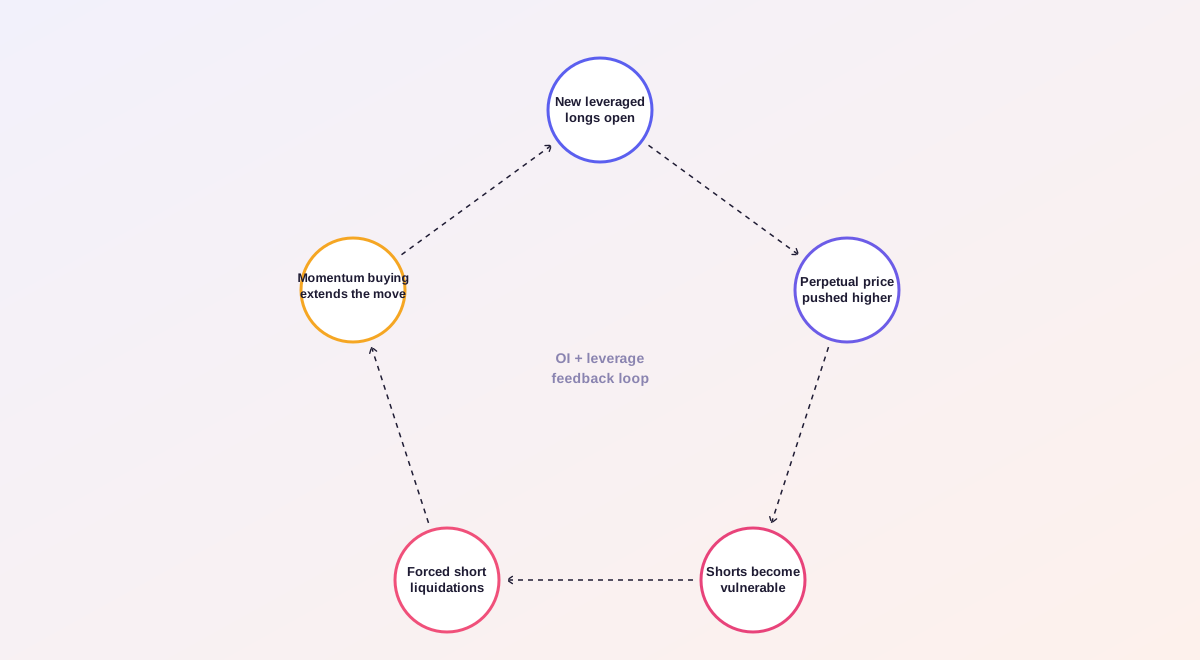
That pattern can strengthen a rally:
- Traders open new leveraged long positions.
- The additional buying pressure pushes the perpetual price higher.
- Arbitrageurs buy spot or sell futures to keep the markets aligned.
- Short positions become increasingly vulnerable.
- Forced short closures create additional market buying.
- The rising price attracts more momentum traders.
However, increasing crypto OI does not prove that every new position is long. Every derivatives contract has opposing exposure. What it shows is that more capital and leverage entered the trade while the price was rising.
The direction becomes clearer only when OI is combined with funding rates, liquidations, order flow and spot volume.
-- Price
What Current Sui (SUI) Futures Positioning Shows
CoinGlass displayed approximately $816 million in SUI open interest on September 24. It also reported roughly $1.5 billion in 24-hour futures volume compared with approximately $300 million in spot volume.
That puts reported futures turnover at about five times spot turnover.
| Metric | September 24 Snapshot | What It Suggests |
|---|---|---|
| SUI price | Approximately $0.96 | Rally had entered a pullback |
| Seven-day price change | Approximately +34% | Much of the weekly advance remained |
| Crypto OI | Approximately $816M | Large outstanding derivatives exposure |
| 24-hour futures volume | Approximately $1.5B | Active leveraged trading |
| 24-hour spot volume | Approximately $300M | Smaller than derivatives turnover |
| 24-hour liquidations | Approximately $5M | Positions were being forcibly closed |
The source did not provide one exact timestamp shared by all figures. Values changed between page retrievals.
The main conclusion is not simply that traders were bullish. It is that derivatives had enough weight to accelerate price movement in both directions.
When futures volume overwhelms spot volume, a rally can travel farther than spot demand alone would justify. The reverse is also true: once crowded futures positioning begins to unwind, the decline may be faster than the original catalyst would suggest.
Did a Short Squeeze Push Sui (SUI) Higher?
A short squeeze probably contributed to the speed of the move, but the available data does not justify claiming that liquidations caused the entire 44% rally.
A short squeeze occurs when rising prices force bearish futures positions to close. Because closing a short normally requires buying back the asset or contract, liquidations can add automatic buying pressure to an existing rally.
The reported sequence fits that mechanism:
- SUI broke above a visible psychological level at $1.
- Trading volume rose.
- Crypto OI increased.
- The token advanced rapidly toward $1.08.
- SUI subsequently pulled back as leveraged positioning adjusted.
Nevertheless, rising OI during the advance also suggests that new positions were being opened. A pure short-covering rally would often cause open interest to decline as old shorts close. The increase in OI therefore points to a mixture of short liquidations and aggressive new futures positioning.
How Leverage Amplified the Sui (SUI) Price Move
Leverage allows a trader to control a position larger than the collateral posted. It does not change how far SUI moves; it changes how much that movement affects the trader’s margin.
Ignoring maintenance margin and fees, the approximate adverse move capable of consuming the initial margin is:
| Leverage | Approximate Adverse Move |
|---|---|
| 2× | 50% |
| 5× | 20% |
| 10× | 10% |
| 20× | 5% |
| 50× | 2% |
SUI moved by considerably more than 5% during several parts of the rally and pullback. A trader using 20× leverage could therefore be liquidated by ordinary intraday movement even if the broader weekly thesis eventually proved correct.
Leverage also creates feedback loops.
During the advance, short liquidations may accelerate buying. After momentum reverses, overleveraged longs can be liquidated, creating forced selling. The same mechanism that makes a breakout look powerful can make the retracement unusually violent.
This is why crypto OI should be treated as a measure of market pressure—not as a standalone bullish signal.
What Else Drove the Sui (SUI) Crypto Rally?
Leverage explains the acceleration, but it does not explain why traders chose SUI in the first place.
Broader Layer-1 Rotation
Bitcoin’s move above $85,000 improved sentiment across the crypto market. Once Bitcoin had established upward momentum, traders began looking for higher-beta assets capable of outperforming it.
SUI benefited from that Layer-1 rotation alongside other large smart-contract networks. The 44% move therefore occurred within a broader risk-on environment rather than in isolation.
Sui Basecamp Expectations
Sui’s official website is promoting Sui Basecamp 2026 for October 7–8 in Singapore. The network has also teased upcoming products and technical announcements around the event.
Pre-event expectations can attract speculative positioning before concrete details are available. That creates opportunity, but also a familiar “buy the rumor, sell the news” risk if the announcement fails to meet elevated expectations. (sui.io)
Rising Trading Activity
Daily trading volume reportedly increased by around 31% during the rally. Higher volume makes a breakout more credible than a thin-market price spike because more capital is changing hands.
Yet the composition of that volume matters. With futures turnover substantially above spot turnover, the volume expansion also confirms that leverage played a major role.
Was the 44% Sui (SUI) Rally Spot-Led or Leverage-Led?
The evidence points to a mixed rally that became increasingly leverage-led.
The initial move likely required genuine spot interest and a supportive wider market. Futures cannot remain permanently detached from spot because arbitrage activity pulls the two markets together.
But three details suggest that leverage became the dominant amplifier:
- Open interest increased by approximately 11%.
- Futures volume reached roughly five times spot volume at the later observation point.
- SUI fell approximately 6% in 24 hours while several million dollars of futures positions were liquidated.
A durable spot-led rally normally looks healthier when spot volume and spot inflows continue rising without a disproportionate expansion in leverage. A derivatives-led rally can still continue, but it becomes more sensitive to funding, liquidations and abrupt changes in sentiment.
What Does the Sui (SUI) Pullback Mean?
The retreat from approximately $1.08 to around $0.96 does not automatically invalidate the broader rebound. It does confirm that the 44% headline captured SUI close to a local peak rather than after the market had consolidated.
The pullback has three possible interpretations:
- Normal profit-taking: Early buyers sold after a rapid move from $0.67.
- Healthy deleveraging: Excessive futures positions were reduced without fully reversing the trend.
- Failed breakout: Demand above $1 proved insufficient and momentum traders began exiting.
The distinction depends on what happens next to price and crypto OI.
| Price | Open Interest | Likely Interpretation |
|---|---|---|
| Rising | Rising | New futures positioning is entering |
| Rising | Falling | Shorts may be closing |
| Falling | Rising | New shorts or trapped leveraged longs are building |
| Falling | Falling | Positions are being closed or liquidated |
If SUI stabilizes while OI decreases, the market may be removing excess leverage. If both price and OI rise sharply again, another powerful move is possible—but so is a more severe liquidation event.
What Traders Should Watch Next for Sui (SUI)
The most useful indicators are:
- The $1 area: This remains an important psychological and technical reference.
- Crypto OI: Another rapid increase without equivalent spot demand would make the trade more crowded.
- Funding rates: Persistently positive funding would show that long positions are paying to remain open.
- Futures-to-spot volume: A widening gap would indicate that derivatives continue to dominate.
- Liquidations: Large short liquidations can extend a breakout; large long liquidations can deepen a pullback.
- Bitcoin direction: SUI’s rally developed alongside strength in Bitcoin and other Layer-1 assets.
- Sui Basecamp announcements: Confirmed product news matters more than pre-event speculation.
Traders should avoid reducing all these variables to a single price target. The stronger question is whether spot participation can take over as leveraged momentum cools.
How to Trade Sui (SUI) on WEEX and Join the Active BTC Reward Event
WEEX lists both SUI/USDT spot and SUI/USDT perpetual futures. The spot page showed approximately 4.097 billion SUI in circulating supply and 10 billion in total and maximum supply at the data cutoff. (Buy & sell Sushiswap on WEEX)
How to Trade Sui (SUI) Spot
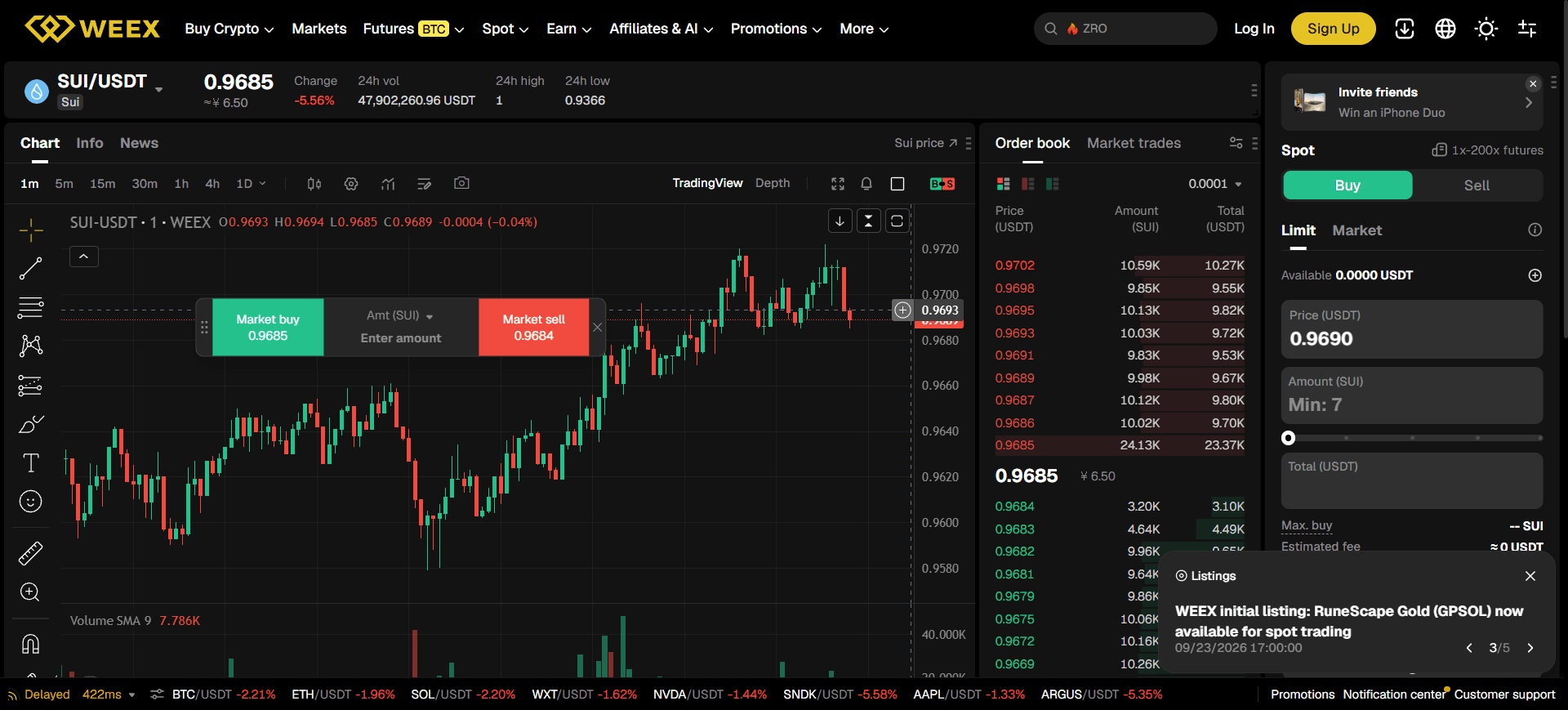
- Open the official WEEX SUI/USDT spot market.
- Sign in and fund the spot account with USDT.
- Confirm that the selected pair is SUI/USDT.
- Choose a limit order for greater price control or a market order for immediate execution.
- Enter the desired SUI or USDT amount.
- Review the price, quantity and fee before confirming.
- Verify the completed order and SUI balance under spot assets.
How to Trade Sui (SUI) Perpetual Futures
SUI/USDT is an officially listed USDT-margined perpetual contract on WEEX. However, at the September 24 data cutoff, the official futures page displayed a circuit-breaker notice stating that opening and closing positions were disabled and only order cancellation was available.
Do not attempt to work around that restriction. Check the SUI/USDT futures page and the WEEX announcement center for confirmation that normal trading has resumed before opening a position.
After normal trading resumes:
- Transfer USDT to the futures account.
- Open the SUI/USDT perpetual market.
- Select cross or isolated margin.
- Reduce leverage from any high default setting where appropriate.
- Choose long or short, then set the order price and size.
- Review the mark price and estimated liquidation price.
- Add stop-loss and take-profit instructions.
- Monitor funding, margin and the circuit-breaker status.
The temporary restriction is particularly relevant in an article about crypto OI and leverage. A functioning risk control can interrupt trading precisely when volatility becomes extreme, so traders should confirm current market availability rather than assuming a listed pair is continuously tradable. (Start Sushiswap futures trading on WEEX)
How to Join the Active WEEX Reward Event With Sui (SUI)
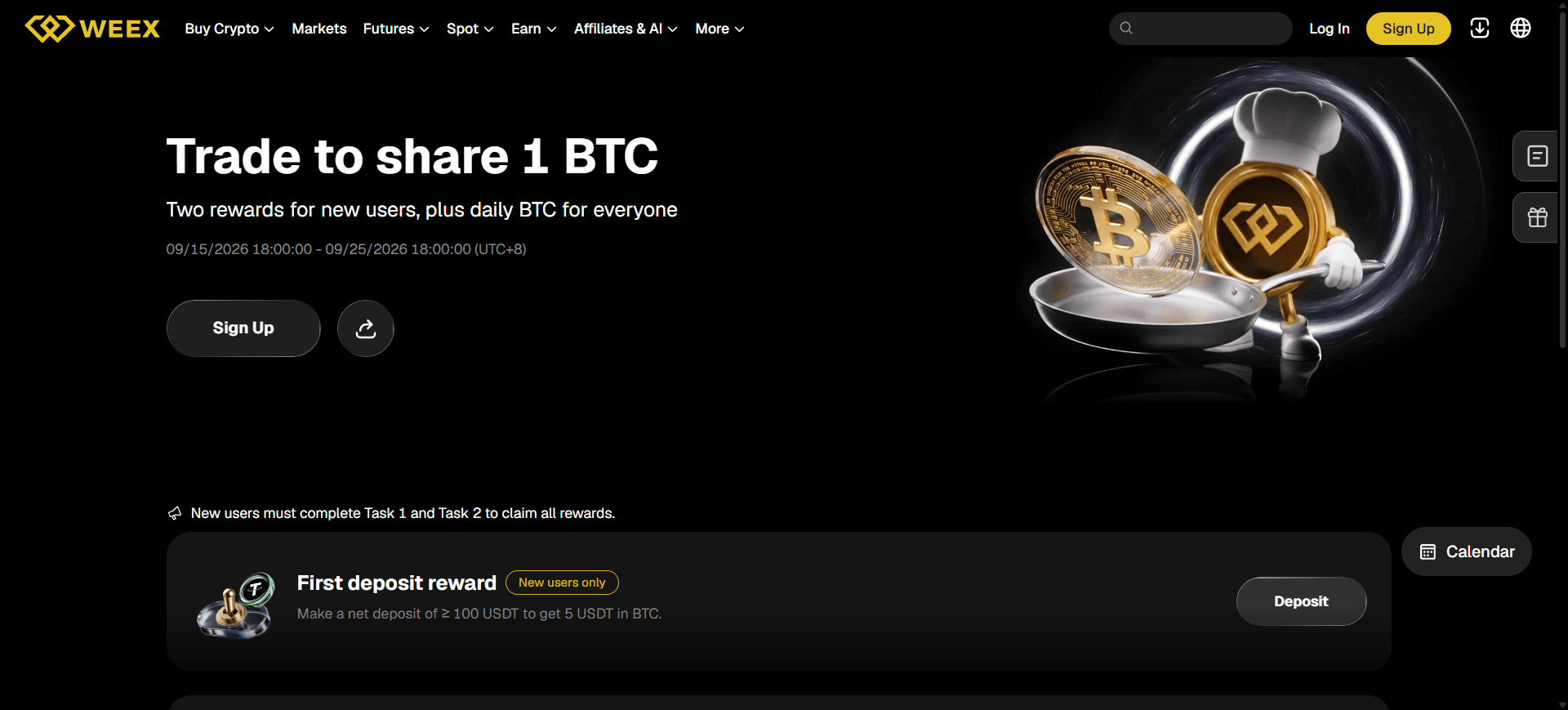
The WEEX “Trade to Share 1 BTC” event runs from September 15, 2026, at 18:00 through September 25, 2026, at 18:00 (UTC+8), subject to the 1 BTC pool remaining available.
SUI spot activity can qualify for parts of the campaign:
- New-user deposit task: Make a net on-chain or P2P deposit of at least 100 USDT to receive 5 USDT in BTC.
- New-user first-trade task: Complete a first spot trade of at least 30 USDT in BTC, ETH or SUI to receive 4 USDT in BTC.
- Daily task for all eligible users: Reach at least 100 USDT in daily spot volume to receive 3 USDT in BTC for that qualifying day.
To participate:
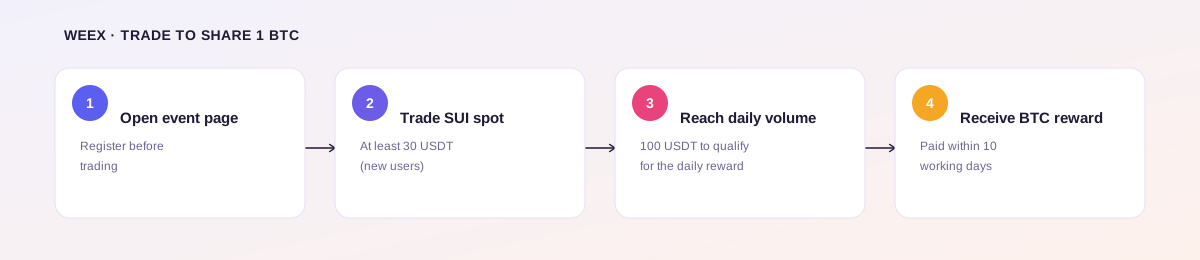
- Open the official event page and register before trading.
- Confirm that the reward pool is still available.
- Complete the relevant deposit requirement if you are a new user.
- Trade at least 30 USDT of SUI/USDT spot for the new-user trading task.
- Reach 100 USDT in daily spot volume for the daily reward.
- Avoid API trading, self-trading or other excluded activity.
- Allow up to 10 working days after the event ends for distribution.
The campaign uses spot volume, not SUI futures volume. The pool is first-come, first-served, and new users can receive only one welcome reward across WEEX new-user events. WEEX’s referenced article lists a base spot fee of 0.1% for maker and taker orders, but users should confirm their applicable rate on the current WEEX fee schedule and order screen. (weex.com)
WEEX Editorial View: The Sui (SUI) Rally Was Powerful but Overleveraged
SUI did not rise 44% for one simple reason. Bitcoin created the favorable market environment, Layer-1 rotation supplied the narrative and rising spot activity gave the move a foundation. Crypto OI and leverage then turned that foundation into a much faster rally.
That distinction matters. Leverage can accelerate price discovery, but it cannot replace durable demand. With futures turnover near five times spot volume and SUI already retreating from $1.08, the market has shown signs of carrying more speculative weight than its spot base can comfortably support.
The sensible conclusion is not that the rally was fake. It is that the 44% headline overstated how stable the new price level had become. Until spot demand strengthens relative to futures positioning, SUI remains a credible Layer-1 trade wrapped in a fragile leverage structure.
Frequently Asked Questions
1. Why Did Sui (SUI) Crypto Rise 44%?
SUI benefited from Bitcoin strength, a broader Layer-1 rotation, rising trading volume and an approximately 11% increase in derivatives open interest. Leverage and possible short liquidations amplified the underlying demand.
2. What Does Crypto OI Mean for Sui (SUI)?
Crypto OI measures the total value of unsettled SUI futures positions. Rising price and OI show that new futures positioning is entering, but they do not prove that every new position is bullish.
3. Was the Sui (SUI) Rally Caused by a Short Squeeze?
Short liquidations probably accelerated the move, but they were not the only cause. Because open interest also increased, new leveraged positions were entering alongside any forced short covering.
4. Can Traders Buy Sui (SUI) on WEEX?
Yes. The SUI/USDT spot market was available at the data cutoff. The SUI/USDT futures market was listed but temporarily restricted by a circuit breaker.
5. Does Sui (SUI) Trading Qualify for the WEEX BTC Event?
Yes. An eligible new user’s first SUI spot trade of at least 30 USDT can satisfy the first-trade task. Eligible users can also complete the 100 USDT daily spot-volume task while the event and reward pool remain active.
Sources
- CryptoRank/CoinEdition — “SUI Price Live: What Is Driving the Latest SUI Price Surge?”, September 22, 2026.
- CoinGlass — Sui Futures Market Data, Open Interest and Liquidations, accessed September 24, 2026. The source did not provide an exact data timestamp.
- Sui — Official Website and Sui Basecamp 2026 Information, accessed September 24, 2026.
- WEEX — SUI/USDT Spot Market, accessed September 24, 2026. The source did not provide an exact data timestamp.
- WEEX — SUI/USDT Perpetual Futures, accessed September 24, 2026; circuit-breaker notice visible at the data cutoff.
- WEEX — SUI USDT Perpetual Futures Listing, accessed September 24, 2026.
- WEEX — Trade to Share 1 BTC Event, accessed September 24, 2026.
- WEEX — BTC Futures Trading and BTC Rewards Guide, published September 18, 2026.
This content is provided for general informational purposes only and doesn't constitute financial, investment, legal, or tax advice. Any events, rewards, online promotions, or related information mentioned herein should not be considered a recommendation, solicitation, or invitation to purchase, sell, trade, or otherwise deal in any crypto assets. Crypto assets are highly volatile and may result in loss. The availability of WEEX services, products, and related events may vary by region. You are responsible for ensuring that your participation is in accordance with applicable local laws and regulations.
You may also like

Circle expands CCTP to EURC and cirBTC on Arc

Bitcoin, Sports, and Politics: Predictive Markets Target $10 Trillion

AI Agent Jev Expects On-Chain Innovation Through Automated Judgment

The End of the Blank Prompt: Why Trading AI Needs a Playbook

Stablecoins hold nearly $200 billion in US debt, but money funds bought the surge
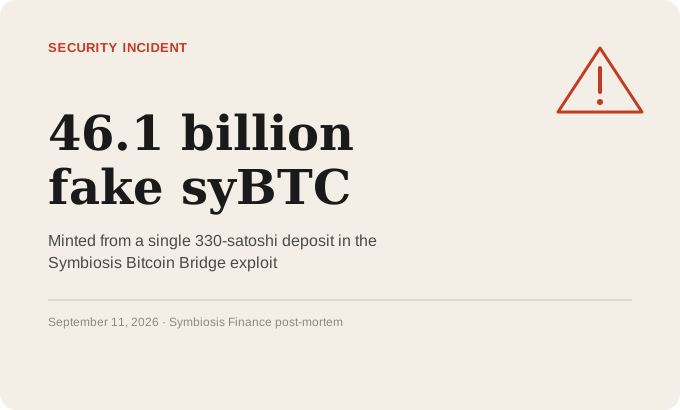
How Did a Hacker Create 46 Billion Fake Bitcoin in the Symbiosis Exploit? Decodes Bitcoin Hacker With WEEX Now
How two Symbiosis bridge bugs let a hacker mint 46.1 billion unbacked syBTC, drain Bitcoin pools and expose critical bridge risks.
CFTC's Selig Emphasizes the Need to Prepare for the Era of Large-Scale Tokenization in the U.S.

The IMF opens an office in Venezuela to supervise an economy that has already migrated to USDT

SOXL Stock Jumped 12% Yesterday: Three Companies Explain the Entire Move
Bitcoin's Hashrate Rises as Miners Reactivate Their Machines

Bitcoin 2x Leveraged ETF Launches on Cboe, But Doesn't Buy Bitcoin: Here's Why

Crypto: The ECB Enters the Tokenized Bond Market
WEEX Bitcoin Weekly Outlook: Why Did Bitcoin Rebound Above $80,000 After the CLARITY Act Vote?
Bitcoin rebounded above $80,000 as SEC and CFTC action, renewed ETF inflows, and a short squeeze outweighed the failed CLARITY Act vote.
Coldcard whitehats move 52.37 BTC to recovery trust
Bitcoin's Rise Does Not Mean the Bull Market Has Returned; Don't Create Stories for Yourself
Deutsche Bank: Markets May Underestimate Rate Peaks After Central Banks' Coordinated Rate Hikes
Hyperliquid Opens Market for Bitcoin Volatility
Tom Lee Discusses Entry into Digital Asset Bull Market and AI Fund Movements

Micron Stock Price Target: Do the $1,500 to $2,000 Estimates Still Make Sense
Micron price targets range from $1,295 consensus to $1,500- lus individual calls, while options pricing implies an 11% swing on September 30 earnings, the actual results will settle which
![[ETH Letter] Ethereum Aims to Activate Sepolia Testnet on October 6](/public-static/26_2e1840f602.png?format=avif)
[ETH Letter] Ethereum Aims to Activate Sepolia Testnet on October 6
Fypher Partners with Korea Medical Tourism Promotion Association for Digital Dollar Payment
TapeOut Ecosystem Overview: From NAND, LATCH to On-Chain Application Ecosystem
[Coin Crime] "If you give us Tether, we will give you oil" - Polish state-owned company falls victim to international fraudsters

Why real-time election odds are misleading prediction market crypto traders

What is PCE and Why September 30 is Important for Cryptocurrencies
Bitcoin: JPMorgan Sees BTC Outperforming Gold

U.S. Treasury Sanctions BitBank Over Iranian Sanctions-Evasion Network
Brazil blocks stablecoins from key cross-border payment rail as $1.1 trillion market faces new limits
RISEx Proposes 20% Retention Condition for Stolen Funds

USDT in Wallets May Be Blocked. What to Do and How to Store Them in Russia
Circle expands CCTP to EURC and cirBTC on Arc
Bitcoin, Sports, and Politics: Predictive Markets Target $10 Trillion
AI Agent Jev Expects On-Chain Innovation Through Automated Judgment
The End of the Blank Prompt: Why Trading AI Needs a Playbook
Stablecoins hold nearly $200 billion in US debt, but money funds bought the surge
How Did a Hacker Create 46 Billion Fake Bitcoin in the Symbiosis Exploit? Decodes Bitcoin Hacker With WEEX Now
How two Symbiosis bridge bugs let a hacker mint 46.1 billion unbacked syBTC, drain Bitcoin pools and expose critical bridge risks.


