
Treasury at Highest in 18 Years: Federal Reserve Set for New Rate Hikes

 Prefer us on Google


Wall Street closed sharply lower on Wednesday, overwhelmed by a wave of selling in government bonds that pushed yields to their highest levels in nearly eighteen years. Behind the drop is a specific fear: new Federal Reserve rate hikes in the coming months, driven by persistent inflation.
Key Points
- The U.S. stock market slips as bond yields accelerate
- Treasury yields reach an 18-year high
- The Fed opens the door to new rate hikes
- Oil rises amid geopolitical tensions and trade truce
- FAQ
- What caused the recent decline in U.S. stock markets?
- How much have Treasury yields risen and why is it significant?
- What are market expectations regarding changes in Federal Reserve rates?
- What recent geopolitical developments could influence the markets?
Key Points
- The S&P 500 lost 0.75%, closing at 7,706.03 points, while the Nasdaq Composite fell 1.13% to 26,936.04.
- The Dow Jones Industrial Average dropped 352.10 points (-0.68%), finishing at 51,511.59.
- The 10-year Treasury yield rose to 5.135%, the highest level since July 2007.
- The CME FedWatch assigns over a 66% probability to a 25 basis point rate hike in October.
- Brent crude oil rose 3.9% to $103.08 per barrel, while WTI gained 1.8% to $92.16.
U.S. Stock Market Slips as Bond Yields Accelerate
Wednesday's session closed with widespread losses across all major Wall Street indices, triggered by the surge in bond yields. The S&P 500 fell 0.75%, closing at 7,706.03 points, while the Nasdaq Composite, more exposed to tech stocks, recorded a sharper decline of 1.13% to 26,936.04. The Dow Jones Industrial Average lost 352.10 points, equivalent to a drop of 0.68%, closing at 51,511.59.
Not all sectors paid the same price. Utilities and discretionary consumer sectors were the most affected, both with losses exceeding 1% during the day. These are traditionally segments sensitive to the cost of money, and their weakness reflects how much the market is already pricing in the possibility of higher rates for a longer time.
-- Price
Treasury Yields Reach 18-Year High
The 10-year Treasury yield surged to 5.135%, a level not seen since July 2007. It was also the largest single-day increase for the 10-year since April 2025. The 2-year Treasury, more sensitive to the Fed's short-term moves, reached 4.947%, the highest since May 2024.
The push came after the release of purchasing managers' index data that exceeded analysts' expectations, a sign that inflationary pressures remain widespread in the economy. Massimo Santicchia, head of U.S. equities at Procyon, noted that while corporate earnings remain solid, inflation is creating uncertainty in the market, extending beyond energy into the services sector.
According to Santicchia, a pause from the Federal Reserve seems unlikely at this stage: the most concrete scenario is that of two or three more rate hikes in the coming months.
The Fed Opens the Door to New Rate Hikes
Santicchia's words were confirmed by the official statements from the central bank. Federal Reserve Governor Michael Barr reinforced this reading on Wednesday, stating that further adjustments to monetary policy will likely be necessary to bring inflation back toward the Fed's target.
Barr acknowledged that economic growth continues at a healthy pace and that employment conditions remain stable. However, he emphasized that inflation remains above the Fed's 2% target, without showing a rapid convergence towards that level. This point weighs on upcoming monetary policy decisions.
He added that risks related to inflation prospects have intensified, while those related to the labor market have eased. This is a significant distinction: when employment risks diminish, the Fed is less hesitant to insist on interest rate adjustments.
The market has already taken a position. According to the CME FedWatch tool, the odds of a 25 basis point hike in October have risen to over 66%, compared to 55.4% recorded the previous day and just 8.8% a month ago. This rapid repricing explains why yields have accelerated so sharply: investors are chasing expectations that change day by day.
Why does this shift in probabilities matter? Because it signals that the market is no longer betting on a Fed pause, but rather on a monetary tightening cycle that could extend for months, with direct effects on financing costs for businesses and households and on stock valuations, particularly those of growth stocks that are more sensitive to rates.
Oil Rises Amid Geopolitical Tensions and Trade Truce
As yields rose, oil also gained ground. Brent crude, with futures contracts for November delivery, rose by 3.9%, closing at $103.08 per barrel. WTI saw a more modest increase of 1.8%, reaching $92.16 per barrel.
On the diplomatic front, President Trump announced that U.S. and Iranian officials held a three-hour meeting on the sidelines of the United Nations General Assembly in New York, calling it a "very positive meeting." He had previously stated at the UN that he faced a "big decision" on how to proceed with Iran: to pursue a diplomatic agreement or take a tougher approach.
On the trade front, Treasury Secretary Scott Bessent announced a two-month extension of the trade truce between the United States and China, valid until January 10. This news comes as the meeting between Trump and Chinese leader Xi Jinping approaches, which is seen by traders as one of the main catalysts for the markets in the coming days.
Futures on the indices indicated further losses for Thursday morning, with concerns about bond yields remaining the dominant theme. The combination of persistent inflation, increasingly aggressive Fed rhetoric, and multiple geopolitical tensions is creating a context in which every new macroeconomic data point risks sharply shifting both the bond and stock markets.
FAQ
What caused the recent decline in U.S. stock markets?
The decline was primarily caused by a surge in Treasury yields, which reached their highest levels in nearly eighteen years, fueled by persistent inflation and expectations of new rate hikes from the Federal Reserve.
How much have Treasury yields risen and why is it significant?
The yield on the 10-year Treasury rose to 5.135%, the highest since July 2007, signaling tighter financial conditions and rising financing costs that worry investors.
What are market expectations regarding changes in Federal Reserve rates?
Market participants expect the Federal Reserve to raise rates two or three more times, with over 66% probability according to the CME FedWatch tool for a 25 basis point hike as early as October.
What recent geopolitical developments could influence the markets?
President Trump met with Iranian officials during the United Nations General Assembly, and the trade truce between the United States and China has been extended by two months until January 10: both developments contribute to uncertainty in the markets.
Content created with the assistance of artificial intelligence and human editorial review.
This content is provided for general informational purposes only and doesn't constitute financial, investment, legal, or tax advice. Any events, rewards, online promotions, or related information mentioned herein should not be considered a recommendation, solicitation, or invitation to purchase, sell, trade, or otherwise deal in any crypto assets. Crypto assets are highly volatile and may result in loss. The availability of WEEX services, products, and related events may vary by region. You are responsible for ensuring that your participation is in accordance with applicable local laws and regulations.
You may also like

Privy Expands Support for TRON with Enhanced Wallet and Payment Infrastructure for Developers
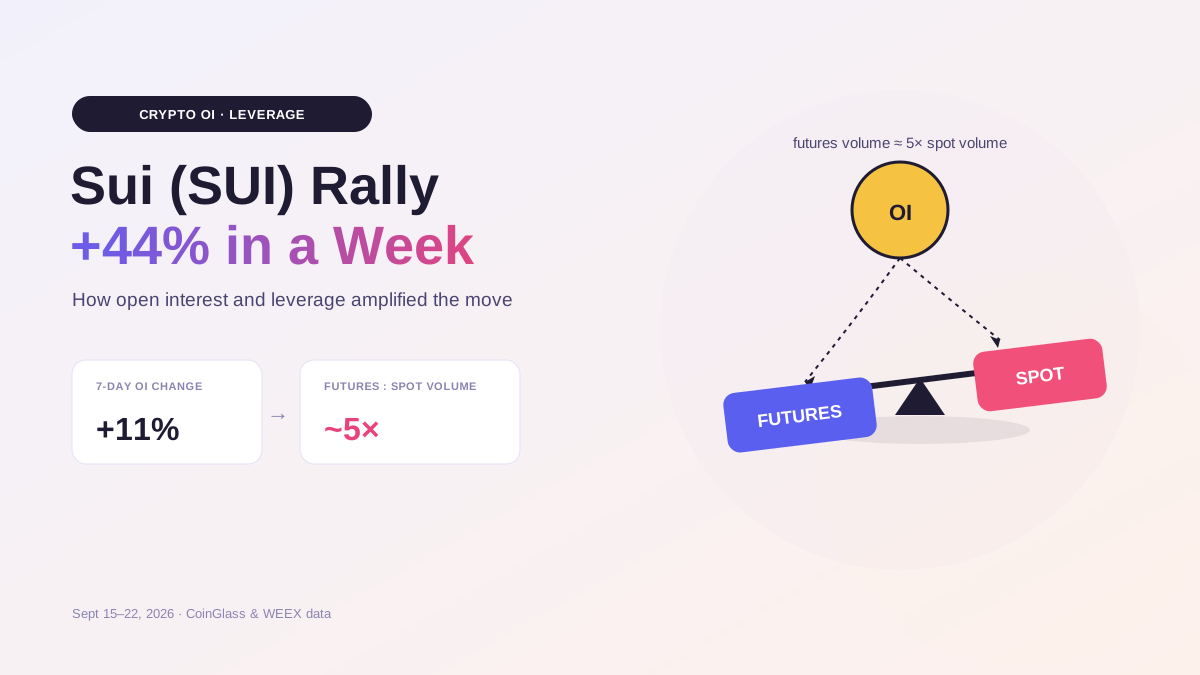
Why Did Sui (SUI) Crypto Price Jump 44%? Crypto OI and Leverage Explain the Rally
See why Sui (SUI) jumped 44%, how crypto OI and leverage amplified the rally, what the pullback means, and how to trade SUI on WEEX.

唐华斑竹 reports that BNB Chain will return to Seoul on October 2

Nearly $20 million in XRP drained from 6,678 wallets across six attack waves

Coinbase traced $1.1 million crypto trail behind AI phishing service EvilTokens

Hack Coldcard: 52 BTC Saved by Ethical Hackers
Yield Curve Approaches Inversion, TGA and Fed Tools Become New Focus in US Treasury Market

Brevo Hacking: After Trezor, Paymium Customer Data Leaked

Inside Coinbase’s $250 Billion Playbook for Post-Quantum Bitcoin Custody

NVDA Stock Rose for a Fifth Straight Day: Jensen Huang Says Sales Will Double Next Year

WEEX P2P now supports XOF, XAF & CDF—Merchant Recruitment Now Open
EURC scam: Dutch police arrest 2 over fake Rolex deals

What is Fast? Understanding the Parallel Payment Infrastructure for AI Agents

Elon Musk’s X adds Bitcoin trading links for U.S. users

Robinhood CEO Says Crypto Will Beat Sports at Prediction Markets' Own Game

ZEC's Largest Mining Company Moves to US Stock Market After Mining 70,000 ZEC in Six Months
U.S. Banks Face $326.7 Billion in Unrealized Losses
MU Stock Retail Sentiment Just Turned Sour: The CEO Sold Shares Right Before Earnings
MU retail sentiment is souring ahead of September 30 earnings, and the CEO just sold $39 million in shares but the sale traces back to a plan set eight months ago.

Cardano x402: the official integration that allows AI agents to pay APIs in ADA
SEC Takes Action: Who Can Handle "Compliant ICOs"?
Circle wants you to love USDC a little like you love Chelsea

Ethereum and Base Abandon Common Standard for Crypto Wallets

Cryptocurrency Security Guide: How to Identify and Prevent Social Engineering Attacks

Your crypto hardware wallet can stay secure while everything around it fails

How to Spend Crypto on Apple Pay in 2026 (No Selling)

Neutrl opens NUSD redemptions as contract reads 0.51

World Money launches in 150+ countries with Stripe
What Are the Conditions for Success of Data Centers? A Map of AI Data Centers in Korea – Bitplanet

Bottomline Chooses Chainlink to Bring On-Chain Payments to 600 Banks
Why Is Bitcoin Reacting to the September 2026 Fed Rate Hike?
Why did Bitcoin hold near $76,000 after the September 2026 Fed rate hike? See how expectations, yields, the dollar, and liquidity shaped BTC.
Privy Expands Support for TRON with Enhanced Wallet and Payment Infrastructure for Developers
Why Did Sui (SUI) Crypto Price Jump 44%? Crypto OI and Leverage Explain the Rally
See why Sui (SUI) jumped 44%, how crypto OI and leverage amplified the rally, what the pullback means, and how to trade SUI on WEEX.
唐华斑竹 reports that BNB Chain will return to Seoul on October 2
Nearly $20 million in XRP drained from 6,678 wallets across six attack waves
Coinbase traced $1.1 million crypto trail behind AI phishing service EvilTokens
Hack Coldcard: 52 BTC Saved by Ethical Hackers





