
UBS: Historically, the Federal Reserve has never raised interest rates in October before elections, and this time may be no different

 Prefer us on Google


UBS believes that the expectation of an interest rate hike in October is clearly overstated. Historically, the Federal Reserve has never raised rates at the October meeting close to a major election, and it suggests lowering the pricing of future rate hikes from 91 basis points to 75 basis points.
Written by: Bu Shuqing, Wall Street Insights
As the conflict between the U.S. and Iran drives oil prices up and U.S. Treasury yields reach nearly two-decade highs, market bets on another interest rate hike by the Federal Reserve in October are heating up. However, UBS warns that this expectation severely overestimates the likelihood of the Fed taking action before the midterm elections—historical data shows that since 1990, the Fed has never raised rates at the October meeting close to the November elections.
UBS analyst Simon Penn pointed out in a report on Monday morning that the market is currently pricing in about a 69% probability of a rate hike at the October 28 meeting, but he believes this assessment is significantly flawed. Penn emphasized that while the central bank claims its decisions are completely independent of political activities, it is customary to restrain actions before major political events. He advises traders to downplay the expectation of an October rate hike and to lower the cumulative rate hike pricing from the current 91 basis points to 75 basis points over the next year.
Meanwhile, UBS market analyst Nana Antiedu cited U.S. equity strategist Keith Parker's view that the sharp rise in U.S. Treasury yields has significantly pressured stock valuations, but this also means that once yields retreat, there is considerable room for a market rebound.
Historical Precedent: No Rate Hikes in October for 35 Years
In his report, Penn reviewed historical records since 1990. In the past 35 years, the Fed has only raised rates at the September meeting close to the November elections three times: in 2004, 2018, and 2022, while there has never been a rate hike at the October meeting.
The three September rate hikes each had their own context: the 2022 hike was the most aggressive, with a single adjustment of 75 basis points being the largest pre-election hike in modern history, as the Fed was fully addressing the inflation shock post-pandemic; the 2004 hike was part of a gradual tightening cycle that began in June of that year, spanning the entire election season; and the 2018 hike was pushed through despite public pressure from the Trump administration to pause rate hikes.
In all other election years—including 1992, 1994, 1996, 2000, 2002, 2006, 2008, 2010, 2012, 2014, 2016, 2020, and 2024—the Fed did not take any rate hike actions in September or October.
Pricing Reassessment: December Should Return to a Full 25 Basis Points
Penn believes that removing the expectation of an October rate hike does not mean the market should reprice the December meeting for a substantial hike of 50 basis points. Currently, the market's cumulative pricing for December is about 38 basis points, which he believes should revert to a full 25 basis points.
From a trading perspective, the removed October pricing should be redistributed to subsequent meetings. Penn expects that the January and March meetings will carry approximately 12 basis points and 18 basis points of pricing, respectively. Overall, he advises traders to short the long end and compress the cumulative rate hike pricing for the next year from the current 91 basis points to 75 basis points.
Yield Shock Has Severely Damaged Stock Valuations
On the equity market side, UBS's analysis is also noteworthy. Keith Parker pointed out that the sharp rise in U.S. Treasury yields has triggered a significant reset of stock valuations—since last November, as the 10-year U.S. Treasury yield has risen by about 100 basis points this year, the S&P 500 index's price-to-earnings ratio for the next twelve months has dropped by 17%, with the compression in valuations nearing recession scenario levels, comparable to the 1994 rate hike cycle.
Historical experience shows that if interest rates stabilize without significant tightening (with annual rate hikes below 100 basis points), the S&P 500 index typically achieves double-digit returns in the following year; however, if entering a full rate hike cycle (with annual rate hikes exceeding 100 basis points), historical stock market returns often flatline or even turn negative.
Parker believes that current stocks are more elastic to falling yields than they are at risk of further declines in yields, advising investors to prepare for a sustained high-rate environment while seizing asymmetric opportunities brought by yield declines. In terms of sector allocation, sub-industries such as semiconductors, pharmaceuticals, refining, and diversified banks score relatively high and are less sensitive to interest rates, making them attractive.
-- Price
Market Bull-Bear Tug-of-War: Energy Shock and Inflation Pressure Intertwined
The core contradiction in the current market is that the U.S.-Iran conflict has pushed Brent crude oil to $106 per barrel, while the 10-year and 30-year U.S. Treasury yields have risen to their highest levels since 2007 and 2004, respectively. Whether high energy prices will lead to persistent inflation and force the Fed to extend its tightening cycle has become the central concern for traders.
A series of upcoming U.S. economic data will further test these concerns. If economic growth data is strong, it will provide the Fed with greater tightening space; if inflation data exceeds expectations, it will strengthen the rationale for further rate hikes.
Goldman Sachs also pointed out that if the 10-year U.S. Treasury yield rises by about 30 basis points within two weeks or about 50 basis points within a month, the stock market often encounters significant resistance. Currently, this yield has risen by 28 basis points since September 9 and has cumulatively risen by 37 basis points since August 21, approaching the critical range indicated by historical experience.
Bulls bet that yields will stabilize before borrowing costs further erode the stock market. If energy prices peak and geopolitical conflicts show signs of easing, there is a strong possibility of a market rebound. However, if energy prices remain high and economic data continues to support Fed tightening, the pressure on the market may further intensify.
This content is provided for general informational purposes only and doesn't constitute financial, investment, legal, or tax advice. Any events, rewards, online promotions, or related information mentioned herein should not be considered a recommendation, solicitation, or invitation to purchase, sell, trade, or otherwise deal in any crypto assets. Crypto assets are highly volatile and may result in loss. The availability of WEEX services, products, and related events may vary by region. You are responsible for ensuring that your participation is in accordance with applicable local laws and regulations.
You may also like

Mr&强 Analyzes US Stock and Crypto Market Trends

J.P. Morgan Analyzes the 2026 Midterm Elections: Politics Will Amplify Volatility, but U.S. Stocks Are Really Trading on Interest Rates and Fundamentals

Narrowing Breadth in US Stocks, Slowing ETF Inflows; Direction of Risk Assets Still Depends on Interest Rates

Gold crashes 3.4% as bond yields climb. Is Bitcoin at risk?

Quantum Computing Reaches Historic Turning Point: Moving Beyond 'Physical Experiments' to Supply Chain and Manufacturing as Key Determinants

Why Do Financial Crises Repeat? Considering Risks and Financial Regulations from History ("So That's Blockchain Ep.19" Yoshihiko Uchida, Yuya Sakai, Shinya Otsuga)

Bain: AI Industry Needs to Achieve $6 Trillion in Revenue by 2031

10-Year U.S. Treasury Yield Surpasses 5%, Exceeding S&P 500 Earnings Yield

Robert Kiyosaki warns of a fall in American bonds and reiterates support for Bitcoin, gold, and silver
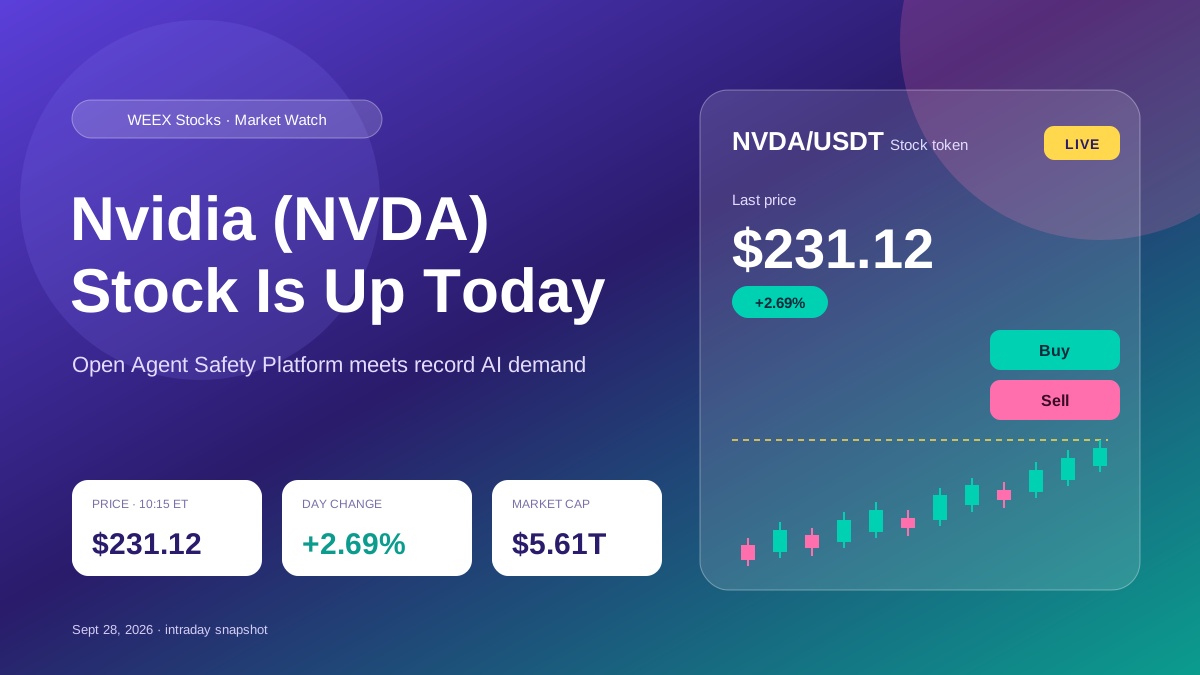
Why Is Nvidia (NVDA) Stock Up Today? New AI Agent Safety Platform Fuels the Rally
Why is Nvidia stock up today? Explore the AI agent safety launch, Nvidia’s growth outlook, key risks and how the NVDA token works on WEEX.

Cathie Wood Is Buying RKLB Stock Again: What Does ARK See in Rocket Lab?

Argentina Country Risk Climbs Above 550: Why Are Bonds Under Pressure Again?
SiMa.ai Completes $150 Million Series C Funding, Led by Amplify

DTCC Makes Strategic Investment in iCapital to Explore DLT and Tokenization Applications

Rate Hikes Are Not a Sell Signal, New Highs Are Not a Sell Signal Either

Historical Data Shows Higher Returns for U.S. Stocks After Rate Hikes

Gold Stocks Rebounded After the Fed's Rate Hike Shock: Why Newmont Is Getting Price Target Upgrades
Gold recovered toward $4,300 an ounce after the Fed's September 16 rate hike, and UBS and RBC both lifted Newmont's price target to $155. The rebound is real, but it rests on cost and cash flow assumptions worth checking.
Mr&强 Highlights Gate Launchpool Event with Impressive Yields from XAUT, LAPTOP, and FOLD Pools

Mr&强 Analyzes US Stock and Crypto Market Trends
Blockchain: IBM Connects Its Digital Asset Platform to Swift's Ledger
U.S. Companies Mention Open Source Models Approximately 6 Times More Than Last Year

Mr&强 Analyzes Key Data for U.S. Stocks This Week

Hedge Funds Focus on Volatility Trading, AI, Oil Prices, and U.S. Treasury Yields Impacting Divergence in U.S. Stocks

US Treasury Yields Rise to Near 20-Year High, US Stocks Remain Resilient
Tether: The United States Seizes $84 Million from a Banking Intermediary
Citi says 77% of institutions eye tokenized collateral

Mr&强 Shares WEEX Singapore Event, Participate to Win Rewards

"Agent vs US Treasuries" — Who Will Dominate the US Stock Market?

70% Chance of Further Rate Hike by Fed... Warning of 'Lagged Shock' to US Economy

DTCC, a Major U.S. Securities Settlement Firm, to Begin Tokenization of $114 Trillion in Assets - Reports
Mr&强 Analyzes US Stock and Crypto Market Trends
J.P. Morgan Analyzes the 2026 Midterm Elections: Politics Will Amplify Volatility, but U.S. Stocks Are Really Trading on Interest Rates and Fundamentals
Narrowing Breadth in US Stocks, Slowing ETF Inflows; Direction of Risk Assets Still Depends on Interest Rates
Gold crashes 3.4% as bond yields climb. Is Bitcoin at risk?
Quantum Computing Reaches Historic Turning Point: Moving Beyond 'Physical Experiments' to Supply Chain and Manufacturing as Key Determinants
Why Do Financial Crises Repeat? Considering Risks and Financial Regulations from History ("So That's Blockchain Ep.19" Yoshihiko Uchida, Yuya Sakai, Shinya Otsuga)





