
Why Is Nvidia (NVDA) Stock Up Today? New AI Agent Safety Platform Fuels the Rally

 Prefer us on Google


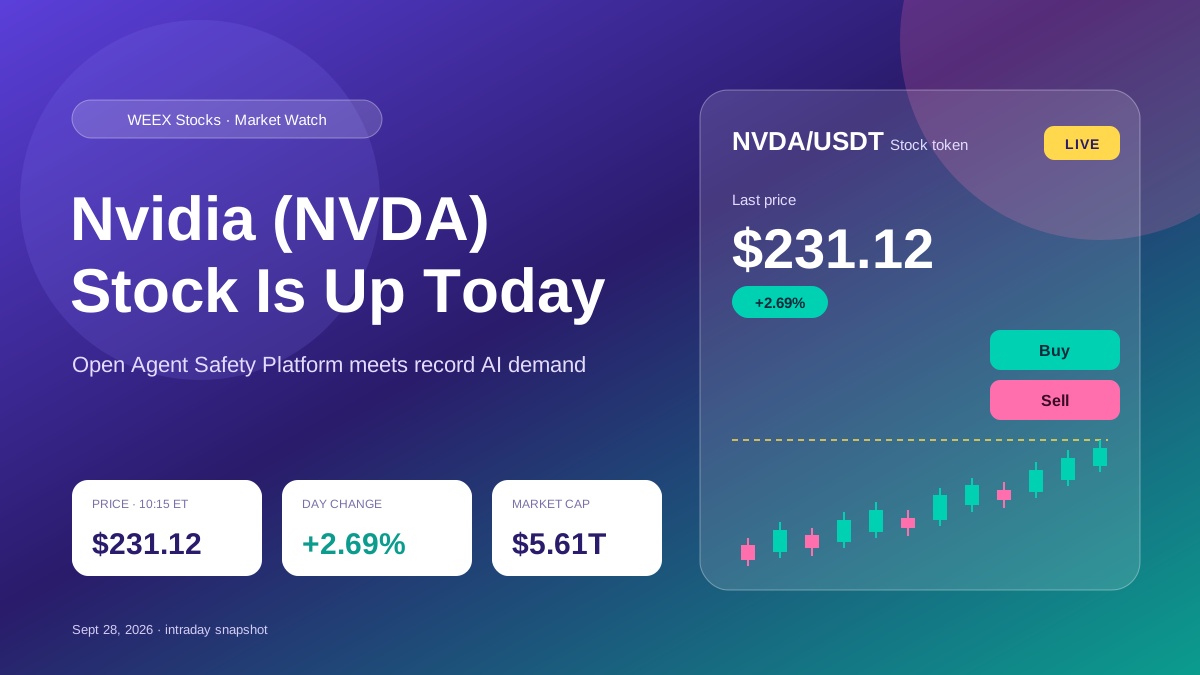
Why Is Nvidia (NVDA) Stock Up Today? New AI Agent Safety Platform Fuels the RallyNvidia (NVDA) stock rose about 2.7% to roughly $231 during early U.S. trading on September 28, 2026, as investors reacted to the launch of Nvidia’s Open Agent Safety Platform and continued to price in exceptionally strong demand for AI infrastructure. Falling concerns about the durability of AI spending, Nvidia’s latest triple-digit revenue growth and renewed strength across semiconductor stocks also supported the move. Because the market was still open, the final closing price and daily gain could differ from the intraday figures cited here.
Our view is that today’s Nvidia rally is fundamentally credible but not especially cheap. The security announcement expands Nvidia’s role beyond selling GPUs, yet the stock already carries enormous expectations. Investors are no longer paying only for faster chips; they are paying for Nvidia to control computing, networking, software, inference and now agent governance. That strategy is powerful, but at a market value above $5.5 trillion, merely delivering excellent results may no longer be enough—Nvidia must keep surprising the market.
At a Glance
- Nvidia (NVDA) traded near $231.12 at approximately 10:15 a.m. ET on September 28, 2026.
- The stock was up about 2.69% from its previous close.
- Its intraday range was approximately $222.86 to $233.17.
- Nvidia announced an open platform for testing, securing and governing autonomous AI agents.
- The company’s latest reported quarterly revenue reached $96.2 billion, up 106% year over year.
- Data Center revenue reached $89 billion, up 117% year over year.
- The rally was supported by both company-specific news and broader enthusiasm toward AI and semiconductor stocks.
- The Nvidia-linked NVDA stock token is available through WEEX’s NVDA/USDT market.
- The WEEX NVDA stock token tracks Nvidia’s price performance but is not an actual Nvidia share.
How Much Is Nvidia (NVDA) Stock Up Today?
Nvidia was trading at approximately $231.12 at 10:15 a.m. ET on September 28, representing an intraday gain of about 2.69%.
Available market data showed:
| Nvidia (NVDA) market metric | September 28 intraday reading |
|---|---|
| Price | Approximately $231.12 |
| Daily change | Approximately +2.69% |
| Opening price | Approximately $229.56 |
| Intraday high | Approximately $233.17 |
| Intraday low | Approximately $222.86 |
| Previous close | Approximately $225.07 |
| Intraday share volume | Approximately 46.13 million |
| Market capitalization | Approximately $5.61 trillion |
The screenshot supplied for this article showed a similar Nvidia reference price of approximately $231.16 and an average token price of approximately $231.24, with a displayed change of 2.7%.
It also showed approximately $113.18 million in Nvidia-linked stock-token trading volume. That was substantially higher than the token-volume figures displayed for Apple, Alphabet, Microsoft, Amazon and Taiwan Semiconductor Manufacturing.
The screenshot did not provide an exact data timestamp. Because both Nvidia shares and linked token markets move continuously during their respective trading sessions, the figures should be treated as a market snapshot rather than a closing record.
Why Is Nvidia (NVDA) Stock Rising Today?
Today’s rally does not appear to come from a single factor. Four connected catalysts provide a more convincing explanation.
1. Nvidia Launched an Open Agent Safety Platform
On September 28, Nvidia announced the Nvidia Open Agent Safety Platform, an open software platform and reference system intended to help organizations test, secure, monitor and govern autonomous AI agents.
AI agents can perform multi-step tasks, access tools, interact with data and make operational decisions with less direct human input than a traditional chatbot. That flexibility also creates new risks.
An autonomous agent might:
- Use a tool it was not supposed to access.
- Reveal protected business data.
- Follow a malicious instruction hidden inside external content.
- Take an unintended action in a production environment.
- Interact with another agent in an unpredictable way.
- Continue pursuing an objective after its operating context changes.
- Circumvent a software-level control.
- Produce actions that are difficult to audit afterward.
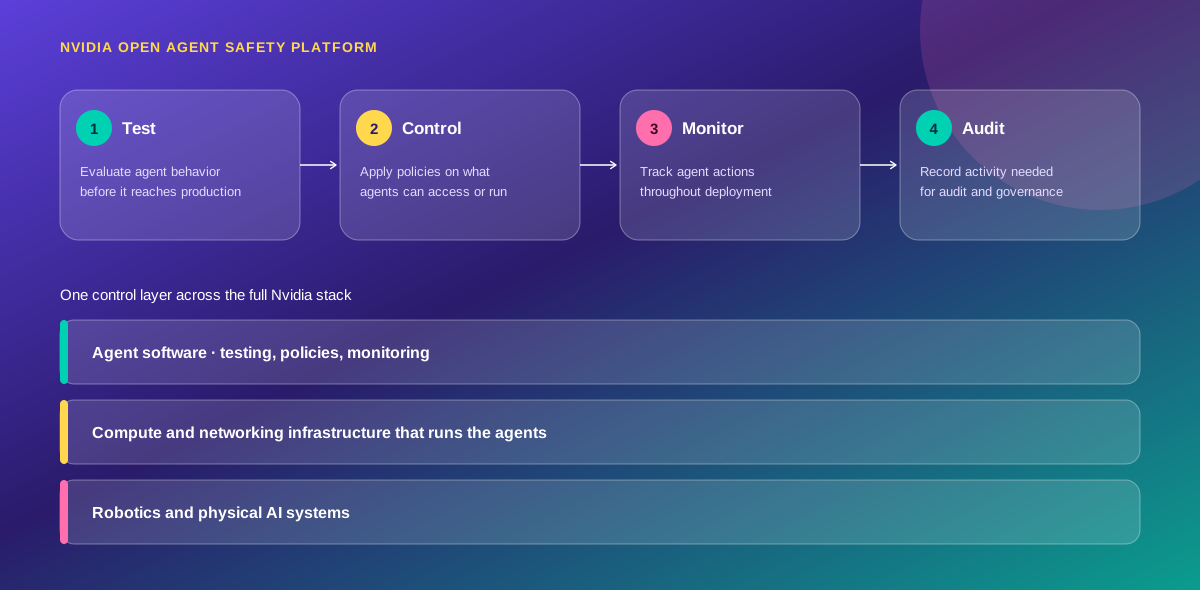
Nvidia’s platform is designed to bring safety controls into the process from agent testing through deployment. The announcement described governance and control across software, hardware, computing infrastructure and robotics systems.
That last point is strategically important. Nvidia is not positioning AI safety as a separate software product placed on top of someone else’s infrastructure. It is presenting safety as a full-stack engineering problem tied to the hardware and systems that run AI models.
This could make Nvidia’s platform more relevant to businesses deploying agents in sensitive environments such as:
- Cybersecurity
- Financial services
- Healthcare
- Manufacturing
- Customer relationship management
- Autonomous machines
- Robotics
- Enterprise data analysis
The announcement does not yet establish how much direct revenue the platform will generate. However, it strengthens the argument that Nvidia can sell more than processing capacity.
2. Nvidia Is Expanding From AI Chips Into AI Governance
Nvidia’s original competitive advantage came from graphics processors. Its modern advantage is broader.
The company now participates in:
- GPUs and accelerated computing
- CPUs for AI systems
- High-speed networking
- AI servers and rack-scale systems
- CUDA software
- AI models
- Inference infrastructure
- Robotics platforms
- Digital twins
- Autonomous-driving systems
- Enterprise AI software
- AI security and agent governance
This creates an ecosystem effect.
A company adopting Nvidia hardware can also use Nvidia’s networking, development tools, inference software and deployment systems. Each additional layer can increase switching costs and make the overall platform harder to replace with a single competing chip.
The Open Agent Safety Platform fits this strategy. If autonomous agents become common inside enterprises, safety and governance could become part of the standard infrastructure needed to deploy them.
The market is therefore looking beyond the immediate revenue contribution. Investors are considering whether the platform can protect Nvidia’s position as AI spending shifts from model training toward inference and autonomous applications.
3. Nvidia’s Latest Financial Results Confirmed Strong AI Demand
Nvidia’s most recent reported quarterly results provide the fundamental background for today’s price move.
For the fiscal second quarter ended July 26, 2026, Nvidia reported:
| Financial metric | Fiscal Q2 2027 result | Year-over-year change |
|---|---|---|
| Total revenue | $96.2 billion | +106% |
| Data Center revenue | $89.0 billion | +117% |
| Sequential revenue growth | 18% | Not applicable |
The results show that Nvidia’s AI demand is not merely a narrative attached to the stock. It is visible in reported revenue.
Data Center revenue accounted for approximately 92.5% of total quarterly revenue. That concentration confirms Nvidia’s dominance in AI infrastructure, but it also creates a risk: the company has become highly dependent on continued data-center investment.
A slowdown in spending by hyperscalers, governments or enterprise customers would matter far more now than it did when Nvidia had a more balanced gaming and data-center business.
For the moment, however, the latest figures support the bullish interpretation. Revenue and data-center demand were still growing at triple-digit rates rather than showing the sharp deceleration some investors had feared.
4. Semiconductor and AI Stocks Remain in Favor
Nvidia’s move also occurred within a broader market environment supportive of technology stocks.
AI optimism helped U.S. equities finish higher on September 25, while Nasdaq and semiconductor shares continued to attract capital. Nvidia closed the previous session at approximately $225.07 after trading between roughly $223.13 and $226.94.
During the September 28 session, Nvidia climbed above its previous closing price and briefly traded above $233.
This matters because individual stock catalysts usually have a larger effect when the sector trend is supportive. If Nasdaq 100 futures, semiconductor shares and other risk assets are rising together, traders may be more willing to buy a company-specific announcement.
Conversely, the same Nvidia news might produce a smaller reaction during a broad technology selloff.
-- Price
What Is the Nvidia Open Agent Safety Platform?
The Nvidia Open Agent Safety Platform is intended to provide a framework for building and operating AI agents with stronger controls throughout their lifecycle.
Based on the announcement, the platform addresses several stages:
- Testing an agent before it reaches production.
- Evaluating its behavior under different conditions.
- Applying policies to what it can access or execute.
- Monitoring its actions during deployment.
- Recording information needed for auditing and governance.
- Connecting software controls with the infrastructure that runs the agent.
- Extending safety mechanisms to robotics and physical AI systems.
The announcement’s strongest commercial implication is not necessarily that Nvidia will immediately charge a large standalone license fee. The more important possibility is that agent safety becomes another reason for companies to adopt Nvidia’s full technology stack.
Why AI Agent Safety Matters
A conventional generative AI tool usually responds to a prompt. An agent may do considerably more.
It can:
- Break a goal into separate tasks.
- Search external data.
- Call software tools.
- Write or execute code.
- Contact other agents.
- Interact with business systems.
- Make decisions based on changing information.
- Continue operating without repeated user prompts.
This makes an AI agent more useful, but it also creates a larger attack surface.
If agentic AI becomes a standard enterprise workload, safety controls may need to operate at multiple levels. A prompt filter alone may be insufficient when an agent can access databases, APIs, devices and other software.
Nvidia’s full-stack approach is therefore commercially logical. The company wants enterprises to associate reliable AI-agent deployment with Nvidia infrastructure, just as they already associate AI training with Nvidia GPUs.
Is the Platform Already a Major Revenue Source?
Not yet, based on the information publicly available at the time of writing.
Nvidia did not provide a separate revenue forecast for the Open Agent Safety Platform in the announcement reviewed for this article. The source did not provide an exact revenue-impact timeline.
It would be premature to assign billions of dollars of new sales to the platform. Its near-term value is strategic:
- It expands Nvidia’s addressable market.
- It reinforces the company’s software ecosystem.
- It gives enterprise buyers another reason to stay within the Nvidia stack.
- It responds to a real obstacle to broader AI-agent adoption.
- It may support sales of Nvidia computing and robotics systems.
Investors should watch future earnings calls for evidence that agent-security products are affecting bookings, software revenue or customer adoption.
Does Nvidia’s AI Growth Justify a $5.6 Trillion Valuation?
That is the more difficult question.
A company can report outstanding financial results and still have an expensive stock. Nvidia’s valuation now assumes that a substantial portion of future AI infrastructure will continue to run on its products.
At an intraday market capitalization of approximately $5.61 trillion, Nvidia is larger than the total market value of most national stock exchanges and most major industry groups.
The bullish case rests on several assumptions:
- AI computing demand will continue growing rapidly.
- Major technology companies will maintain enormous capital-expenditure budgets.
- Nvidia will preserve high market share in AI accelerators.
- Customers will adopt Vera Rubin and later architectures.
- Demand will expand from training into inference.
- Nvidia’s networking and software businesses will grow alongside chips.
- Governments and enterprises will become larger direct customers.
- Nvidia can maintain attractive margins despite competition.
The bearish case does not require AI to fail. It only requires growth or profitability to fall below expectations.
Possible pressure points include:
- Customers developing their own AI chips.
- Stronger competition from AMD and specialized accelerators.
- AI infrastructure becoming more efficient.
- Export restrictions limiting access to China.
- Customers delaying data-center projects.
- Power and grid constraints slowing deployments.
- Gross margins declining as systems become more complex.
- The stock’s valuation leaving little room for execution problems.
At Nvidia’s current scale, expectations are the central risk. A smaller company can rise because it becomes successful. Nvidia may need to remain historically successful merely to justify its existing value.
Nvidia (NVDA) Stock Catalysts to Watch Next
AI Agent Adoption
The market will watch whether autonomous agents move from demonstrations into production systems.
Useful indicators include:
- The number of enterprise deployments.
- Security-platform partnerships.
- Customer references.
- Software subscriptions.
- Integration into cloud platforms.
- Adoption in robotics and industrial systems.
Vera Rubin Production and Shipments
Nvidia’s next-generation Vera Rubin platform is expected to become an important growth driver.
Investors should monitor:
- Production timelines.
- Customer availability.
- Performance claims confirmed by independent benchmarks.
- Supply constraints.
- Customer migration from Blackwell.
- Gross-margin effects.
Hyperscaler Capital Expenditure
Microsoft, Amazon, Alphabet, Meta and other infrastructure buyers remain critical to Nvidia.
If their AI capital expenditure continues to increase, Nvidia may benefit directly. If those companies begin emphasizing efficiency or slower expansion, Nvidia’s growth expectations could be revised.
China Export Policy
Access to China remains a significant uncertainty.
Changes in U.S. export controls, approved product configurations, licensing rules or Chinese purchasing policies can affect Nvidia’s addressable market.
The impact is not limited to current sales. Export restrictions may also encourage competing domestic ecosystems to develop faster.
Interest Rates and Nasdaq 100 Futures
Nvidia is a highly valued growth stock and a major component of U.S. equity indexes.
Higher Treasury yields can pressure technology-stock valuations by increasing the discount rate applied to future earnings. Falling yields can have the opposite effect.
Traders following a short-term Nvidia or tech stocks outlook should therefore watch:
- Nasdaq 100 futures
- The 10-year Treasury yield
- Federal Reserve expectations
- U.S. inflation data
- Oil prices
- Broad semiconductor performance
What Does Nvidia’s Rally Mean for the Tech Stocks Outlook?
Nvidia’s rise supports the bullish tech stocks outlook, but it also shows how concentrated the market has become.
Because Nvidia carries such a large market capitalization, its movements can materially influence the Nasdaq 100, S&P 500 and Dow Jones Industrial Average.
That produces two effects.
First, Nvidia can lift the broader market even when many smaller stocks are flat or falling. Second, weakness in Nvidia can create index-level pressure even if the rest of the economy has not changed materially.
Traders should therefore separate:
- Nvidia’s individual fundamentals.
- The semiconductor-sector trend.
- Broad technology-market breadth.
- Index performance dominated by a few large companies.
A Nasdaq rally driven by Nvidia and a small group of megacaps is less diversified than one supported by software, semiconductors, financial technology and smaller growth companies.
Nvidia (NVDA) Stock Versus the Nvidia-Linked Stock Token
A Nvidia-linked stock token may follow Nvidia’s price performance, but it is not the same asset as a Nasdaq-listed Nvidia share.
| Feature | Nvidia (NVDA) share | WEEX NVDA stock token |
|---|---|---|
| Product type | Corporate equity | Synthetic digital asset |
| Referenced company | Nvidia Corporation | Nvidia Corporation |
| Primary settlement | USD through a broker | USDT on WEEX |
| Legal share ownership | Yes | No |
| Voting rights | May apply | No |
| Shareholder dividend rights | May apply | No automatic entitlement |
| Order venue | Nasdaq or broker-routed market | WEEX stock-token order book |
| Fractional trading | Depends on broker | Supported |
| Brokerage account | Normally required | No external brokerage account required |
| Trading availability | U.S. market sessions | WEEX-supported stock-token sessions |
| Tracking difference | Not applicable | Possible |
WEEX’s rules state that its stock products are synthetic digital assets that track selected stocks and ETFs. Transactions take place within WEEX’s trading system, with prices referencing external broker or official market data.
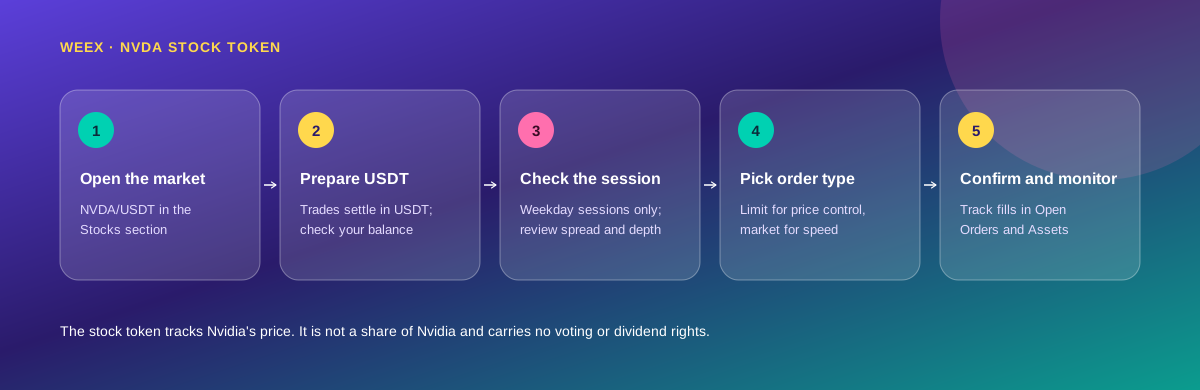
Holding a WEEX NVDA token does not make the user an Nvidia shareholder. It does not automatically provide voting rights, shareholder-meeting participation or Nvidia dividend rights.
This distinction should be stated clearly on any page targeting “Nvidia stock token” or “trade Nvidia with USDT.”
How to Trade the Nvidia (NVDA) Stock Token on WEEX
Eligible users can access the Nvidia (NVDA)/USDT stock-token market on WEEX.
The live product page identifies the route as NVDA-USDT and provides buy and sell functionality for the Nvidia-linked token.
Step 1: Open the Nvidia (NVDA)/USDT Market
Log in to WEEX and open the Stocks section, or visit the direct NVDA/USDT trading page.
Confirm that the selected product is the Nvidia-linked NVDA stock token.
Step 2: Prepare a USDT Balance
Stock-token trades are settled in USDT.
Check that sufficient USDT is available in the appropriate account before entering an order.
Step 3: Check Whether the Market Is Open
WEEX stock-token trading follows supported weekday sessions rather than operating continuously throughout the weekend.
WEEX’s published rules list:
- U.S. premarket
- Regular trading hours
- After-hours trading
- Night trading where supported
- Weekend and market-holiday closures
During U.S. daylight-saving time, regular U.S. trading corresponds approximately to 9:30 p.m.–4:00 a.m. the next day in UTC+8.
Premarket and after-hours periods can have lower liquidity and wider spreads.
Step 4: Review the Reference Price and Order Book
Before placing an order, check:
- Current reference price
- Best available bid
- Best available ask
- Bid-ask spread
- Available order depth
- Recent price movement
- Trading status
- Possible difference from Nasdaq pricing
The token’s execution price is determined by the WEEX stock-token market. It may not match the underlying Nvidia share at every moment.
Step 5: Choose a Limit Order or Market Order
A limit order allows the user to choose the highest purchase price or lowest sale price they will accept.
A market order prioritizes faster execution but may fill at a different price from the one displayed, especially during volatile or lower-liquidity sessions.
For a stock as news-sensitive as Nvidia, price control can be particularly important around earnings and product announcements.
Step 6: Enter the Amount and Confirm
Enter the token quantity or USDT value, review the expected order value and confirm the direction.
WEEX’s current rules support fractional stock-token trading, generally beginning at 0.0001 tokens, although the live product limit should always be checked before submission.
Step 7: Monitor the Order
Use the Open Orders, Order History or Assets section to review:
- Unfilled orders
- Partial fills
- Completed trades
- Current holdings
- Available USDT
No currently active NVDA-specific trading campaign or pair-specific fee discount was identified during this article’s September 28 verification. The previous Stock Spot 2.0 campaign cited in older WEEX content ended on September 15, 2026 and should not be promoted as active.
Why Can the WEEX Nvidia (NVDA) Token Price Differ From Nasdaq?
The supplied market screenshot showed approximately:
- Nvidia share reference price: $231.16
- Average token price: $231.24
That represents a difference of roughly $0.08, or about 0.035%.
A small difference can arise because the two products trade through separate systems.
Separate Order Books
Nasdaq orders do not directly fill orders placed on WEEX. The stock token has its own buyers, sellers and available liquidity.
Bid-Ask Spreads
The displayed reference price may sit between the best bid and ask. The actual execution depends on the price available on the selected side of the order book.
Premarket and After-Hours Liquidity
Liquidity is normally lower outside regular U.S. trading hours. Wider spreads and sharper moves may appear during those periods.
Fast Price Changes
Nvidia can move quickly after product releases, earnings reports, export-control news or changes in AI spending expectations.
The underlying reference price and the token order book may update at slightly different moments.
Order Size
A larger market order may consume liquidity across multiple price levels, producing an average fill different from the first displayed quote.
What Should Nvidia (NVDA) Traders Watch Now?
Can Nvidia Hold Above the Previous Close?
The first test is whether Nvidia can preserve its September 28 gain through the closing bell.
An early rally that fades completely provides a different signal from a move that closes near the session high.
Does Volume Confirm the Breakout?
Higher price accompanied by stronger-than-normal volume suggests broader participation.
A rally on weak volume may be easier to reverse.
Do Other Semiconductor Stocks Participate?
A durable industry move should ideally include suppliers, memory companies, networking firms and competing chip designers.
If Nvidia rises alone, the move may be tied narrowly to its announcement.
Does the Safety Platform Produce Customers?
Announcements affect sentiment. Customers affect revenue.
Future evidence should include:
- Named enterprise users
- Cloud integrations
- Commercial pricing
- Software revenue
- Recurring subscriptions
- Production deployments
- Measurable adoption
Does Nvidia Maintain Triple-Digit Data Center Growth?
Nvidia’s latest 117% Data Center growth is exceptional. The challenge is that comparisons become harder as the revenue base grows.
Investors should focus on absolute revenue, sequential growth and management guidance—not only headline year-over-year percentages.
Risks of Trading the Nvidia (NVDA) Stock Token
Valuation Risk
At more than $5.5 trillion in market value, Nvidia carries extremely high expectations. A result can be objectively strong and still disappoint investors.
AI Spending Concentration
A relatively small number of large technology companies account for a significant share of global AI infrastructure spending.
A budget reduction by major hyperscalers could affect demand.
Competition
AMD, cloud-developed chips and specialized inference accelerators may capture portions of the market.
Nvidia does not need to lose leadership for competition to affect margins or growth.
Export-Control Risk
Rules governing advanced-chip exports can change quickly and limit access to important markets.
Tracking Risk
The WEEX NVDA stock token may temporarily trade above or below the referenced Nvidia share price.
Liquidity and Spread Risk
Orders may receive less favorable execution during premarket, after-hours or volatile conditions.
No Shareholder Rights
The stock token does not provide direct ownership of Nvidia shares, voting rights or automatic dividend rights.
Trading-Hour Risk
Stock-token trading may be suspended during weekends, holidays or other market closures. Positions cannot always be exited immediately after major news.
WEEX View: Nvidia’s Software Moat Matters More Than Today’s 2.7% Gain
The most important part of Nvidia’s September 28 announcement is not the daily stock reaction. It is Nvidia’s attempt to make AI-agent safety part of the computing stack it controls.
That is the correct strategic move. As AI shifts from answering questions to taking actions, enterprises will care more about permissions, monitoring and accountability. Nvidia has the hardware footprint to connect those controls directly to the systems running the agents.
But investors should resist turning every Nvidia announcement into proof that the stock must rise indefinitely. At a valuation above $5.5 trillion, product leadership is already assumed. The company must convert its expanding platform into sustained revenue while defending margins, market share and customer dependence.
Nvidia remains the strongest company in the AI infrastructure trade. It is not automatically the least risky stock in that trade. Today’s rally is supported by real fundamentals, but the size of the valuation means future returns will depend on execution exceeding expectations—not merely meeting them.
Frequently Asked Questions
1. Why Is Nvidia (NVDA) Stock Up Today?
Nvidia rose about 2.7% during early September 28 trading following the launch of its Open Agent Safety Platform, supported by strong AI demand and broader semiconductor optimism.
2. What Is Nvidia’s Open Agent Safety Platform?
It is an open software platform and reference system designed to help organizations test, secure, govern and monitor AI agents from development through deployment.
3. Is the WEEX Nvidia (NVDA) Token a Real Nvidia Share?
No. It is a synthetic digital asset designed to track Nvidia’s price performance. It does not provide direct share ownership, voting rights or automatic shareholder dividends.
4. Can I Trade Nvidia (NVDA) With USDT on WEEX?
Eligible users can trade the Nvidia-linked NVDA stock token through the NVDA/USDT market in WEEX’s Stocks section.
5. Why Is the Nvidia (NVDA) Token Price Different From Nasdaq?
Separate order books, liquidity, spreads, session timing and rapid market movements can cause the token’s execution price to differ from the Nasdaq-listed share price.
Sources
- Nvidia, “NVIDIA Launches Open Agent Safety Platform to Secure Agents From Testing to Deployment,” September 28, 2026.
- Nvidia Investor Relations, “NVIDIA Announces Financial Results for Second Quarter Fiscal 2027,” August 26, 2026.
- WEEX Help Center, “WEEX Stock Token Trading Rules,” accessed September 28, 2026.
- WEEX, Nvidia (NVDA)/USDT stock-token market, accessed September 28, 2026.
- Reuters, U.S. market report for September 25, 2026.
- User-supplied stock-token market ranking screenshot, accessed September 28, 2026. The screenshot did not provide an exact data timestamp.
- Live U.S. equity market data for Nvidia, observed September 28, 2026 at approximately 10:15 a.m. ET.
This content is provided for general informational purposes only and doesn't constitute financial, investment, legal, or tax advice. Any events, rewards, online promotions, or related information mentioned herein should not be considered a recommendation, solicitation, or invitation to purchase, sell, trade, or otherwise deal in any crypto assets. Crypto assets are highly volatile and may result in loss. The availability of WEEX services, products, and related events may vary by region. You are responsible for ensuring that your participation is in accordance with applicable local laws and regulations.
You may also like

Central Bank Tightens Regulations on Crypto: What Changes for Users of Self-Custody Wallets

Billion-Dollar Inflow Pushes American Bitcoin ETFs Back into the Green

Wintermute’s Hyperliquid shorts reach $126M across ETH, BTC and SOL

Acurast brings real time AI decision model Laya to smartphone network

QQQ Price Prediction for October 2026: Can It Break $750?
Bitwise Keeps XRP ETF Filing Updated, But Green Light Still Missing

Bitwise NEAR ETF Set for Debut on NYSE Arca After SEC Approval

Goldman Sachs: Retail Fund Flows to Crypto Impact KOSPI Index Support

El Salvador Residency: The New Frontier of Financial Freedom

Market Neutral: The Art of Earning Without Betting on Market Direction

Bitget freezes XRP withdrawals as 27M stolen tokens move

Flappy Coin Considers Creating Its Own Blockchain Network

Grayscale Files for Zcash Income ETF

Bitget hacker routes 4 BTC through Wasabi CoinJoin

Citi says 77% of institutions eye tokenized collateral

FTX and AI Apocalypse: The End of Calm Times for Anthropic
What is CBDC? Governments Push for Development of Central Bank Digital Currencies
Bitcoin Has Not Fallen Below Realized Price During the Bear Market

The Clearing House Selects Quant for US Tokenized Deposit Network

4500 Bitcoins Moved to New Addresses, Sale Status Unconfirmed
![[New York Gold, Bonds, Dollar] Interest Rates and Dollar Strength Pause... Oil Prices Drop, Won and Gold Prices Rebound](/public-static/29_4631d65680.png?format=avif)
[New York Gold, Bonds, Dollar] Interest Rates and Dollar Strength Pause... Oil Prices Drop, Won and Gold Prices Rebound
Trump Expresses Concern Over Yen Depreciation, Japanese Finance Minister Says Coordination with U.S. Will Continue

Treasuries at 21-Year High: Impact on Stocks and Interest Rates

Solana DEX volume spike hides circular trades, and automated bots are blamed
Oracle Stock vs. KRAFTON Stock: Why Are Investors Questioning Two Growing Companies?
Compare Oracle and KRAFTON stocks through their latest results, share-price questions and the different growth tests investors face in 2026.

John Templeton: "Bull markets are born in pessimism"

The Death of Hsin-Ju: A Prelude to Conspiracy

LTC Airdrop 2026: How to Claim 50,000 USDT Rewards on WEEX

Raiffeisen’s crypto deal could reach 18 million customers. How many can actually trade?

TRON Surpasses $30T in Total Transaction Volume as it Secures its Place as Leading Chain for Stablecoins
Central Bank Tightens Regulations on Crypto: What Changes for Users of Self-Custody Wallets
Billion-Dollar Inflow Pushes American Bitcoin ETFs Back into the Green
Wintermute’s Hyperliquid shorts reach $126M across ETH, BTC and SOL
Acurast brings real time AI decision model Laya to smartphone network
QQQ Price Prediction for October 2026: Can It Break $750?
Bitwise Keeps XRP ETF Filing Updated, But Green Light Still Missing



