
Will Bitcoin (BTC) Go Back Up in 2026? How to Tell a Real Recovery From a Short-Covering Bounce

 Prefer us on Google



Bitcoin (BTC) can go back up after a sell-off, but no chart, analyst target, or social-media prediction can confirm the timing in advance. A durable Bitcoin recovery normally needs sustained spot demand, improving or stable macro liquidity, healthy spot Bitcoin ETF flows, and futures positioning that is not becoming dangerously crowded. If Bitcoin is rising mainly because short sellers are forced to buy back, the move may be powerful but can fade once that forced demand is exhausted.
The uncomfortable truth is that “Will Bitcoin go back up?” is often treated as a request for certainty when it should be treated as a request for evidence. A neat six-figure forecast is emotionally satisfying and editorially weak. The more useful question is whether the market is building a recovery that can survive a pullback, a difficult inflation print, a rise in yields, or the return of leveraged speculation. If it cannot, the rally is not necessarily false—but it is not yet proven.
Quick Answer
Bitcoin (BTC) tends to recover when four forces begin pointing in the same direction: buyers return to spot markets, ETF demand improves or stabilizes, macro conditions stop tightening, and derivatives traders do not rebuild excessive leverage immediately.
The quality of the recovery matters more than the speed. A fast move caused by short liquidations can push Bitcoin sharply higher in hours. A spot-led recovery often looks slower and less dramatic, but it is usually more resilient because actual buyers—not forced derivatives activity—are absorbing supply.
Why Is Bitcoin (BTC) Going Up?
Bitcoin does not rise for one universal reason. It rises when incremental demand exceeds the supply offered at current prices, but the source of that demand can change from day to day.
Sometimes the trigger is macroeconomic. When inflation data comes in cooler than expected, investors may expect less pressure from higher interest rates or tighter financial conditions. Bitcoin often responds to this shift because it is widely treated as a high-volatility, liquidity-sensitive risk asset. Barron’s reported that Bitcoin rose after cooler-than-expected U.S. inflation data on September 30, 2026, demonstrating how quickly changes in macro expectations can alter crypto market pricing.
Sometimes the trigger is institutional demand. Spot Bitcoin ETF inflows can create visible demand because they offer investors a regulated route to gain Bitcoin exposure through traditional brokerage accounts. Inflows do not guarantee a rally, but they can make an existing recovery more credible when they persist.
Sometimes the trigger is derivatives. If Bitcoin rises while many traders are positioned short, those traders may be forced to close positions by buying Bitcoin back. This short-covering process can create a fast upward move. It is real market demand in the moment, but it is not the same as a broad decision by investors to allocate fresh capital to Bitcoin.
And sometimes the market simply reprices risk. Improved regulatory expectations, a weaker dollar, changes in bond-market expectations, or an improvement in global risk appetite can all support Bitcoin. Reuters noted in late September that Bitcoin had risen alongside broader market moves during a period shaped by AI, bonds and commodity volatility.
The first analytical task is therefore to identify the buyer. The second is to ask whether that buyer is likely to remain active after the initial move.
Is Bitcoin (BTC) Going to Go Back Up, or Is This Just a Bounce?
A bounce is a price rise. A recovery is a process.
Bitcoin can bounce because an oversold market attracts dip buyers, because a large short position is unwound, or because a single positive macro headline improves sentiment for a day. None of those conditions is meaningless. But none, on its own, proves that Bitcoin has completed a bottoming process.
A more durable recovery should show persistence. Price should hold part of its advance when the first burst of enthusiasm cools. Spot demand should remain visible after short sellers have covered. Futures positioning should not immediately become more leveraged than it was before the rally. Macro conditions should remain supportive enough that investors do not rush back out of risk assets at the first setback.
Coinbase Research described the 2026 market backdrop as a transition from a corrective phase toward accumulation, while still favoring a patient, defined-risk approach because liquidity and macro conditions could remain restrictive. That is a far better framework than declaring a new bull market after one strong daily candle.
The Difference Between a Bounce and a Recovery
| Market Feature | Short-Term Bounce | Higher-Quality Recovery |
|---|---|---|
| Main buyer | Short covering, tactical dip buyers, momentum traders | Spot buyers, ETF demand, broader investor allocation |
| Price behavior | Fast, often volatile, vulnerable to reversal | Holds gains through retests and pullbacks |
| Futures positioning | Open interest can rebuild too quickly | Leverage remains more balanced |
| Funding | Can turn positive rapidly as traders chase | Stays relatively controlled while price improves |
| Macro backdrop | One favorable headline | A broader improvement in liquidity or risk appetite |
| Market psychology | Relief and FOMO | Gradual rebuilding of confidence |
The table is not a prediction model. Markets rarely present perfect evidence. Its value is that it forces an investor or trader to stop treating all green candles as identical.
-- Price
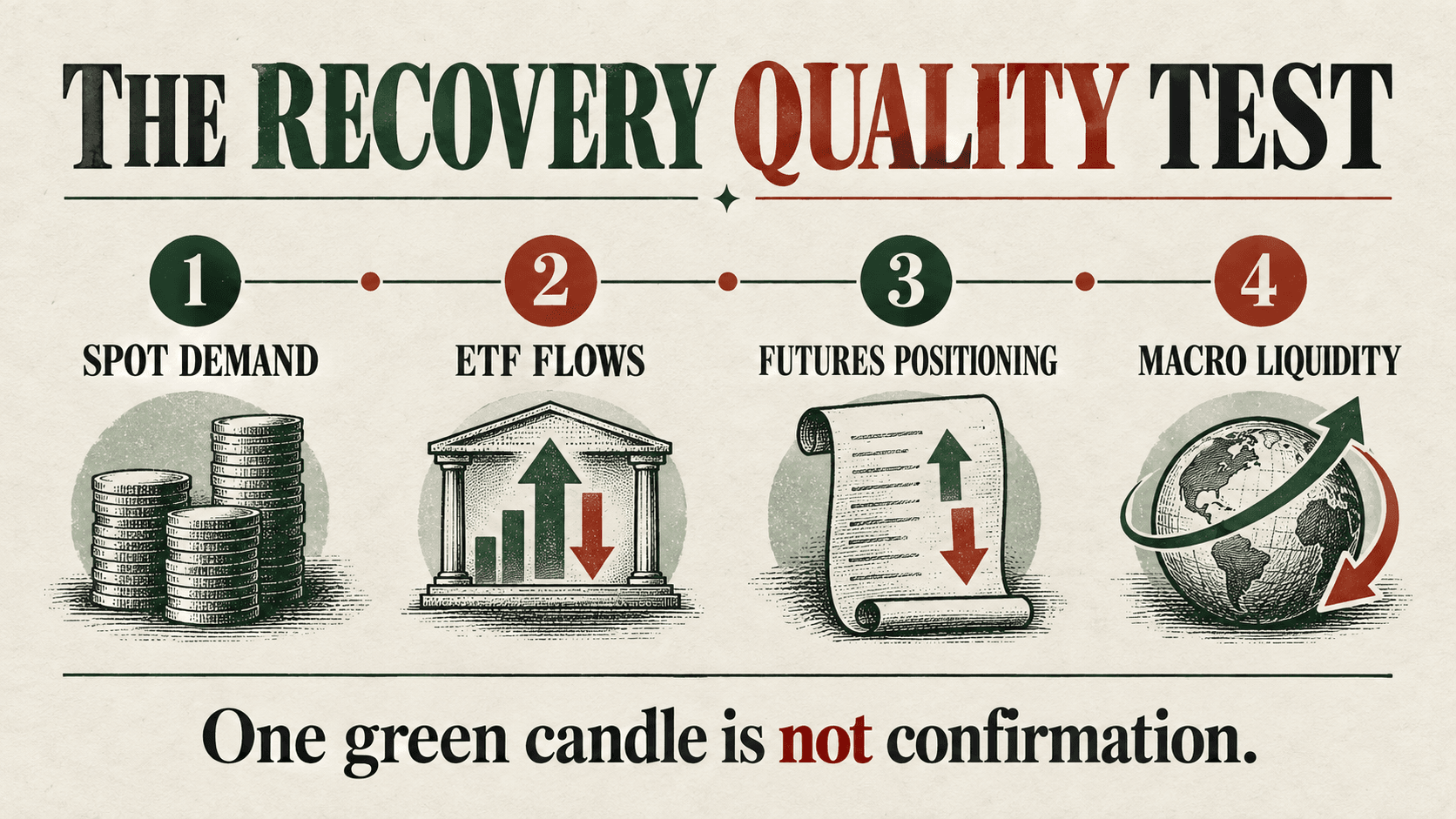
The First Test: Is There Real Spot Demand?
Spot demand is the foundation of a stronger Bitcoin recovery because it represents actual buying without the same forced liquidation dynamics found in perpetual futures.
When large investors allocate through spot Bitcoin ETFs, their purchases can add a visible source of demand. When retail buyers, companies or long-term holders also accumulate, the recovery may become broader. But the direction of ETF flows should be read as a trend, not a daily headline.
One positive ETF-flow day can happen during a weak market. One negative day can happen during a broader recovery. What matters is whether buyers consistently absorb available supply over time.
Binance Research reported on September 28, 2026 that ETF demand and improving trend signals were supporting Bitcoin’s rebound, while also warning that higher rate expectations could interrupt it. That caveat is essential. ETF flows matter, but they do not exist in isolation from the macro environment.
For a practical Bitcoin weekly outlook, readers should ask:
- Are ETF flows improving over several reporting periods rather than for one session?
- Is Bitcoin holding gains after the initial flow-related move?
- Are spot buyers still active when derivatives activity cools?
- Is the rally broadening beyond a single news catalyst?
A “yes” to one question is encouraging. A “yes” to all four is stronger evidence.
The Second Test: Is Global Liquidity Helping or Hurting Bitcoin?
Bitcoin is often marketed as separate from the traditional financial system. In practice, it frequently trades as a liquidity-sensitive asset.
When yields rise sharply, the U.S. dollar strengthens, or investors become more cautious about risk, Bitcoin can struggle even if its long-term narrative remains intact. When inflation pressure eases, expected policy becomes less restrictive, or global liquidity improves, Bitcoin can benefit as investors become more willing to own volatile assets.
Fidelity Digital Assets has argued that growth in global liquidity can become a positive Bitcoin catalyst, while also making clear that historical relationships do not guarantee future price performance. This is exactly the correct level of confidence: macro liquidity is a meaningful condition, not a price oracle.
The macro transmission process is usually indirect:
| Macro Change | Possible Market Effect | Why Bitcoin (BTC) May React |
|---|---|---|
| Lower inflation pressure | Fewer fears of tighter policy | Risk appetite can improve |
| Falling or stabilizing yields | Lower discount-rate pressure | High-volatility assets may become more attractive |
| Weaker U.S. dollar | Easier global financial conditions | Dollar-priced risk assets can gain support |
| Improved equity sentiment | Broader willingness to own risk | Bitcoin often trades with risk-sensitive assets |
| Rising geopolitical or commodity stress | Higher uncertainty and inflation risk | The reaction can be mixed and unstable |
This is why a serious BTC forecast should not ignore the macro calendar. A Bitcoin rally can be technically convincing on Monday and challenged by inflation, employment, policy or bond-market developments later in the week.
The Third Test: Is Futures Positioning Supporting the Rally or Weakening It?
Crypto OI, or open interest, measures the amount of outstanding derivatives exposure that has not been closed or settled. It is one of the most useful metrics for understanding whether Bitcoin’s price move is supported by balanced participation or distorted by leverage.
Open interest rising is not automatically bearish. It can simply mean more traders are entering the market. The problem emerges when price rises, OI expands rapidly, funding becomes strongly positive, and traders begin treating a short-term move as a guaranteed continuation.
That pattern can create a fragile rally. It gives Bitcoin more fuel on the way up, but it also creates a larger group of leveraged positions that may need to be closed if price reverses.
A more constructive recovery often has a less glamorous profile. Bitcoin rises, but funding remains relatively controlled. Spot demand carries more of the move. Pullbacks do not immediately trigger a large liquidation cascade. The market advances without forcing everyone to borrow conviction.
This distinction matters because many traders mistake leverage for confidence. It is not confidence. It is borrowed exposure.
Why Positive Funding Is Not Automatically Bullish
Positive funding generally means long-position holders in perpetual futures are paying short-position holders. It can indicate bullish positioning, but it can also show that traders are becoming too one-sided.
The key question is whether the market can continue rising without making leverage increasingly expensive or crowded.
A moderate positive funding environment during a spot-led rally may be normal. Extremely positive funding combined with rapidly rising crypto OI can signal that traders are chasing rather than investing. In that situation, even a modest pullback can force leveraged longs to reduce risk.
For this reason, the most useful futures-positioning question is not “Are traders bullish?” It is “How costly and fragile has bullishness become?”
The Fourth Test: Can Bitcoin (BTC) Hold Its Gains After the Headline Fades?
The market’s reaction to good news matters less than its behavior after that news has been absorbed.
If Bitcoin rallies on a favorable inflation report, an ETF inflow headline or regulatory optimism, then immediately loses the move when the next small macro concern appears, the market is still fragile. If Bitcoin holds a reclaimed level, attracts buyers on pullbacks and stops making lower lows, the recovery is gaining quality.
This is one of the clearest ways to separate market psychology from market structure.
A short-covering bounce can be spectacular because it forces traders to act in a narrow time window. A healthier recovery looks more ordinary. It may consolidate, retest support and move sideways before resuming higher. That is not a failure. In fact, it can be evidence that the market is building a base rather than relying on panic buying.
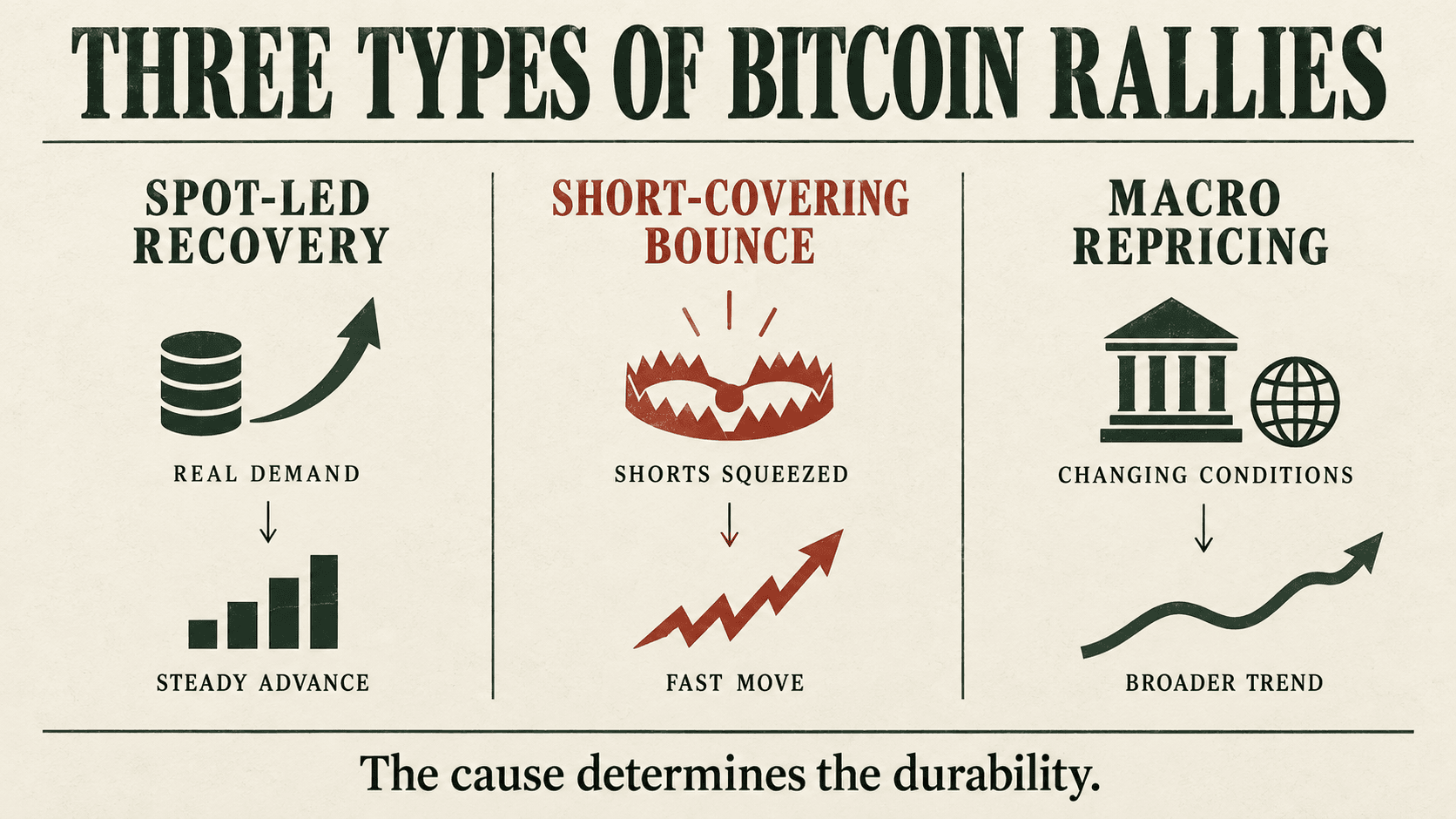
Three Bitcoin (BTC) Rally Types Traders Should Not Confuse
Spot-Led Recovery
A spot-led recovery is driven by buyers who are adding exposure without relying primarily on leverage. This can include ETF flows, direct institutional purchases, corporate treasury demand, retail accumulation or longer-term investor allocation.
This is generally the most durable type of recovery because it reduces available supply without requiring a derivatives squeeze. It can still fail if macro conditions deteriorate, but its foundation is stronger than a purely technical bounce.
Short-Covering Bounce
A short-covering bounce occurs when traders who have bet against Bitcoin need to buy it back as price rises. The move can be violent because each rising price level puts more pressure on remaining shorts.
Short squeezes can become the beginning of a real rally. But they need follow-through. If spot buyers do not replace the forced demand, price may stall once the short positions have been closed.
Macro Repricing Rally
A macro repricing rally occurs when markets collectively become more willing to own risk. It can be driven by lower inflation concerns, reduced expectations of policy tightening, changes in liquidity conditions or a broader improvement in equity-market sentiment.
This type of rally can support Bitcoin powerfully, but it is also sensitive to reversal. If yields rise again or the dollar strengthens sharply, the same macro channel can turn against Bitcoin.
A Practical Bitcoin (BTC) Recovery Checklist
The following framework is designed for judging recovery quality rather than predicting exact prices.
| Checkpoint | Stronger Signal | Warning Signal |
|---|---|---|
| Spot demand | Buyers return after pullbacks | Price rises only during derivatives bursts |
| ETF flows | Flows improve across multiple periods | One positive day followed by renewed outflows |
| Futures positioning | OI and funding remain controlled | Leverage rises much faster than price |
| Market structure | Higher lows and retained reclaimed levels | Every bounce fails below prior resistance |
| Macro liquidity | Risk appetite improves broadly | Yields, dollar strength or policy fears reaccelerate |
| Sentiment | Skepticism gradually shifts to participation | Sudden FOMO creates crowded longs |
The list should be used as a process, not a scorecard that must be perfectly green before anyone can act. Financial markets rarely offer complete confirmation at the lowest price. But waiting for multiple forms of evidence can help avoid confusing a brief relief rally with a sustained recovery.
The right approach depends on time horizon. A short-term trader may focus on liquidation risk, open interest and immediate market structure. A longer-term investor may care more about ETF flows, macro liquidity and whether demand is returning on a multi-week basis.
Will Bitcoin (BTC) Ever Go Back Up to Its Previous High?
Bitcoin has recovered from major drawdowns before, but previous recoveries do not establish a timetable for the next one.
A return to a prior high would likely require enough demand to overcome supply from holders who may sell into recovery. It would also require a macro backdrop that does not punish risk assets and a derivatives market that does not repeatedly destabilize itself through excessive leverage.
Some market commentary has pointed to a possible 2026 bottoming or accumulation process, while emphasizing that the conclusion remains unconfirmed. Other outlooks have argued that Bitcoin’s recovery still needs confirmation from market structure and broader financial conditions.
The important distinction is between possibility and evidence. Bitcoin can recover without being able to prove, today, the path it will take.
What Would Invalidate the Bullish Recovery Case?
A responsible bullish case should include conditions that would weaken it.
The recovery thesis becomes less convincing if ETF flows turn persistently negative, Bitcoin cannot hold reclaimed levels, macro conditions tighten sharply, or futures leverage expands while genuine spot demand fades. It also becomes weaker if each rally is followed by an immediate return to lower lows.
This does not mean a trader must become bearish at the first sign of weakness. It means a thesis should be testable.
The market is not obliged to follow the most popular forecast. A useful forecast identifies what evidence would prove it wrong.
Bitcoin (BTC) Perpetual Futures on WEEX: Check Live Market Status First
WEEX provides a Bitcoin (BTC)/USDT perpetual futures page. At the time of checking on October 5, 2026, the page displayed a circuit-breaker notice stating that positions were protected from liquidation, with order cancellation available but opening and closing positions disabled.
This is a time-sensitive market-status notice, not a permanent description of the contract. Users should check the live page and official announcements before attempting to trade.
When the market is available, traders should review the current funding rate, contract specifications, selected margin mode, order type and liquidation level before using leverage. A positive Bitcoin recovery thesis does not reduce the operational risks of perpetual futures. In fact, a rapidly improving market can encourage the exact kind of overleveraging that makes a later reversal more damaging.
WEEX Editorial View: Stop Treating Recovery as a Single Moment
The market loves a turning point because it is easy to narrate. “Bitcoin bottomed on this day” is a cleaner story than “Bitcoin gradually rebuilt demand while leverage normalized and macro pressure eased.” But the second story is usually closer to how durable recoveries actually develop.
Bitcoin does not need unanimous optimism to go back up. It needs enough persistent demand to absorb supply without constantly depending on forced buying from short sellers or borrowed conviction from increasingly leveraged longs.
The smart response to a rally is not to demand certainty. It is to watch whether the market can keep improving after the easy catalysts have already been priced in.
FAQ
1. Will Bitcoin (BTC) Go Back Up Soon?
Bitcoin (BTC) may go back up soon, but the timing cannot be verified in advance. A more credible near-term recovery needs sustained spot demand, controlled leverage, supportive ETF flows and a macro backdrop that does not remove liquidity from risk assets.
2. Why Is Bitcoin (BTC) Going Up Today?
Bitcoin may rise because of spot buying, ETF inflows, improved regulatory expectations, softer inflation data, short covering or broader risk-on sentiment. The reason matters because short-covering rallies can fade faster than spot-led recoveries.
3. Is Bitcoin (BTC) Going to Go Back Up After a Crash?
Bitcoin can recover after a crash, especially after leverage has been cleared. However, a lasting recovery should be confirmed by follow-through in spot demand, market structure, ETF flows and macro conditions rather than by the first rebound alone.
4. Do Spot Bitcoin ETF Inflows Guarantee a Bitcoin (BTC) Rally?
No. Spot Bitcoin ETF inflows can support demand, but they do not guarantee a rally. Bitcoin price can still be affected by macro liquidity, interest-rate expectations, large-holder selling and futures positioning.
5. What Are the Best Bitcoin (BTC) Catalysts to Watch?
Useful Bitcoin catalysts include sustained spot ETF inflows, easing inflation pressure, lower or stable yields, supportive regulation, improving crypto liquidity and an increase in spot demand that is not simply caused by leveraged short covering.
Sources
- Coinbase Research, “Charting Crypto (Q3 2026),” published August 2026.
- Binance Research, “Weekly: BTC Tests a Trend Reversal,” published September 28, 2026.
- Barron’s, “Bitcoin Rises on Cooler-Than-Expected Inflation Data,” published September 30, 2026.
- Reuters, “Global Stocks Weather Third-Quarter AI, Bond and Crude Maelstrom,” published September 30, 2026.
- Fidelity Digital Assets, “Bitcoin 2026: From Mispricing to Macro Recovery,” published January 2026.
- WEEX, “BTC/USDT Perpetual Futures,” accessed October 5, 2026.
Data Cutoff: October 5, 2026, 17:56 UTC+8.
This content is provided for general informational purposes only and doesn't constitute financial, investment, legal, or tax advice. Any events, rewards, online promotions, or related information mentioned herein should not be considered a recommendation, solicitation, or invitation to purchase, sell, trade, or otherwise deal in any crypto assets. Crypto assets are highly volatile and may result in loss. The availability of WEEX services, products, and related events may vary by region. You are responsible for ensuring that your participation is in accordance with applicable local laws and regulations.
You may also like

Bitcoin: Strategy Acquires Another 334 BTC, Raising Its Reserve to 848,000

SNDK Stock Fell 3.8% After a 650% Rally: Does a Single-Digit P/E Make Sandisk Cheap or Just Cyclical?

Oil Futures Hold Above $100 After Houthis Claim Aramco Attacks: What Is Confirmed and What Is Not

MSTR Stock Slips After Strategy Buys Just 334 Bitcoin: Why It Spent More on Preferred Shares Than on BTC

INTC Stock Drops After TSMC Terafab Talks: Is Intel's Biggest Outside Endorsement at Risk?

Who Will Aave Hand Its Brand Over To? The DAO Asset Ownership Dispute Behind the Foundation Proposal

Hyperliquid's Perpetual Futures Listed on Bloomberg Terminal, Increasing Institutional Investor Interest
NSE Stock Price Hits a New Low After IPO: Can National Stock Exchange Shares Recover?
National Stock Exchange of India shares traded near ₹1,741 on October 5, close to a post-listing low of about ₹1,735 and roughly 2.5% below the ₹1,785 IPO price. The stock has now spent more than a week under its issue price, and a recovery depends on retail demand, derivatives volumes and the broader Indian market.

Trump Creates Super Intelligence Force: What Changes in the AI Race

Home-jacking crypto: they threaten to kill a pregnant woman's baby in England

Bitcoin Exchange Withdrawal Rate Declines, Signaling Long-Term Holding

Bitcoin Miners Sign Their Best Month Since January

NFT: Porsche abandons its Web3 project around the 911

Former The Arena Advisor Accuses ROVE of Salary and Token Quota Arrears

Movement of Old Ethereum and Limited Exchange Reserves
Plunging GPU prices threaten AI hosts, and new hedges step in

Kalshi Hits the Brakes as Regulators Target User Incentives in Prediction Markets
Global Dollar: Is the Fed's Hegemony Breaking?
Economy: Christine Lagarde Calls for Regulation of AI Agents Already Paying in Stablecoins

XST Coin Surges Again: Can XSolut Price Recover to $0.01?
XST coin climbed toward $0.002038 on October 2, 2026, up roughly 77% over seven days. Reaching $0.01 would require a gain of about 391% from that level, and a separate September analysis flagging contract tracking concerns is worth understanding before treating any XST price chart as reliable.
Why Would a Public Blockchain Stop? Understanding Blockchain Consensus from Cosmos's 25-Hour Downtime

Fed’s Jefferson signals patience as October rate hike odds fall to 23%

New York and Wyoming Sign Agreement to Coordinate Cryptocurrency Company Regulation
The Quantum Issue: Quantum Isn't Coming For Your Bitcoin

PA Daily | Fed's Kashkari Expects One More Rate Hike This Year; OpenAI Plans to Raise $30 Billion, Valuation Reaches $1.4 Trillion

Why Did Google Stock Reverse After Gemini 4 Argon: What's Actually Going On

PTT Stock: A Pipeline Shutdown Hit the Same Day Profit Jumped 23%
OpenAI and Anthropic Targeted by the FTC: Investigation Launched into AI Safety

Crypto: Aave V4 Surpasses One Billion Dollars, Driven by Multisig

Bitcoin Cash: The History of Its Emergence, BCH Technology, Risks and Opportunities for Investors
Bitcoin: Strategy Acquires Another 334 BTC, Raising Its Reserve to 848,000
SNDK Stock Fell 3.8% After a 650% Rally: Does a Single-Digit P/E Make Sandisk Cheap or Just Cyclical?
Oil Futures Hold Above $100 After Houthis Claim Aramco Attacks: What Is Confirmed and What Is Not
MSTR Stock Slips After Strategy Buys Just 334 Bitcoin: Why It Spent More on Preferred Shares Than on BTC
INTC Stock Drops After TSMC Terafab Talks: Is Intel's Biggest Outside Endorsement at Risk?
Who Will Aave Hand Its Brand Over To? The DAO Asset Ownership Dispute Behind the Foundation Proposal
Contents
Latest articles


Latest coin listings on WEEX


