
Lumentum (LITE) Perpetual Futures: Why 25x Leverage Is the Limit

 Prefer us on Google


Lumentum perpetual futures on WEEX cap leverage at 25x, and that number is not a limitation to work around but the first piece of risk information the contract gives you. Lumentum (NASDAQ: LITE) closed at $919.40 on 16 September 2026, up 9.59% on the day from $838.96, after showing next-generation optical components at the European Conference on Optical Communications and drawing a fresh round of analyst targets averaging $1,121 (Yahoo Finance, TradingKey). A stock that moves almost 10% in one regular session, sits on a 52-week range of $144.52 to $1,085.68 and carries a beta of 1.54 does not need much leverage to produce crypto-sized returns or crypto-sized liquidations. This guide explains how the LITE-USDT perpetual works, why WEEX sets a lower cap on stock perpetuals than on crypto pairs, how to calculate the leverage you are actually running, and where the overnight gap risk on a 24/7 contract tied to a stock that only trades 6.5 hours a day comes from.
What is driving Lumentum stock, and why it matters for leverage
Lumentum makes lasers and optical components, and since 2025 it has been one of the purest listed plays on the optical interconnect layer of AI data centres. Fiscal fourth-quarter revenue, reported on 11 August 2026, was $1.01 billion, up 109.3% year on year, with non-GAAP EPS of $3.23 and non-GAAP gross margin of 50.4%. Guidance for the September quarter is $1.225–1.275 billion in revenue and $4.05–4.35 in non-GAAP EPS, which management said reached its target model more than a quarter ahead of schedule. The GAAP figures show a $7.2 billion net loss, but that is a $7.8 billion non-cash charge from equitising convertible notes, not an operating problem.
The stock has re-rated to match. Market cap is about $82.5 billion as of 16 September, roughly six times where it stood a year earlier. Analyst targets range from $600 to $1,400, and the next earnings report is expected around 5 November 2026. In the perpetual market, LITE now trades on 24 venues with aggregate open interest of $39.6 million and 24-hour volume of $134.7 million, with 8-hour funding running from 0 to +7.1 basis points depending on the venue (Loris Tools, 17 September 02:35 UTC).
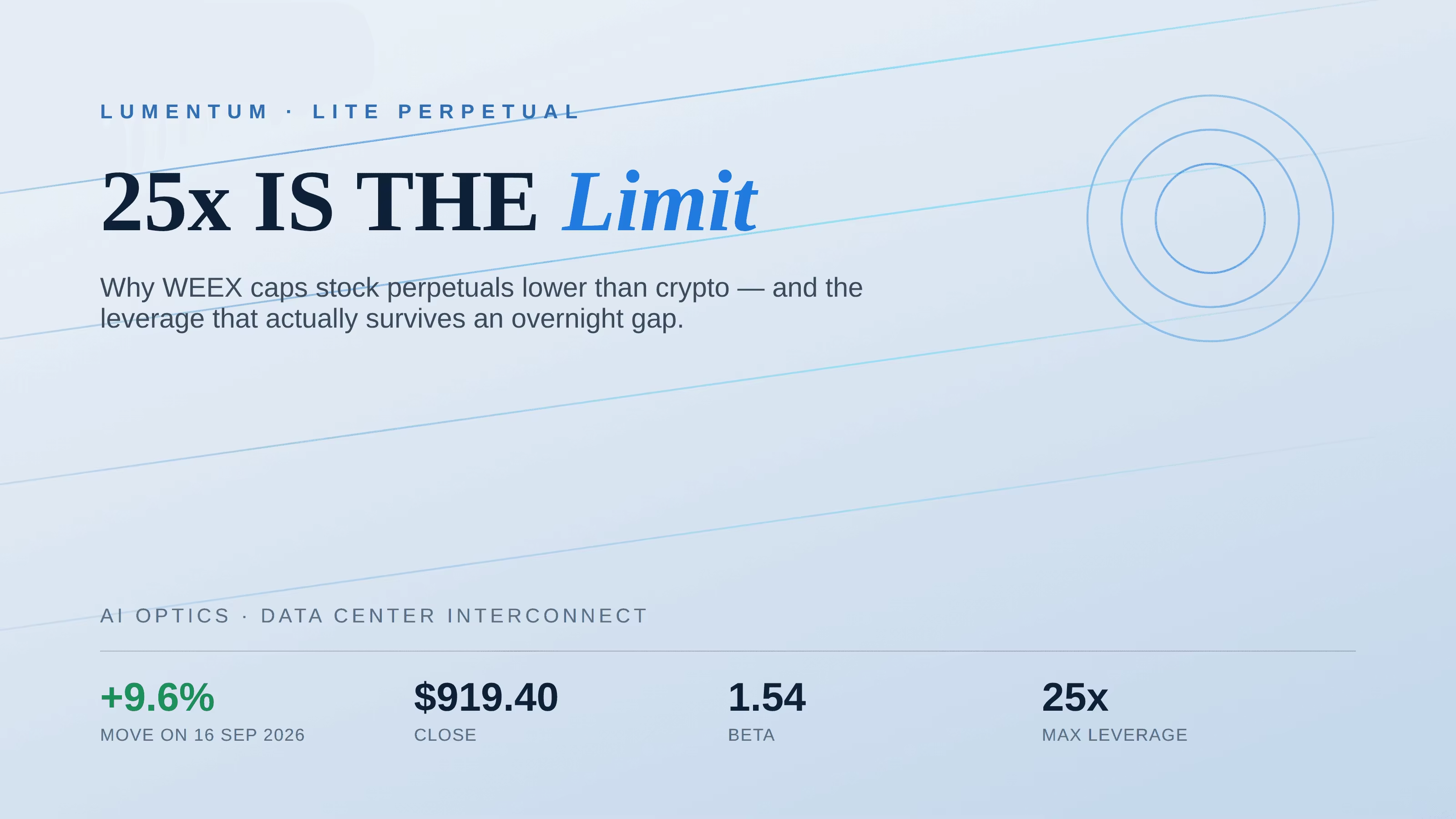
For a leverage decision, three of those numbers matter more than the rest. A 9.6% single-day move means a 10x position lost or gained 96% of its margin in one session. A beta of 1.54 means LITE moves about one and a half times as much as the index on macro days such as the Fed decision. And a $600–$1,400 target range means analysts themselves disagree by more than 100% about where the stock belongs, which is another way of saying the volatility is not going away.
How the WEEX LITE-USDT perpetual works
The LITE-USDT perpetual on WEEX is a USDT-margined contract that tracks Lumentum's share price through an index, settles PnL in USDT, has no expiry, and uses funding payments between longs and shorts to keep the contract price near the underlying. You never own the shares; you own a position whose value moves with them. Maximum leverage is 25x as of 17 September 2026.
WEEX's own US stock perpetuals guide sets out the features that make these contracts different from a BTC or SOL perpetual. They trade 24/7, but liquidity varies by market session, so spreads widen when US cash markets are closed. Corporate actions such as dividends and stock splits may trigger sharp price movements or early settlement. Trading halts on the underlying stock can affect the futures contract. And availability is subject to regional restrictions.
The 24/7 point is the one that changes the leverage calculation. Lumentum's shares trade from 9:30 to 16:00 Eastern; the perpetual trades continuously. Between the US close and the next open, the index price the contract references has to be estimated from pre-market and after-hours prints and from correlated instruments, and when the cash market reopens the index can jump to wherever the stock actually opens. On 16 September LITE opened well above the previous close and kept climbing; on a day with an adverse headline it does the same in reverse, and a leveraged long is marked to the new index whether or not the perpetual's order book had any depth at the time.
Why stock perpetuals cap leverage lower than crypto pairs
WEEX offers up to 300x on XRP-USDT and SOL-USDT, up to 100x on MU-USDT, and 25x on LITE-USDT. The gap is not arbitrary; it reflects how liquidation works when the reference price can gap.
Liquidation is triggered when the margin rate, defined by WEEX as (position margin + unrealized PnL) ÷ position value, falls to the maintenance margin rate. On a crypto pair that trades continuously with deep books, the exchange can usually close a position close to the liquidation price, so the maintenance margin required is small and high leverage is feasible. On a stock perpetual, the index can move 5–10% between one price and the next at the US open, or after an earnings release at 16:05 Eastern. If leverage were 100x, a 1% maintenance cushion would be gone before any order could execute, leaving the position underwater and the exchange's insurance mechanisms carrying the loss. A 25x cap means initial margin is at least 4% of position value, which is about the size of a typical LITE overnight gap. That is the exchange telling you what it thinks a one-session move looks like.
The same logic explains why maximum leverage falls as position size rises under the position-tier rules: a large LITE position liquidated into a thin after-hours book would move the price itself, so the maintenance margin rate rises with size.
-- Price
Effective leverage: The number that actually decides your risk
Nominal leverage is the multiplier you select. Effective leverage is position value divided by the equity you are actually risking, and for a stock that gaps it is the only number worth tracking.
Take LITE at $919.40 and a trader with 5,000 USDT in the futures account.
- 25x, isolated, 1,000 USDT margin: position value $25,000, about 27 shares. A 4% adverse gap at the open produces a $1,000 loss, the full margin, so the position is liquidated on the first bad open. Effective leverage relative to the account is 5x, but relative to the margin assigned it is 25x, and that margin is gone in one gap.
- 5x, isolated, 1,000 USDT margin: position value $5,000, about 5.4 shares. The same 4% gap costs $200, and a 9.6% move like 16 September costs or earns $480. Liquidation sits near $745, roughly 19% below entry, which is outside any single-day move LITE has made this quarter.
- 5x, cross, no other positions: the whole 5,000 USDT balance backs the $5,000 position, so effective leverage against the account is 1x. The position can absorb a 50% move. That is the configuration most equity-native traders actually want when they say they want "some leverage" on Lumentum.
The rule that falls out of this is that leverage should be set from the gap size, not from the cap. If LITE's typical adverse gap is 4–6% and its worst plausible gap around earnings is 15–20%, then a directional hold through an earnings date belongs at 2–3x, a hold through ordinary sessions at 3–5x, and anything above 10x is an intraday scalp that must be closed before the US market closes.
How to open a LITE position on WEEX and choose leverage from the gap, not the cap
- Open the LITE-USDT perpetual and check the funding countdown and current mark price against the last Nasdaq print. A large gap between the two after hours is a sign the contract is pricing a move the cash market has not yet made.
- Choose isolated margin for a directional trade so the maximum loss is the margin assigned, and cross margin only if you are deliberately running low effective leverage against the whole balance.
- Set leverage from the scenario, not the slider maximum. For a hold through the next session, 3–5x; through 5 November earnings, 2–3x; for an intraday trade during US hours, up to 10x with a hard exit before 16:00 Eastern.
- Use a limit order during US cash hours when the perpetual's book is deepest; outside those hours, market orders on a stock perpetual can fill several dollars away from the mark.
- Attach a stop-loss on mark price and a take-profit before submitting. Note that a stop-loss on a stock perpetual can fill far below its trigger if it is hit by an opening gap; it limits the loss on a trend, not on a jump.
- Check the liquidation price on the position panel and compare it to LITE's recent gap sizes. If a normal overnight move would reach it, the leverage is too high regardless of the multiplier selected.
What traders coming from crypto perpetuals get wrong on LITE
The most common error is treating the LITE perpetual as an always-open market with the liquidity of a top crypto pair. It is always open, but the information arrives in bursts: Nasdaq hours, the 16:05 earnings drop, analyst notes at 07:00 Eastern, and conference presentations like the one that moved the stock on 16 September. Positions held through those windows at crypto-style leverage are exposed to gaps that crypto pairs rarely produce.
The second error is ignoring funding on a stock perpetual. Positive funding on LITE across venues means longs are paying to hold the AI-optics trade. At 7 basis points per 8 hours, a $25,000 position pays about $17.50 per settlement, or more than $50 a day, which erodes a leveraged long that is not moving.
The third error is holding through corporate actions. WEEX's guide is explicit that dividends, splits and trading halts can cause sharp moves or early settlement. Lumentum does not pay a dividend today, but a split at a $900 share price is a live possibility, and a leveraged position at that moment is exposed to settlement mechanics rather than to the stock's direction.
Lumentum perpetual futures give a crypto trader clean exposure to one of the strongest AI-hardware stories of 2026 without a brokerage account or options chain. The 25x cap is the contract's honest assessment of how far the stock can gap; treating it as a ceiling rather than a target is what keeps a leveraged LITE position alive long enough for the AI-optics thesis to matter.
FAQ: Lumentum (LITE) perpetual futures
1. What is the maximum leverage on the WEEX LITE-USDT perpetual?
25x as of 17 September 2026. It is lower than on crypto pairs because a stock index can gap between sessions and after earnings, so the exchange requires a larger margin cushion.
2. Does the LITE perpetual trade when the US stock market is closed?
Yes. WEEX US stock perpetuals trade 24/7, but liquidity varies by session and spreads widen outside Nasdaq hours. The index can jump at the next US open.
3. Do I own Lumentum shares when I go long the perpetual?
No. A perpetual is a USDT-settled derivative that tracks the share price through an index. You have price exposure but no shares, no voting rights and no dividends.
4. What happens to a LITE perpetual position on a stock split?
WEEX notes that corporate actions such as splits and dividends may trigger sharp moves or early settlement. Check the contract announcements before holding through a corporate action.
5. Why did Lumentum stock rise 9.6% on 16 September 2026?
The company showed next-generation optical components for AI data centres at the European Conference on Optical Communications, and several analysts reiterated targets averaging about $1,121, with a high of $1,400.
6. What leverage is sensible for holding LITE through earnings?
With earnings-day gaps of 15–20% plausible for a stock that moved 9.6% on a conference showcase, 2–3x keeps the liquidation price outside the expected range. Higher leverage is an intraday tool.
Risk Warning
Lumentum perpetual futures are leveraged derivatives on a volatile equity, and leverage multiplies both gains and losses: a 4% adverse gap at the US open removes the entire margin on a 25x position. Because the contract trades 24/7 while the underlying stock does not, the index can jump between sessions and around earnings, corporate actions and trading halts, so stop-loss orders may fill far from their trigger and liquidation can occur at a level different from the last traded price. Positive funding adds a holding cost to leveraged longs. Availability of US stock perpetuals is subject to regional restrictions. You may lose part or all of the margin you post, and in cross-margin mode losses can extend to your full futures balance. Trade only with funds you can afford to lose and verify current LITE-USDT contract parameters on WEEX before opening a position.
This content is provided for general informational purposes only and doesn't constitute financial, investment, legal, or tax advice. Any events, rewards, online promotions, or related information mentioned herein should not be considered a recommendation, solicitation, or invitation to purchase, sell, trade, or otherwise deal in any crypto assets. Crypto assets are highly volatile and may result in loss. The availability of WEEX services, products, and related events may vary by region. You are responsible for ensuring that your participation is in accordance with applicable local laws and regulations.
You may also like
What Is a Funding Rate? How Perpetual Futures Charge Longs and Shorts

How Does WEEX KYC Verification Work? A Taiwan User Guide

Macro Protocol (MTP): Listing Status and a Safe Verification Guide
Lisk Chain Shutdown October 31: How to Move LSK Safely
What Is BONK? WEEX Spot and 1000BONK Futures Status and Risk Checks
What Is BRETT? WEEX Spot and Futures Status and Risk Checks
What Is FLOKI? WEEX Spot and 1000FLOKI Futures Status and Risk Checks
What Is WIF (dogwifhat)? WEEX Spot and Futures Status and Risk Checks
How to Test a Trading Strategy on WEEX Demo Before Going Live
WEEX API Key Setup: Permissions, IP Binding and Key Limits

CoinEx Is Closing: Shutdown Timeline and How to Withdraw Before September 29, 2026
Lost Your 2FA Device? Here's What to Do Next
Senate CLARITY Act Cloture Vote Today: Can Trump's Ethics Compromise Get 60 Votes?
Trust Wallet vs MetaMask: Which One Is Better for Beginners?
Monero Futures Trading: The Liquidity Risk Guides Ignore
Bitcoin Funding Rate Before the Fed: What Longs Pay to Hold BTC
Crypto Futures Trading Explained: Leverage, Funding, Liquidation
How to Trade U.S. Stocks Without a Brokerage Account Using USDT

MetaMask Transaction Stuck or Failed? Here's How to Fix It

How to Install and Set Up MetaMask (2026 Updated Guide)
Is Arbitrum (ARB) Worth Buying After Its 30% Rally? An Analysis About Utility, Supply and Risks
Can You Trade U.S. Stocks With 5 USDT? Here's the Real Math
SpaceX Stock Price Holds Near $141: Why Isn't a $100 Billion Spaceport Plan Moving It?
Marvell Stock (MRVL) Beat Earnings and Raised Guidance: Why Did It Fall Anyway?
Where Is XST Actually Trading Now? A Look at Volume Distribution After the Crash
NVDA Stock Jumps 7% After Earnings: Is $250 Next?
Why Is Raini Studios Token (RST) Up Today Despite Low Trading Volume?
Before You Buy CyberLeek: You Should Know CYBERLEEK Token Risks First
Is CyberLeek (CYBERLEEK) Safe? Price Crash and Key Token Risks Explained
CyberLeek Price Prediction 2026: Can CYBERLEEK Recover After the Crash?
What Is a Funding Rate? How Perpetual Futures Charge Longs and Shorts
How Does WEEX KYC Verification Work? A Taiwan User Guide
Macro Protocol (MTP): Listing Status and a Safe Verification Guide
Lisk Chain Shutdown October 31: How to Move LSK Safely
What Is BONK? WEEX Spot and 1000BONK Futures Status and Risk Checks
What Is BRETT? WEEX Spot and Futures Status and Risk Checks





