
Stonkfly Fruit-Fly Brain Bitcoin Experiment: What It Shows and Does Not Prove

 Prefer us on Google


Stonkfly is an open-source fruit-fly connectome simulation built by Coinbase engineer Alex Wormuth to turn bitcoin market data into trading actions. The experiment shows how a neural model can be connected to a market-data feed and an order interface; it does not show that a fruit-fly brain can predict prices or beat a simple holding strategy.
The Register reported on 11 September 2026 that Wormuth started Stonkfly with a simulated $100 balance and connected the project to cryptocurrency market data. Read the reported account alongside the Stonkfly project and the WEEX source story. For a Taiwan reader, the useful frame is an engineering demonstration that combines a neuroscience model, visual encoding and trading software—not a ready-made trading method.
What the experiment actually does
Stonkfly is not a living insect placed in front of a trading screen, and it is not a digital trader that understands news. The project turns public BTC-USDC prices into a coloured chart, converts that image into simulated sensory inputs, and lets the retained neural network respond. A fixed readout then proposes buy, sell or hold. In its 11 September 2026 report, The Register described the model as a male fly brain and ventral nerve cord with no virtual body; engineered interfaces carry market information in and translate neural activity into trading actions.
The project README, fetched on 17 September 2026, describes the MaleCNS v1.0 graph as containing 166,700 neurons and roughly 25.6 million connections. The same README says the market image stimulates 3,335 brightness inputs and 811 R8 colour inputs. These figures describe the model's structure. They do not measure its accuracy on unknown market conditions, and a larger network is not automatically a better financial model.
Why the “dopamine” language needs care
The system turns portfolio gains and losses into engineered reinforcement signals. The Stonkfly README, fetched on 17 September 2026, says positive portfolio performance stimulates 15 identified PAM11 cells while negative performance stimulates two PPL101 aversive cells. It also says these are engineered signals rather than modeled pain receptors. A programmed signal can alter selected synaptic connections; it should not be read as proof of subjective experience, consciousness or biological learning.
The distinction between a response and a strategy matters. If prices rise after a simulated buy, the account value may rise without the system discovering a repeatable advantage. The Register reported on 11 September 2026 that the project documentation recommends comparisons with cash and simple exposure baselines, because a rising cryptocurrency can make any buyer look skilled. A result that is not compared with those baselines is difficult to interpret.
Paper trading and live orders are different evidence
The README fetched on 17 September 2026 describes the default mode as paper trading with public BTC-USDC data and a simulated $100 balance. No account key is needed for that mode. It is useful for observing the data flow, display and logs, but it does not put that balance at market risk. The project also includes a spot-order interface for Coinbase Advanced. The README says a user must create a dedicated portfolio, use a narrowly scoped credential, and explicitly choose live mode. Those safeguards describe how the software is operated; they do not certify a profitable system.
A careful reader should ask whether a chart shows a simulation or an account record, and whether the record includes fees, slippage, rejected orders, downtime and the full holding period. A few attractive trades cannot answer whether a strategy works across rising, falling, flat and sharply volatile markets. An equity curve without a benchmark, a complete interval and trading costs is not enough to establish performance.
-- Price
What this experiment does not prove
First, it does not prove that a fruit-fly brain understands bitcoin. The model receives an image selected and formatted by software, and its actions pass through readout rules designed by people. Every layer can shape the result. Second, it does not prove that neural activity creates excess returns. The README fetched on 17 September 2026 states that the repository tests have not demonstrated profitable learning, strategy improvement, biological replication or live-funded performance.
Third, a favourable result in one run cannot be carried into the future. A short demonstration may not cover enough market regimes, and it may not rule out data leakage, selection effects or costs that were not recorded. To make a learning claim credible, the project would need pre-declared rules, separate training and test periods, baselines, costs and complete failure records that another reader can reproduce. That is a standard for evaluating an engineering experiment, not an attempt to diminish an interesting project.
How Taiwan readers can evaluate similar demonstrations
- Ask where the data came from. Determine whether the chart uses live data, historical data or a selected interval, and whether delays and execution costs are included.
- Separate each decision layer. Identify the visual input, neural readout, order condition and risk limit. “Uses a brain model” is not a trading rule by itself.
- Demand a baseline. Compare with cash, simple holding and other rules fixed before the result. Only then can a reader tell whether the outcome exceeds market direction.
- Keep simulated and funded records apart. A simulated balance, a demonstration order and a real account record are different types of evidence and should not be described as interchangeable.
Stonkfly is valuable because it places an intricate neural model in a familiar market setting where claims are easy to exaggerate. Its lesson is methodological: the more entertaining the model, the more carefully readers should inspect its inputs, decision rules, costs and baselines. Engineers can use it to test interfaces and hypotheses; readers should keep “it produces an action” separate from “it is reliable.”
Related reading: check the account before acting
For a practical account-safety checklist, read Is WEEX a Scam? Safety, Regulation and Withdrawals Explained (2026), then How to Identify Fake WEEX Websites and Customer Service Impersonators. The first focuses on identity and withdrawals; the second focuses on official domains and support channels. Both are more useful preparation for real account decisions than chasing a single simulated result.
This page is general information, not financial, investment, legal or tax advice, and is not a recommendation of any asset or platform. Virtual assets involve significant risk; check the rules and terms that apply to your location, identity and activity.
This content is provided for general informational purposes only and doesn't constitute financial, investment, legal, or tax advice. Any events, rewards, online promotions, or related information mentioned herein should not be considered a recommendation, solicitation, or invitation to purchase, sell, trade, or otherwise deal in any crypto assets. Crypto assets are highly volatile and may result in loss. The availability of WEEX services, products, and related events may vary by region. You are responsible for ensuring that your participation is in accordance with applicable local laws and regulations.
You may also like
Circle's Arc Mainnet Is Live: Can It Actually Close the Gap With Tether's USDT?
SOL Perpetual Contracts: Mark Price, Index Price and Liquidation
XRP Futures: How to Long or Short XRP After the Clarity Act Vote
WEEX API Key Security: What a Leaked Key Can Still Do to You
WEEX API Key Setup: Permissions, IP Binding and Key Limits
Lost Your 2FA Device? Here's What to Do Next
Trust Wallet vs MetaMask: Which One Is Better for Beginners?

Trust Wallet Seed Phrase: How to Store It Safely and What Never to Do
AVAX Futures: Trading the Avalanche RWA Catalyst With Leverage
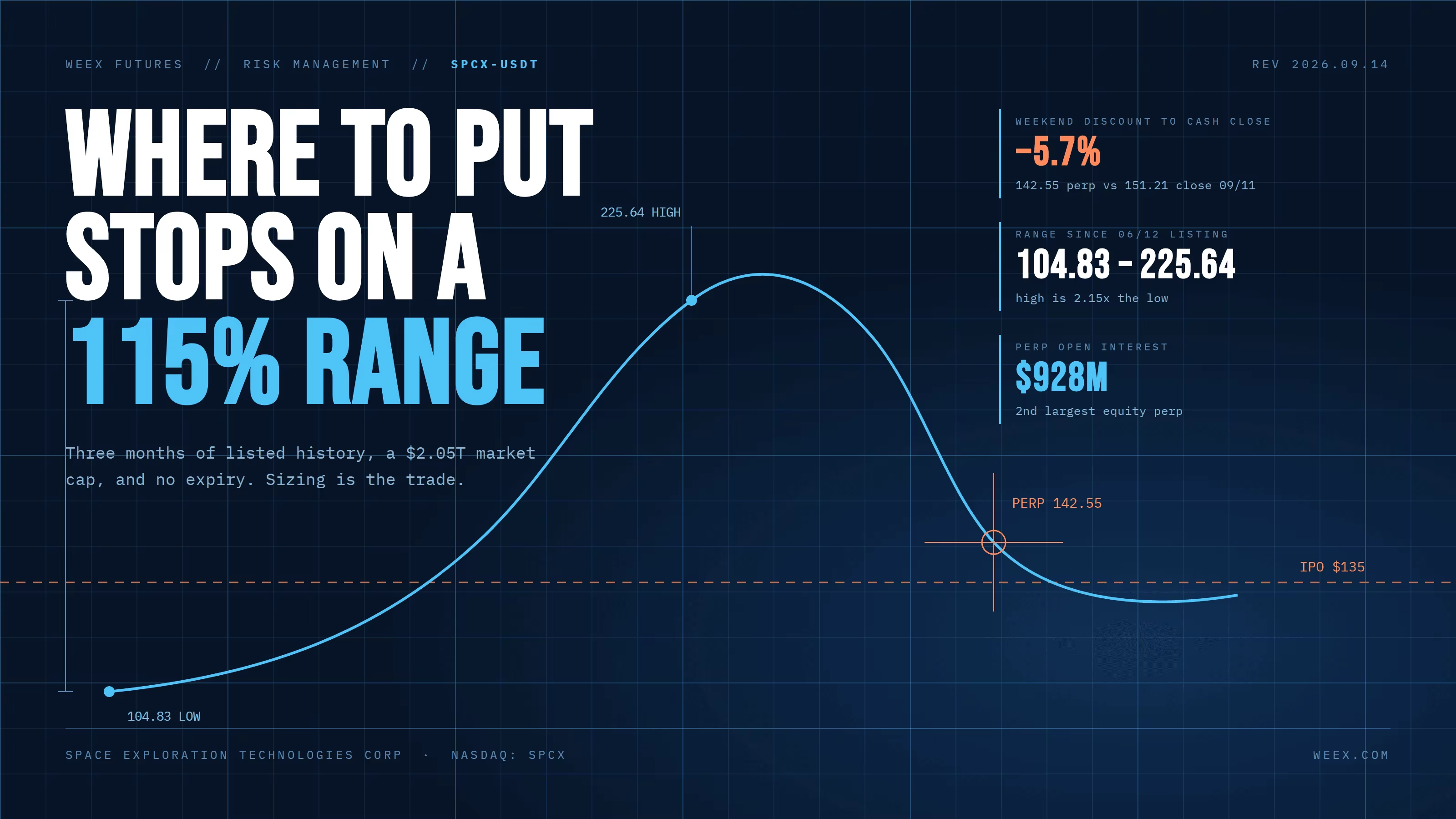
SpaceX Stock Futures: Where to Put Stops on a 115% Range
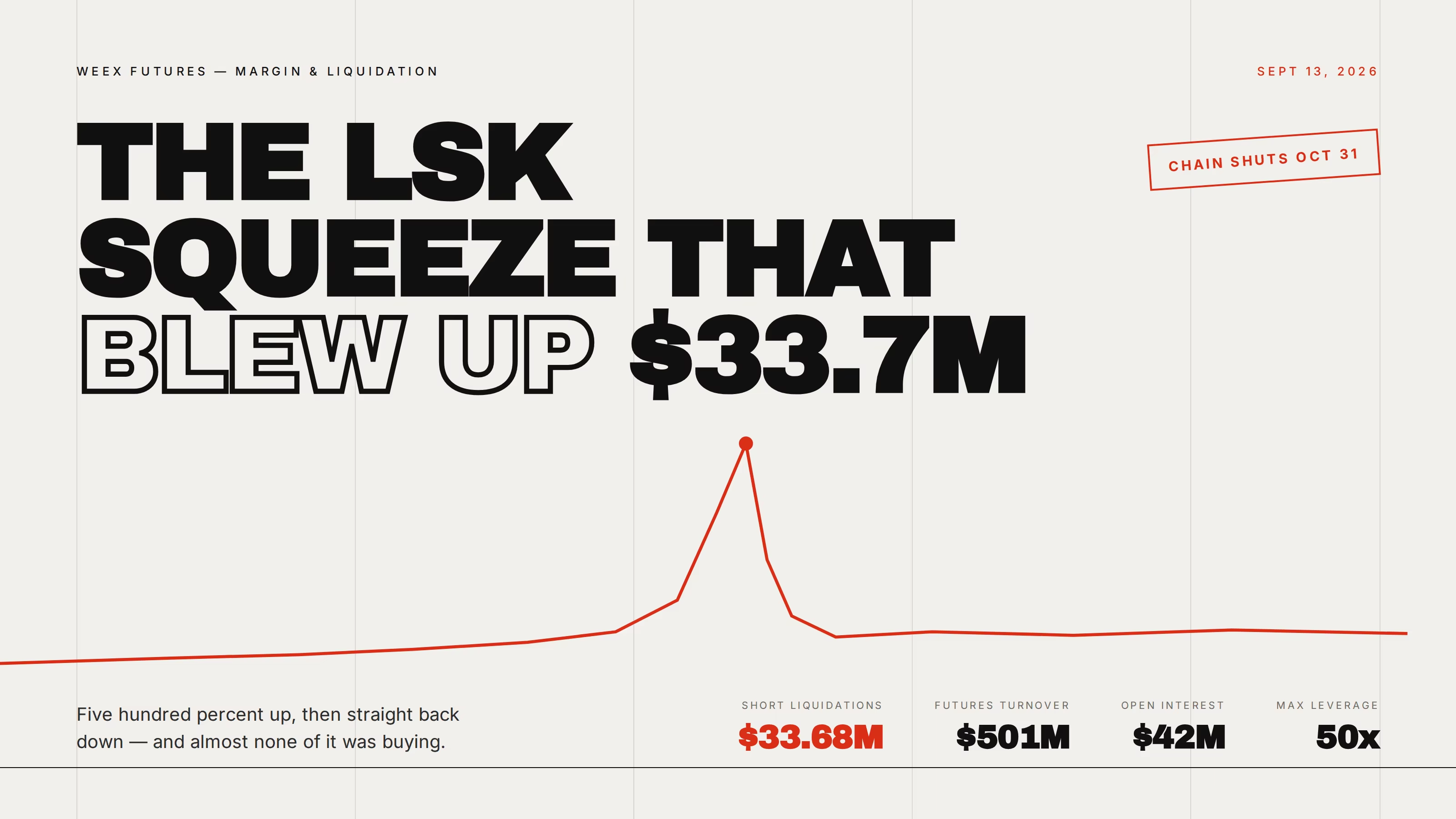
LSK Short Squeeze: How $33.7M of Bears Blew Up in a Day
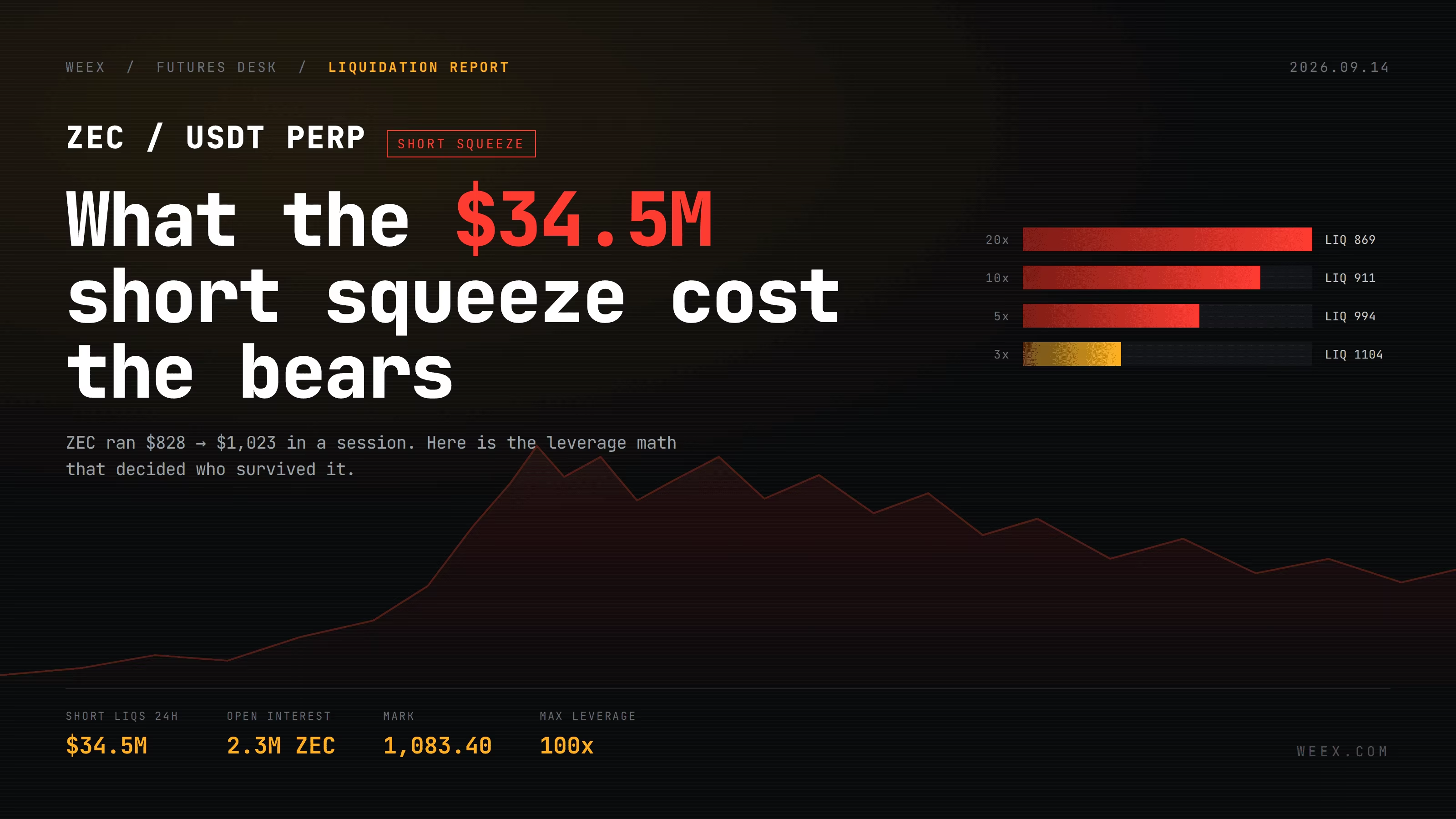
Zcash Futures: What the $34.5M Short Squeeze Cost the Bears
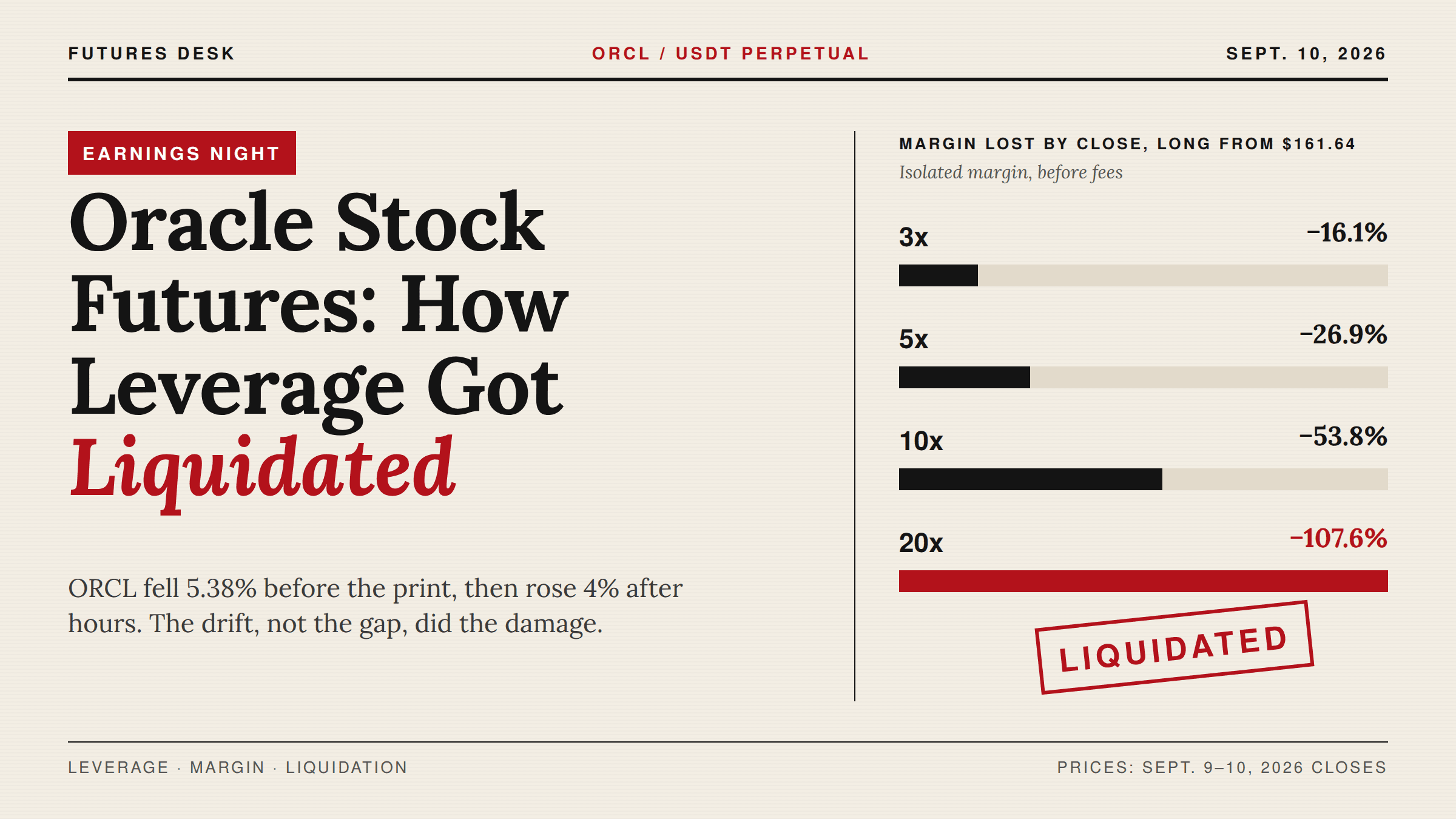
Oracle Stock Futures After Earnings: How Leverage Got Liquidated
How to Trade Microsoft (MSFT) Stock Token with USDT on WEEX
AVAV Stock Futures: How to Trade AeroVironment With Leverage
Is The US Becoming The Crypto Capital? Brad Garlinghouse's Bold Predictions Explained
Nike S&P 100 Exit: What the Removal Means for NKE Holders
Trump's "Hundreds of Billions" Stock Claim: The Trader's View

CLARITY Act Enters a Critical Window: What the September 15 Senate Vote Actually Means
What Is Tangem Wallet? A Complete Beginner's Guide

CyberLeek Crypto: The GTA 6 Token's Exit Liquidity Problem
How to Install and Set Up MetaMask (2026 Updated Guide)
Dell Earnings: $95B AI Backlog Now Dwarfs Its Own Guidance
Fable 5.1: What Anthropic's New Model Means for AI Tokens
"We're Back": Why Strategy's Return to Bitcoin Buying Is Moving More Than Just MSTR Stock

How to Transfer Funds from P2P Wallet to Futures in Pakistan: A Step-by-Step Guide
SpaceX Stock Price Holds Near $141: Why Isn't a $100 Billion Spaceport Plan Moving It?
What to Do After Buying USDT in Pakistan: Spot, Futures or Hold?
Salesforce Stock Price Targets Are Rising Fast: What Wall Street Actually Sees
Marvell Stock (MRVL) Beat Earnings and Raised Guidance: Why Did It Fall Anyway?
Circle's Arc Mainnet Is Live: Can It Actually Close the Gap With Tether's USDT?
SOL Perpetual Contracts: Mark Price, Index Price and Liquidation
XRP Futures: How to Long or Short XRP After the Clarity Act Vote
WEEX API Key Security: What a Leaked Key Can Still Do to You
WEEX API Key Setup: Permissions, IP Binding and Key Limits
Lost Your 2FA Device? Here's What to Do Next


