
United States Dividend Fund (USDF): Is There a Connection to Trump’s Dividend Plan?

 Prefer us on Google


Is United States Dividend Fund (USDF) connected to Trump’s dividend plan? In the sources reviewed, no evidence shows that United States Dividend Fund (USDF) is a government program or an official project of the president, although its name and marketing borrow the same dividend language.
The question keeps appearing because the president pledged a $5,000 payment to adult citizens in September 2026, and the token’s marketing uses similar wording. A pledge and a token can share a word without sharing anything else, so the useful step is to compare what the pledge actually is with what the United States Dividend Fund (USDF) websites say.
What Is Trump’s Dividend Plan and Where Does It Stand?
On September 9, 2026, at the Republican midterm convention in Dallas, President Trump said, “I will issue a dividend to every adult citizen in the United States of America for $5,000,” according to Fox Business. The pledge is conditional on Republicans winning both the House and the Senate. Al Jazeera, as summarized by Outlook India, places the midterm elections on November 3.
The cost estimates differ because the number of recipients differs. Fox Business put the cost at about $1.2 trillion by its own arithmetic, based on roughly 240 million adult citizens. Al Jazeera estimated roughly 270 million recipients and a cost of roughly $1.3 trillion. Fox Business also reported that the White House had not released eligibility rules or a detailed funding plan, and a Hoodline report published on October 25 identified no bill authorizing the payment. The plan is therefore a campaign pledge, not an enacted program.
It is not the first time a tariff-linked payment has been floated. Earlier ideas, including a proposed $2,000 payment, drew a comment from Treasury Secretary Scott Bessent, reported by Kiplinger, that Congress would have to approve any payout and that no final design had been set. According to the Outlook India report, those earlier payments did not materialize.
How Would the Plan Be Paid For and Who Must Approve It?
Vice President JD Vance described the dividend as “a dividend for American workers” linked to tariff revenue, according to Outlook India. Fox Business reported that Vance also suggested wealthy Americans could be excluded, which would lower the cost. The Tax Policy Center projects about $1.7 trillion in tariff revenue over fiscal years 2026 to 2036, including about $177 billion in 2026, and the Outlook India report says projected tariff revenue falls well short of the cost.
Fox Business cited Treasury data showing $34.2 billion in customs duties in one month and about $208.5 billion since January. It noted these are gross figures that do not account for refunds tied to tariffs the Supreme Court later struck down. Reuters reported that borrowing to fund the payments could raise federal debt, interest costs and inflation, and the Associated Press noted that the federal deficit is already nearly $1.8 trillion.
On approval, the sources disagree. House Speaker Mike Johnson said Congress “would have to authorize the spending,” and legal experts cited by Al Jazeera also say approval is required. The Associated Press, as cited by Outlook India, reported that Trump said he did not believe congressional approval was needed, and Senate Majority Leader John Thune questioned whether the measure could win enough votes.
What Does the USDF Name Borrow From the Plan?
Bitrue reported that the USDF website describes a tokenized fund with a “fund return,” lists adult American investors as eligible, claims a payout of $5,000 per eligible adult and shows a countdown to October 1, 2026. Bittime reported that the site also uses the phrase “Trump Dividend Fund.” These are the project’s own claims, and none has been independently verified.
The timelines also differ. The president’s pledge depends on the result of the November election, while the USDF countdown pointed to October 1, according to Bitrue. By the dates in those reports, the two do not line up, and none of the reports reviewed confirms that any payment was made.
-- Price
Does Any Evidence Link USDF to the White House or Treasury?
Bittime found no evidence that USDF is a government project or an official Trump project. The same report says the USDF website describes itself as an independent project that is not affiliated with the White House, the Treasury, the IRS or other government agencies. Bitrue noted that this footer disclaimer sits uneasily with the dividend-style marketing on the same site.
Bitrue also reported that no team, legal entity, fund administrator or audited financials were publicly explained, and that no verified mechanism links holding the token to a dollar payment. The connection is therefore one of narrative, not of official backing. None of the sources reviewed points to an official announcement that involves a token, and a government payment would be announced through official government channels, not through a token page.
Why Do Different USDF Pages Show Different Tokens?
Third-party reports list different contract addresses and different price and market figures for tokens associated with the name, and Coinbase shows more than one United States Dividend Fund asset. WEEX’s website checks, covered in the earlier guide on whether United States Dividend Fund (USDF) is legit, found separate sites, including usdfgov.org, usdf.live and usdf.info, and could not confirm that they belong to the same issuer. The guide to what United States Dividend Fund (USDF) is explains the project’s claimed identity in more detail.
For this reason, the price or trading data for one USDF token cannot be applied to another, and a claim made on one website says nothing about a token shown on another.
What Should Readers Check Before Trusting a USDF Claim?
Several questions help separate a documented program from a marketing story. Who is named as the payer, and where would the money come from? What law or program authorizes the payment? Who is eligible, and how would a payment be received? Is there proof that a distribution has actually taken place? Does the website name an accountable issuer, and does the token address match across the website, the trackers and the wallet?
Claims about a government dividend should be checked on official government websites, not on a token page. Bittime also lists trading risks that apply to tokens of this kind. Low liquidity relative to daily volume can cause rapid price moves, large wallets can affect the price significantly, and political branding can drive trading without proving official backing. Bitrue reported that one tracker flagged a large share of bundled buys for a USDF token it examined, and the figures differ by token and by time, so any single snapshot should be treated with care.
Conclusion
The USDF name borrows the dividend language of a real campaign pledge, but the reports reviewed found no evidence of an official link. The pledge itself depends on an election result and on congressional approval, so it is not an enacted program. Until a named issuer documents the payment source, the eligibility rules and an actual distribution, the dividend claims attached to USDF remain unverified.
FAQ
1. Is United States Dividend Fund (USDF) connected to Trump’s dividend plan?
No evidence in the sources reviewed shows an official connection. The United States Dividend Fund (USDF) website describes itself as an independent project that is not affiliated with the White House or other government agencies, according to Bittime.
2. What is Trump’s dividend plan?
It is a pledge made on September 9, 2026, to pay $5,000 to every adult citizen if Republicans win both chambers of Congress, as reported by Fox Business. It is a campaign promise, not an enacted program, and has no bearing on the United States Dividend Fund (USDF) token.
3. Has Congress approved the dividend?
No bill authorizing the payment was identified in a report published on October 25. House Speaker Mike Johnson said Congress would have to authorize the spending, while Trump said he did not believe approval was needed.
4. Is United States Dividend Fund (USDF) a government fund?
No evidence shows that United States Dividend Fund (USDF) is a government fund. Its own website states that it is not affiliated with the White House, the Treasury or the IRS.
5. Why do some pages show different USDF tokens?
Several websites and trackers use the same name with different contract addresses and market figures, so data for one token cannot be applied to another. This is why identity checks matter for any United States Dividend Fund (USDF) page.
This content is provided for general informational purposes only and doesn't constitute financial, investment, legal, or tax advice. Any events, rewards, online promotions, or related information mentioned herein should not be considered a recommendation, solicitation, or invitation to purchase, sell, trade, or otherwise deal in any crypto assets. Crypto assets are highly volatile and may result in loss. The availability of WEEX services, products, and related events may vary by region. You are responsible for ensuring that your participation is in accordance with applicable local laws and regulations.
You may also like

Binance Hack Explained: What Is Confirmed, What Is Disputed and What Users Should Do Now
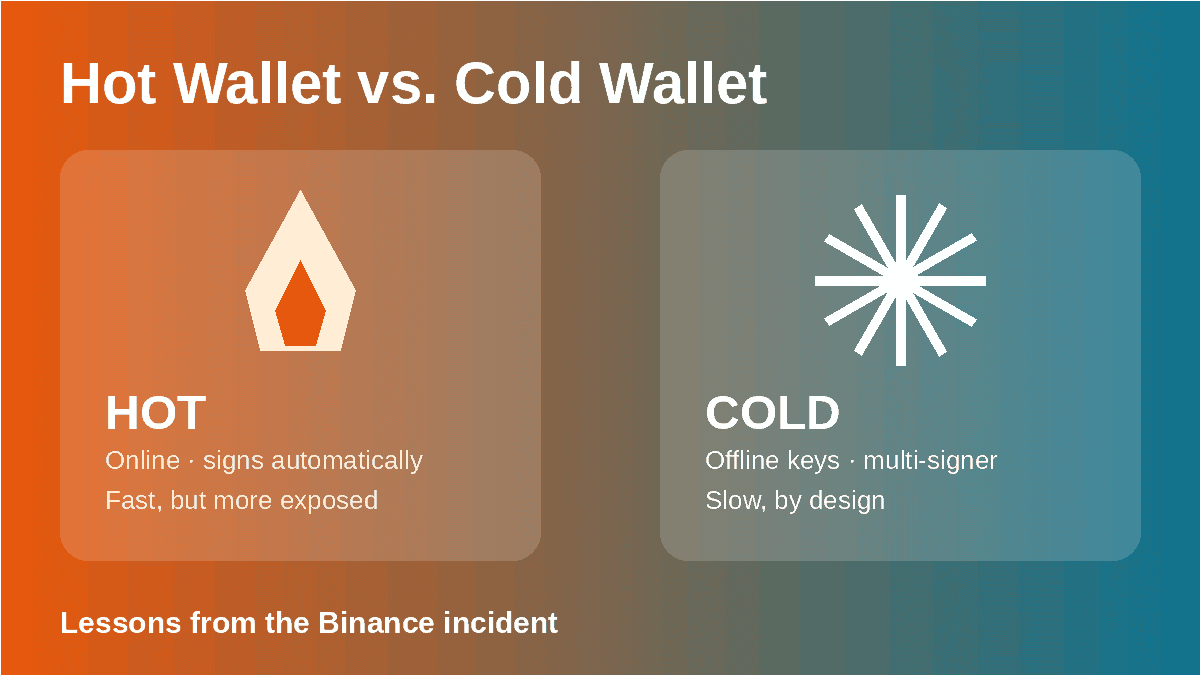
Hot Wallet Security Explained: Lessons From the Binance Incident

Binance Hack Scams: How to Spot Fake Refund and Recovery Offers
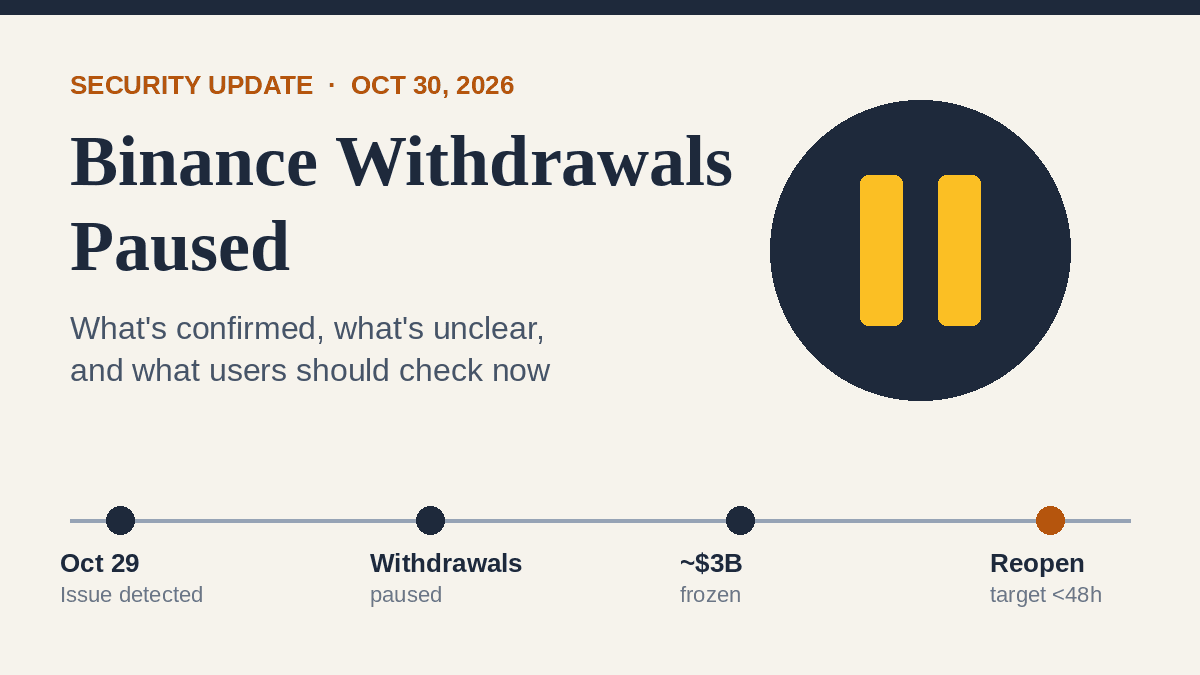
Binance Withdrawals Paused: What Users Should Check Right Now

HYPE Price Jumps After ICE Backs trade[XYZ] on Hyperliquid: What Is Confirmed and What Is Not
GOOGL Q3 Earnings: Why Alphabet Fell Despite 103% Cloud Growth
Is XTruth Oil (XTO) Legit? Contract Checks, Payout Gaps and Liquidity Risks
United States Dividend Fund (USDF) October 30 Announcement and October 31 Date: What to Verify Before Believing Either Claim
Ripple National Trust Bank: Who Really Gains From OCC Approval
Hyperliquid US Entry: What Kraken's Payward Plan Actually Builds
How Do Stablecoin Issuers Make Money? The Business Behind a $1 Token

Robinhood RLUSD: What Ripple’s Partnership Means for XRP and the XRP Ledger
Why Unitree Stock Jumped: JPMorgan Upgrade, Physical AI Timelines and What Investors Should Check

SKHY Q3 Earnings: SK Hynix's 632% Profit Jump Is a Price Story
TSLA Barclays Upgrade: What the $450 Price Target Assumes
XRP After Ripple's OCC Charter: What the Bank Approval Changes
BTC Fights for $80K Before the Fed: Why Leverage Hasn't Flushed

AVGO and META Stock: What an $88B AI Financing Week Signals

Gold Price Back Above $4,000: Fed, Iran Risk and the Next Test
USDT Interest Rate 2026: Current APR and Earnings Calculator
Taiwan Crypto Regulations 2027: What Investors Need to Know
What Does the Kalshi–S&P Dow Jones Deal Mean? Event Contracts vs. Index Investing
Tokenized Stocks Explained: What to Check Before You Trade
CLS Stock After Q3 Earnings: Revenue Up 83%, 2027 Outlook and What Investors Should Check
Which WEEX Moves Cost You Auto Earn Interest? 9 Actions Checked
Bloom Crypto Bot Wallet Drains: What Happened and What Users Should Check
How to Use WEEX Bubbles: A Practical Guide to Crypto Bubbles and Market Trends

TSLA Stock After the Flying Roadster Reveal: What the Q3 Results, SpaceX Merger Talk and Analysts Say
SK Hynix Stock Before Q3 Earnings: Special Dividend Reports, HBM4 and What Investors Want to See on October 28
Corporate Actions for Tokenized Stocks: How Dividends, Splits and Mergers Are Handled
Binance Hack Explained: What Is Confirmed, What Is Disputed and What Users Should Do Now
Hot Wallet Security Explained: Lessons From the Binance Incident
Binance Hack Scams: How to Spot Fake Refund and Recovery Offers
Binance Withdrawals Paused: What Users Should Check Right Now
HYPE Price Jumps After ICE Backs trade[XYZ] on Hyperliquid: What Is Confirmed and What Is Not
GOOGL Q3 Earnings: Why Alphabet Fell Despite 103% Cloud Growth




