
Bitwise Maps Solana to $80, $385 or $1,100 by 2031 in Scenario-Based Research

 Prefer us on Google



TL;DR
- Bitwise's research outlines bear, base and bull cases for SOL by 2031, not a single guaranteed price.
- The cited outcomes are about $80, $385 and $1,100.
- The highest scenario depends on substantial tokenization growth and Solana capturing a large share of activity.
Bitwise has published a five-year framework for Solana that includes very different possible outcomes for SOL's price. The range extends from an $80 bear case to a $385 base case and an $1,100 bullish scenario for 2031, according to reporting on its November 16 research. Those numbers are scenarios, not an announcement that the token will reach any particular level. The interesting story is the set of expectations about tokenized securities, payments and on-chain trading required to justify the more ambitious outcome.
What the research is trying to measure
Bitwise's paper, "Tokenization, 24/7 Trading, and the Economics of Solana," links possible SOL valuations to the role a fast blockchain might play in financial activity. The firm argues that tokenized assets, payments and round-the-clock trading could shift more transactions on-chain over time. Its publicly available summary identifies a $385 base-case outlook for 2031. That is a modeled result within a research framework, not a quoted future market price or a probability-weighted consensus. Investors should read the full assumptions and risk disclosures before comparing the figure with spot trading.
The high case requires major market capture
The $1,100 scenario discussed in The Block's coverage assumes a much larger tokenized-equity market and unusually strong Solana participation. Among the assumptions cited are a 5% tokenization of global stocks and a large share of resulting trading volume flowing through Solana. A scenario built on that scale can help illustrate upside sensitivity, but it also magnifies execution risk. There is no guarantee that securities issuers will tokenize at the modeled pace, or that Solana rather than other blockchains and traditional infrastructure will win most of the business.
For related context, see our earlier report on Solana treasury and staking disclosures.
Growth does not automatically flow to SOL holders
Even if tokenized assets and payments grow, their relationship to the native token's value depends on fee structures, network demand, supply dynamics and competition. Low transaction fees can attract activity without making each additional transaction economically equivalent to a large increase in token demand. Layer-two systems, private networks and alternative settlement solutions may also compete for institutional transactions. The mechanism from network activity to investment return needs to be assessed, not assumed. Forecast tables tend to look precise even when the underlying business model is uncertain.
-- Price
A better way to use the numbers
The three cases are most useful as a way to frame questions: how much tokenized volume might actually migrate, how quickly payments grow, what share Solana can secure and how much capacity it would need. The bearish case also reminds readers that technological adoption and investor returns can diverge. Bitwise itself sells crypto investment products, so its commercial perspective should be noted while examining the research. Treat each figure as conditional on the inputs rather than as investment advice or an independent valuation fact.
Scenario analysis becomes more informative when its inputs are varied, rather than when the highest output is presented as a prediction. An investor could test a slower tokenization rollout, tighter fee competition, different staking rewards or a valuation multiple below the research base case. Small changes in several assumptions can compound over five years. Bitwise's work is useful as a model of how network activity might translate into token economics, but competing networks, policy choices and unforeseen technology changes could make realised outcomes very different.
For related context, see our earlier report on Solana transaction-privacy development.
Forecasts make headlines, but assumptions are where the debate belongs. Tracking tokenized equity usage, payment volumes, transaction economics and competition over the next five years will show whether the underlying thesis is getting stronger or weaker.
Reporting sources: Bitwise research introduction · The Block discussion of the scenarios
Written by the News Desk and edited by Samuel Rae.
This content is provided for general informational purposes only and doesn't constitute financial, investment, legal, or tax advice. Any events, rewards, online promotions, or related information mentioned herein should not be considered a recommendation, solicitation, or invitation to purchase, sell, trade, or otherwise deal in any crypto assets. Crypto assets are highly volatile and may result in loss. The availability of WEEX services, products, and related events may vary by region. You are responsible for ensuring that your participation is in accordance with applicable local laws and regulations.
You may also like

IonQ Stock Plunged 48% in Six Months. Is It a Bargain Buy?

Tencent: WorkBuddy Achieves Annualized Revenue of Over $500 Million in Seven Days, More Than Twice That of Tencent Meeting

With Democrats to Control Congress, Is It Better to Buy Bitcoin or an Index Fund?

Chubb Group Expects to Exceed 2027 Strategic Goals

Emerging Markets: Over $60 Billion Flees in Two Months Amid Growing AI Crisis Fears

Monument Bank puts £250M on Midnight, but hides strict bank rules

Tencent Q3 Earnings Preview: Profit May End 16-Quarter Growth, AI Spending and Cash Flow Become Revaluation Focus

Injective releases new whitepaper weeks after first U.S. INJ ETF launch

World Platinum Investment Council Predicts Supply Shortage in Platinum Market by 2027
Saylor: Bank Financing is Key to Bitcoin Bull Market, Explains $48 Billion in Credit Product Issuance Capacity
Cypherpunk Reports 8,967 ZEC Mined as Zcash Treasury Nears 342,000 Tokens

Why is Crypto Payment Still Not Working Even with Licenses?

DeFi Development Adds 9,482 SOL as Treasury Grows for Tenth Straight Week
HashKey Capital Partners with Epoch to Launch RWA Trade Financing Strategy, Connecting Digital Capital with the Real Economy

Bitmine Adds 7,653 ETH as Ethereum Treasury Climbs Above 6.08 Million Tokens

Nike Shares Down 78%, Dividend Yield at 4.3%

United Natural Foods shares rise 7.6% after Goldman Sachs upgrade

Tether’s Paolo Ardoino backs RGB for Bitcoin tokenization

Google uncovers AI hacking tool that turns security fixes into cyberattacks

Aecom Stock Jumps 8.5% After Mixed Q4 Earnings Report
Key Focus Areas in NVIDIA's Earnings Report
Power Policy Dominates Midterm Elections, 'European Virginia' Becomes Latest Battleground
Animoca Co-Founder Criticizes Traditional Bank Checking Accounts, AI Agents and DeFi May Reshape Financial Services

Microsoft Ignite Conference Kicks Off Today! Focus on Copilot Monetization and AI Computing Returns, Can the Enterprise AI Flywheel Deliver?
How to Reassess Core Assets with 'Revenue + Narrative' After Market Crash?

IOSG: Bitcoin Needs to Reach $250,000 to Compete with AI in Mining

Li Auto CTO Xie Yan Attends TSMC 2026 OIP Ecosystem Forum

Why Are Tokenized Stocks Seeing Strong Buying Pressure While Prices Keep Falling?
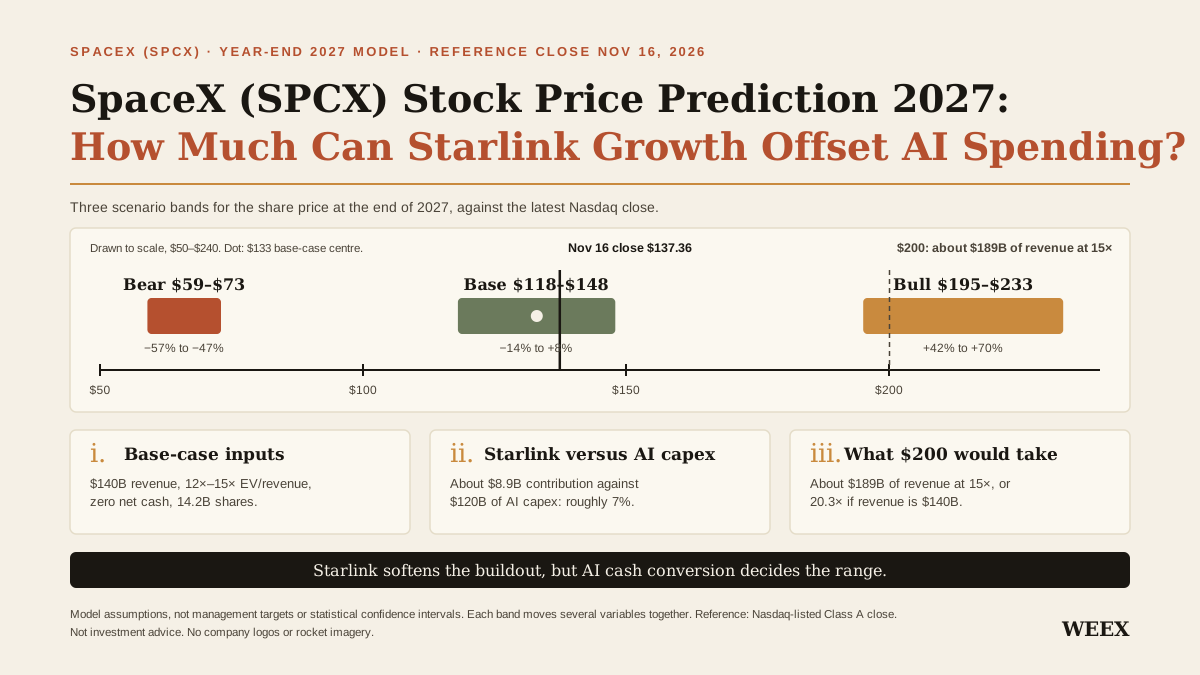
SpaceX (SPCX) Stock Price Prediction 2027: How Much Can Starlink Growth Offset AI Spending?
SpaceX stock price prediction for 2027: See the $118–$148 base case, how much Starlink could offset AI spending, and what it would take to reach $200.
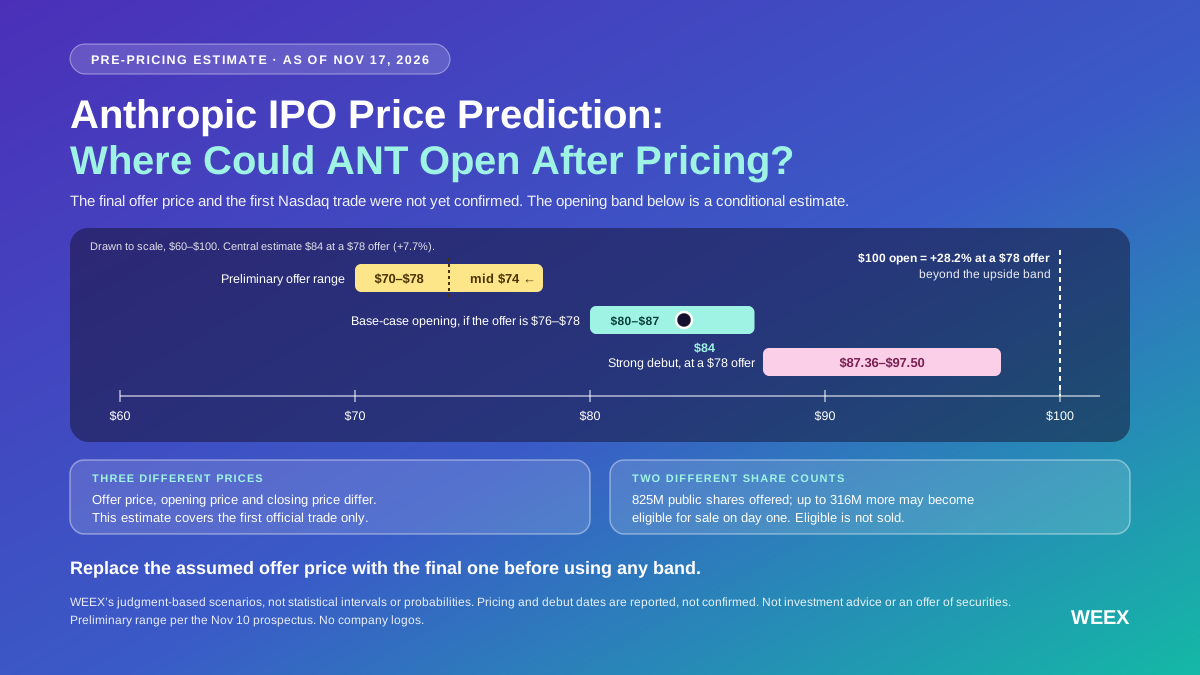
Anthropic IPO Price Prediction: Where Could ANT Open After Pricing?
Anthropic IPO price prediction: See ANT’s $80–$87 base-case opening range, how the final offer price changes it, and what could push shares above $90.
IonQ Stock Plunged 48% in Six Months. Is It a Bargain Buy?
Tencent: WorkBuddy Achieves Annualized Revenue of Over $500 Million in Seven Days, More Than Twice That of Tencent Meeting
With Democrats to Control Congress, Is It Better to Buy Bitcoin or an Index Fund?
Chubb Group Expects to Exceed 2027 Strategic Goals
Emerging Markets: Over $60 Billion Flees in Two Months Amid Growing AI Crisis Fears
Monument Bank puts £250M on Midnight, but hides strict bank rules
Latest articles


Latest coin listings on WEEX


