
Anthropic IPO Price Prediction: Where Could ANT Open After Pricing?

 Prefer us on Google
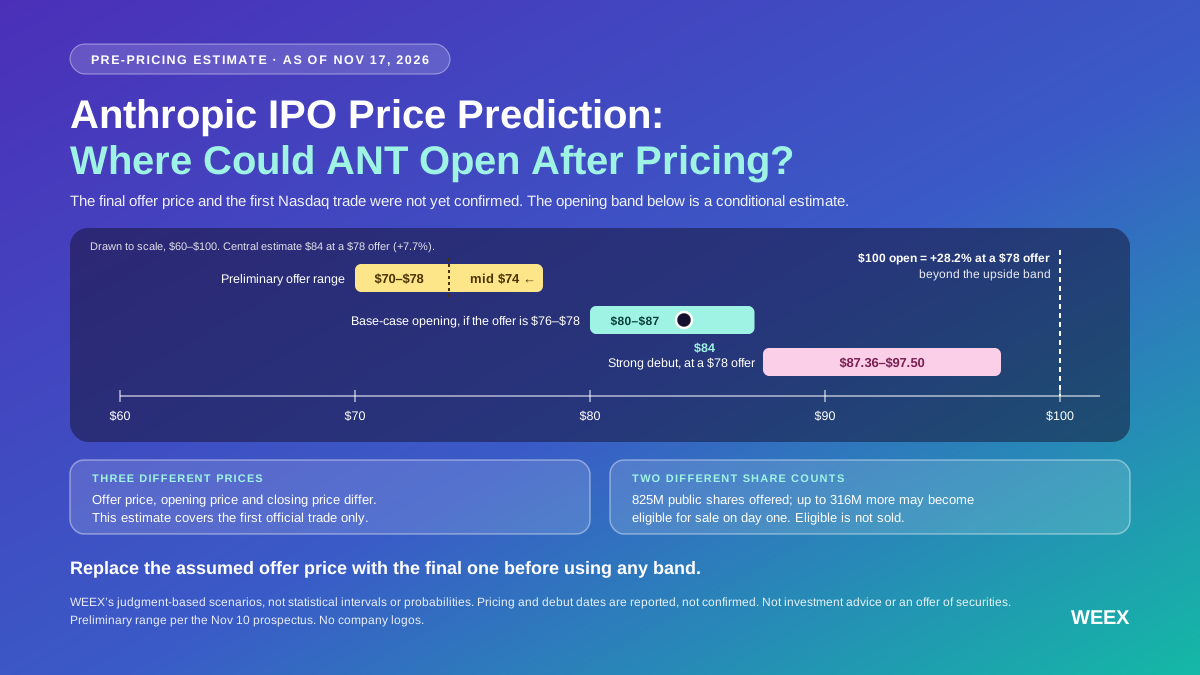
Anthropic’s Nasdaq debut could open at about $80 to $87 per share if the company prices its IPO at $76 to $78 and market conditions remain broadly stable. If the final offer price is $78, our central estimate for the first trade is about $84, a premium of roughly 7.7%. As of November 17, 2026, the latest public prospectus we reviewed still indicated a $70 to $78 offering range. The final offer price and the first Nasdaq trade had yet to be confirmed.
A positive opening premium is more plausible than a flat debut if the reported demand holds through pricing. But there is a reason to keep the estimate below the biggest opening-day forecasts: investors have to absorb a very large public offering, and the prospectus identifies additional shares that may become eligible for sale on the first trading day. That combination supports a moderate opening premium as the base case. A much bigger move would require evidence that buyers still want more shares at prices materially above the final offer.
Key Takeaways
- Base case: $80–$87 at the first Nasdaq trade, conditional on a $76–$78 offer price and stable market conditions.
- At a $78 offer, $84 is our central estimate. An opening at $100 would require a 28.2% premium, beyond the upside band in our model.
- The order book and the opening auction measure different things. Reported oversubscription describes demand for an IPO allocation; the opening print depends on buy and sell orders submitted for the debut.
- Shares offered and shares eligible for sale are different counts. The preliminary deal covers 825 million public shares, and up to 316 million additional shares may become eligible for sale on the first trading day. Eligibility does not tell us how many will be sold.
Anthropic IPO Price, Ticker and Expected Trading Date
Anthropic, the company behind Claude, has applied to list its Class A common stock on the Nasdaq Global Select Market under the ticker ANT. Its November 10 preliminary prospectus proposes a public offering of 825 million shares at an estimated $70–$78 per share. Reports available at the time of writing pointed to final pricing on November 18 and an expected Nasdaq debut on November 19, both U.S. dates. The dates are expected milestones, and $78 is the top of the preliminary range, not a confirmed offer price.
| IPO item | What was known as of November 17, 2026 |
|---|---|
| Proposed stock ticker | ANT |
| Proposed exchange | Nasdaq Global Select Market |
| Preliminary offer range | $70–$78 per share |
| Midpoint of preliminary range | $74 per share |
| Shares in the base public offering | 825 million Class A shares |
| Public deal size at $70–$78 | $57.75 billion–$64.35 billion gross, before fees and excluding the underwriters’ option |
| Concurrent private placement | $26 billion at the final IPO offer price, subject to closing conditions |
| Reported timetable | Pricing expected November 18; Nasdaq debut expected November 19 |
The $57.75 billion to $64.35 billion is the size of the public offering, not the amount Anthropic itself would collect. The company planned to issue about 801.35 million of the public shares, while existing holders planned to sell about 23.65 million. Anthropic receives no proceeds from the selling holders’ shares. The separate $26 billion placement would also bring capital into the company if completed, but those investors are buying Class N shares under separate terms. Their commitment is not a $26 billion buy order waiting in Nasdaq’s opening auction.
There are three prices to keep straight. The offer price is what investors with an IPO allocation pay. The opening price is the first official Nasdaq trade. The closing price is where the stock ends its first public trading session. A stock can open above its offer price and still finish below its opening print. This forecast addresses the first official trade only.
Anthropic IPO Price Prediction: Bear, Base and Bull Cases
Our model separates two decisions: where Anthropic prices the deal and what premium or discount buyers pay at the open. The first depends on the final bookbuild and the issuer’s decision. The second depends on buy and sell orders around the listing. Keeping them separate makes it possible to update the forecast as soon as the offer price is announced.
Estimated opening price = final offer price × (1 + opening premium or discount).
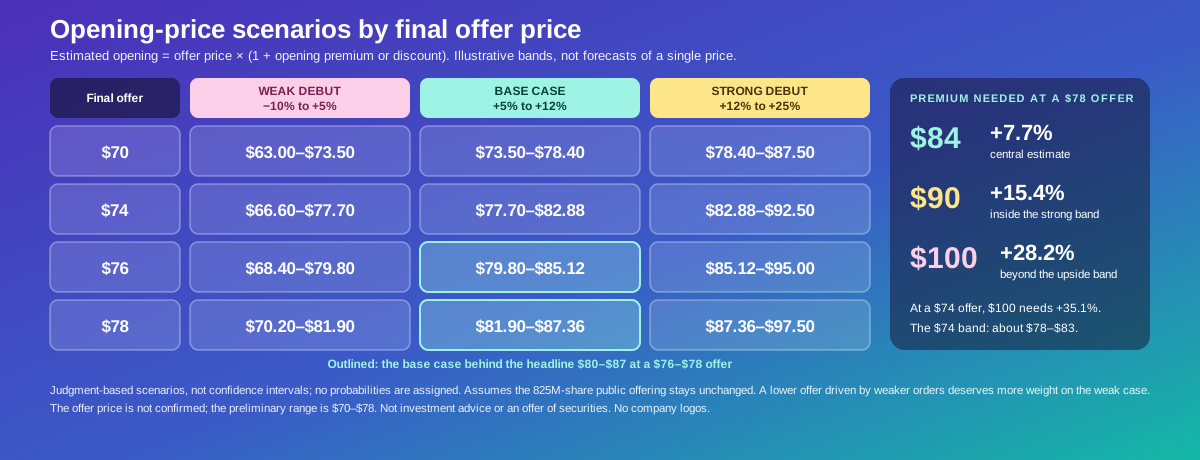
The following bands are judgment-based scenarios. They are not statistical confidence intervals and do not assign probabilities to individual prices. The model keeps the published public offering size as its working assumption; a major change in deal terms would call for a fresh estimate.
| Final IPO offer price | Weak debut: −10% to +5% | Base case: +5% to +12% | Strong debut: +12% to +25% |
|---|---|---|---|
| $70 | $63.00–$73.50 | $73.50–$78.40 | $78.40–$87.50 |
| $74 | $66.60–$77.70 | $77.70–$82.88 | $82.88–$92.50 |
| $76 | $68.40–$79.80 | $79.80–$85.12 | $85.12–$95.00 |
| $78 | $70.20–$81.90 | $81.90–$87.36 | $87.36–$97.50 |
The headline $80–$87 range rounds the base-case endpoints for a $76–$78 offer. If Anthropic prices at $74, the same premium band brings that estimate down to about $78–$83. In practice, a lower offer price can also carry information: if it reflects weaker orders rather than a deliberate pricing decision, the weak-debut case deserves more weight. Simply lowering the input price while assuming buyers’ appetite is unchanged can make the forecast look more resilient than it is.
Why a 5%–12% premium is the base case
Reuters, citing Bloomberg’s reporting, said on November 12 that the deal had drawn orders for roughly six times the shares available at that stage. The reporting also indicated that existing backers could be favored in the allocation. If buyers who receive fewer shares than requested still want exposure after the listing, some of that unmet demand could support the opening auction.
However, a bookbuild order is made against an indicated price range. Buyers may adjust their orders as the deal moves toward the top of that range, and a buyer who wants stock at $74 may have little appetite at $90. The public has no reliable way to convert the reported order total into a price-by-price schedule of firm aftermarket bids. A 5%–12% band allows for some of that unmet demand without assuming the entire book follows the stock into the open.
What would put a $90 or $100 open in play?
At a $78 offer, a $90 opening requires a 15.4% premium. That is inside the strong-debut band: plausible if allocations prove tight, tech equities are firm, and the indicative auction price holds above the base range as the launch approaches. A $100 opening requires a 28.2% premium at the same offer price. It is possible, but it would require materially stronger auction demand than our upside case assumes. If the offer lands at the $74 midpoint, getting to $100 would require a still larger 35.1% premium.
The weak case also deserves room. If investors cut exposure to growth equities before the listing, or if more shares come to market than buyers expect, Anthropic can open near or below its offer price despite strong initial interest. That would show weaker demand at the offered valuation on debut day. It would not settle the longer-term question of whether Anthropic can grow into that valuation.
The Share Supply Most Anthropic IPO Forecasts Should Account For
The public offering size is the best starting point for assessing supply, but it is not the same as the maximum number of shares that could become available when trading begins. The prospectus says up to 316 million Class A shares may become eligible for sale starting on the first trading day following the date of the prospectus. This is a potential source of sell orders alongside shares distributed in the IPO.
Relative to the 825 million base offering shares, 316 million is about 38%. That comparison shows the size of the provision. It does not mean the float will automatically expand by 38%, or that eligible holders will place sell orders. Even a portion of that potential supply, however, can change where the opening auction clears if buyers were assuming very few existing holders could sell.
The prospectus also gives underwriters an option to buy up to 123.75 million additional shares. That option is distinct from the first-day resale eligibility provision. It should not be treated as already exercised, and neither figure should be added mechanically to the auction’s expected supply. One concerns additional IPO shares the underwriters can buy; the other concerns existing holders’ potential ability to sell. Actual sell orders are a third number, and they are the one that matters for the opening print.
The $26 billion strategic placement requires the opposite adjustment. It shows that an identified group of investors committed capital at the eventual offer price, subject to the deal’s conditions. It may strengthen confidence in financing the business, but it does not establish what those investors would pay in the open market or how much incremental demand there will be at $84 or $90. Our model uses it as context for offer pricing, without counting it again as demand for debut shares.
What Comparable IPOs Tell Us About the First Trade
The relevant comparison is offer price to opening trade, not offer price to intraday high or first-day close. The difference matters because headline IPO returns often describe how the stock ended the session, after hours of additional buying and selling.
| Nasdaq debut | IPO offer price | First trade | Opening premium or discount | What the comparison tests |
|---|---|---|---|---|
| SpaceX (SPCX), June 2026 | $135 | $150 | +11.1% | A highly anticipated public offering can open at a material premium without an opening jump of 25% or more. |
| CoreWeave (CRWV), March 2025 | $40 | $39 | −2.5% | Exposure to AI infrastructure and recognized investors does not ensure a positive opening. |
Nasdaq reported SpaceX’s $150 opening. Reuters reported CoreWeave’s $39 first trade. SpaceX is useful as a comparison for deal scale and public attention. CoreWeave is a much smaller offering with a different business model, but it supplies a useful counterexample to the idea that AI enthusiasm automatically translates into a strong auction. These are deliberately chosen examples, not a representative IPO sample. We use them to test whether the scenarios are plausible, not to calculate an average return for Anthropic.
Anthropic has a more explicit near-term catalyst than either comparison can capture: investors will have fresh information about the AI trade just before pricing. NVIDIA scheduled its earnings call for November 17 at 5 p.m. ET, equivalent to November 18 at 6 a.m. Beijing time. The relevant signal is how AI and growth stocks respond to earnings and guidance, rather than whether one earnings-per-share number beats expectations. The WEEX Stock Token Earnings Calendar provides related earnings dates and times for investors tracking that backdrop.
What an $84 Opening Would Imply for Anthropic’s Valuation
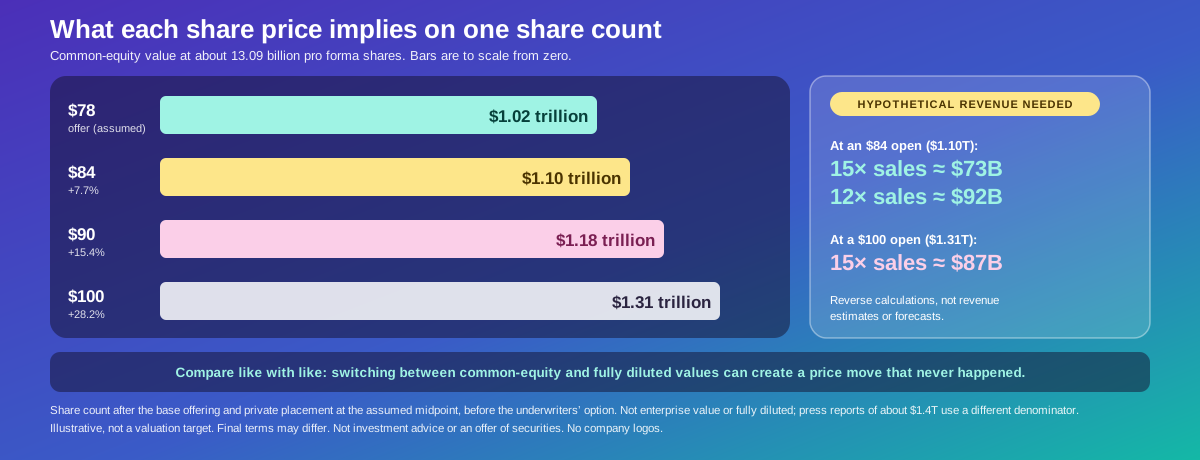
A share price is meaningful only when paired with a share count. Anthropic’s filing shows approximately 13.09 billion common shares outstanding on a pro forma basis after the base offering and concurrent private placement at the assumed midpoint, before full exercise of the underwriters’ option. Holding that count rounded at 13.09 billion lets us compare prices on a consistent basis. The resulting values are common-equity market-cap illustrations, not enterprise values or fully diluted valuations. Final figures will vary with the share count and other deal terms.
| Illustrative share price | Implied common-equity value at 13.09 billion shares | Premium to a $78 offer |
|---|---|---|
| $78 | $1.02 trillion | — |
| $84 | $1.10 trillion | 7.7% |
| $90 | $1.18 trillion | 15.4% |
| $100 | $1.31 trillion | 28.2% |
This explains why press coverage could discuss a valuation of roughly $1.4 trillion on a fully diluted basis within the proposed offer range, while the outstanding-share calculation yields a lower figure. The two calculations use different denominators. Fully diluted valuations can include additional equity claims under specified assumptions; a comparison should use the same definition at the offer and at the open. Switching definitions between the two can create the appearance of an enormous price move that never occurred.
The valuation gets demanding even on the smaller denominator. At an $84 open, the implied common-equity value of roughly $1.10 trillion would equal about 15 times hypothetical annual revenue of $73 billion, or 12 times hypothetical annual revenue of $92 billion. Those revenue figures are reverse calculations, not estimates of what Anthropic will earn in 2027. They show how much revenue the market would need to expect under two chosen multiples, before making a separate judgment about margins, cash flow and dilution. At the same 15 times sales assumption, a $100 open would require about $87 billion of annual revenue to support that multiple.
What the reported revenue growth does and does not prove
Anthropic disclosed $33.24 billion in revenue for the first nine months of 2026, up from $2.55 billion a year earlier. It also reported about $974 million in operating income for the June quarter and a $567 million operating loss for the September quarter. A business can grow sales rapidly while operating margins move in the opposite direction. In this case the company singled out expensive short-term compute and noncash donation-matching charges as factors in the September quarter.
The prospectus also reports $6.6 billion in operating cash flow for the first nine months. That is useful alongside the operating result, but it is not free cash flow and does not remove the need to examine spending on compute and infrastructure. For the same reason, a run-rate revenue figure will not tell you how much revenue has already been recognized or how much cash shareholders could ultimately receive. The opening-price model gives Anthropic credit for exceptional reported growth through the demand assumption. It does not use that growth to turn the auction estimate into a long-term fair-value target.
What to Check Once Anthropic Announces the Final IPO Price
Once the final terms are public, replace the forecast’s assumed offer price with the actual price and check whether the share count changed. A $78 offer with the same 825 million public shares keeps the base opening band at $81.90–$87.36, all else equal. An above-range offer or an upsized deal would justify more than a simple substitution: stronger pricing can signal demand, while a higher starting price or greater supply may absorb some of the expected opening premium.
Next, separate any indicative quote from the official opening price. Under Nasdaq’s rules for releasing IPOs for trading, the exchange disseminates indicative price information while orders build before the first trade. New orders and cancellations can change that indication. A scheduled debut date also does not guarantee the stock opens at 9:30 a.m. ET. When the auction crosses, the resulting first trade is the figure to use for the realized premium.
Finally, measure that premium against the final offer and keep the close separate. For example, an $84 open after a $78 offer gives 7.7% from offer to open. If the stock then finishes the session at $80, that is 2.6% above the offer but 4.8% below the open. All three figures describe the same day, from different entry points. Someone who received an allocation and someone who bought at the first trade would have experienced very different results.
WEEX Editorial View
Our pre-pricing judgment is that $84 is a defensible central estimate at a $78 offer, with about $82–$87 as the base band under that specific pricing assumption. The strongest evidence for a premium is the reported demand for allocations and Anthropic’s disclosed revenue growth. The strongest reason to cap the base case is the scale of the public sale combined with potential first-day resale supply and a valuation that leaves limited room for disappointment.
The number to watch after the offer is set is the premium sustained in the auction as orders accumulate, especially if the early indication moves above $90. That would move the debut into the strong case at a $78 offer. If the indication instead slips below the final offer as launch approaches, the reported bookbuild demand should carry less weight than the orders Nasdaq can actually match.
FAQ
1. What Is the Anthropic IPO Price?
The preliminary offer range was $70 to $78 per share as of November 17, 2026. The final offer price had not been confirmed in the materials reviewed. The $74 midpoint is an assumption used in the prospectus, not an official IPO price.
2. When Is Anthropic Expected to Start Trading?
The reported timetable called for pricing on November 18 and first trading on November 19, U.S. dates, under the proposed Nasdaq ticker ANT. The expected debut date does not establish the exact time of the opening trade.
3. Could Anthropic Open Above $100?
It could, but a $100 open at a $78 offer implies a 28.2% premium. That is beyond the strong-debut band in this model and would require materially stronger auction demand than our base case. A lower final offer would raise the premium needed to reach $100.
4. Is the Anthropic IPO Price the Same for Everyone?
The offer price applies to shares distributed through the IPO. Investors who buy once the stock starts trading pay the price at which their order executes, which can be higher or lower than the offer. Requesting an IPO allocation does not guarantee that the request will be filled.
5. Why Do Anthropic’s IPO Valuation Estimates Differ?
Reports can use different share counts. Multiplying the price by the post-deal common shares outstanding produces one equity value; using a fully diluted share count can produce a higher one. Enterprise value is a separate measure with additional adjustments. Check which figure a source uses before comparing its valuation with a price target.
This content is provided for general informational purposes only and doesn't constitute financial, investment, legal, or tax advice. Any events, rewards, online promotions, or related information mentioned herein should not be considered a recommendation, solicitation, or invitation to purchase, sell, trade, or otherwise deal in any crypto assets. Crypto assets are highly volatile and may result in loss. The availability of WEEX services, products, and related events may vary by region. You are responsible for ensuring that your participation is in accordance with applicable local laws and regulations.
You may also like
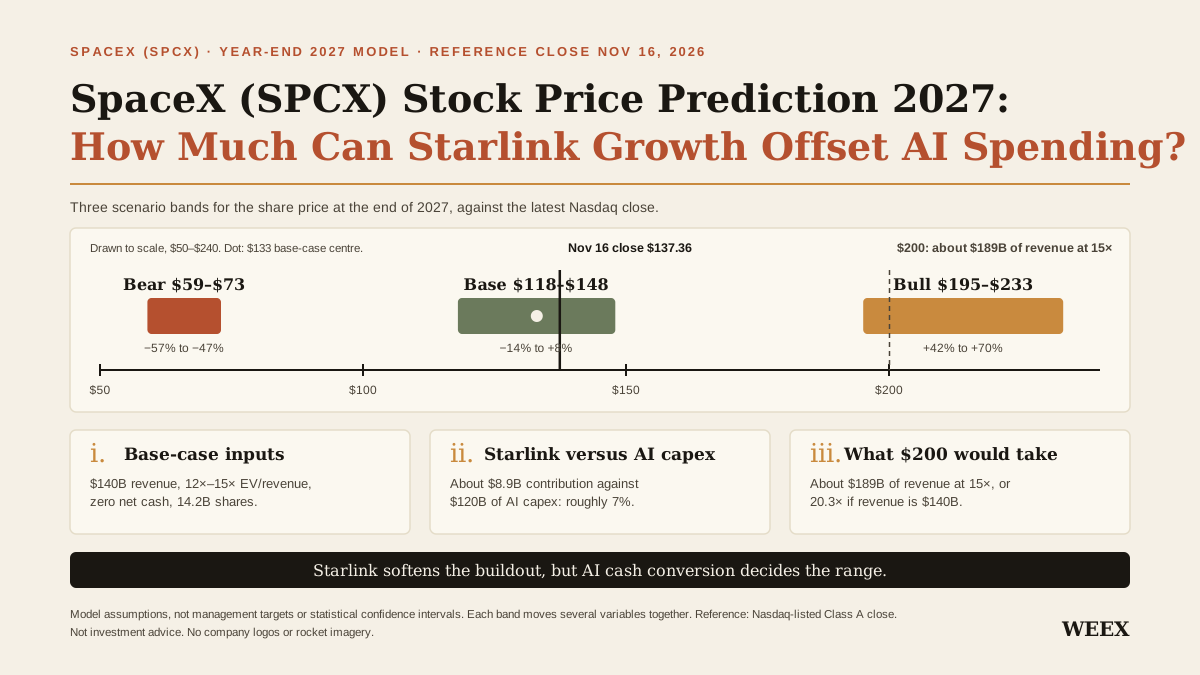
SpaceX (SPCX) Stock Price Prediction 2027: How Much Can Starlink Growth Offset AI Spending?
SpaceX stock price prediction for 2027: See the $118–$148 base case, how much Starlink could offset AI spending, and what it would take to reach $200.

Major Indexes Close Lower, Nvidia Earnings Are Imminent | WEEX Daily Market Brief (November 17, 2026)
At the November 16 close, the three major indexes all finished lower. Technology-stock selling continued, with the chip sector leading declines. Bitcoin’s weekend selloff showed signs of stop-loss hunting; it is currently around $64,000. Backpack received regulatory approval. On November 17, watch for October retail sales data and earnings from Nvidia, Home Depot, Disney, and JD.com.

Bitcoin Falls to $62,000 Over the Weekend; Rumors of Former Nvidia CEO’s Return | WEEX Daily Market Brief (November 16, 2026)
Crypto markets continued to decline amid low weekend liquidity, with Bitcoin probing lower levels. The DeFi sector rebounded first. Stock indexes showed mixed performance last week, with notable volatility in the AI sector. Anthropic is expected to list this Thursday. On November 16, watch Baidu and Trip.com earnings, as well as the execution period for the Coinbase CEO’s stock sale plan.

NVDA Earnings, Retail Sales and FOMC Minutes | WEEX Weekly Market Hotspot Preview (2026.11.16-11.20)
WEEX’s weekly market hotspot preview focuses on retail sales, Microsoft Ignite, NVDA earnings, FOMC minutes, WMT and PANW earnings, final consumer sentiment, and the ZRO unlock. After another volatile stretch for AI trades, markets will reprice AI demand, consumer resilience, rate expectations, and crypto risk appetite, putting QQQ, BTC, ETH, NVDA, MSFT, HD, WMT, PANW, and ZRO in focus.
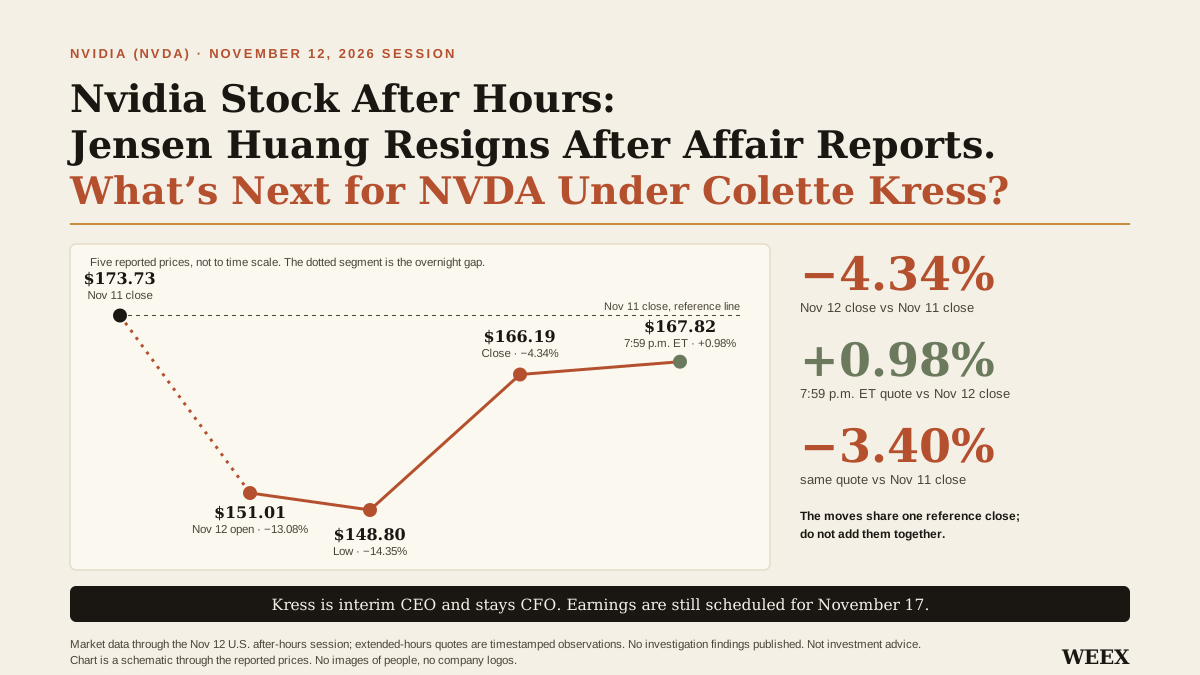
Nvidia Stock After Hours: Jensen Huang Resigns After Affair Reports. What’s Next for NVDA Under Colette Kress?
Nvidia fell 4.34% after Jensen Huang resigned, then rose 0.98% after hours. See what Colette Kress’s appointment means for NVDA and November 17 earnings.

Nvidia CEO Resignation Impacts Tech Stocks; Bitcoin Falls to $70,000 Support | WEEX Daily Market Brief (November 13, 2026)
Technology-stock selling pushed Bitcoin down to the $70,000 support level, while Ethereum briefly fell below $2,000. Spot Bitcoin ETFs recorded net outflows for the fifth consecutive trading day. Nvidia CEO’s resignation triggered sharp share-price volatility. Nebius’s full-year guidance missed expectations. The October PPI is the key release to watch on November 13.

CoreWeave Earnings Drive an AI Rebound, Bitcoin Trades in a Narrow Range | WEEX Daily Market Brief (November 12, 2026)
At the November 11 close, the three major indexes all closed higher. CoreWeave’s strong earnings drove a rebound in technology stocks. Bitcoin treasury companies’ purchase-to-sale ratio fell below 90%. ZEC lost the $1,000 level. GRAM rebounded in the short term. On November 12, watch for Nebius and Ondas before the open, and Cerebras, Applied Materials, and Cisco after-hours earnings.

CPI Exceeds Expectations, Three Major Indexes and Bitcoin Lower | WEEX Daily Market Brief (November 11, 2026)
October CPI rose 0.4% month over month, above expectations. Bond yields climbed, and the three major indexes all closed lower. Bitcoin briefly fell below $73,000. CoreWeave’s third-quarter revenue beat expectations. TSMC’s October revenue was strong. The bond market is closed on November 11; watch for Rumble’s earnings report.

Middle East Easing Expectations Boost Stocks | WEEX Daily Brief (November 10, 2026)
On November 9 close, the S&P 500 and Dow both rose more than 2%. Middle East easing expectations pushed oil prices lower. Bitcoin and Ethereum spot ETFs saw net outflows last week. AVAX rose on reports of tokenized-stock clearing. PIEVERSE surged short-term. November 10 focus is October CPI, TSMC monthly sales data, CoreWeave earnings and others.

CPI, PPI and AI Infrastructure Earnings | WEEX Weekly Market Hotspot Preview (2026.11.09-11.13)
WEEX’s weekly market hotspot preview focuses on CPI, PPI, AI infrastructure earnings, and the MSCI index review. After last week’s sharp tech volatility, markets will reprice inflation pressure, AI capex returns, and risk appetite, putting QQQ, BTC, ETH, CRWV, CSCO, AMAT, NBIS, and CBRS in focus.

Bitcoin Falls for Five Consecutive Weeks, Berkshire Cash Hits New High, Focus on RKLB, CEG Earnings | WEEX Daily Market Brief (November 9, 2026)
Bitcoin and Ethereum spot ETFs saw net outflows last week. Analysts discuss cycle positioning. PEPE rebounded short-term. Nvidia was lower pre-market. Berkshire’s third-quarter cash holdings hit a new high. Anthropic plans to launch an IPO. November 9 focus is CEG and KKR pre-market, and OXY, RKLB and others after hours.

AI Policy Risk Sparks Selloff, BTC Breaks $76K | WEEX Weekly Recap (2026.11.02-11.06)
The market quickly shifted from post-election risk recovery to AI policy risk and data-center restriction pricing. After Democrats gained a clear seat advantage in the midterms, risk assets first traded lower uncertainty, but data-center limits, tighter AI regulation risk, and tech valuation pressure became the new selloff triggers. Thursday’s tech and AI-chain decline pulled BTC below $76,000, moving the market from earnings trades into a second-wave volatility window.
Stocks Crash; Bitcoin Plummets to $76K Support | WEEX TradFi Daily Brief (November 6, 2026)

Major Indexes Rise After Election Clarity, Oil Plunges| WEEX Daily Market(November 5, 2026)
At the November 4 close, all three major indexes rose. Risk assets rebounded after election clarity, but AI-related stocks broadly declined. Brent and WTI oil both fell more than 9% over 24 hours. Bitcoin briefly rose above $80,000, and the crypto market warmed across the board. TRUMP token plunged. November 5 focus is earnings from Moderna, Sony, ConocoPhillips and others.

Tech Stocks Rebound,ARM Earnings in Focus | WEEX Daily Market Brief (November 4, 2026)
At the November 3 close, equity indexes were mixed and divergent, while tech and semiconductors rebounded. Nvidia rose about 2.29%, with market cap returning above $5 trillion. AMD and Super Micro Computer surged after hours. Bitcoin is focused on the $76,000–$77,000 range. November 4 focus is pre-market earnings from Uber, McDonald’s and others, plus after-hours results from Arm, MercadoLibre and others.

Bitcoin Falls to $77,000, Nasdaq Enters Technical Correction | WEEX Daily Market Brief (November 3, 2026)
Bitcoin has fallen for four consecutive weeks. The Nasdaq-100 entered a technical correction, with semiconductors and optical communications under pressure. Apple fell further after hours despite beating expectations, while Palantir posted strong results but declined after hours. Anthropic pre-market contracts fell. Oil fell more than 4% on negotiation signals. November 3 focus is earnings from AMD, Shopify and others.

Midterm Elections, Payrolls and AI Earnings | WEEX Weekly Market Hotspot Preview (2026.11.02-11.06)
WEEX’s weekly market preview focuses on midterm elections, ISM manufacturing and services PMI, JOLTS job openings, payrolls, and earnings from AAPL, PLTR, AMD, SMCI, ARM, QCOM, UBER and NET. After last week’s pressure on tech stocks, markets will trade policy uncertainty, AI investment returns, labor data and crypto risk appetite more directly, with QQQ, BTC, ETH, AAPL, PLTR, AMD, SMCI, ARM, QCOM, NET and ZEC set for more active volatility.

Apple Regains Market-Cap Lead, Silver Back Near $50 | WEEX Daily Market(November 2, 2026)
At the October 31 close, Apple’s market cap once again surpassed Nvidia during the tech pullback. Alphabet fell more than 10% last week. Silver returned near $50. TRUMP token rose more than 10% over 24 hours. OP turned higher after stabilizing. November 2 focus is Marriott before the open and after-hours earnings from Apple, Palantir and others.

AI Earnings Diverge, Tech Sells Off, BTC Breaks $80K | WEEX Weekly Recap (10.26-10.30)
WEEX’s weekly recap tracks AI investment, rate expectations, and crypto. The Nasdaq rose for two sessions early in the week, but concerns about inflation, GOOGL’s sharp drop, and weak after-hours reactions to AMZN and INTC pushed volatility higher. BTC briefly fell below $80,000. As of the morning of October 30, the ECI, Chicago PMI, and XOM and CVX earnings were still pending.

Major Indexes Close Lower as Tech Comes Under Pressure | WEEX TradFi Daily(October 30, 2026)
All three major indexes closed lower on October 29, led down by technology and communication services; healthcare and defensive sectors were relatively resilient. Amazon and Intel came under pressure after hours. HYPE continued to rally toward its record high. TRX rose against the broader crypto-market decline. Investors will watch pre-market earnings from AbbVie, Exxon Mobil, Chevron and others on October 30.

Federal Reserve Holds Rates; AMZN, MSTR Earnings in Focus | WEEX TradFi Daily (October 29, 2026)
All three major indexes closed higher on October 28. The Federal Reserve held its policy rate at 3.75%–4%. Bitcoin briefly rose above $81,000 before pulling back. Storage, optical communications and Neocloud stocks strengthened broadly, with SK Hynix up more than 10%. Google fell about 9%–10% after hours, while Microsoft rose about 4%. Investors will watch after-hours earnings from Amazon, Intel and others on October 29.

SK Hynix Revenue Tops 104 Trillion Won,BTC Holds Near $80,000 | WEEX TradFi Daily (October 28, 2026)
All three major equity indexes closed higher on October 27, led by the Nasdaq. SK Hynix reported third-quarter revenue of 104.6 trillion won and operating profit of 83.3 trillion won, and announced a large-scale shareholder return program. Boeing shares fell about 10.7% after the company lowered delivery targets, hitting an 18-month low. Bitcoin was near $80,200. Meme and Robinhood ecosystem coins strengthened. The October 28 focus is the Federal Reserve decision and after-hours earnings from Google, Microsoft and others.
Anthropic IPO Filing Lifts AI Sentiment; BTC Holds Near $80,000 | WEEX TradFi Daily (October 27, 2026)
All three major indexes closed higher on October 26. Anthropic formally filed for a listing, rekindling AI speculation; the Philadelphia Semiconductor Index rose about 3% on the day, and Tesla reached a more-than-three-month high. Bitcoin was near $80,200, down for three consecutive weeks and testing $80,000 for a third time. Local assets plunged after the election result. The October 27 focus is the opening of the Federal Reserve meeting and earnings from Visa, PayPal and others.
Fed Decision, GDP and PCE Set the Tone | WEEX Weekly Market Preview (10.26-10.30)

Gold Breaks Below $4,000, Bitcoin Pulls Back Below $80,000 | WEEX TradFi Daily(October 26, 2026)
At the October 23 close, major indexes were mixed, with the Dow weaker. Brent crude rose to about $116.7, a near six-month high, and energy led; gold briefly fell below $4,000 as Bitcoin pulled back toward $80,000. Cybersecurity stocks strengthened last week, with CrowdStrike up nearly 12%. Markets are watching whether Bitcoin’s correction is nearing its end, along with earnings from Verizon, Cadence, Celestica and Amkor today.

Risk-Off Sentiment Spreads as Tech| WEEX TradFi Daily(October 23, 2026)
At the October 22 close, the Nasdaq fell about 2.6%, its steepest daily decline since June. Investors reassessed the potential returns on heavy AI investment, while spending commitments from companies such as Meta added to credit concerns. Risk aversion pushed long-bond yields lower, while Brent and WTI reached roughly five-month highs, with WTI nearing $100 a barrel. Bitcoin hovered around $81,000–$82,000, while gold and silver also weakened. Today’s pre-market focus is AXP and SLB earnings.

AI Spending Fears Hit Tech and BTC | WEEX Weekly Recap (2026.10.19-2026.10.23)
WEEX’s weekly recap covers AI spending, technology earnings, crypto assets, and oil. Tech stocks rebounded before selling off sharply: SpaceX results briefly lifted AI sentiment, while Meta, Tesla, and Lam Research drew mixed reactions. The Nasdaq then dropped, BTC retreated toward $81,000–$82,000, oil climbed, and gold and silver weakened.
Major Indexes Close Higher; Focus on TSLA, META Stock Earnings | WEEX TradFi Daily(October 22, 2026)
The three major indexes closed higher on October 21, led by the Nasdaq. SpaceX beat earnings expectations and disclosed AI-business revenue; merger discussions with Tesla also helped lift AI and crypto-related stocks. Bitcoin traded near $84,000 and Ethereum near $2,470. LIT led majors on compliance-license expectations. On October 22, investors will watch Procter & Gamble, Southern Copper and Union Pacific before the open, followed by Western Digital and Newmont after the close.
SpaceX Q3 Revenue Beats and Strengthens After Hours| WEEX TradFi Daily(October 21, 2026)
On October 20, equity indexes were mixed. The S&P 500 closed slightly higher, while the Nasdaq was roughly flat. SpaceX reported third-quarter revenue of $14.58 billion and net income of $4.4 billion, both well above forecasts, and rose about 3% after hours. Bitcoin traded near $83,000, while ZEC led majors with a more-than-10% gain in 24 hours. Memory, optical and crypto-finance names rose from the prior evening, and CoreWeave and SMCI bounced off lows. Tesla, Meta and other companies report on October 21.
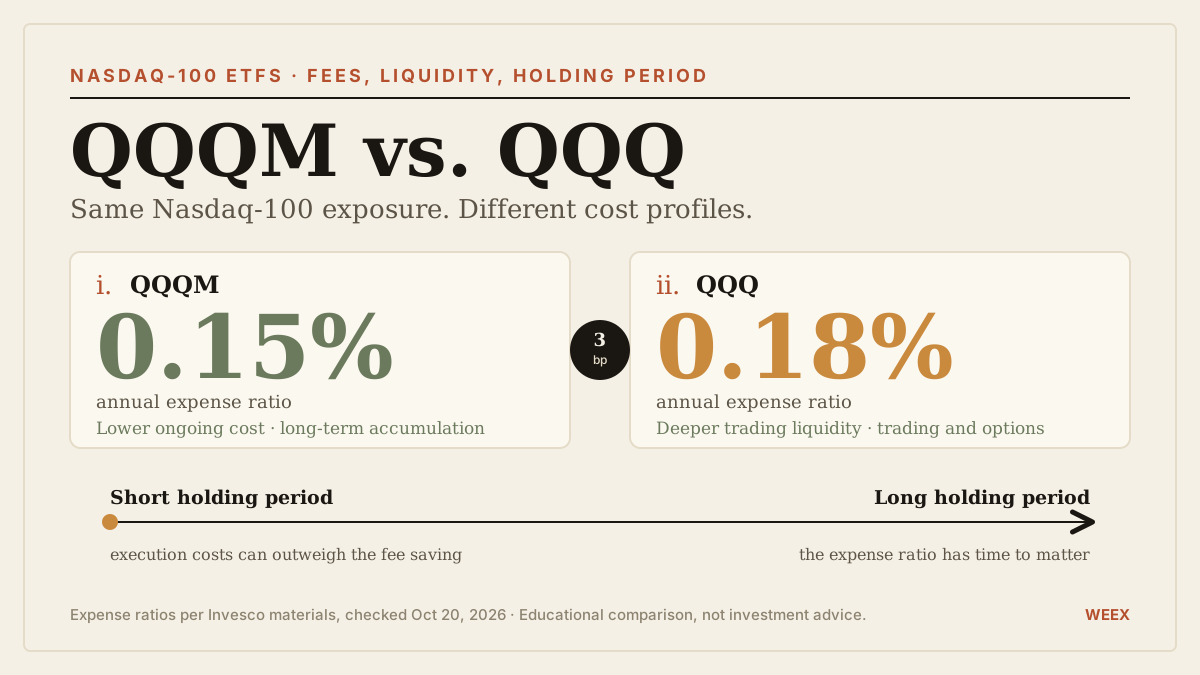
QQQM vs. QQQ in 2026: Fees, Liquidity and Long-Term Investing Compared
Compare QQQM vs. QQQ in 2026: current fees, trading costs, long-term savings, and when switching an existing investment may cost more than it saves.
SpaceX (SPCX) Stock Price Prediction 2027: How Much Can Starlink Growth Offset AI Spending?
SpaceX stock price prediction for 2027: See the $118–$148 base case, how much Starlink could offset AI spending, and what it would take to reach $200.
Major Indexes Close Lower, Nvidia Earnings Are Imminent | WEEX Daily Market Brief (November 17, 2026)
At the November 16 close, the three major indexes all finished lower. Technology-stock selling continued, with the chip sector leading declines. Bitcoin’s weekend selloff showed signs of stop-loss hunting; it is currently around $64,000. Backpack received regulatory approval. On November 17, watch for October retail sales data and earnings from Nvidia, Home Depot, Disney, and JD.com.
Bitcoin Falls to $62,000 Over the Weekend; Rumors of Former Nvidia CEO’s Return | WEEX Daily Market Brief (November 16, 2026)
Crypto markets continued to decline amid low weekend liquidity, with Bitcoin probing lower levels. The DeFi sector rebounded first. Stock indexes showed mixed performance last week, with notable volatility in the AI sector. Anthropic is expected to list this Thursday. On November 16, watch Baidu and Trip.com earnings, as well as the execution period for the Coinbase CEO’s stock sale plan.
NVDA Earnings, Retail Sales and FOMC Minutes | WEEX Weekly Market Hotspot Preview (2026.11.16-11.20)
WEEX’s weekly market hotspot preview focuses on retail sales, Microsoft Ignite, NVDA earnings, FOMC minutes, WMT and PANW earnings, final consumer sentiment, and the ZRO unlock. After another volatile stretch for AI trades, markets will reprice AI demand, consumer resilience, rate expectations, and crypto risk appetite, putting QQQ, BTC, ETH, NVDA, MSFT, HD, WMT, PANW, and ZRO in focus.
Nvidia Stock After Hours: Jensen Huang Resigns After Affair Reports. What’s Next for NVDA Under Colette Kress?
Nvidia fell 4.34% after Jensen Huang resigned, then rose 0.98% after hours. See what Colette Kress’s appointment means for NVDA and November 17 earnings.
Nvidia CEO Resignation Impacts Tech Stocks; Bitcoin Falls to $70,000 Support | WEEX Daily Market Brief (November 13, 2026)
Technology-stock selling pushed Bitcoin down to the $70,000 support level, while Ethereum briefly fell below $2,000. Spot Bitcoin ETFs recorded net outflows for the fifth consecutive trading day. Nvidia CEO’s resignation triggered sharp share-price volatility. Nebius’s full-year guidance missed expectations. The October PPI is the key release to watch on November 13.
Latest articles
Latest coin listings on WEEX


