
Why is Crypto Payment Still Not Working Even with Licenses?

 Prefer us on Google



The goal of a project should not be the number of licenses, but the integrity of its operational structure.
Written by: Shao Jiadian
In the development of crypto payment projects, licenses are usually not the first issue to arise. Companies may have obtained CASP authorization, completed FinCEN MSB registration, and connected with licensed payment institutions abroad, yet their operations may still be hindered by specific aspects such as customer funds, wallet control, fiat accounts, and merchant settlements.
Once the business starts running, several issues quickly become apparent: institutions capable of handling digital assets may not be able to process euro payments; banks may be willing to open operational accounts but refuse to accept long-term aggregation of third-party customer funds; and different companies within the group may be responsible for customer development, contract signing, wallet control, and transaction execution.
As a result, each company in the group has its own regulatory identity, yet the entire transaction still cannot be completed smoothly. The number of licenses does not solve this problem; the key lies in whether customers, assets, fiat, and responsibilities are aligned within an executable business chain.
Licenses can only answer whether a certain entity can engage in a regulated business. Who receives the customers, who controls the stablecoins, who pays the euros, why the bank accepts the funds, and who handles refunds or freezes must all be tied to specific entities, contracts, accounts, and system permissions.
Previous articles have discussed the MSB in the U.S., MSB in Canada, DCE in Australia, MiCA CASP in the EU, VARA in Dubai, stablecoins in Hong Kong, and licensed collaborations. Returning to the practical operation of crypto payments, the question is actually quite simple: if every link has compliance arrangements, why are transactions still unable to be completed?
The focus of judgment is on which entities, accounts, and systems the transactions actually pass through; it cannot be based solely on the list of licenses.
Projects need to break down customer wallets, asset custody, stablecoin exchanges, on-chain transfers, fiat payments, and merchant settlements, clearly stating which entity completes each function, based on which authorization, and who bears responsibility when issues arise.
Projects need a table correlating business functions with regulatory identities: customer wallets, asset custody, stablecoin exchanges, on-chain transfers, fiat payments, and merchant settlements, specifying which entity completes each function, based on which authorization, and who bears responsibility when issues arise.
01 License Lists Do Not Reflect Real Business
The most common mistake projects make is placing all regulatory qualifications obtained by the group on the same promotional page and then assuming that these licenses cover all business activities.
For example, the group may have MSB registration in the U.S., CASP authorization in Europe, and established partnerships with licensed payment institutions in other regions. These regulatory identities are certainly valuable, but they cannot simply be added together.
The MSB registration from FinCEN in the U.S. does not cover a unified operating license for money transmission across the entire country; specific activities still need to be judged in conjunction with state laws.
The EU CASP can enter other member states through the MiCA Passporting mechanism after completing the required cross-border notifications, but the services it can provide across borders are still limited to the original scope of authorization for crypto asset services. Completing Passporting does not automatically grant full business permissions for payment institutions or electronic money institutions.
For stablecoin payment projects, the issues may be even more complex. On March 2, 2026, the transitional period set by the EBA for MiCA and PSD2 will end, and some transfers and custody wallet services involving electronic money tokens (EMT) may simultaneously require addressing payment service authorization issues.
This means that projects cannot simply ask how many licenses the group has; they must confirm item by item: customer wallets, asset custody, stablecoin exchanges, on-chain transfers, fiat payments, and merchant settlements, which specific entity's authorization each falls under.
What projects need is a table correlating business functions with regulatory identities, not a list of group licenses.
02 Customer Relationships, Asset Control, and Fund Paths Do Not Align
Suppose a corporate client is preparing to make a payment to a European merchant.
The client registers on the project’s official website, uploads corporate information, and completes KYC/KYB, then transfers stablecoins to the wallet designated by the platform. The platform completes the exchange and then transfers euros to the merchant's bank account through a payment partner.
What the user sees may just be a payment, but regulatory and bank due diligence needs to restore at least three different paths.
The first path is the customer relationship path. Which company within the group does the client sign the service agreement with? Is the client purchasing digital asset exchange services, funds transfer services, or a complete cross-border payment service? In the event of refunds and complaints, which entity should be responsible?
The second path is the crypto asset control path. Which address does the client's stablecoin enter? Who controls the private key? When is the asset transferred to the CASP or liquidity provider? Who has the authority to decide on transaction execution, and who bears the responsibility for protecting customer assets?
The third path is the fiat fund path. Where do the dollars or euros go after the stablecoins are exchanged? Is that account allowed to receive the relevant funds? Who ultimately executes the payment to the merchant, and can the bank identify the actual payer and payee?
If the client signs with a European CASP but the assets and fiat are long-term controlled by other entities without the corresponding business permissions, the project needs to re-examine the actual service providers and legal responsibilities.
If the contract states it is a technical service, but in reality, a technology company receives customer funds and decides on transactions, it cannot be simply determined that it is completely unrelated to financial regulation based solely on the contract name.
03 Having Licenses Does Not Mean Banks Are Willing to Accept Transactions
This is where the previous issues often converge and become apparent.
A company may have already obtained regulatory approval and found a partner that can provide fiat services, yet still cannot establish stable payment and receipt accounts.
The reason may not necessarily be that banks do not accept the crypto asset industry, but that the intended use of the accounts proposed by the project cannot be recognized by the banks.
For example, banks may allow companies to open accounts for payroll, rent, and normal operating expenses, but that does not mean that the account can be directly used to receive payments from multiple third-party customers.
A licensed institution may be able to handle specific types of financial transactions, but that does not mean its banking partners have approved all customer regions, transaction amounts, sources of funds, and merchant categories.
The European Banking Authority (EBA) emphasizes that financial institutions should assess customers based on their actual risks and should not excessively de-risk entire categories of customers without sufficient basis. However, banks still need to comply with anti-money laundering requirements and decide whether to establish or continue business relationships when they cannot effectively manage related risks.
Therefore, even if a project is licensed, it still needs to explain to the bank: what the account is specifically used for, how customer funds are formed, whether transactions correspond to real commercial activities, which links the on-chain assets have passed through, and how the enterprise identifies and handles abnormal transactions.
If this explanation cannot hold, simply increasing the number of licenses may not solve the account opening issue.
Licenses can prove that a certain business has a legal operating basis, but banks still need to assess whether they can bear the risks associated with that business entering their account system.
Thus, a truly mature license planning should not wait until after approval to seek banks.
Account types, payment and receipt paths, clearing methods, and the business admission scope of banking partners should be considered simultaneously when designing licenses and group entities.
-- Price
04 Many Licensed Partners, Yet No One Takes Responsibility for Complete Transactions
The crypto payment industry has already formed a large number of mature infrastructure cooperation models.
Wallets can connect to third parties, identity verification can call KYC service providers, exchanges can be handled by liquidity institutions, and fiat payments can be undertaken by PIs, EMIs, or banks.
This division of labor is not problematic in itself. For enterprises that do not plan to hold licenses in all markets, reasonably utilizing licensed institutions may even be a more efficient business choice.
However, the more partners there are, the easier it is for responsibilities to become dispersed.
For example, a customer payment may be paused due to a risk alert triggered by the on-chain address. The wallet service provider believes it is only responsible for technology, the CASP thinks KYC is handled by the front-end platform, the payment institution believes the source of assets is not within its review scope, and the project party thinks the entire process has been handed over to licensed partners.
If, when a transaction experiences an anomaly, all parties start discussing who has the authority to freeze, who is responsible for explanations, and who contacts the customer, it indicates that this cooperation relationship has not yet formed a truly executable responsibility arrangement.
Article 73 of MiCA clearly states the requirements for CASP outsourcing: enterprises can outsource operational functions, but cannot therefore transfer their regulatory responsibilities, nor can outsourcing change the relationship between the CASP and customers or its authorization conditions.
Licensed cooperation must handle interface access and business sharing, and also clearly define responsibility boundaries.
Cooperation agreements should also clarify customer access, transaction instructions, asset control, compliance monitoring, abnormal handling, data sharing, complaints and refunds, regulatory inspections, and how to migrate customers after cooperation termination.
For regulated services that enterprises have already actually provided, necessary authorizations cannot simply be replaced by the licenses of partners.
Whether services can be handed over to others to complete is different from whether regulatory responsibilities can be transferred to others.
05 Business Runs Smoothly, Yet Cannot Form Continuous Risk Control
Some projects can complete test transactions and provide transfer and exchange services for a small number of customers, but may still encounter significant obstacles when scaling up.
The reason lies in the differing requirements between completing a transaction and operating a financial business long-term.
Early projects may only serve a small number of corporate clients, with relatively clear sources of transactions and uses of funds. However, as the platform begins to cover more countries, increase the number of merchants, support self-custody wallets, or connect multiple liquidity providers, the risk management requirements will also change accordingly.
In July 2026, the FATF released the seventh update on the regulation of virtual assets and service providers, particularly focusing on the abuse of stablecoins, transactions related to self-custody wallets, offshore VASPs, DeFi arrangements, and the difficulties in implementing the Travel Rule.
This means that for crypto payment projects, compliance cannot stop at completing a KYC once when opening an account or purchasing a set of on-chain analysis tools.
Projects need to continuously identify customers and trading partners, monitor abnormal transactions, fulfill applicable Travel Rule information requirements, and handle risks related to sanctions, fraud, and suspicious funds.
A more practical issue is, once customer funds have entered the platform, how to handle situations where transactions cannot be executed or banks refuse to settle? If a partner suddenly stops providing services, can the platform promptly identify affected customer assets and arrange for refunds or other legal disposals?
A truly mature risk control system should cover before the transaction starts, during execution, and after transaction failures.
06 Before Launch, Conduct a Complete Stress Test with One Transaction
Instead of checking all licenses and regulatory documents together, it is better to choose a typical business scenario that the project is preparing to launch and conduct a simulation from start to finish.
For example, an Asian company uses a stablecoin that meets applicable regulatory requirements to pay a European supplier for goods, and the supplier ultimately receives euros.
The project needs to answer the following questions according to the actual business process.
If there are questions that cannot be answered, the project cannot claim that it has met all conditions for launch, nor can it cover this gap by relying on licenses already held in other areas.
Some issues cannot be resolved simply by adding a license. If banks refuse to accept specific types of customer funds, it may require adjustments to account and transaction structures; if responsibilities within the group are unclear, it may require redefining the signing and asset control entities; if partners lack access to transaction data, it may require modifying system permissions and agreement arrangements.
For enterprises, this method of inspection is closer to real operations than simply comparing the number of licenses.
07 Coordinated Multi-License, Three Diagrams Are Essential
A company preparing to conduct global crypto payment business long-term does not necessarily need to establish completely independent business systems in every market.
However, it must confirm that different regulatory entities can work together according to clear rules.
A more reasonable planning approach can be divided into three stages.
The first stage: design the business, then choose the regulatory path.
Projects need to clarify which countries their main customers are located in, where the funds come from, where the final settlement is, and whether the products involve issuance, custody, exchange, fund transfers, or traditional payment services.
On this basis, they can determine which qualifications the group needs to hold themselves and which businesses can be completed through licensed cooperation.
The second stage: synchronize the design of licenses, accounts, and fund paths.
Enterprises should determine customer signing entities, asset control methods, bank account purposes, payment partners, and service agreements within and outside the group at the entity structure stage, rather than adding a new company for each license obtained.
For projects that plan to expand into multiple markets in the future, they also need to consider local customer access, cross-border service restrictions, and business licensing scopes in advance.
The third stage: verify the entire structure in real transactions.
Before officially launching on a large scale, representative customers and transaction types should be selected to verify whether the flow of funds, information, and responsibilities is consistent according to the approved testing arrangements, and check the handling capabilities in cases of abnormal transactions, cooperation interruptions, refunds, and customer complaints.
The focus is not on completing a successful payment, but on confirming whether the entire business can be continuously executed in real operations.
When to obtain licenses, when to cooperate, and when to adjust business structures.
Conclusion: Licenses Must Ultimately Transform into Executable Payment Paths
From the MSB in the U.S., MSB in Canada, and DCE in Australia, to DASP in El Salvador, VASP in the Cayman Islands, and MiCA in the EU, VARA in Dubai, stablecoins in Hong Kong, and multi-license coordination, we have discussed the regulatory paths of different countries and regions in the "Global Crypto Payment Compliance Map."
These systems each have their characteristics and correspond to different market and business needs.
However, if we look at the entire series together, we find that there is a persistent issue:
A crypto payment project needs to solve not only what a certain country allows it to do, but also how to connect different countries, different financial institutions, and different business functions.
An MSB registration cannot replace state-level licenses, a CASP cannot automatically cover all fiat payment services, a VARA license cannot directly solve all payment token issues, and having multiple licensed partners does not mean that banks will necessarily accept the relevant funds.
The goal of the project should not be the number of licenses, but the integrity of its operational structure.
Who provides services to the customer, who legally holds and transfers assets, who executes exchanges and payments, why the bank can accept these funds, and who bears responsibility when anomalies occur.
These questions must have clear answers for licenses to truly transform into business capabilities.
The ultimate goal of global crypto payment compliance is not to let every company obtain the most licenses, but to ensure that every fund can be completed through a legal, clear, and sustainable path.
This is also the core question that the entire series of the "Global Crypto Payment Compliance Map" aims to answer.
This content is provided for general informational purposes only and doesn't constitute financial, investment, legal, or tax advice. Any events, rewards, online promotions, or related information mentioned herein should not be considered a recommendation, solicitation, or invitation to purchase, sell, trade, or otherwise deal in any crypto assets. Crypto assets are highly volatile and may result in loss. The availability of WEEX services, products, and related events may vary by region. You are responsible for ensuring that your participation is in accordance with applicable local laws and regulations.
You may also like

Interest Rates Rebound to Three-Week High, Mortgage Demand Weakens

Target's Q3 Earnings Exceed Expectations, Raises Full-Year Guidance

Mining Giant MARA's Strategic Shift: Selling 40,000 BTC for Power Plants

Emerging Markets: Over $60 Billion Flees in Two Months Amid Growing AI Crisis Fears

Warnings Behind 50 Authorizations: How TBC Tightens Signature Permissions

a16z Frontier Explores AI Agent Sector, Uncovering a New Startup Opportunity

US Judge Acquits in $25 Million Fraud Case

SoFi Is Targeting 100 Million Products by 2030. Here’s What $10,000 Invested Today Could Be Worth if It Gets There.

CFTC Blockchain Derivatives Approval: Does It Mean You Can Trade Yet?

Genesis AI CEO States Robots Don't Need Heads

IOSG: Bitcoin Needs to Reach $250,000 to Compete with AI in Mining
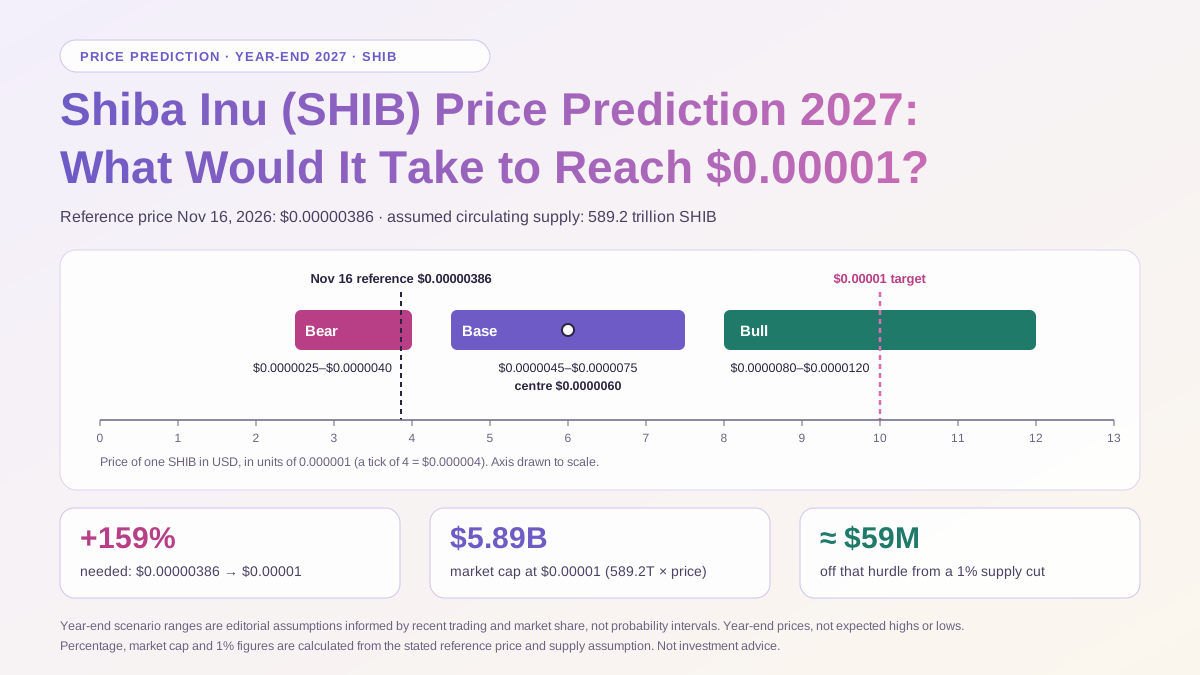
Shiba Inu (SHIB) Price Prediction 2027: What Would It Take to Reach $0.00001?
See our Shiba Inu price prediction for 2027, including the $0.000006 base estimate, the market cap needed for $0.00001, and how much burns could help.

Samsung Electronics and Apple Close to Signing Long-term DRAM Supply Agreement

WEEX P2P now supports CAD —Merchant Recruitment Now Open

Cardano Foundation seeks 25M ADA for 2027 events despite $1.2M funding gap

NVIDIA Employees Warn Board of Potential Loss of "Irreplaceable" Talent

The Arrogance and Prejudice of a16z

Unocoin Estimates $200,000 Loss as Backup-Key Finding Explains Wallet Transfers
ARTEX AI tool breaches networks in under 3 hours, FBI warns
Matt Hougan has a positive outlook on Bitcoin and altcoins

Win an iPhone 18 Pro Max on WEEX? 201 Lucky Eggs Explained

Tesla Autopilot Team Veterans Found Simulation Startup Valued at $1 Billion
CoW Swap Launches on Solana, Supporting USDC and Wrapped SOL Exchange

CoW Swap Launches Alpha Version, Supporting USDC and wSOL Exchange
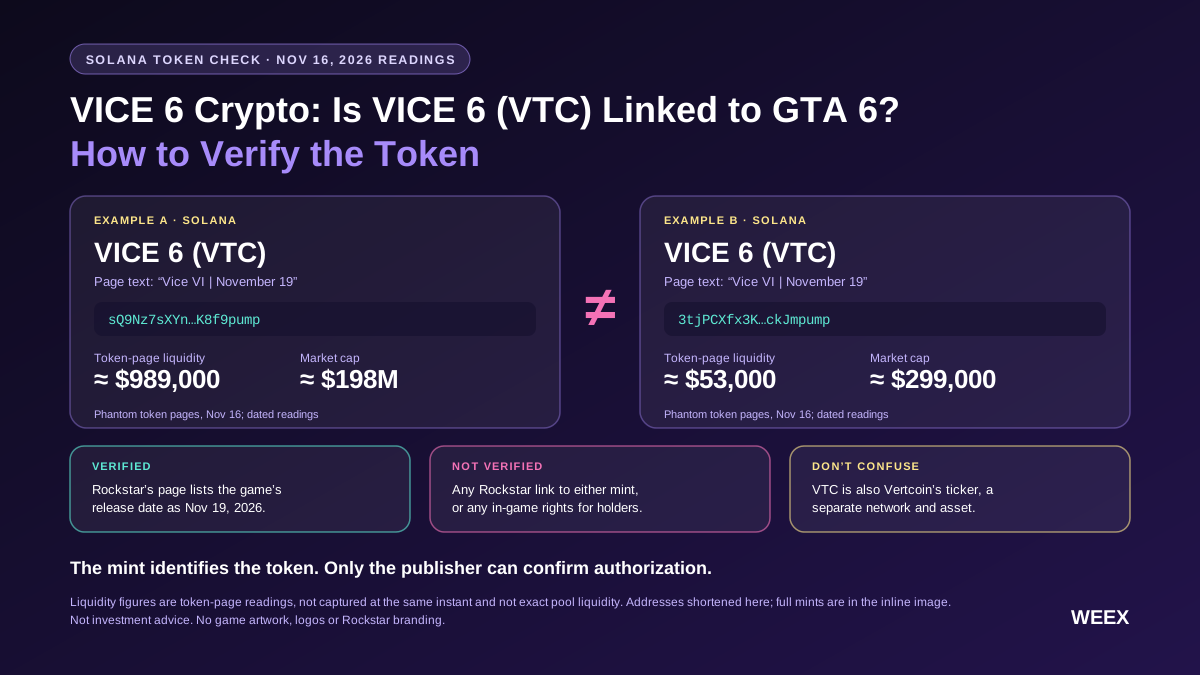
VICE 6 Crypto: Is VICE 6 (VTC) Linked to GTA 6? How to Verify the Token
Is VICE 6 crypto linked to GTA 6? Compare two Solana tokens using VTC, verify their mint and pool addresses, and see what Rockstar has confirmed.
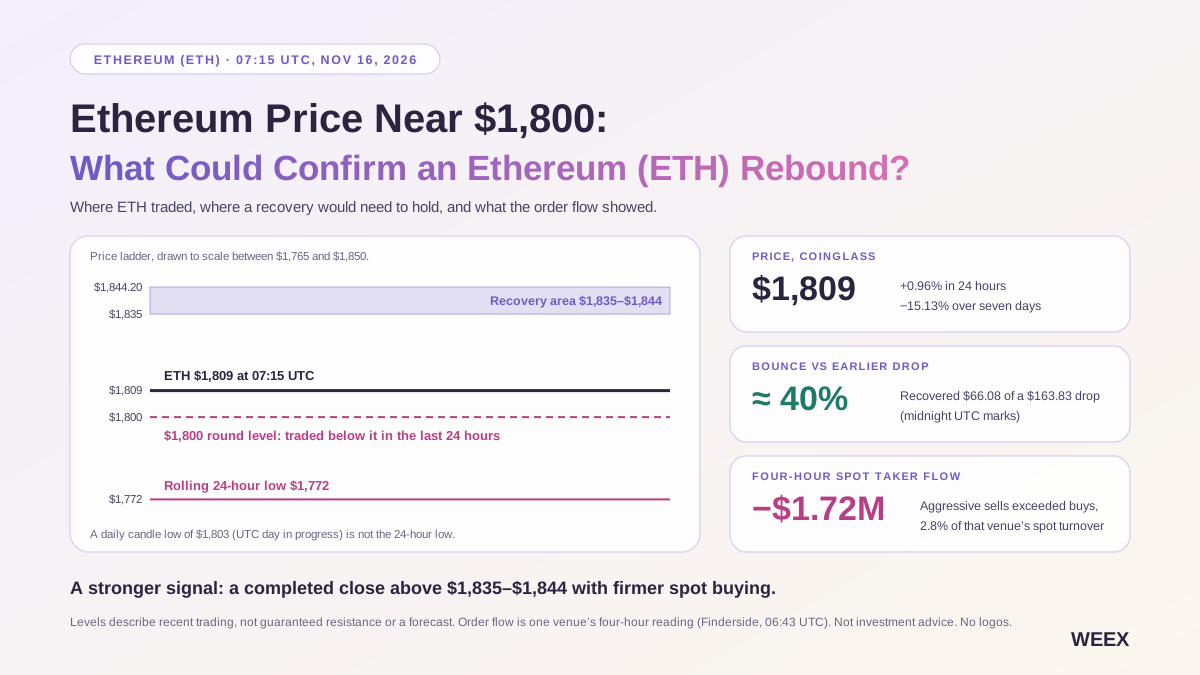
Ethereum Price Near $1,800: What Could Confirm an Ethereum (ETH) Rebound?
Ethereum traded near $1,800 on November 16. See what four-hour spot order flow, futures positioning, and Friday’s ETF flows say about an ETH rebound.
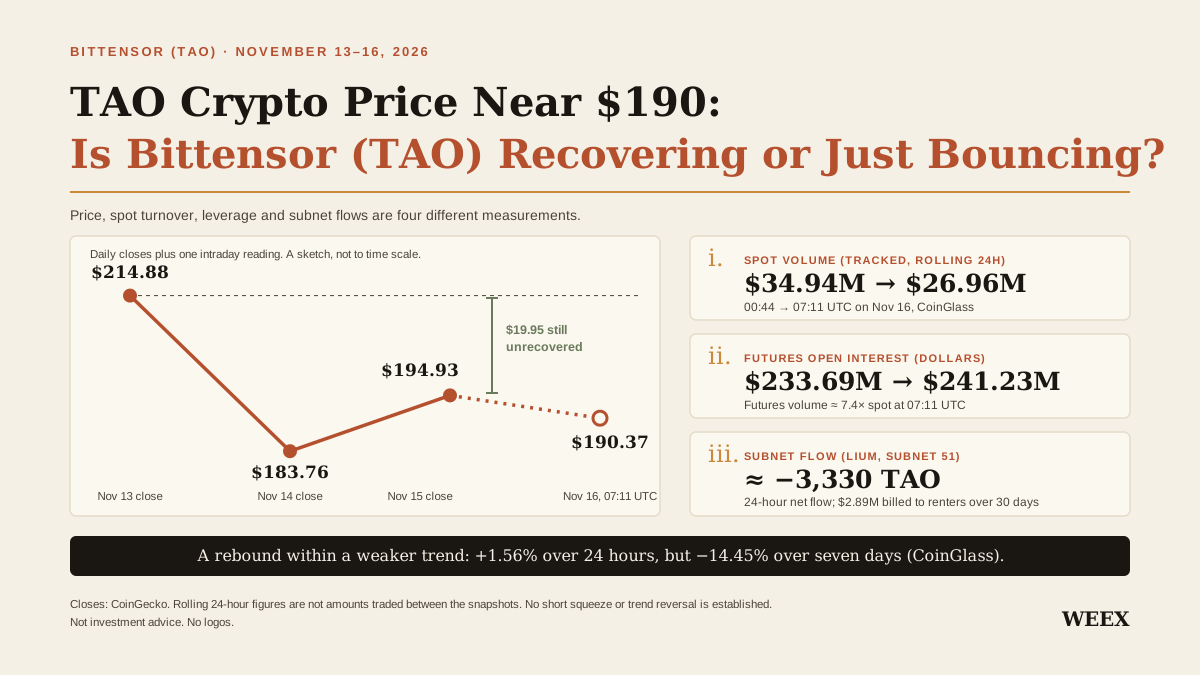
TAO Crypto Price Near $190: Is Bittensor (TAO) Recovering or Just Bouncing?
TAO bounced near $190. Compare spot volume, futures positioning, and Bittensor subnet flows to see what would confirm a more durable recovery.
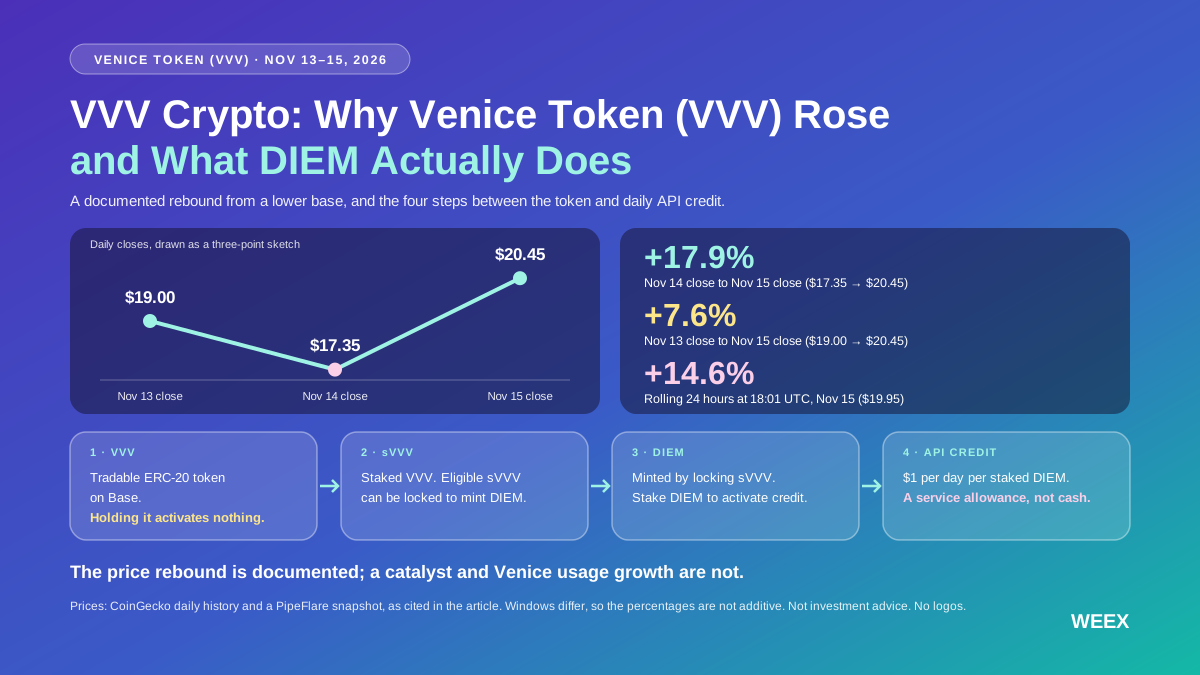
VVV Crypto: What Is Venice Token, Why Venice Token (VVV) Rose and What DIEM Actually Does
Venice Token rose about 14.6% in one November 15 snapshot. Learn what the data shows, how VVV staking works, and what DIEM’s daily API credit buys.
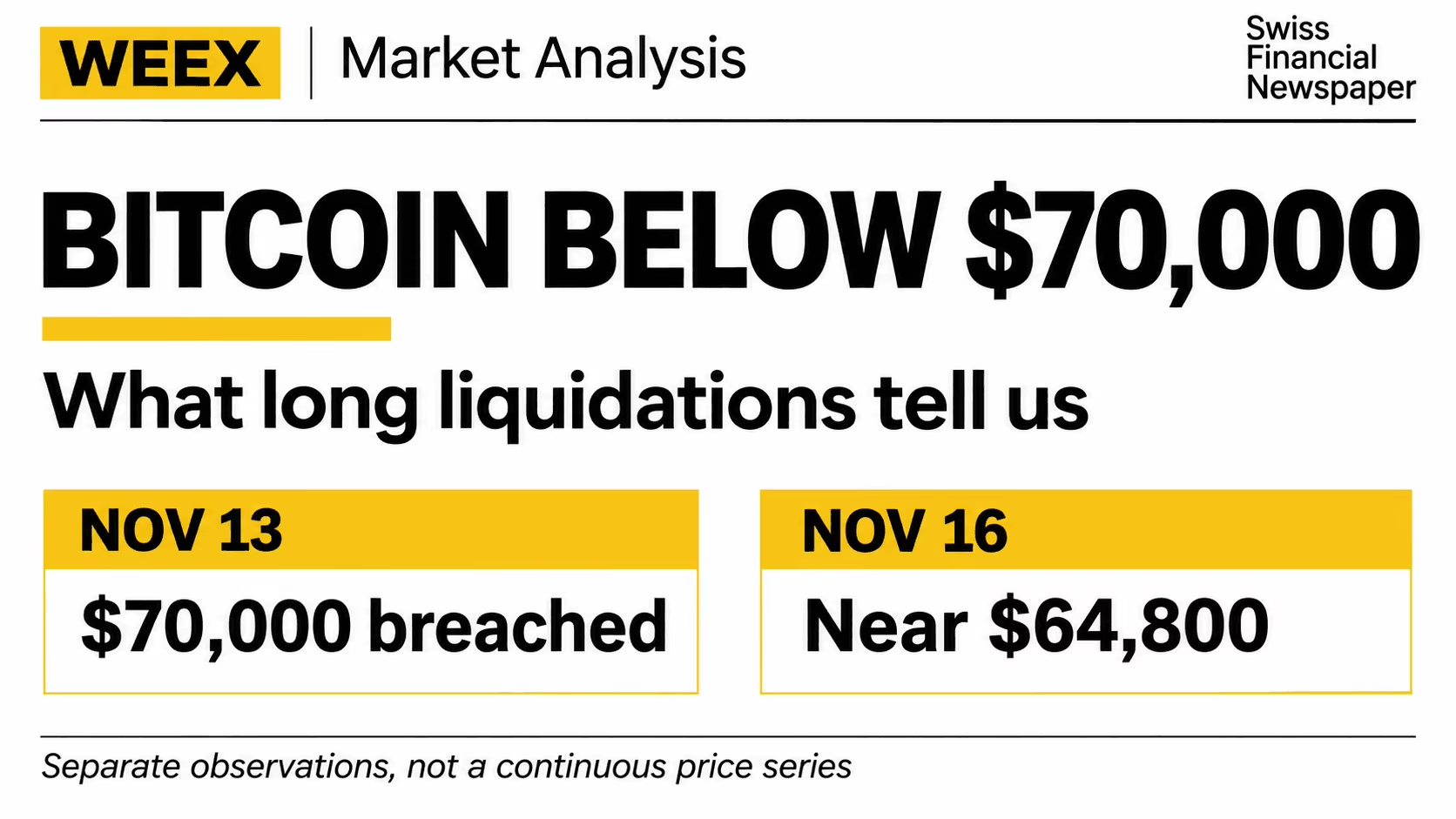
Why Did Bitcoin (BTC) Drop Below $70,000? What Long Liquidations Tell Us
See why Bitcoin fell below $70,000 on November 13, how long liquidations amplified the decline, and what to watch before calling a rebound. If you already plan to trade, you can check whether your activity qualifies for the WEEX Lucky Eggs event, scheduled to run through November 25, 2026 (UTC+8).

WEEX Lucky Eggs: How to Earn Daily Egg Cracks and Win Every Time
Learn how to earn daily WEEX Lucky Eggs from qualifying futures trading volume, check your progress, and understand what “Win Every Time” means.
Interest Rates Rebound to Three-Week High, Mortgage Demand Weakens
Target's Q3 Earnings Exceed Expectations, Raises Full-Year Guidance
Mining Giant MARA's Strategic Shift: Selling 40,000 BTC for Power Plants
Emerging Markets: Over $60 Billion Flees in Two Months Amid Growing AI Crisis Fears
Warnings Behind 50 Authorizations: How TBC Tightens Signature Permissions
a16z Frontier Explores AI Agent Sector, Uncovering a New Startup Opportunity
Latest articles


Latest coin listings on WEEX


