
CFTC Chair Calls for "Mass Tokenization"! Wall Street Faces Three Barriers to Full On-Chain Adoption

 Prefer us on Google


The Chair of the U.S. Commodity Futures Trading Commission (CFTC), Michael Selig, stated during a keynote speech at the 2026 U.S. Treasury Market Conference that the U.S. market must prepare for "mass tokenization," on-chain finance, and 24/7 trading. He believes that tokenized assets can facilitate near-instant settlement and the immediate flow of collateral among clearinghouses, intermediaries, and end users.
Selig emphasized that regulators must prepare traditional markets for mass tokenization, on-chain finance, and 24/7 trading by adjusting existing capital, collateral, and market structures to enable large-scale adoption of technologies like blockchain in a regulated environment. He also pointed out that high-quality tokenized collateral can enhance market resilience, allowing assets to be transferred almost instantaneously among exchanges, clearinghouses, and market participants; stablecoins may become important settlement and margin tools in the on-chain derivatives market.
Policies Transitioning from Slogans to Limited Trials
This year, the CFTC has allowed futures merchants to list certain payment stablecoins and non-security digital assets as customer margin under specified conditions. Staff have also issued guidelines for 24/7 trading, clearing, and settlement, requiring exchanges, clearinghouses, and futures merchants to proactively address market surveillance, margin, cybersecurity, business continuity, and liquidity risks.
However, these measures do not imply that all markets will soon operate year-round. The CFTC has made it clear that 24/7 trading must be assessed by asset class: crypto assets already have a global, round-the-clock spot market, while agricultural and energy contracts involve regional supply and demand, physical delivery, and specific hedging practices that may not be suitable for the same model.
Selig reiterated at the conference, "While many markets are transitioning to round-the-clock trading, this does not mean that all markets are ready to make immediate changes. I have made it clear that under my leadership, the Commission will not adopt a one-size-fits-all approach to 24/7 trading. The evolution of market structure should occur through thoughtful, responsible gradualism, rather than assuming that a model applicable to one product or trading venue can be universally applied."
Stablecoins Are Scalable, Tokenized Securities Are Still Early Stage
Data from RWA.xyz as of September 24 shows that the global stablecoin market capitalization is approximately $306.3 billion, increasing by 1.21% over the past 30 days; the monthly on-chain transfer volume is about $7.13 trillion, growing by 6.06%. Stablecoins have reached a market scale capable of serving as the infrastructure for on-chain payments and collateral.
In contrast, the scale of tokenized U.S. Treasury funds is about $14.93 billion, declining by 5.96% over the past 30 days; the value of tokenized equities is approximately $3.14 billion, which, although increasing by 14.98% month-on-month, remains limited compared to traditional stocks, bonds, and derivatives markets.
This indicates that the financial on-chain transition is currently exhibiting two speeds: stablecoins have entered payment, trading, and collateral scenarios, while tokenized securities are still in the product testing, regulatory exemption, and market cultivation stages.
The Real Bottleneck Is Not Order Placement, But Clearing and Legal Rights
Wall Street still needs to overcome three barriers to full on-chain adoption: first, whether banking, payment, and clearing systems can support 24/7 collateral management; second, whether on-chain tokens can represent clear and legally enforceable asset rights; third, whether exchanges and clearinghouses can establish round-the-clock valuation, margin, and market risk control mechanisms.
Tokens can be transferred 24 hours a day, but this does not mean that banking cash, custody, clearing, and risk departments can operate in sync. If there is significant volatility over the weekend, market participants may be unable to promptly replenish traditional fiat collateral, and clearinghouses may need to raise margin requirements, reduce leverage, or demand additional assets in advance.
The existence of tokens on-chain does not guarantee that holders possess complete legal rights to the corresponding assets. This is also the most important distinction between "true tokenized stocks" and "synthetic tokens that merely track stock prices." Regulators still need to confirm:
- Whether tokens represent actual stock, bond, or fund rights;
- Whether holders enjoy dividends, voting rights, and redemption rights;
- Whether on-chain assets are isolated from company assets in the event of issuer bankruptcy;
- Which set of records prevails when on-chain records conflict with traditional security registration data;
- Which jurisdiction's laws apply after cross-border asset transactions.
Stablecoins can fill part of the time gap during "bank holidays while the market is still trading," but this requires that issuers have reliable reserves, redemption mechanisms, bankruptcy isolation, and custody arrangements, and clearinghouses must also set valuation discounts and concentration limits. Therefore, the qualification of stablecoins as collateral does not equate to being regarded as risk-free cash.
A 24/7 market cannot rely on risk management systems that are only updated on business days. Exchanges, clearinghouses, and futures merchants must be able to operate around the clock, and even if a certain stablecoin is approved as collateral, it does not mean it is fully equivalent to cash in U.S. dollars. Clearinghouses may still impose valuation discounts due to issuer, reserve, liquidity, or decoupling risks.
Selig mentioned, "Extending trading hours must be done responsibly and based on the mission of institutions to promote responsible innovation and maintain market integrity. The Commission's responsibility is to ensure that our monitoring systems, margin frameworks, and operational safeguards can continue to function effectively to respond to market decisions to shift to a 24/7 trading model."
In conclusion, Selig stated that during the entire term of the Trump administration, the U.S. has laid the groundwork to maintain its leading position, "With the advancement of technologies such as tokenization, on-chain finance, and 24/7 trading, the changes in financial markets over the next decade may exceed the total of the past several decades. If the question is whether the U.S. can continue to lead these markets, my answer is yes."
-- Price
This content is provided for general informational purposes only and doesn't constitute financial, investment, legal, or tax advice. Any events, rewards, online promotions, or related information mentioned herein should not be considered a recommendation, solicitation, or invitation to purchase, sell, trade, or otherwise deal in any crypto assets. Crypto assets are highly volatile and may result in loss. The availability of WEEX services, products, and related events may vary by region. You are responsible for ensuring that your participation is in accordance with applicable local laws and regulations.
You may also like
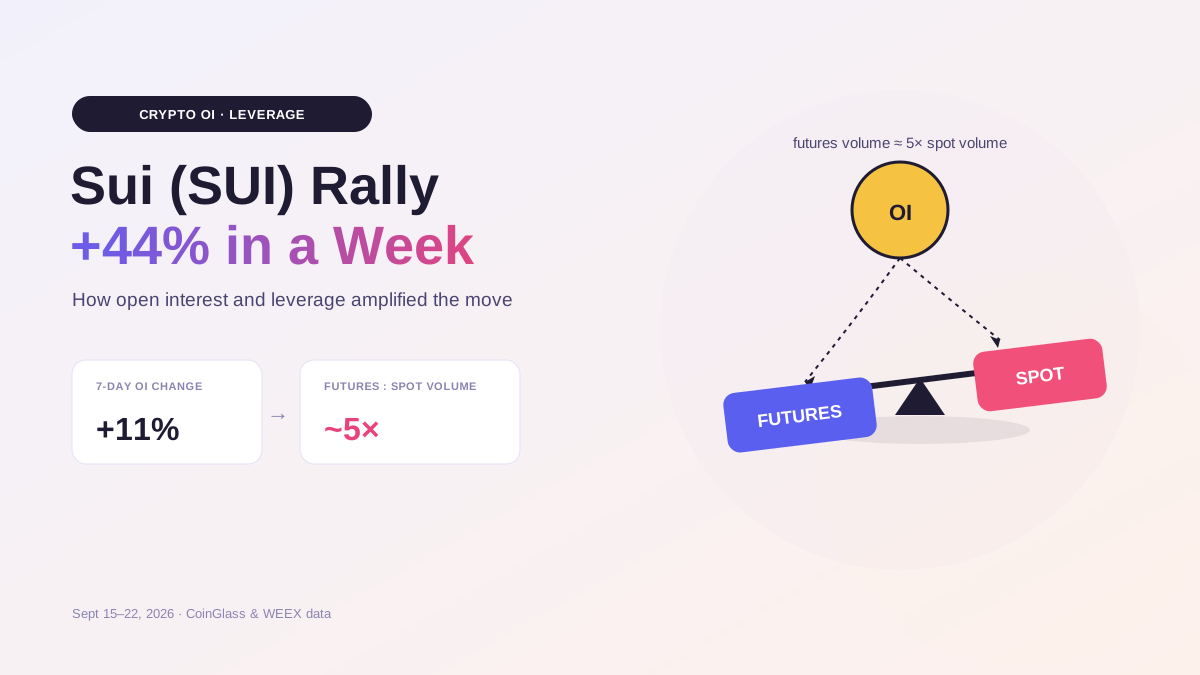
Why Did Sui (SUI) Crypto Price Jump 44%? Crypto OI and Leverage Explain the Rally
See why Sui (SUI) jumped 44%, how crypto OI and leverage amplified the rally, what the pullback means, and how to trade SUI on WEEX.

Is the 1 Billion POL Burn Just a Joke?

Bitcoin Pulls Back From $87,000| WEEX TradFi Daily Brief (September 24, 2026)
Bitcoin pulled back from about $87,000 to about $84,000, with Ethereum near $2,680. S&P Global PMI on September 23 ET far exceeded forecasts. The 10-year yield broke above 5.00%, while the 5-year and 30-year touched highs last seen in 2007 and 2004. The S&P 500 and Nasdaq slipped. Energy moved with oil and crypto-treasury stocks followed bitcoin lower. Investors await earnings from COST, BB, and others.

WEEX Exclusive:Bitcoin Pulls Back From $87,000| WEEX TradFi Daily Brief (September 24, 2026)

MIT Warns AI Bubble May Require 2.7x Productivity Increase by 2030
Davie Reveals BTC Strategy Data, Volume 205.42K, Rate +0.0016%

Stablecoins hold nearly $200 billion in US debt, but money funds bought the surge

Coin Metrics revises 19 months of Bitcoin ETF wallet data

HTX Research Analyst WZ: Crypto Market Pricing Extends Beyond Crypto, Regulation and Liquidity Become Key Variables

Ye Tan: The Internet Era is Coming to an End, the AI Era has Already Begun

Chainalysis: Crypto Economic Activity Down 1.6%, Market Value Shrinks by $2.1 Trillion

$1.7 Billion Inflow to Bitcoin ETFs in Two Days

Why Do You Always Make Small Profits and Then Lose Everything? Taleb Explained It with 'Asymmetric Leverage' Twenty Years Ago

Coinbase traced $1.1 million crypto trail behind AI phishing service EvilTokens
Over 70% of South Korean Crypto Investors Oppose Crypto Tax: What Are Their Concerns?

Nomura Warns of 'Double Whammy' Risk: The Next Market Storm May Start with Interest Rate Volatility

VVV Hits All-Time High: Founder’s Perspective on Models, Privacy, and Crypto

Binance Research Team: A Bull Market Requires the Resonance of Monetary Easing and Paradigm Innovation, with RWA as a Key Driving Force

Bitpace Partners with Fireblocks for Cross-Border Payments with Stablecoins
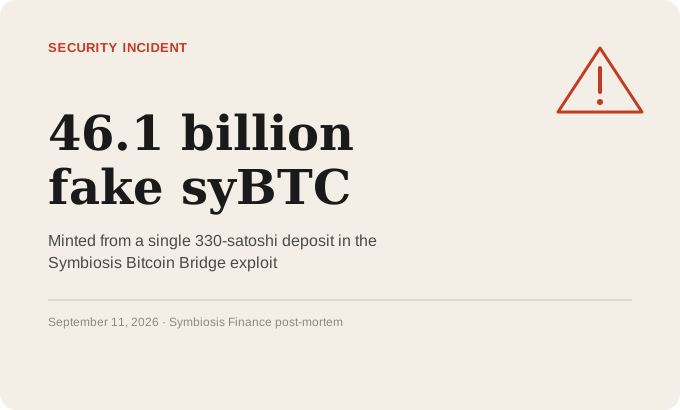
How Did a Hacker Create 46 Billion Fake Bitcoin in the Symbiosis Exploit? Decodes Bitcoin Hacker With WEEX Now
How two Symbiosis bridge bugs let a hacker mint 46.1 billion unbacked syBTC, drain Bitcoin pools and expose critical bridge risks.
[Interview] Lee Yun-ho, CEO of KIP: "We need to set the stage before the STO market opens... sharing RWA know-how with financial companies"
What is Fin.com? Understanding Cross-Border Payment Infrastructure via API

Uniswap (UNI) Price Jumps Toward $10 as CME Futures Launch Nears: What Traders Need to Know
Bernstein Research Report: Why Can Gold Still Surge to $5,700 Even with Continued Rate Hikes by the Fed?
Masayoshi Son is borrowing money again, betting billions on OpenAI

Hashed invests in $300 million digital-asset private credit fund
The IMF opens an office in Venezuela to supervise an economy that has already migrated to USDT

The Link Between Bitcoin and Stocks Strengthened by ETF Effects
Crypto firms still face full AML rules after CLARITY Act vote
Discord Cointribune: The New Crypto Hub of France?
Why Did Sui (SUI) Crypto Price Jump 44%? Crypto OI and Leverage Explain the Rally
See why Sui (SUI) jumped 44%, how crypto OI and leverage amplified the rally, what the pullback means, and how to trade SUI on WEEX.
Is the 1 Billion POL Burn Just a Joke?
Bitcoin Pulls Back From $87,000| WEEX TradFi Daily Brief (September 24, 2026)
Bitcoin pulled back from about $87,000 to about $84,000, with Ethereum near $2,680. S&P Global PMI on September 23 ET far exceeded forecasts. The 10-year yield broke above 5.00%, while the 5-year and 30-year touched highs last seen in 2007 and 2004. The S&P 500 and Nasdaq slipped. Energy moved with oil and crypto-treasury stocks followed bitcoin lower. Investors await earnings from COST, BB, and others.
WEEX Exclusive:Bitcoin Pulls Back From $87,000| WEEX TradFi Daily Brief (September 24, 2026)
MIT Warns AI Bubble May Require 2.7x Productivity Increase by 2030
Davie Reveals BTC Strategy Data, Volume 205.42K, Rate +0.0016%
Contents
Latest articles


Latest coin listings on WEEX


