
Ledger CTO: "Threshold for Decryption Continues to Lower"... Bitcoin Cryptography Warning

 Prefer us on Google


Researchers from Bochum University and the Max Planck Institute have proposed a new algorithm for solving elliptic curve cryptography. The cost of quantum attack circuits has decreased by 70% compared to Google's estimates. Alice & Bob claim that it would take less than an hour to decrypt with fewer than 30,000 cat qubits.
[Block Media Reporter Lee Hye-yeon] Charles Guillemet, the Chief Technology Officer (CTO) of Ledger, has issued a warning regarding two cryptographic research results that could shake the security foundation of digital assets, including Bitcoin (BTC). One study suggests that the mathematical problem underlying the elliptic curve cryptography (ECC) that secures Bitcoin can be solved more easily, while the other indicates that the resources required to attack ECC with quantum computers have significantly decreased.
In a post on X (formerly Twitter) on the 30th (local time), Guillemet stated, "Did you think it was a tough week for the digital asset market? You might have missed the real news."
New Algorithm Emerges... Quantum Attack Costs Reduced by 70%
The first study is a paper titled "A Subexponential Time Algorithm for Elliptic Curve Discrete Logarithm," published by researchers from Ruhr University Bochum and the Max Planck Institute for Security and Privacy.
Elliptic curve cryptography relies on the fact that the 'elliptic curve discrete logarithm problem' cannot be solved practically. Until now, the best general method for solving this problem has been Pollard's rho algorithm, which has a structure where computational costs increase exponentially as key lengths grow. The researchers theoretically proposed a subexponential time algorithm that can solve the problem more efficiently.
However, there is a significant caveat. This algorithm is based on another claim from OpenAI researchers that requires additional verification. Guillemet emphasized that the new algorithm does not threaten the currently used cryptographic systems. The best attacks on widely used curves, including Bitcoin's secp256k1, NIST P-256, and Ed25519, are still based on Pollard's rho algorithm, and the new method is only more efficient for very large virtual curves, meaning it currently remains a theoretical achievement.
The second study indicates that the efficiency of attacking elliptic curve cryptography with quantum computers has greatly increased. Guillemet mentioned the public research project "ECDSA.fail," aimed at improving the efficiency of quantum attacks on elliptic curve digital signatures (ECDSA).
ECDSA.fail is a public benchmark operated by Eigen Labs since May, where participants compete to implement the quantum circuit for 'point addition' that the Shor algorithm uses to find private keys with fewer resources. As of the 17th of this month, 1,589 circuits have been submitted from 147 accounts, with many participants utilizing AI coding agents. It is important to note that this is a competition to optimize circuit design rather than an actual attack on breaking private keys, so these numbers do not directly indicate the possibility of hacking Bitcoin.
According to Guillemet, the researchers have lowered the estimated cost of quantum circuits by about 70% compared to Google's previously announced figures. Based on the metric of multiplying the number of logical qubits by the number of Toffoli gates, Google's estimate was 2.99 billion, but the current estimate has dropped to about 910 million.
You thought this was a bad week in crypto? You might have missed the bigger news.
Two results just landed on elliptic-curve cryptography. Both are worrying. Neither one breaks a key anyone uses today.
1️⃣ The problem under ECC is less hard than we thought.
ECC is secure because... pic.twitter.com/urLoFGdW2J
--- Charles Guillemet (@P3b7_) October 30, 2026
"30,000 Cat Qubits Can Break It in an Hour"... Reality Still Far Off
What Guillemet considers more important is a new paper from the French quantum computing company Alice & Bob. They theorized that it could take fewer than 30,000 physical cat qubits to break Bitcoin's secp256k1 encryption in about an hour. The same paper estimates that it would require 22,593 cat qubits and about 3.14 days to factor the RSA-2048 encryption.
The paper, posted on the International Association for Cryptologic Research (IACR) preprint repository, presents a maximum resource requirement of 29,588 qubits and 61.8 minutes for the attack. The researchers from Alice & Bob estimated that in 2023, 126,133 cat qubits and 9 hours would be needed for the 256-bit elliptic curve problem, indicating a significant reduction in required resources over three years. Cat qubits are superconducting qubits designed by Alice & Bob that reduce the number of physical qubits needed for error correction.
However, this estimate assumes that there are no bit-flip errors during computation. If we consider a bit-flip occurring once an hour, the number of qubits needed for RSA-2048 would increase to about 45,000. The company explained that an attack time exceeding one hour would be longer than Bitcoin's average block generation time of about 10 minutes, making it difficult to target transactions waiting for confirmation after transmission.
Of course, these figures are based on a highly fault-tolerant quantum computer that does not yet exist. Guillemet pointed out that since such quantum computers are not available, there is no immediate danger to Bitcoin. However, he explained that these studies remind us that the estimated resources needed to break widely used cryptographic systems are continuously decreasing.
Alice & Bob predicts that advancements in hardware and declining resource estimates will converge in the early 2030s, urging that the transition to quantum-resistant cryptography should begin before actual quantum attacks emerge. Discussions about transitioning to counter quantum threats are expected to continue in the Bitcoin industry.
-- Price
This content is provided for general informational purposes only and doesn't constitute financial, investment, legal, or tax advice. Any events, rewards, online promotions, or related information mentioned herein should not be considered a recommendation, solicitation, or invitation to purchase, sell, trade, or otherwise deal in any crypto assets. Crypto assets are highly volatile and may result in loss. The availability of WEEX services, products, and related events may vary by region. You are responsible for ensuring that your participation is in accordance with applicable local laws and regulations.
You may also like

Uniswap launches TJAR fee tool for fixed payment arbitrage

Bitcoin censorship dispute pits Ocean miner freedom against lost fees

From Binance to PHP2Shell: Redefining the Frontline of Web Security in the AI Era

Anonymous Interviews with Frontline Investors and Entrepreneurs: Who is Forcing Whom to Chase Consensus?
Google DeepMind Research Claims AI Collaboration Ability is Key to Economic Transformation

Google Cloud Previews Institutional Crypto Key-Security Service as Custody Risks Grow
Coinbase CEO Plans to Sell 8.1674 Million Shares Worth Approximately $1.31 Billion
$470 billion wiped out, Wall Street plunges amid inflation

Solana's Tokenized Asset Value Exceeds $5.19 Billion
Crowded, Confused, and Missing the Boat: Multiple Extreme Signals Emerge in Global Markets
Collector Crypt CEO: The Real Threshold of Digital Card Drawing Platforms Lies in These Four Aspects

When will the next crypto bull run happen?

Midterm Election Predictions: Why Use Four Contracts to Measure Senate Control?

Why is Strive More Aggressive than Strategy in Financing Bitcoin?

Morpho RWA deposits pass $2B as loans approach $900 million

Key Institutional Prerequisite for Tokenization: Issuer Authorization
Kalshi Discusses User Protection Measures with Regulators, Willing to Raise Participation Age to 21

A New Wave of TGE? 19 Projects Expected to Launch Intensively in Q4

OCC Finalizes Stablecoin Issuance Guidelines in the U.S.
Reviewing the US, India, and South Korea: How Retail Investors Ignite the Options Market?

Looking Ahead to Tonight's Federal Reserve Meeting: A Pause in Rate Hikes in October is Almost Certain, How It Affects December Rate Hike Probabilities Becomes the Focus
On-Chain Options Blue Ocean: The Real Battlefield is in Retail Distribution
Robinhood Predicts Market Gains, But Crypto Revenue Halves
Bitcoin: Small Holders Leave, Big Buyers Step In

Bitcoin: Hyperliquid Whales Go Short for the First Time Since March
Why JPMorgan Raised the Target Price for Yushu Technology to 995 Yuan
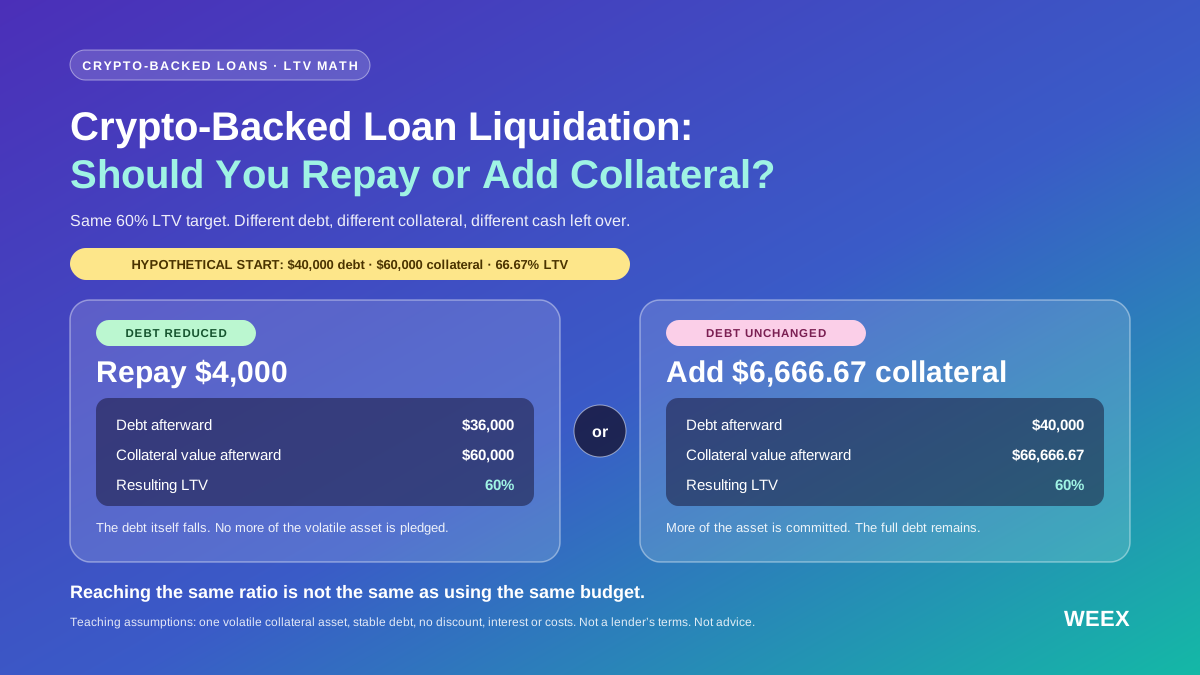
Crypto-Backed Loan Liquidation: Should You Repay or Add Collateral?
Facing crypto-backed loan liquidation? Compare repayment and collateral top-ups using equal budgets, LTV calculations, stress tests and protection limits.

Turbulent Middle Eastern Crypto Market Welcomes Leadership Change

Ritual Raises $30 Million to Launch Token: AI Game Changer or Retail Investor Trap?

Global Markets in the Last 24 Hours: Brent Oil Reaches $115.81, Bitcoin Drops to $79,818
Uniswap launches TJAR fee tool for fixed payment arbitrage
Bitcoin censorship dispute pits Ocean miner freedom against lost fees
From Binance to PHP2Shell: Redefining the Frontline of Web Security in the AI Era
Anonymous Interviews with Frontline Investors and Entrepreneurs: Who is Forcing Whom to Chase Consensus?
Google DeepMind Research Claims AI Collaboration Ability is Key to Economic Transformation
Google Cloud Previews Institutional Crypto Key-Security Service as Custody Risks Grow


