
The Q3 Market in Turmoil: How Much is Circle Worth?

 Prefer us on Google
Ultimately, regardless of the narrative, the essence is to drive the significant adoption of USDC, which is the core.
Written by: Awang
After the Q3 financial report was released, Circle's stock fell along with tech stocks and crypto assets. Looking solely at the financial report, the adjusted EBITDA increased from $143 million to $317 million, which is a significant rise. However, after deducting the ARC presale revenue, the rough estimate is only $135 million, lower than the previous two quarters.
Circle's total revenue and reserve income for Q3 2026 was $865 million, a quarter-on-quarter increase of about 23%. Among this, reserve income was $658 million, a quarter-on-quarter decrease of about 1.5%; other income was $207 million, compared to $34 million in the previous quarter. The other income in Q3 included about $182 million from the ARC token presale. The adjusted EBITDA for the quarter was $317 million, a quarter-on-quarter increase of about 122%, with the group's RLDC profit margin rising from 41.2% in the previous quarter to 52.4%.
When the Q1 financial report came out, we calculated Circle's valuation. This time, let's calculate how much value the stablecoin business (issuance + payment) can sustain: how much value can the reserve business support, and how much valuation can the payment business recharge?
1. ARC Presale Boosts Profits, USDC Average Balance Declines
At first glance, the Q3 financial report looks strong. Total revenue and reserve income increased from $701 million to $865 million in Q3, with about $182 million coming from the ARC token presale. The company confirmed about three-quarters of the presale revenue after launching on the public mainnet and completing token minting and delivery.
After deducting the ARC presale revenue, total revenue and reserve income for Q3 was about $683 million. This article directly subtracts the ARC presale revenue from the disclosed adjusted EBITDA, resulting in about $135 million, lower than Q2's $143 million and Q1's $151 million.
The RLDC in the table represents the money left after total revenue and reserve income minus distribution, transaction, and other costs. Dividing this number by total revenue and reserve income gives the group's RLDC profit margin.
1.1 For Every $100 Earned in Reserve Income, Circle Retained 80 Cents Less
Q3 reserve income decreased from $668 million to $658 million. The reserve yield slightly increased to 3.54%, failing to offset the impact of a 4% decline in average USDC circulation. The average balance for the entire quarter was $73.3 billion.
The chart shows the circulating market value at the end of the quarter, with the quarterly average balance affecting the reserve income for that quarter. The main chart retains the published values for each period, with the total stablecoin Q3 quarter-on-quarter using the revised Q2 base from CoinGecko.
In Q3, for every $100 earned in reserve interest, after deducting related distribution and transaction costs, Circle retained $37.80. In Q2, they retained $38.60. The CFO attributed this decline mainly to the Hyperliquid partnership running for a full quarter, with related USDC balances held on Coinbase. The revenue-sharing terms after Binance's renewal will not fully run for a quarter until Q4.
Coinbase and Circle renewed under the original terms. The terms remained unchanged, but the money's location changed.
According to Coinbase's disclosed integer, the average USDC balance across the network decreased by $4 billion in Q3. Coinbase's products added $2 billion, while the platform outside decreased by $6 billion. Allaire hopes to provide more incentives to major channels to ultimately bring USDC outside the platform. This quarter has not yet seen growth in external balances. The market pullback may also drag down balances, and this account will need to be reviewed over several quarters.
2. Payment Volume Increased, But Where is the Revenue?
Excluding the ARC presale, Circle's other income fell from $42 million in Q1 to $34 million in Q2, and only about $25 million remained in Q3. Management stated that there were fewer blockchain integration projects confirming revenue this quarter. We believe this will be the norm moving forward, as there are few new public chains and integration projects.
We are more interested in whether payments can bring in a recurring revenue stream each quarter.
Other income also includes subscription and service income from chain integration and maintenance, fund management, etc. Transaction income includes redemption fees, blockchain rewards, and digital asset trading infrastructure income (including CCTP). Q2's transaction income was derived by deducting Q1 and Q3 from the cumulative total for the first nine months.
2.1 CPN's Transaction Volume Increased, But How Much is Visible in the Financial Report?
Circle Payments Network (CPN) connects financial institutions for cross-border settlements using stablecoins. Its annualized payment volume at the end of the quarter increased from $8.3 billion in Q1 to $14.7 billion in Q2, reaching $41.3 billion in Q3. This figure is derived from approximately $3.4 billion in transaction volume over the 30 days before the end of the quarter.
Calculating at 5 basis points (0.05%), running at the Q3 end speed for a year, CPN corresponds to about $20.65 million in revenue. The financial report only provided the group's transaction income, which also includes redemption fees, blockchain rewards, and CCTP, among other items. The actual transaction fees and how much was collected from CPN are not currently visible.
2.2 How Much of Tazapay's Transaction Volume Can Be Converted into Circle's Revenue?
Circle plans to acquire the remaining shares of Tazapay for about $400 million in stock, with the price subject to adjustment upon delivery. Tazapay's annualized payment volume exceeds $25 billion, with about 60% involving stablecoins. It has previously been a design partner of CPN.
Why is Circle buying Tazapay, which was already a partner of CPN? They have clients and a network for transferring money to local accounts. By acquiring these capabilities, Circle has the opportunity to bring in more transactions and also handle payments, currency exchanges, and withdrawals. Based on the transaction volume at the end of Q3, if they can receive 10 basis points in 2027, the annualized revenue would be about $41.3 million. If Tazapay simultaneously brings in new billable transactions, the contribution of payments to other income will be even greater.
The table tests the same CPN transaction volume against two fee rates. The two volumes will have a lot of overlap and cannot be directly added together. However, Tazapay's volume will be more accurate (CPN's volume will be an aggregate). The 10 basis points is just a uniform calculation assumption; actual revenue will depend on which transactions are charged, who charges them, and how the revenue is split.
Assuming this transaction is priced at an 8x price-to-earnings ratio, the equity acquired for $400 million would need to contribute about $50 million in after-tax net profit annually. Whether this price is worth it depends on how much Tazapay earns itself and how much more Circle can earn after taking over.
3. Circle's Three-Layer Business, What is Each Worth?
We will continue to use the breakdown from May to separately calculate the reserve business, other businesses, and Arc. Using this quarter's data, the main range is approximately $59 to $95 per share, with a neutral estimate of about $77.
The first layer uses the 10/14/18 times from Q1, referencing the pricing of banks, custodians, and asset management companies. A 10x multiple does not give a growth premium, 14x accounts for the growth value of USDC, and 18x requires stronger scale growth and stable interest rates. The multiples are applied to the reserve income after deducting distribution, transaction, and other costs, without accounting for company operating expenses and taxes.
The second layer references the valuations of high-growth payment companies, giving 20/25/30 times for other income, with a 10x pressure tier set. The third layer estimates about $750 million based on the ARC presale price of $0.30 per token, combined with an initial supply of 10 billion tokens and assuming a 25% retention after sale.
The model uses Q3 annualized reserve contributions of about $984 million and an adjusted full-year other income guidance median of about $138 million.
Valuation per share = (Reserve contribution × multiple + Other income × multiple + Arc valuation + about $1.7 billion in cash) ÷ about 256 million shares.
The full-year other income guidance, after deducting confirmed ARC presale, is about $128 million to $148 million. Tazapay is expected to close in 2027, and its profits and newly issued shares are not yet included in this table.
Mizuho and Citi both attributed the Q3 outperformance mainly to the ARC presale. Looking ahead, Mizuho is concerned that revenue sharing will compress Q4 net reserve profit margins to just above 30%, according to sell-side estimates. Citi places more emphasis on payment and CPN adoption, expecting other income of about $400 million in 2027, without breaking down how much of that is recurring payment fees in the public summary.
4. The Take | If Money Can't Be Retained, Can It Still Make Money?
Circle is trying to make the same amount of money contribute to two types of income. Money stays in USDC to earn reserve income. Money goes through the payment network to earn service fees. Even if a sum of money is exchanged back to local currency on the same day, it may still leave revenue for Circle, which is precisely why Tazapay is worth paying attention to (closer to customers, solving the last mile).
Q3 has already revealed pressure on the first type of income. The decline in balances and increased channel sharing have widened the gap between issuance scale and shareholder returns. The second type of income has seen considerable transaction volume, but still lacks a clear account of fees and costs. The 10 basis points calculation indicates that this business is worth waiting for, but it is not enough to treat it as realized profit. ------ This may need to be looked at in 2027.
Therefore, the revenue structure for the upcoming Q4 will also face challenges: Binance's distribution agreement will be reflected in a full quarter, along with the compression of circulation and transaction volumes under a less optimistic macro market.
Although we see many new stablecoins like OUSD in traditional financial payments, these are more internal stablecoins, which have very limited impact on widely circulated USDC and USDT in the market. However, the stablecoin market is still affected by the macro environment.
The ARC is actually just a presale price we calculated, equivalent to counting an option. What happens in the future is not yet considered. This time we only consider the value of CRCL under pressure.
As for the Agentic Payment part, the narrative of CRCL is more from the perspective of stablecoins, still leaning towards narrative, and lacks substantial scenarios (which are hard to reflect in reported income), as well as opportunities for integration with AI entry points (which will be more attractive on the fiat side and card group side).
So in this recalculation of valuation, we care more about the conditions behind the range. The reserve business supports today's operations, and how much valuation the payment business can achieve depends on when it can turn transaction volume into recurring income.
Ultimately, regardless of the narrative, the essence is to drive the significant adoption of USDC, which is the core. Only with volume can there be everything.
This content is provided for general informational purposes only and doesn't constitute financial, investment, legal, or tax advice. Any events, rewards, online promotions, or related information mentioned herein should not be considered a recommendation, solicitation, or invitation to purchase, sell, trade, or otherwise deal in any crypto assets. Crypto assets are highly volatile and may result in loss. The availability of WEEX services, products, and related events may vary by region. You are responsible for ensuring that your participation is in accordance with applicable local laws and regulations.
You may also like
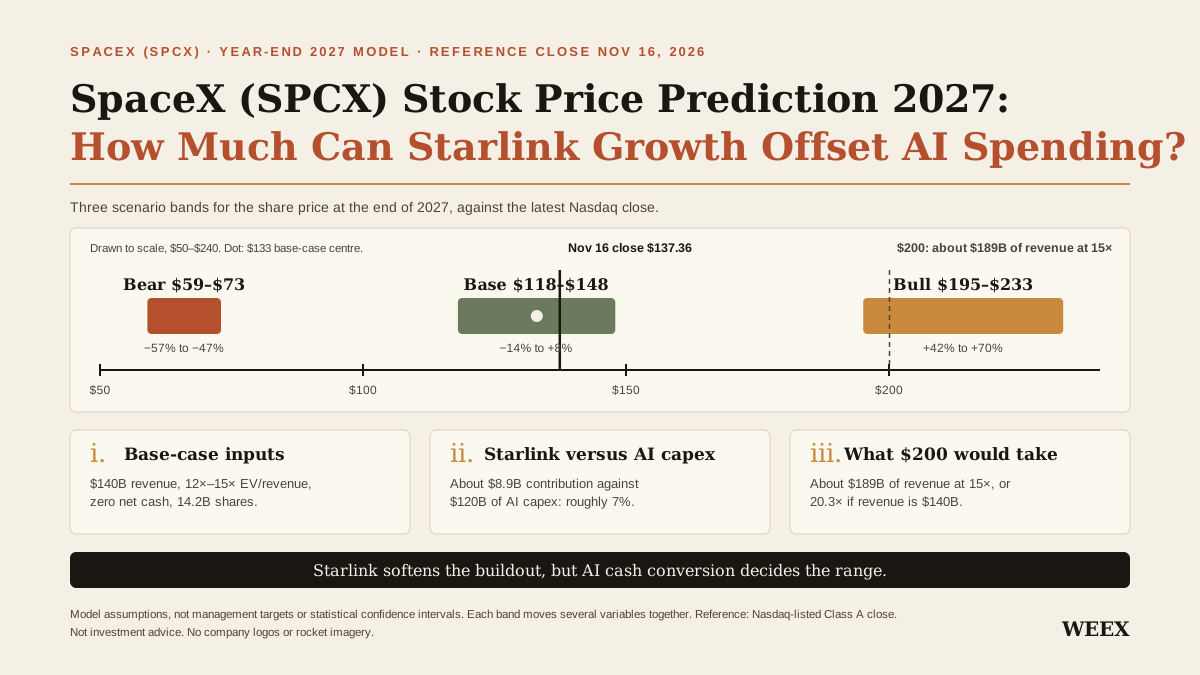
SpaceX (SPCX) Stock Price Prediction 2027: How Much Can Starlink Growth Offset AI Spending?
SpaceX stock price prediction for 2027: See the $118–$148 base case, how much Starlink could offset AI spending, and what it would take to reach $200.

Chevron Expands in the Gulf of Mexico with Plans to Acquire Majority Stake in Oil Field for Over $5 Billion
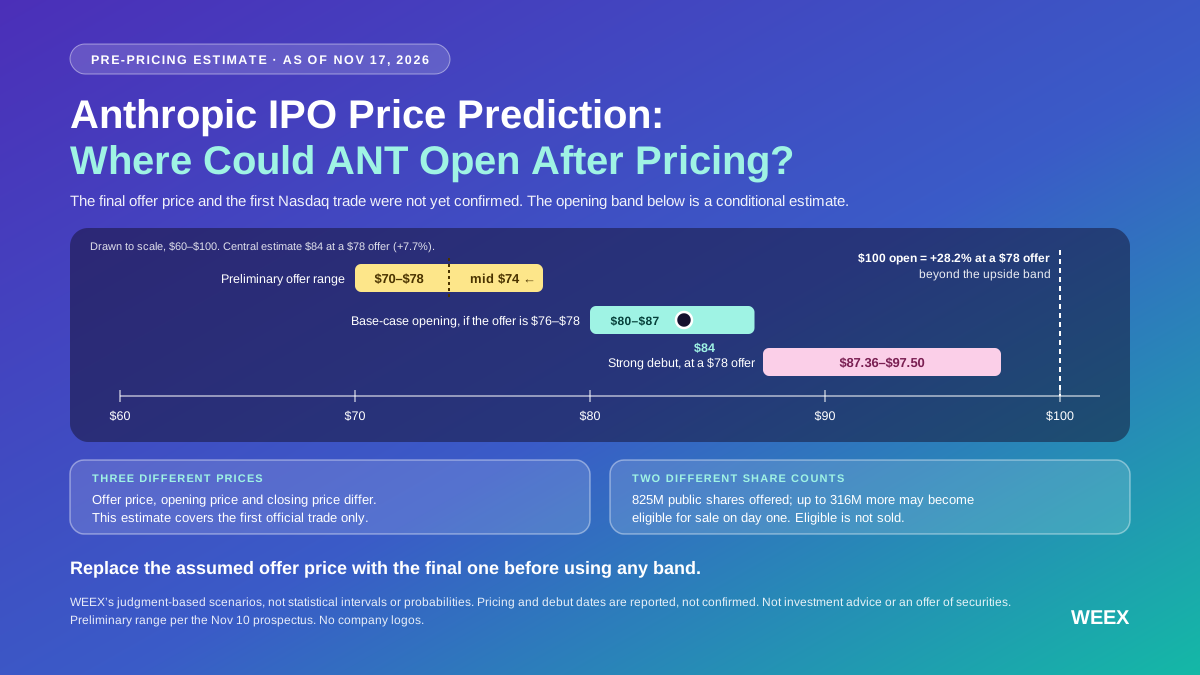
Anthropic IPO Price Prediction: Where Could ANT Open After Pricing?
Anthropic IPO price prediction: See ANT’s $80–$87 base-case opening range, how the final offer price changes it, and what could push shares above $90.

IOSF: The Cost Paradox of Video AI - Why Is Generating Cheaper but Final Cuts Still Expensive?

Will the $50 billion request materialize? The U.S. transportation system urgently needs funding for upgrades, but Congress has become a "lame duck"

Japan Proposes Establishing an 'Asian Version of the International Energy Agency' to Enhance Southeast Asia's Oil Storage Capacity in Response to Energy Crises

Federal Reserve Warns Korean Investors About Leveraged ETF Risks

Mercado Bitcoin Withdrawal Update: Pix Restart and Crypto Suspension
Mercado Bitcoin set November 17 for Pix deposits and withdrawals in Brazilian reais. Read the withdrawal rules and the background to the crypto suspension.

Reasons Why Cryptocurrency Kiosks Face Increasing Regulation

A Decade of a Crypto Neutral Fund Manager: A High-Pressure Way of Life

JPMorgan and DBS Enable On-Chain USD Payments! 24-Hour Cross-Border Transfers, Ant International Becomes First Client

XRP holders demand Ripple burn 31.1 billion tokens by March 2027

Major Indexes Close Lower, Nvidia Earnings Are Imminent | WEEX Daily Market Brief (November 17, 2026)
At the November 16 close, the three major indexes all finished lower. Technology-stock selling continued, with the chip sector leading declines. Bitcoin’s weekend selloff showed signs of stop-loss hunting; it is currently around $64,000. Backpack received regulatory approval. On November 17, watch for October retail sales data and earnings from Nvidia, Home Depot, Disney, and JD.com.

Cardano vs Solana: Which Blockchain is Superior?

Surge in Drone Demand Drives Swiss Defense Group to Accelerate U.S. Market Expansion

25 million stolen in 12 seconds: the MEV brothers acquitted

Citi Updates Preferred List of U.S. Software Stocks: Box, Navan, and Roper Technologies Take the Top Three Spots

JPMorgan and MIT Map More Than 150 Requirements for Institutional Blockchains

J.P. Morgan Chief Global Strategist: Tech Stock Trading Enters a Phase of Volatility and Uncertainty, Investors Should Diversify AI Holdings

One Hundred Million Dollars in Floating Profit Goes to Zero: A Contract Trader's Dilemma

Figment to Support Staking Through BNY’s Digital Asset Custody Platform
Crypto: Tether Gold (XAU₮) Receives Unqualified Audit from KPMG

Pony Ma's Internal Speech: The Wave of AI Has Already Hit, Tencent Must 'Transform from Army to Navy' and Get Everyone on Board

Uniswap freezes $300,000 in stranded fees, halting automatic token burns
NVIDIA Employees Warn Board of Potential Loss of "Irreplaceable" Talent

What Are Value Indicators Beyond Money? Considering 'Sweat' (Inside 'So That's Blockchain' Ep.24)

The Arrogance and Prejudice of a16z

Backpack Founder’s Latest Speech: Solana Will Become the API of American Finance, Welcoming the Era of Neobrokerage

If a Bear Market Is Coming, History Says This Is the Safest Investing Move You Can Make

Ethereum test exposes flaw that lets transactions skip payments
SpaceX (SPCX) Stock Price Prediction 2027: How Much Can Starlink Growth Offset AI Spending?
SpaceX stock price prediction for 2027: See the $118–$148 base case, how much Starlink could offset AI spending, and what it would take to reach $200.
Chevron Expands in the Gulf of Mexico with Plans to Acquire Majority Stake in Oil Field for Over $5 Billion
Anthropic IPO Price Prediction: Where Could ANT Open After Pricing?
Anthropic IPO price prediction: See ANT’s $80–$87 base-case opening range, how the final offer price changes it, and what could push shares above $90.
IOSF: The Cost Paradox of Video AI - Why Is Generating Cheaper but Final Cuts Still Expensive?
Will the $50 billion request materialize? The U.S. transportation system urgently needs funding for upgrades, but Congress has become a "lame duck"
Japan Proposes Establishing an 'Asian Version of the International Energy Agency' to Enhance Southeast Asia's Oil Storage Capacity in Response to Energy Crises
Latest articles
Latest coin listings on WEEX


